AQA · GCSE · Business
Course version: 8132 · Version from Sept 2017
Business location
Business location is one of the most critical, long-term strategic decisions an entrepreneur must make. A poor location choice can fatally undermine an otherwise excellent business model through high costs or lack of footfall.
- 4 min read
- 3 worked examples
- 5 practice questions
- 6 key terms
Check what you remember
Read the wording for your board, then hide it and explain Footfall in your own words. Rough notes are fine. This is a self-check, with no mark or grade.
Reference: AQA
The number of people passing by a particular location.
Study Notes
Overview
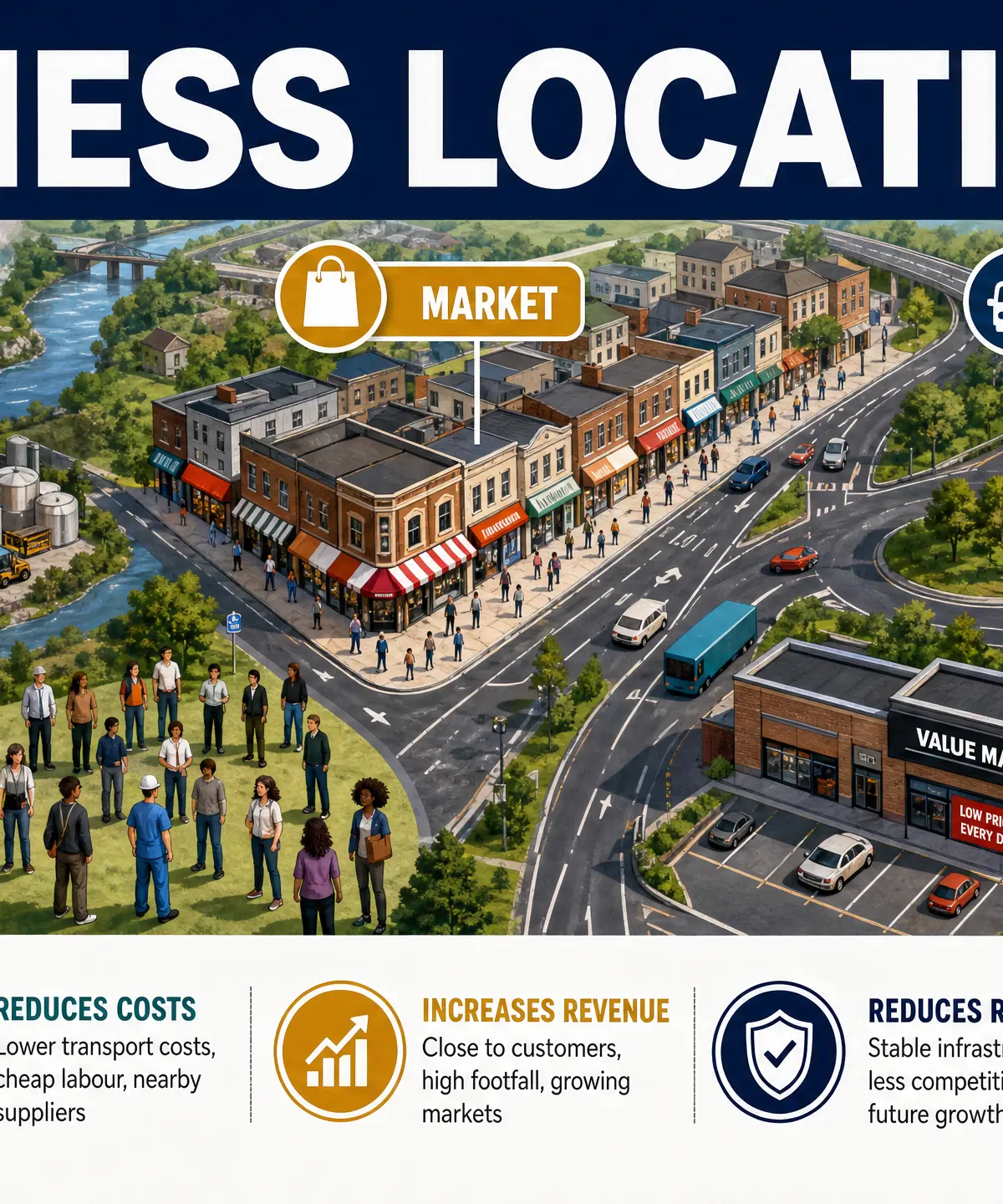
Location is a fundamental business decision that requires a careful balancing act between competing priorities. For examiners, the key concept is trade-off: no location is perfect, and businesses must compromise to find the most suitable site. A city centre offers high footfall but exorbitant rent; a rural industrial estate offers cheap land but poor access to customers.
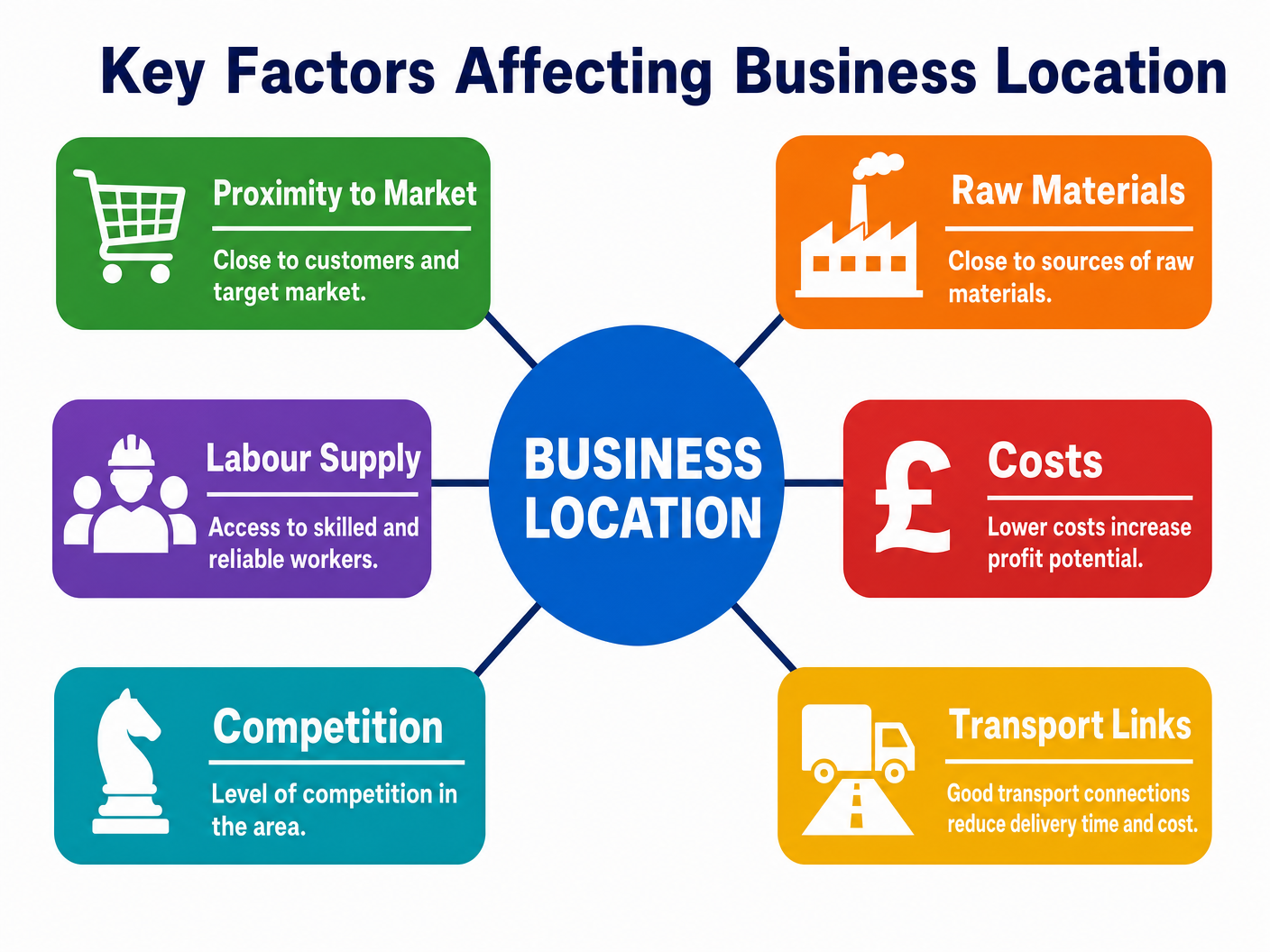
This topic requires candidates to understand the five key factors influencing location decisions: proximity to market, availability of raw materials, availability of labour, proximity to competition, and costs. Crucially, examiners reward candidates who can apply these factors to specific business contexts rather than writing generic lists.
Key Location Factors
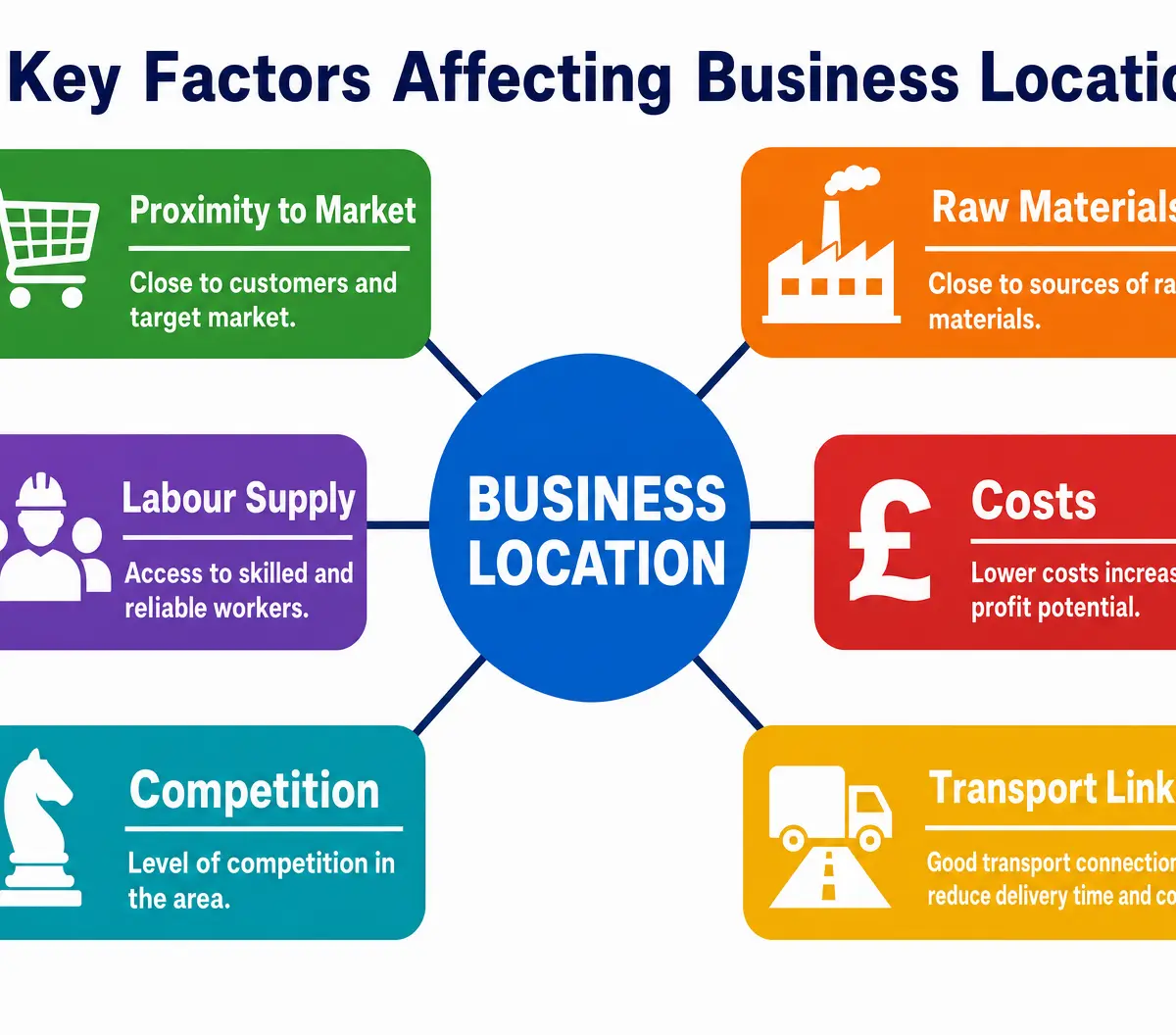
Proximity to Market
What it means: How close the business is to its target customers.
Why it matters: For retail and service businesses (like cafes or hairdressers), being close to the market is essential. High footfall (passing trade) drives revenue. For manufacturers, proximity to the market reduces transport and distribution costs, which lowers the cost of sales and increases profit margins.
Specific Knowledge: E-commerce businesses are less reliant on proximity to the end customer, but highly reliant on proximity to distribution networks (e.g., motorways).
Availability of Raw Materials
What it means: Being located near the source of necessary inputs.
Why it matters: If raw materials are bulky, heavy, or perishable, transporting them long distances is expensive and risky. Food processing plants often locate near farms, while steelworks historically located near coal and iron ore deposits.
Availability of Labour
What it means: Having access to a workforce with the right skills in the right quantities.
Why it matters: Businesses need workers. Technology firms often cluster near universities (e.g., Cambridge Science Park) to access highly skilled graduates. Conversely, a distribution warehouse might locate in an area with high unemployment to access a large pool of unskilled labour at lower wage rates.
Proximity to Competition
What it means: How close the business is to rival firms.
Why it matters: Sometimes businesses avoid competitors to capture a local monopoly (e.g., the only village shop). However, many businesses actively choose to cluster together (agglomeration) — such as car dealerships or restaurants. This clustering attracts more customers to the area overall, as consumers value choice and comparison.
Costs of Location
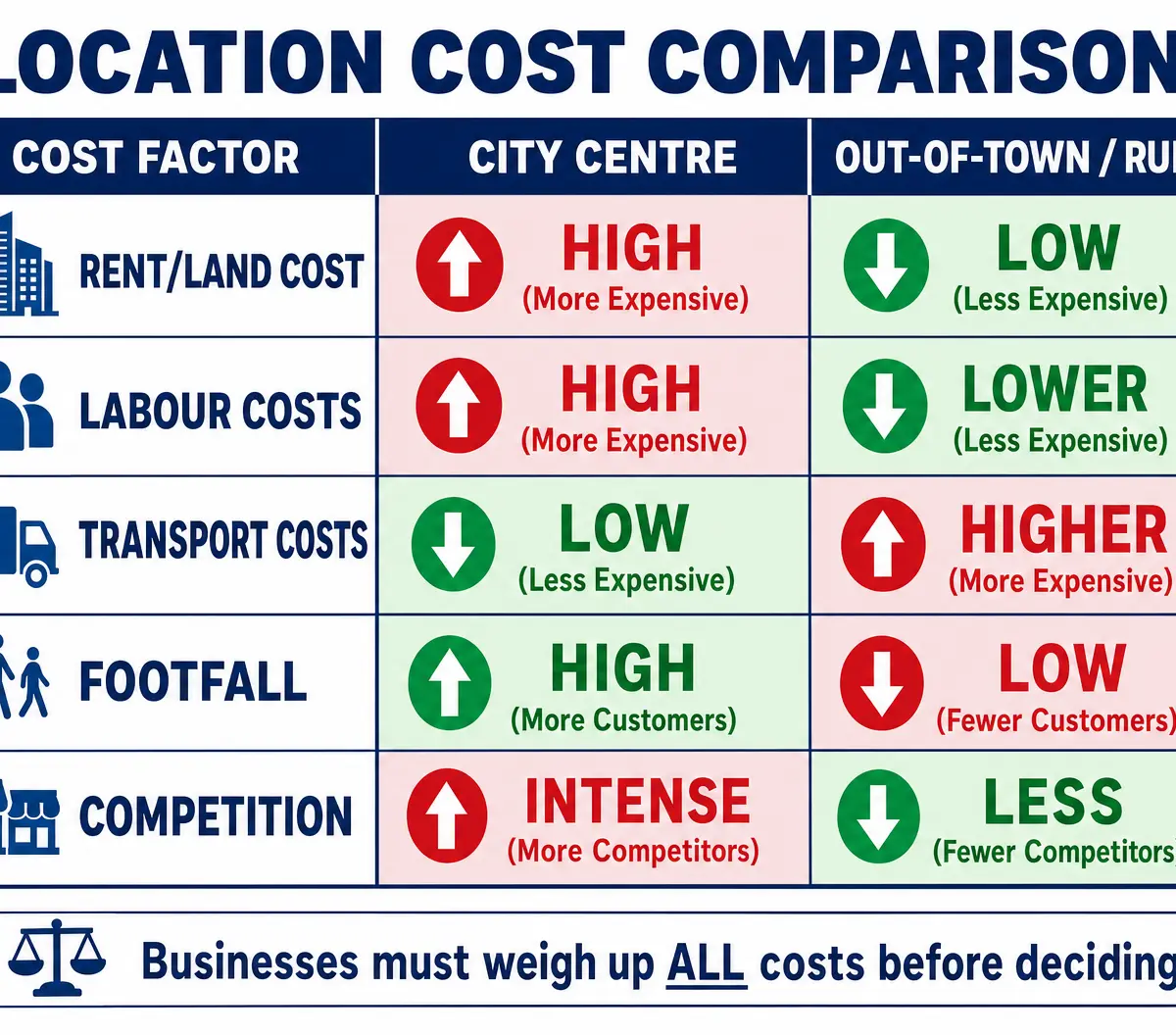
What it means: The financial implications of the chosen site.
Why it matters: This is often the deciding factor. Prime locations command high rent/leasing costs. Businesses must evaluate whether the increased revenue from a prime location outweighs the higher fixed costs. Additionally, government incentives (like Enterprise Zones) can significantly reduce location costs in certain regions.
Revision Podcast
Listen to our comprehensive 10-minute revision podcast covering all these concepts with examiner tips:
Quantitative Skills
Candidates may be asked to calculate and compare the total costs of two different locations. Always remember: Total Cost = Fixed Costs (Rent) + Variable Costs (Transport, Wages).
Visual Resources
2 diagrams and illustrations
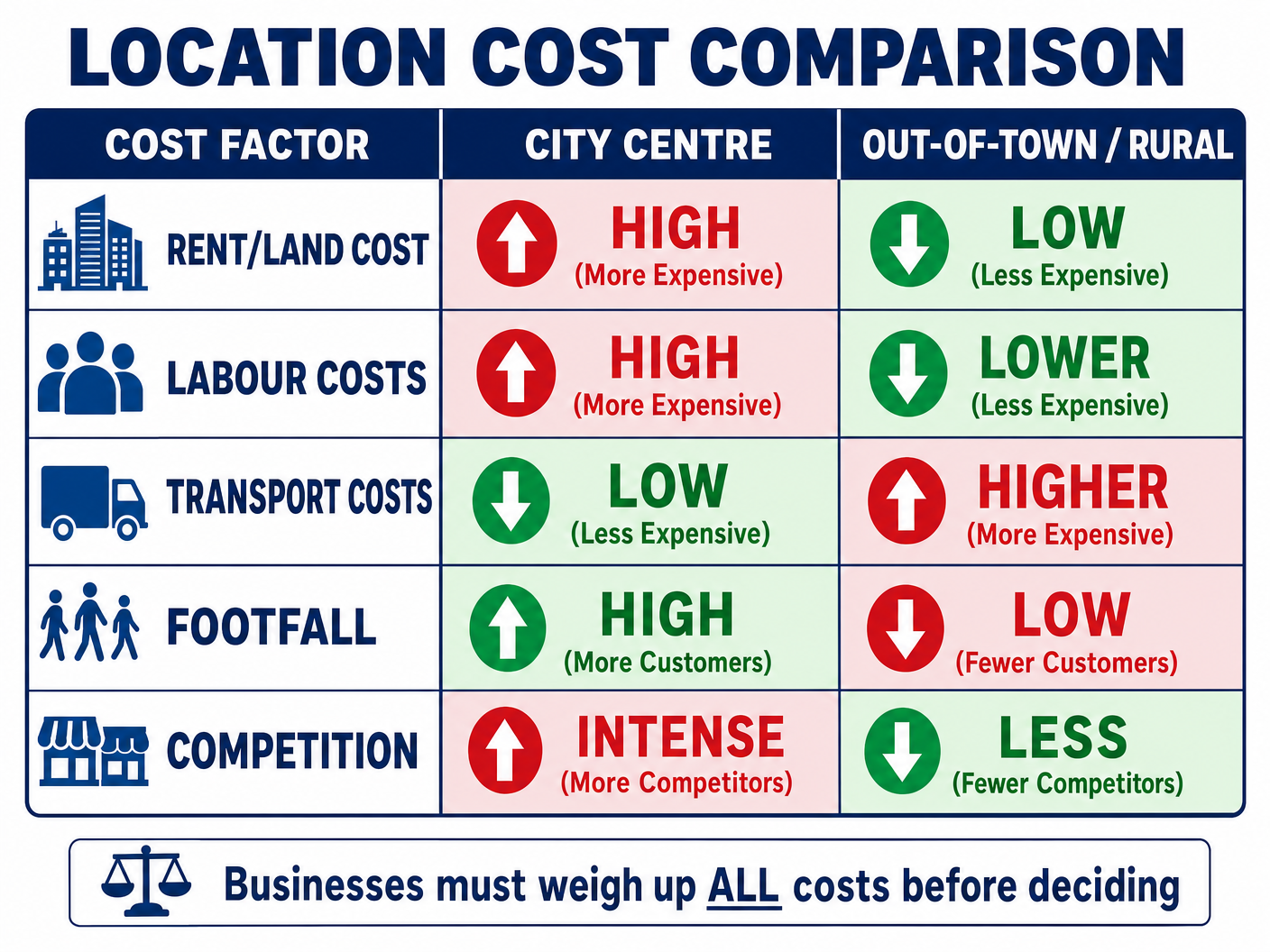
Interactive Diagrams
1 interactive diagram to visualise key concepts
Conceptual Flow Outline
The Location Decision Trade-offs
Worked Examples
3 worked examples — open one to explore the question and available guidance.
Practice Questions
Try the question, then reveal an answer plan or example response
State two factors a web-design agency would consider when choosing a location. (2 marks)
Hint: Think about what a digital service business needs most.
Explain how the availability of raw materials influences the location of a manufacturing business. (3 marks)
Hint: Focus on the weight/bulk of materials and the cost of moving them.
A fast-food franchise is looking for a new location. It is considering either a busy high street or a quiet residential area. Recommend which location the franchise should choose. (9 marks)
Hint: Compare footfall against rent costs, and consider the nature of fast food.
Explain why a car dealership might choose to locate next to several other competing car dealerships. (3 marks)
Hint: Think about customer behaviour when buying expensive items.
Analyse two reasons why an e-commerce clothing retailer might choose to locate its main distribution warehouse in the Midlands rather than in London. (6 marks)
Hint: Consider land costs and geographical distribution networks.
Exam technique
How to turn what you know into marks
How to approach the question
Always highlight the TYPE of business in the question before answering.
How to structure your answer
- Explain questions
- Point (Factor) -> Evidence (Context of the specific business) -> Explanation (Business impact like costs/revenue).
- Evaluate questions
- Advantage -> Disadvantage -> Conclusion weighing up which factor is most significant for THAT specific business.
Timing
Approximately 1 minute per mark.
Common pitfalls
- Writing generic answers that don't apply to the specific business mentioned in the case study.
- Stating a location is 'good' without explaining how it impacts costs, revenue, or profit.
- Assuming businesses always want to be far away from competitors.
What the command words want
- Analyse
- Look at impacts/consequences. Often requires looking at both sides.
- Explain
- Requires a linked chain of reasoning. Use 'therefore' or 'this leads to'.
- State/Identify
- One word or short phrase. No explanation needed.
- Evaluate/Recommend
- Must include a justified conclusion that directly answers the question based on the preceding arguments.
Watch or listen (optional)
Test your understanding of Business location
Active recall beats re-reading. Take an instant quiz now to test what you’ve learned and lock it into long-term memory.
7 days Premium · Then the free plan continues · No card, no charge