Business operations Revision Notes

    Subject: Business | Level: GCSE | Exam Board: AQA

    Business Operations is the engine room of any enterprise, covering how products are made, how quality is assured, and how customers are served. Mastering this topic is crucial for the exam, as examiners frequently test your ability to link operational decisions—like choosing JIT over JIC—directly to a business's bottom line and overall objectives.

    Revision Notes & Key Concepts

    ![Business Operations: The Engine Room of Enterprise](https://xnnrgnazirrqvdgfhvou.supabase.co/storage/v1/object/public/study-guide-assets/guide_6b5da753-80ce-454e-ae74-7f3b7c12590e/header_image.png) ## Overview Business Operations involves the core processes of producing goods and providing services. Think of it as the 'engine room' of a business. It encompasses production methods, lean production techniques, procurement, stock management, quality control, and customer service. For GCSE Business candidates, understanding this topic is essential because it is heavily weighted in exams and connects directly to other functional areas like marketing, human resources, and finance. Examiners expect you to not only describe these processes but to analyse their trade-offs and evaluate their impact on business objectives such as profitability, growth, and customer satisfaction. ### Listen to the Podcast Listen to our comprehensive 10-minute audio guide covering all key concepts, exam tips, and a quick-fire recall quiz: ![GCSE Business Operations Audio Guide](https://xnnrgnazirrqvdgfhvou.supabase.co/storage/v1/object/public/study-guide-assets/guide_6b5da753-80ce-454e-ae74-7f3b7c12590e/business_operations_podcast.mp3) ## Key Concepts & Processes ### Production Methods Businesses must choose the most appropriate method to produce their goods. The choice depends on the nature of the product, the size of the market, and the resources available. ![Comparison of Production Methods](https://xnnrgnazirrqvdgfhvou.supabase.co/storage/v1/object/public/study-guide-assets/guide_6b5da753-80ce-454e-ae74-7f3b7c12590e/production_methods_diagram.png) **Job Production**: Making a single, unique product to meet specific customer requirements (e.g., bespoke wedding cakes, custom-built houses). - *Key features*: High skill levels, high cost per unit, high quality, very flexible. - *Exam focus*: Often tested in the context of small start-ups or artisan businesses. **Batch Production**: Producing groups of identical items together before moving on to the next batch (e.g., a bakery making 50 loaves of white bread, then 50 wholemeal). - *Key features*: Medium output, some flexibility, lower cost per unit than job production, but involves downtime between batches. **Flow Production**: Continuous, non-stop production of large volumes of standardised products (e.g., car manufacturing, bottling plants). - *Key features*: Very high output, low cost per unit due to economies of scale, low flexibility, high initial setup costs. ### Lean Production and Stock Management Lean production focuses on eliminating waste from the production process to improve efficiency and reduce costs. **Just In Time (JIT)**: A lean technique where stock is ordered and arrives exactly when it is needed for production. - *Benefits*: Lower storage costs, less capital tied up, fresher materials. - *Risks*: Highly vulnerable to supply chain disruptions; late deliveries cause production to stop (stockouts). **Just In Case (JIC)**: Holding buffer stock in reserve to protect against unexpected spikes in demand or supplier delays. - *Benefits*: Security of supply, ability to meet sudden orders. - *Risks*: Higher storage and insurance costs, risk of stock becoming obsolete. ![Stock Management: JIT vs JIC](https://xnnrgnazirrqvdgfhvou.supabase.co/storage/v1/object/public/study-guide-assets/guide_6b5da753-80ce-454e-ae74-7f3b7c12590e/stock_management_diagram.png) ### Procurement and the Supply Chain Procurement is the strategic process of sourcing and purchasing the inputs a business needs. When choosing suppliers, businesses must balance three key factors: 1. **Price**: Affects costs and profit margins. 2. **Quality**: Affects the final product and customer satisfaction. 3. **Reliability**: Affects whether production can run smoothly without delays. ![The Supply Chain Process](https://xnnrgnazirrqvdgfhvou.supabase.co/storage/v1/object/public/study-guide-assets/guide_6b5da753-80ce-454e-ae74-7f3b7c12590e/supply_chain_diagram.png) The supply chain encompasses the entire journey of a product from raw materials to the final customer. Effective supply chain management ensures the right product is in the right place at the right time, reducing costs and improving efficiency. ### Quality Management Maintaining high quality is vital for customer satisfaction and brand reputation. **Quality Control**: A traditional method where finished products are inspected at the end of the production process. Defective items are discarded or reworked. *Drawback*: Waste has already occurred. **Total Quality Management (TQM)**: A holistic approach where quality is everyone's responsibility at every stage of production. The aim is zero defects. *Drawback*: Expensive and time-consuming to implement, requiring a significant culture change. ### Customer Service Operations extends beyond production to how a business interacts with its customers. Good customer service (helpful staff, easy returns, efficient support) builds loyalty and repeat business. Poor service leads to lost sales and negative reviews. ICT plays a crucial role here, with CRM (Customer Relationship Management) systems allowing businesses to track preferences and provide personalised service.

    Revision Podcast Transcript

    Welcome to GCSE Business Revision with me, your tutor for today. I'm so glad you've joined me for this episode, because today we're diving into one of the most practical and mark-rich topics in your entire GCSE Business course — Business Operations. Whether you're sitting AQA, Edexcel, OCR, or any other board, this topic comes up again and again, and the good news is that once you understand it, you can pick up marks really confidently. So grab a pen, get comfortable, and let's get started. So — what actually is Business Operations? At its heart, it's everything a business does to produce its goods or deliver its services. Think of it as the engine room of a business. While marketing gets the customers in and finance keeps the money flowing, operations is where the actual work happens. It covers production methods, how stock is managed, how suppliers are chosen, how quality is maintained, and how customers are served. Examiners love this topic because it connects to every other part of the business — and the best candidates show they understand those connections. Let's start with production methods, because this is almost always tested. There are three main methods you need to know: job production, batch production, and flow production. Job production is where a single, unique product is made to the specific requirements of one customer. Think of a bespoke wedding cake, a tailor-made suit, or a custom-built house. The key features here are: high skill levels required, high cost per unit, but also high quality and flexibility. If an exam question asks you to identify a production method, look for clues like one-off, unique, made to order, or individual customer requirements. Batch production is where groups of identical products are made together. A bakery making fifty loaves of sourdough, then switching to fifty baguettes — that's batch production. It's more efficient than job production, costs are lower per unit, but there's some flexibility because you can change the batch between runs. Watch out for the downtime between batches — that's a real cost. Flow production — also called mass production — is continuous, non-stop production of large volumes of standardised products. Think of a car factory or a bottling plant. Costs per unit are very low because of economies of scale, but it's inflexible and very expensive to set up. A stoppage on the production line can be catastrophic. Now, here's a key exam skill: you need to be able to recommend the right production method for a given business. A small artisan chocolate maker? Job production. A clothing manufacturer making seasonal ranges? Batch. A fizzy drinks company? Flow. Always justify your answer by linking back to the business context — examiners give marks for application. Next, let's talk about lean production and Just In Time — JIT for short. Lean production is all about eliminating waste from the production process. The idea is that any resource that doesn't add value to the product is waste — and waste costs money. JIT is a lean production technique where stock is only ordered and delivered exactly when it is needed for production. No warehouses full of raw materials sitting around. No finished goods gathering dust. The stock arrives just in time to be used. The benefits of JIT are significant: lower storage costs, reduced waste, less capital tied up in stock, and fresher materials. Toyota is the classic real-world example — they pioneered JIT in their car manufacturing plants in Japan, and it transformed their efficiency and profitability. But — and this is a big but — JIT carries real risks. If a supplier is late, production stops. If demand suddenly spikes, you can't meet it. This is called a stockout, and it means lost sales and unhappy customers. A common mistake candidates make is confusing the benefits of JIT with the risks of stockouts. Remember: JIT saves money on storage but creates vulnerability in the supply chain. This brings us neatly to stock management. The key decision here is JIT versus JIC — Just In Case. JIC means holding buffer stock — extra stock kept in reserve just in case demand increases or a supplier lets you down. It gives you security but costs money in storage, insurance, and the risk that stock becomes obsolete or damaged. When you're drawing or interpreting a stock control graph — which does come up in exams — you need to know three key levels: the maximum stock level, the reorder level, the point at which you place a new order, and the buffer stock level, the minimum you always keep. The graph shows a sawtooth pattern as stock is used up, hits the reorder level, and is then replenished. Now let's move on to procurement and supply chain management. Procurement is the process of sourcing and purchasing the inputs a business needs — raw materials, components, services. It's not just buying — it involves evaluating suppliers, negotiating contracts, and managing relationships. Don't confuse procurement with general purchasing — procurement is strategic, purchasing is operational. When choosing a supplier, businesses consider three main factors: price, quality, and reliability. Price affects costs and profit margins. Quality affects the final product and customer satisfaction. Reliability affects whether production can run smoothly. In an exam, if you're asked to analyse supplier choice, make sure you discuss all three factors and consider the trade-offs. A cheap supplier who delivers late or delivers poor quality materials will cost the business more in the long run. The supply chain is the full sequence of activities from raw materials through to the final customer. A well-managed supply chain reduces costs, improves efficiency, and ensures customers receive the right product at the right time. Poor supply chain management — delays, quality failures, stockouts — can damage a business's reputation and profitability. Examiners love questions that ask you to evaluate the impact of supply chain decisions on business performance. Quality is our next big area. There are two main approaches to quality you need to know: quality control and Total Quality Management, or TQM. Quality control is a traditional approach where finished products are inspected at the end of the production process. Defective products are rejected or reworked. The problem? Waste has already occurred — you've used materials, time, and labour to make a faulty product before you catch the problem. TQM is a much more modern, holistic approach. The idea is that quality is everyone's responsibility, at every stage of production. Rather than catching defects at the end, TQM aims to prevent them from happening in the first place. It involves training all staff, building quality into every process, and continuously improving. The benefits are significant: less waste, lower costs in the long run, higher customer satisfaction, and a better reputation. The downside? It's expensive and time-consuming to implement, and it requires a genuine culture change across the whole organisation. Now, a key exam skill here: when you're evaluating quality methods, always consider both costs and benefits. A candidate who says TQM is always better without acknowledging the implementation costs will not reach the higher mark levels. Examiners want balanced analysis. Finally, let's talk about customer service — because operations doesn't end when the product is made. How a business serves its customers is a critical part of operations. Good customer service includes: helpful and knowledgeable staff, efficient after-sales support, easy returns and complaints processes, and increasingly, digital tools like chatbots, online tracking, and personalised communications. ICT — Information and Communications Technology — has transformed customer service. Businesses can now use CRM systems — Customer Relationship Management systems — to track customer preferences and history, enabling personalised service. Online portals allow customers to self-serve, reducing costs. Social media allows businesses to respond to complaints publicly and quickly. These tools improve customer experience and build loyalty. Poor customer service has serious consequences: lost sales, negative reviews, damage to brand reputation, and ultimately reduced profit. A dissatisfied customer is far more likely to tell others about a bad experience than a satisfied customer is to share a good one. Examiners expect you to link customer service back to business objectives — a business that aims to grow market share must prioritise excellent customer service. Now let's move into exam tips and common mistakes — this is where you can really pick up extra marks. First: always link operational decisions back to business objectives. If a question asks why a business might adopt JIT, don't just explain what JIT is — explain how it helps the business achieve its objectives. Lower costs improve profit margins. Reduced waste supports sustainability goals. Faster production improves customer satisfaction. Second: when evaluating, always give both sides. The command word evaluate or to what extent requires you to weigh up advantages against disadvantages and reach a justified conclusion. Candidates who only give one side of the argument are capped at lower mark levels. Third: use business terminology accurately. Examiners award marks for precise use of terms like procurement, buffer stock, reorder level, TQM, economies of scale. Vague language like the business saves money is less convincing than the business reduces its unit costs through economies of scale in flow production. Fourth: apply concepts to the specific business in the question. If the question is about a small bakery, don't write about car factories. Use the context. Examiners reward application. Fifth: don't confuse JIT with lean production generally. JIT is one lean production technique. Lean production is the broader philosophy of eliminating waste. Now for our quick-fire recall quiz! Cover up your notes and test yourself. Ready? Question one: What are the three production methods? Pause and think... Job, batch, and flow production. Question two: What does JIT stand for, and what is its main benefit? Just In Time — it reduces storage costs by delivering stock only when needed. Question three: What is the difference between quality control and TQM? Quality control checks products at the end; TQM builds quality into every stage of production. Question four: Name three factors a business considers when choosing a supplier. Price, quality, and reliability. Question five: What is buffer stock? The minimum level of stock a business keeps in reserve to protect against unexpected demand or supply delays. Question six: What does TQM stand for? Total Quality Management. How did you do? If you got all six, brilliant — you're in great shape. If you missed any, go back and review those sections. Let's wrap up with a quick summary of everything we've covered today. Business operations is the engine room of any business. The three production methods — job, batch, and flow — each suit different types of businesses and products. Lean production and JIT reduce waste and costs but carry supply chain risks. Stock management involves balancing the cost savings of JIT against the security of JIC buffer stock. Procurement involves strategically choosing suppliers based on price, quality, and reliability. Supply chain management affects efficiency, costs, and customer satisfaction. Quality can be managed through quality control or the more comprehensive TQM approach. And customer service — increasingly supported by ICT — is a critical part of operations that directly impacts business reputation and profitability. Remember: in the exam, the candidates who score highest are those who don't just describe these concepts, but analyse them, evaluate trade-offs, and link them back to business objectives. That's what gets you into the top mark levels. Thank you so much for listening today. I hope this has given you a really solid foundation for your revision. Good luck in your exam — you've got this!

    Key Terms & Definitions

    Job Production
    A method of production where a single, unique product is made to the specific requirements of a customer.
    Batch Production
    A method of production where groups of identical items are made together, before the machinery is altered to make a different batch.
    Flow Production
    Continuous production of large quantities of standardised goods, usually on an assembly line.
    Just In Time (JIT)
    A stock control method where materials arrive exactly when they are needed in the production process, eliminating the need for warehousing.
    Buffer Stock
    A minimum level of inventory kept on hand to protect against unexpected surges in demand or delays from suppliers.
    Total Quality Management (TQM)
    An approach to quality where all employees are involved in continuously improving processes to achieve zero defects.
    Procurement
    The process of finding, evaluating, and purchasing the goods and services a business needs from external suppliers.

    Worked Examples

    Practice Questions

    Business operations

    AQA
    GCSE
    Business

    Business Operations is the engine room of any enterprise, covering how products are made, how quality is assured, and how customers are served. Mastering this topic is crucial for the exam, as examiners frequently test your ability to link operational decisions—like choosing JIT over JIC—directly to a business's bottom line and overall objectives.

    5
    Min Read
    3
    Examples
    5
    Questions
    7
    Key Terms
    🎙 Podcast Episode
    Business operations
    0:00-0:00

    Study Notes

    Business Operations: The Engine Room of Enterprise

    Overview

    Business Operations involves the core processes of producing goods and providing services. Think of it as the 'engine room' of a business. It encompasses production methods, lean production techniques, procurement, stock management, quality control, and customer service. For GCSE Business candidates, understanding this topic is essential because it is heavily weighted in exams and connects directly to other functional areas like marketing, human resources, and finance. Examiners expect you to not only describe these processes but to analyse their trade-offs and evaluate their impact on business objectives such as profitability, growth, and customer satisfaction.

    Listen to the Podcast

    Listen to our comprehensive 10-minute audio guide covering all key concepts, exam tips, and a quick-fire recall quiz:

    GCSE Business Operations Audio Guide

    Key Concepts & Processes

    Production Methods

    Businesses must choose the most appropriate method to produce their goods. The choice depends on the nature of the product, the size of the market, and the resources available.
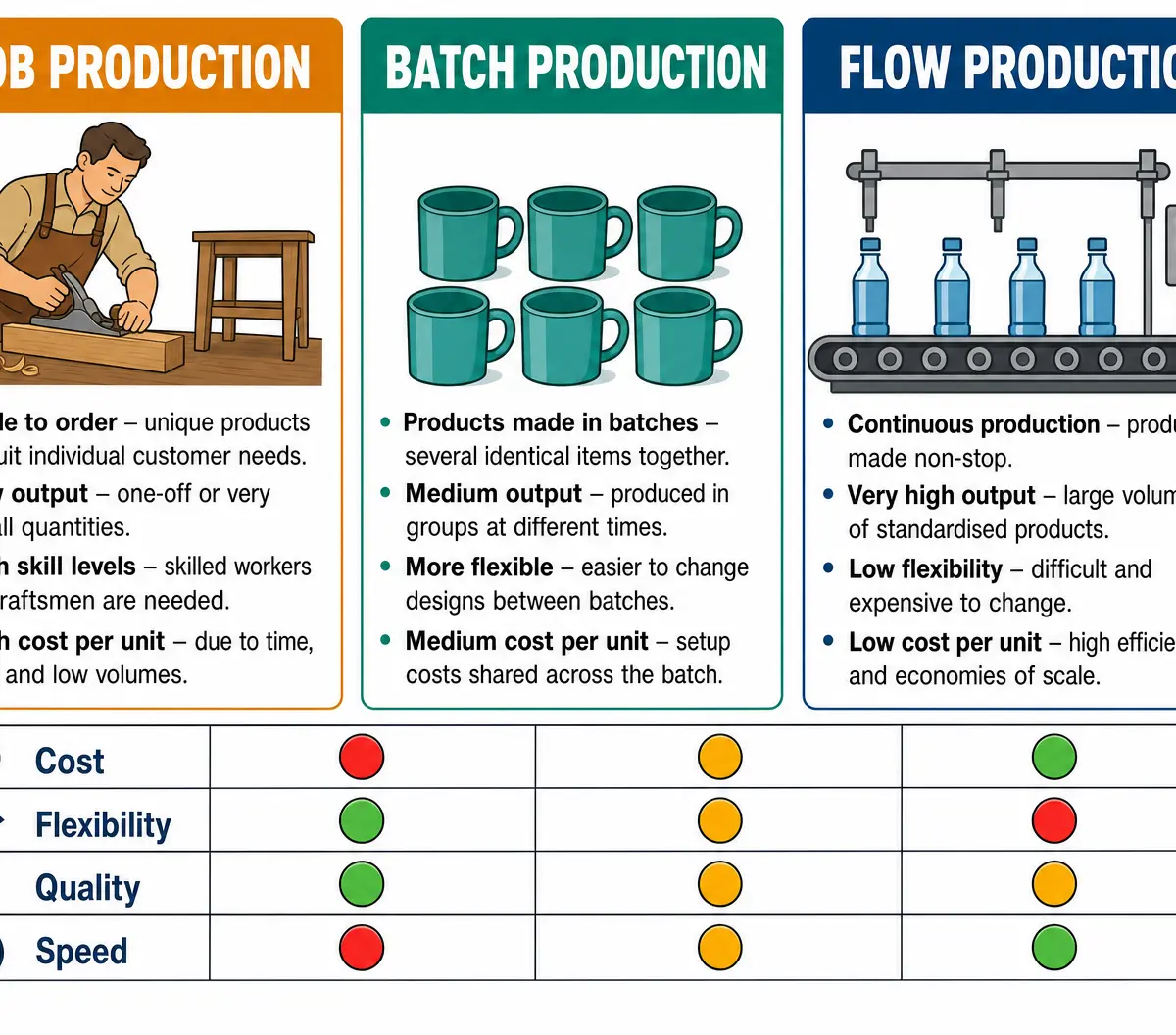
    Comparison of Production Methods

    Job Production: Making a single, unique product to meet specific customer requirements (e.g., bespoke wedding cakes, custom-built houses).

    • Key features: High skill levels, high cost per unit, high quality, very flexible.
    • Exam focus: Often tested in the context of small start-ups or artisan businesses.

    Batch Production: Producing groups of identical items together before moving on to the next batch (e.g., a bakery making 50 loaves of white bread, then 50 wholemeal).

    • Key features: Medium output, some flexibility, lower cost per unit than job production, but involves downtime between batches.

    Flow Production: Continuous, non-stop production of large volumes of standardised products (e.g., car manufacturing, bottling plants).

    • Key features: Very high output, low cost per unit due to economies of scale, low flexibility, high initial setup costs.

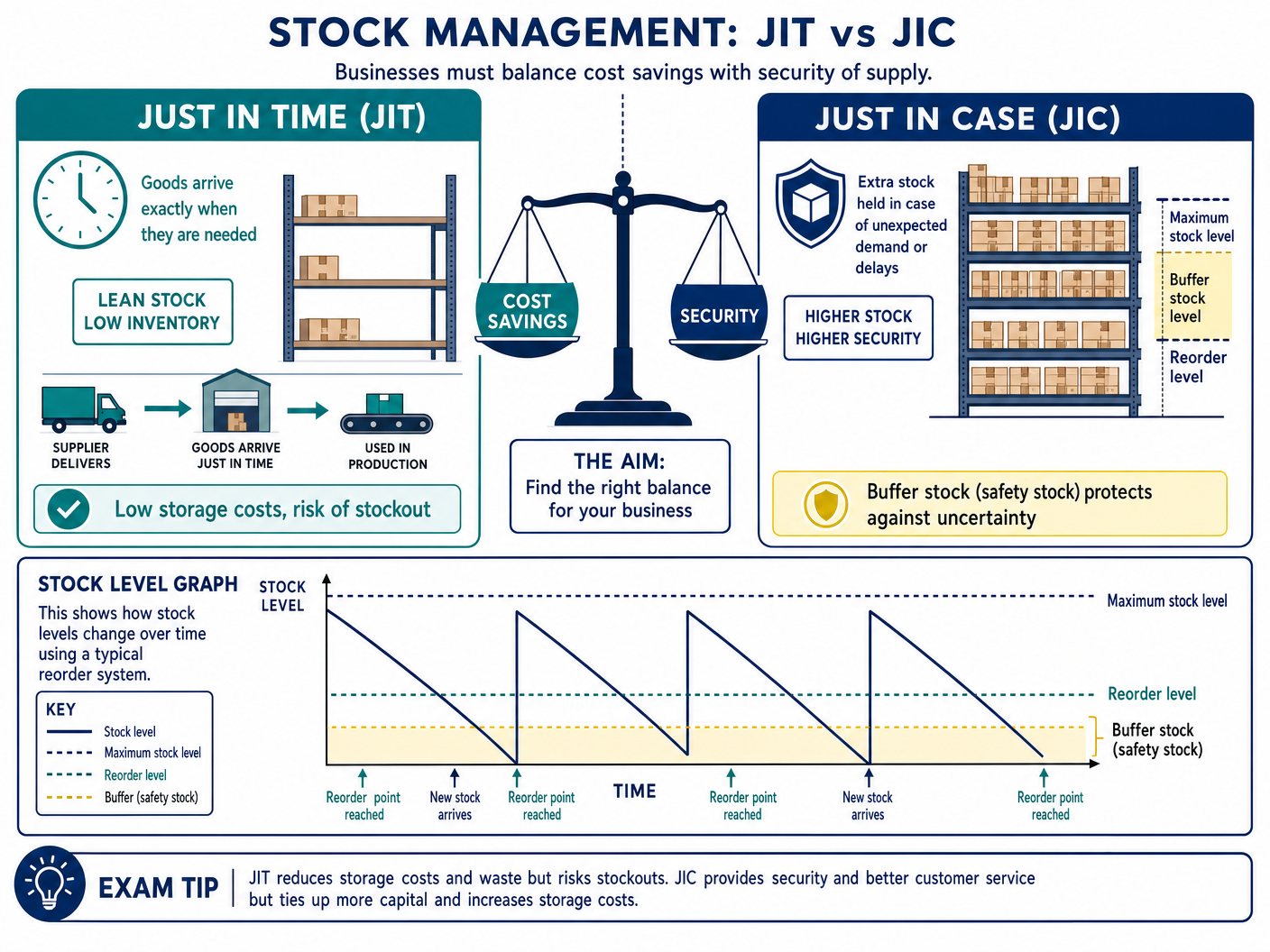
    Lean Production and Stock Management

    Lean production focuses on eliminating waste from the production process to improve efficiency and reduce costs.

    Just In Time (JIT): A lean technique where stock is ordered and arrives exactly when it is needed for production.

    • Benefits: Lower storage costs, less capital tied up, fresher materials.
    • Risks: Highly vulnerable to supply chain disruptions; late deliveries cause production to stop (stockouts).

    Just In Case (JIC): Holding buffer stock in reserve to protect against unexpected spikes in demand or supplier delays.

    • Benefits: Security of supply, ability to meet sudden orders.
    • Risks: Higher storage and insurance costs, risk of stock becoming obsolete.
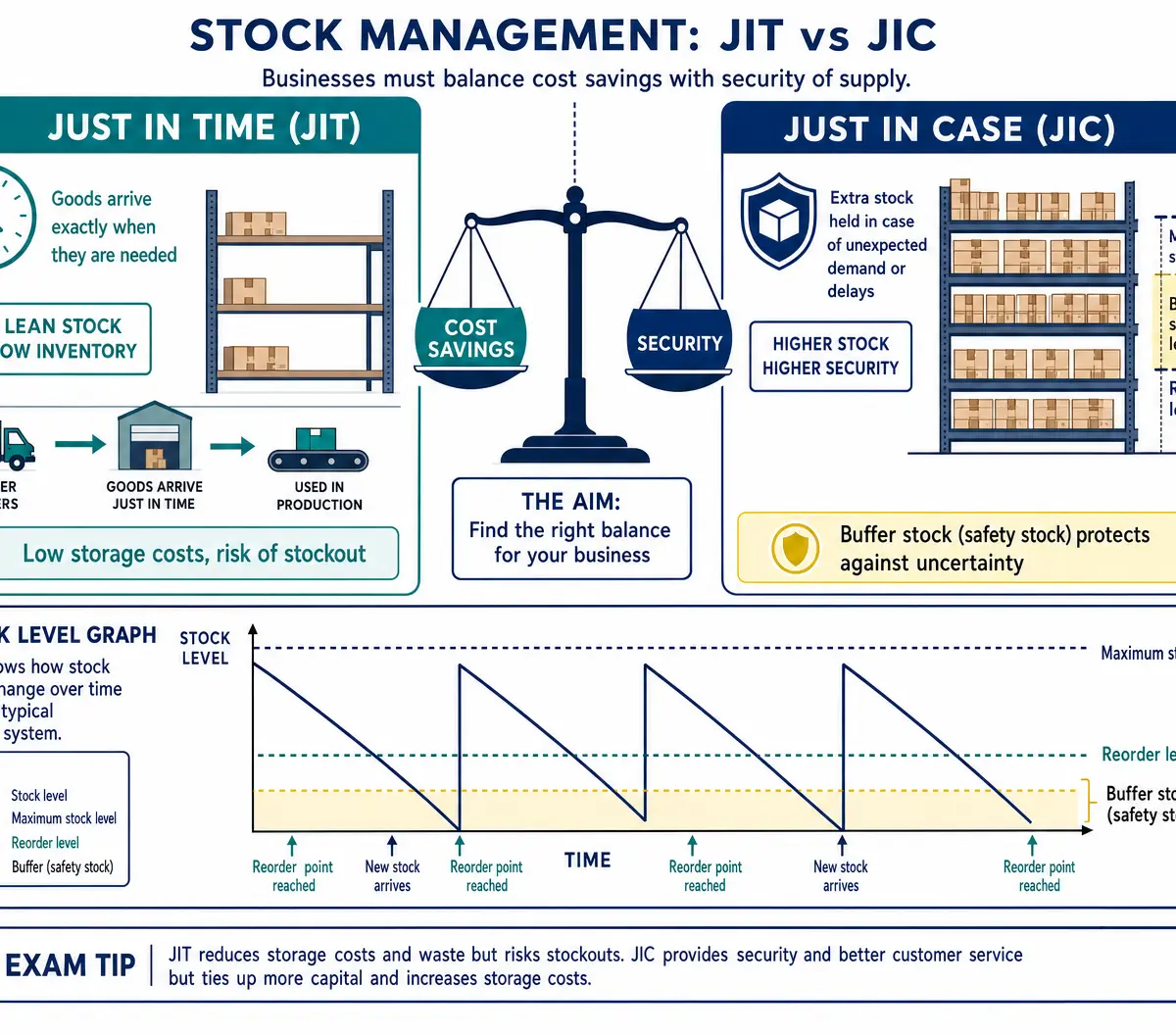
    Stock Management: JIT vs JIC

    Procurement and the Supply Chain

    Procurement is the strategic process of sourcing and purchasing the inputs a business needs. When choosing suppliers, businesses must balance three key factors:

    1. Price: Affects costs and profit margins.
    2. Quality: Affects the final product and customer satisfaction.
    3. Reliability: Affects whether production can run smoothly without delays.
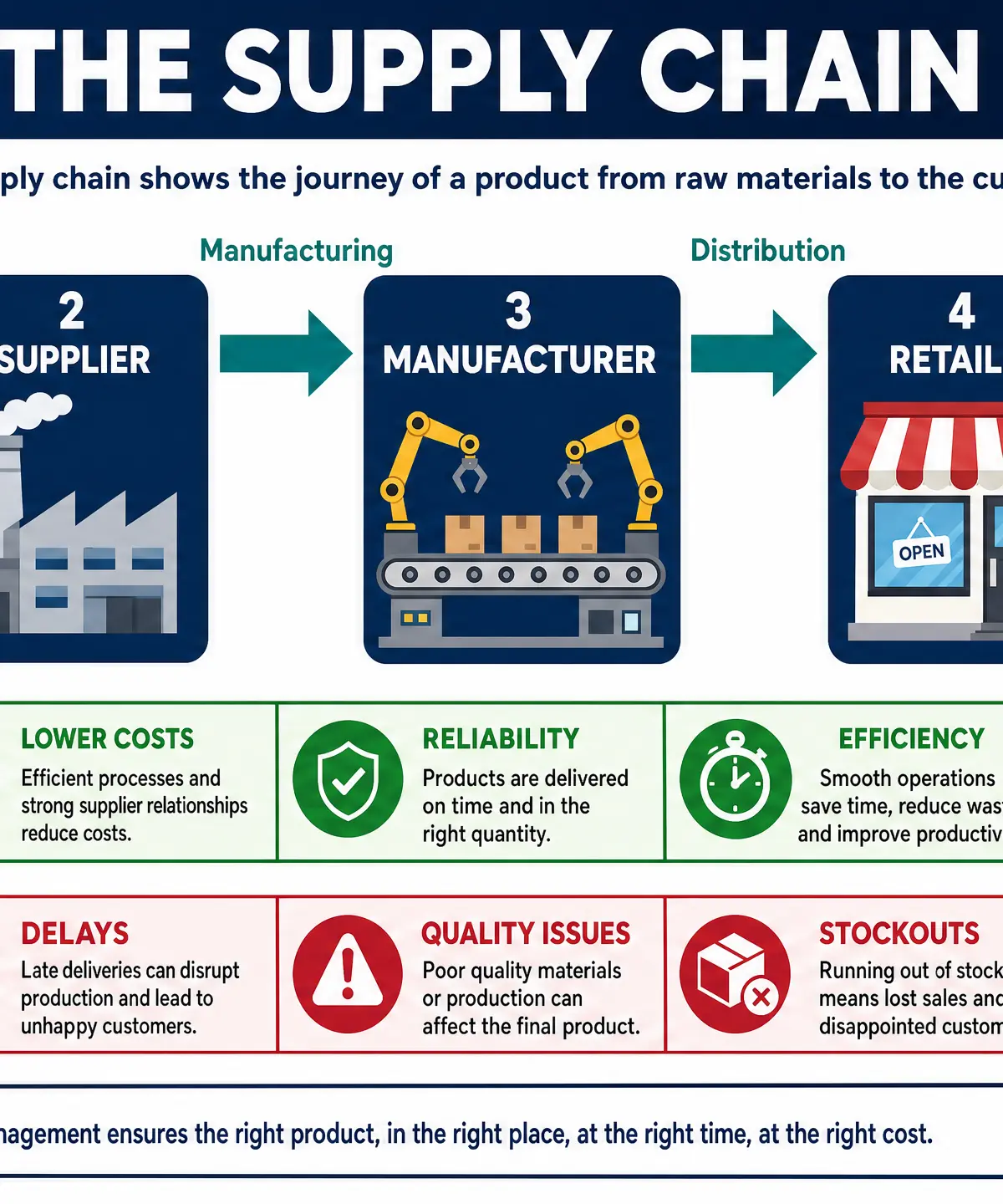
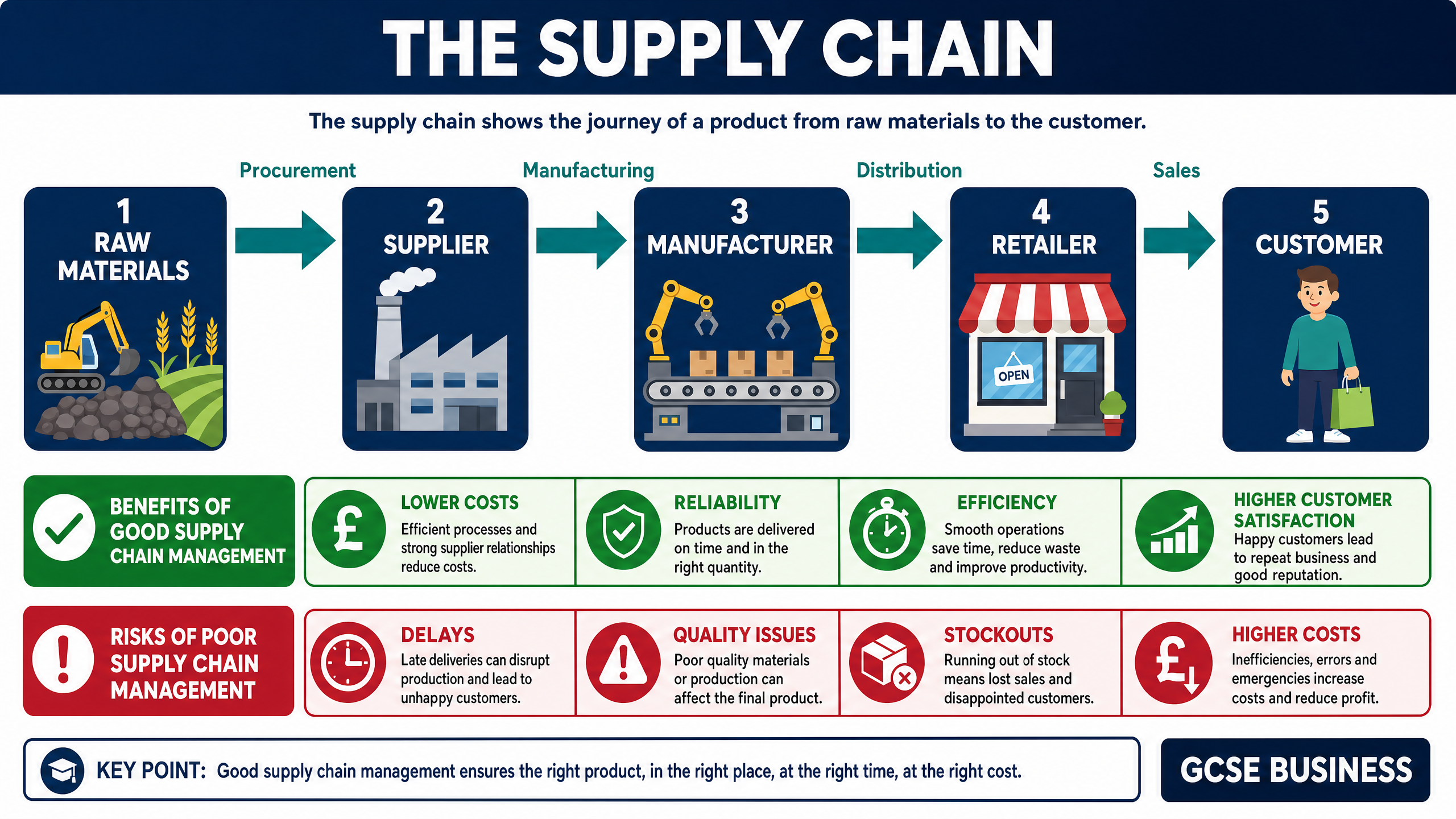
    The Supply Chain Process

    The supply chain encompasses the entire journey of a product from raw materials to the final customer. Effective supply chain management ensures the right product is in the right place at the right time, reducing costs and improving efficiency.

    Quality Management

    Maintaining high quality is vital for customer satisfaction and brand reputation.

    Quality Control: A traditional method where finished products are inspected at the end of the production process. Defective items are discarded or reworked. Drawback: Waste has already occurred.

    Total Quality Management (TQM): A holistic approach where quality is everyone's responsibility at every stage of production. The aim is zero defects. Drawback: Expensive and time-consuming to implement, requiring a significant culture change.

    Customer Service

    Operations extends beyond production to how a business interacts with its customers. Good customer service (helpful staff, easy returns, efficient support) builds loyalty and repeat business. Poor service leads to lost sales and negative reviews. ICT plays a crucial role here, with CRM (Customer Relationship Management) systems allowing businesses to track preferences and provide personalised service.

    Visual Resources

    3 diagrams and illustrations
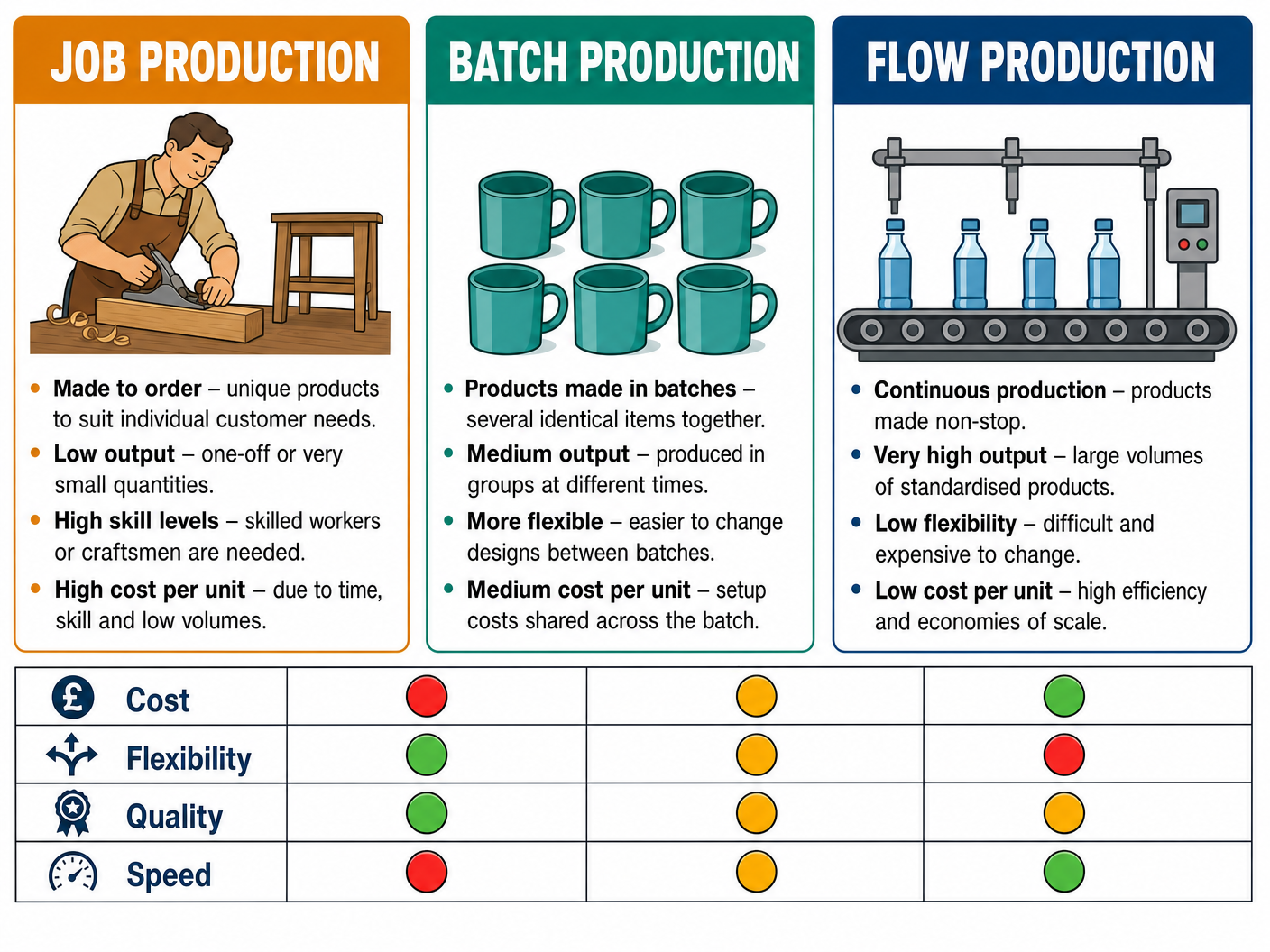
    Comparison of Production Methods
    Comparison of Production Methods
    Stock Management: JIT vs JIC
    Stock Management: JIT vs JIC
    The Supply Chain Process
    The Supply Chain Process

    Interactive Diagrams

    1 interactive diagram to visualise key concepts

    The basic stages of a supply chain.

    Worked Examples

    3 detailed examples with solutions and examiner commentary

    Practice Questions

    Test your understanding — click to reveal model answers

    Q1

    A fast-food restaurant is considering switching its meat supplier to a cheaper alternative. Evaluate the impact of this decision on the business. (9 marks)

    9 marks
    standard

    Hint: Think about the PQR framework (Price, Quality, Reliability). How does cheaper meat affect the other two?

    Q2

    State two features of flow production. (2 marks)

    2 marks
    easy

    Hint: Think about a car assembly line.

    Q3

    Explain how implementing Total Quality Management (TQM) could benefit a smartphone manufacturer. (6 marks)

    6 marks
    standard

    Hint: How is TQM different from just checking at the end? What does zero defects mean for costs and customers?

    Q4

    Analyse the impact of poor customer service on a business. (6 marks)

    6 marks
    standard

    Hint: Think about the immediate reaction of a customer and the long-term ripple effect.

    Q5

    Explain one reason why a business might choose to hold buffer stock. (3 marks)

    3 marks
    easy

    Hint: What unexpected things can happen that buffer stock protects against?

    Explore this topic further

    View Topic PageAll Business Topics

    Key Terms

    Essential vocabulary to know