AQA · GCSE · Business
Course version: 8132 · Version from Sept 2017
Calculation
Mastering calculations is the secret weapon for top grades in GCSE Business. This guide demystifies every formula you need, showing exactly how examiners award marks for method and analysis.
- 3 min read
- 3 worked examples
- 5 practice questions
- 6 key terms
Check what you remember
Read the wording for your board, then hide it and explain Revenue in your own words. Rough notes are fine. This is a self-check, with no mark or grade.
Reference: AQA
The total amount of money brought in by a company's operations, measured by price × quantity.
Study Notes
Overview
Calculations form a significant proportion of the marks in any GCSE Business paper. Examiners don't just test your ability to do the maths; they test your ability to apply quantitative skills to real business scenarios and use the results to make decisions. You will be expected to calculate revenue, profit, margins, averages, and percentage changes, as well as construct and interpret cash flow forecasts. Remember, you will not be given a formula sheet in the exam. You must memorise these formulas, show your working clearly to secure method marks, and be prepared to evaluate what your numerical answers mean for the business in question.
Listen to our comprehensive audio guide for a detailed walkthrough of all concepts:
Core Formulas & Concepts
Revenue, Costs and Profit
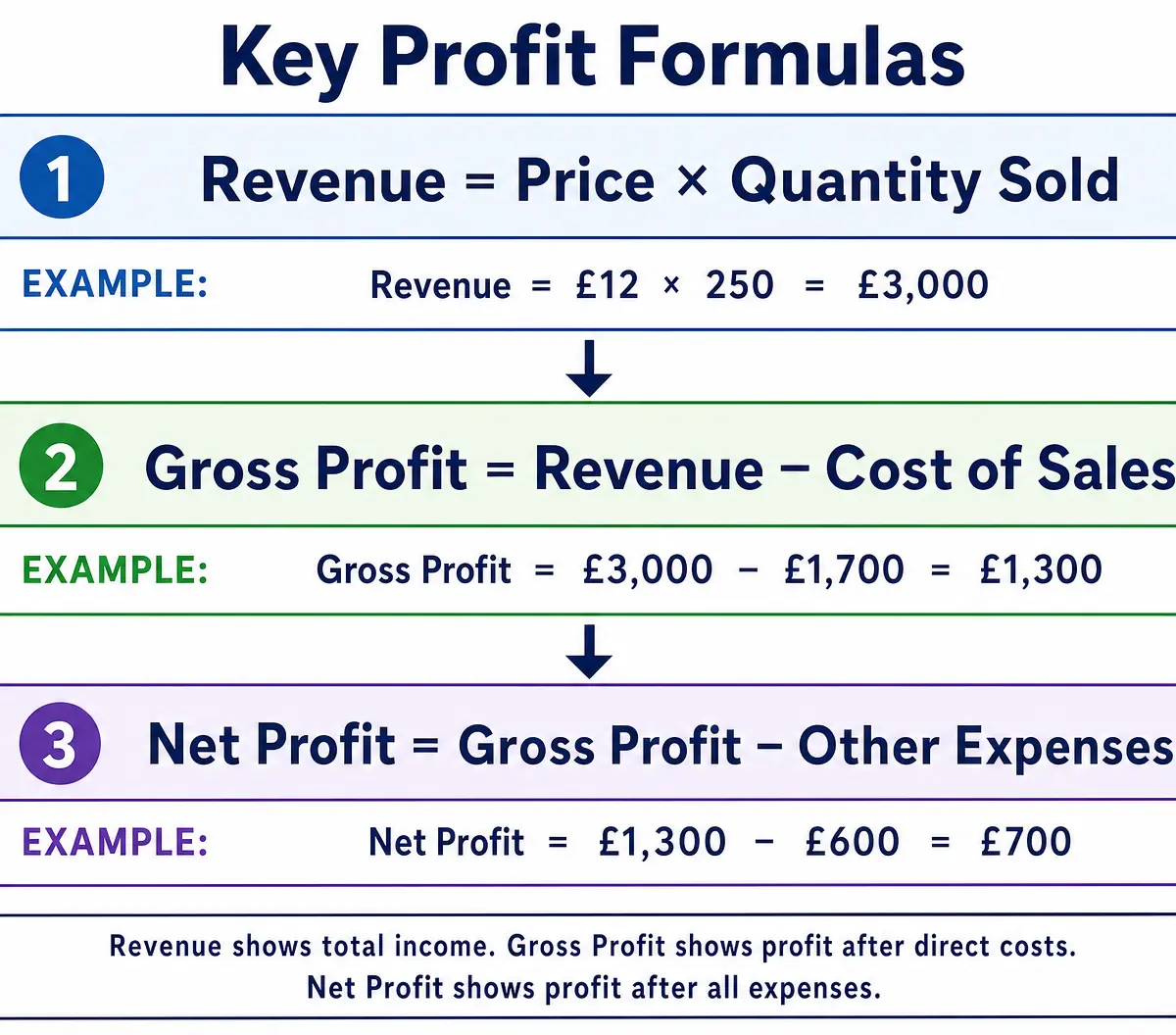
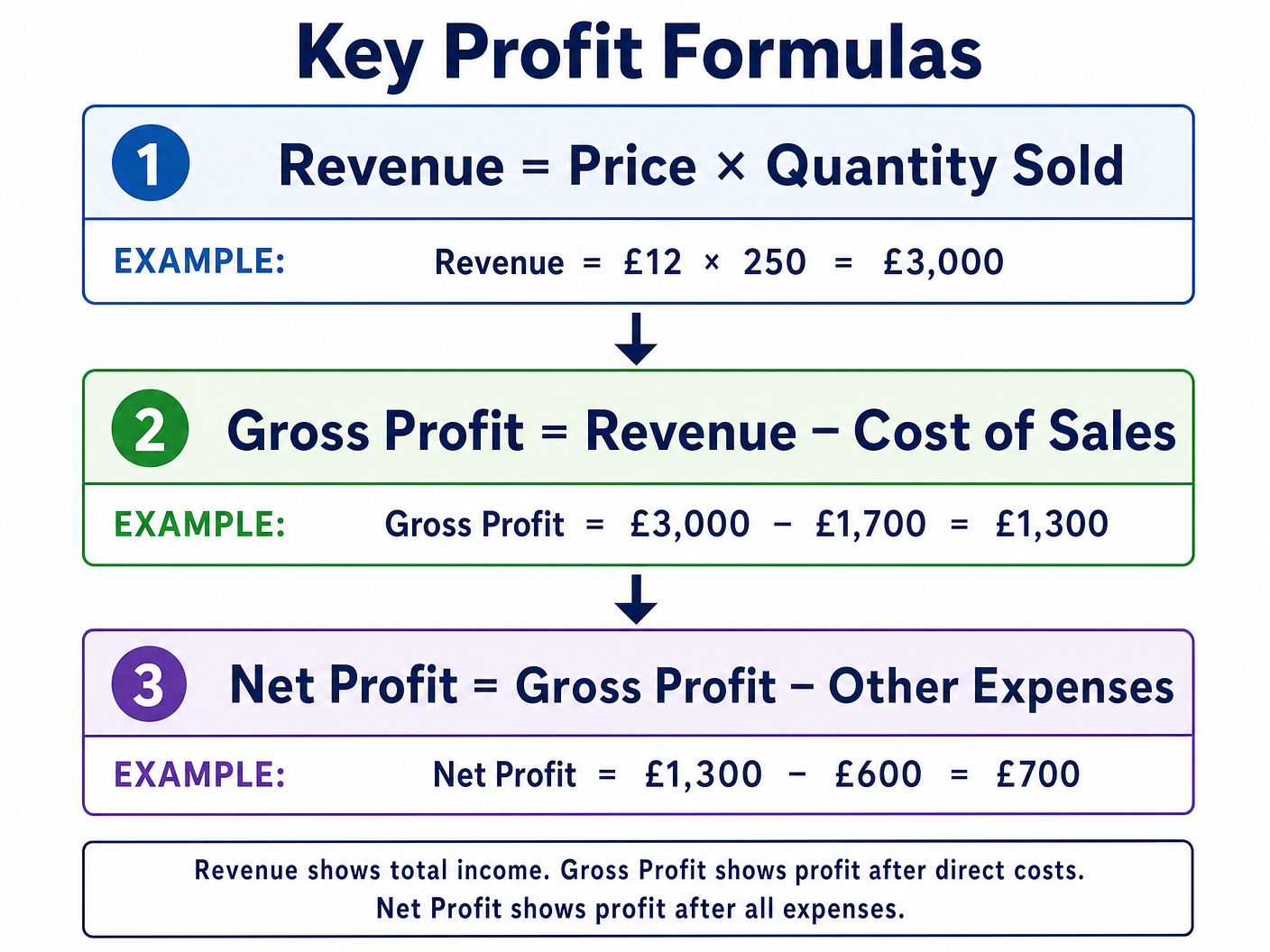
Revenue: The total income a business receives from selling its goods or services.
Formula: Revenue = Price × Quantity Sold
Gross Profit: The profit left after deducting the direct costs of making the product.
Formula: Gross Profit = Revenue − Cost of Sales
Net Profit: The final profit after all other operating expenses (like rent and wages) have been deducted.
Formula: Net Profit = Gross Profit − Other Expenses
Profit Margins
Profit margins show the percentage of revenue that is converted into profit. They are crucial for assessing business efficiency.
Gross Profit Margin (%):
Formula: (Gross Profit ÷ Revenue) × 100
Net Profit Margin (%):
Formula: (Net Profit ÷ Revenue) × 100
Percentage Change
Used to calculate growth or decline in sales, costs, or profits over time.
Formula: ((New Value − Old Value) ÷ Old Value) × 100
Average Rate of Return (ARR)
Used to evaluate whether an investment is worthwhile by comparing the average annual profit to the initial cost.
Formula: (Average Annual Profit ÷ Cost of Investment) × 100
Cash Flow Forecasts
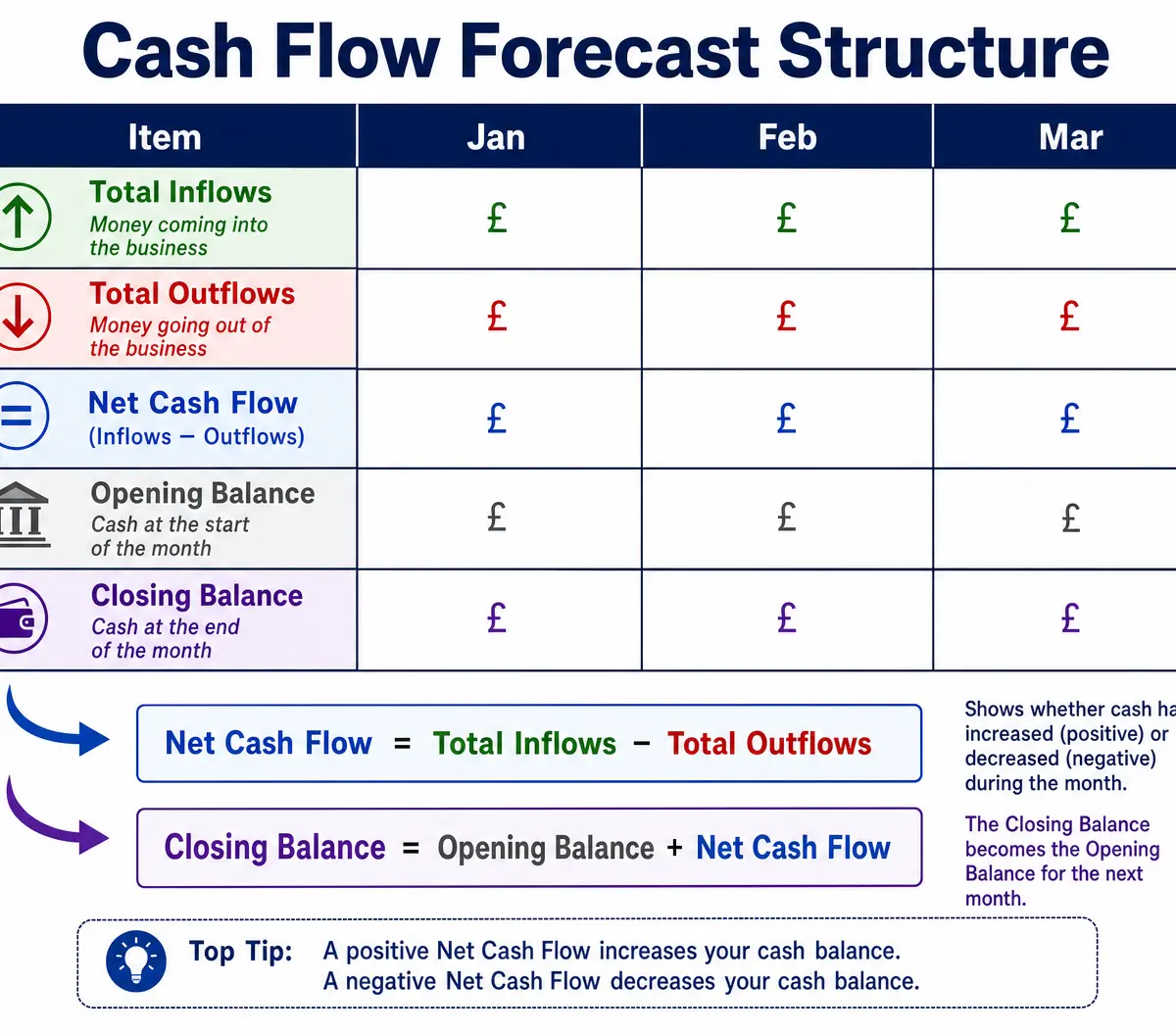
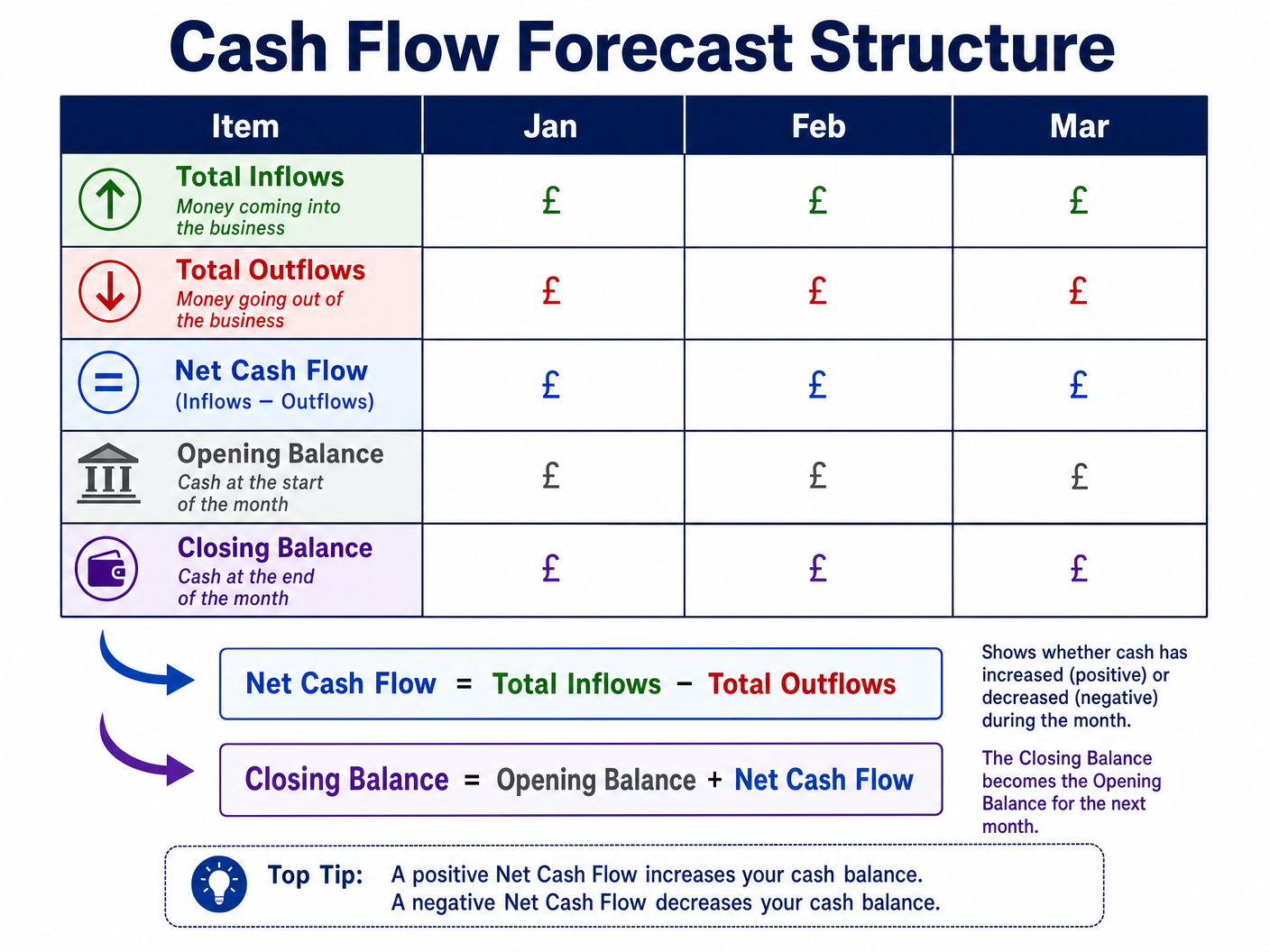
A cash flow forecast predicts the movement of money into and out of a business. It is vital for ensuring the business has enough liquidity to survive.
Net Cash Flow: Total Inflows − Total Outflows
Closing Balance: Opening Balance + Net Cash Flow
Analytical Skills
Examiners award the highest marks (AO3) when candidates can explain why a calculation matters. If a net profit margin falls from 15% to 10%, candidates must suggest reasons (e.g., rising supplier costs, increased marketing spend) and evaluate the impact on the business's future (e.g., less retained profit for expansion).
Interactive Diagrams
1 interactive diagram to visualise key concepts
Conceptual Flow Outline
The flow of profit through a business
Worked Examples
3 worked examples — open one to explore the question and available guidance.
Practice Questions
Try the question, then reveal an answer plan or example response
A coffee shop's revenue increased from £50,000 in 2022 to £62,000 in 2023. Calculate the percentage change in revenue. (2 marks)
Hint: Use the NOO formula: (New - Old) / Old × 100
A business has a Gross Profit of £45,000 and Revenue of £150,000. Calculate the Gross Profit Margin. (2 marks)
Hint: Margin means expressing the profit as a percentage of revenue.
An investment costs £120,000 and yields a total profit of £36,000 over 3 years. Calculate the ARR. (3 marks)
Hint: Remember to find the average annual profit first.
Explain one impact on a business of a falling Net Profit Margin. (3 marks)
Hint: What does Net Profit measure? What happens if it gets smaller?
In May, a business forecasts Total Inflows of £12,000 and Total Outflows of £15,000. The Opening Balance is £4,000. Calculate the Closing Balance. (3 marks)
Hint: Find the Net Cash Flow first, then apply it to the Opening Balance.
Exam technique
How to turn what you know into marks
How to approach the question
Always write the formula first. Substitute the numbers. Calculate the answer. Add units (£ or %).
How to structure your answer
- Essay questions
- Use calculations to support your arguments. E.g., 'I recommend Option A because its ARR is 12% compared to Option B's 8%.'
- Source questions
- Use data from the provided case study in your calculations.
- Explain questions
- State the calculation result, identify a consequence of that result, and explain the impact on the business.
Timing
Approximately 1 minute per mark. A 4-mark calculation should take about 4 minutes.
Common pitfalls
- Forgetting to write down the formula (losing method marks if the final answer is wrong).
- Confusing Gross Profit and Net Profit.
- Forgetting to multiply by 100 for percentages and margins.
- Not carrying the closing balance forward to the next month's opening balance in cash flows.
What the command words want
- Analyse
- Use the calculation result to explain a chain of events or consequences for the business.
- Evaluate
- Make a judgement based on the calculations (e.g., is the investment worth it? Is the business performing well?).
- Calculate
- Show working and provide the final numerical answer with units.
- Recommend
- Choose an option based on numerical evidence and justify why it is better than the alternative.
Watch or listen (optional)
Test your understanding of Calculation
Active recall beats re-reading. Take an instant quiz now to test what you’ve learned and lock it into long-term memory.
7 days Premium · Then the free plan continues · No card, no charge