AQA · GCSE · Business
Course version: 8132 · Version from Sept 2017
Competitive environment
The competitive environment is the battleground where businesses fight for customer attention, sales, and survival. Understanding how competition impacts every aspect of a business—from marketing to finance—is essential for analysing real-world scenarios and scoring high marks in your GCSE Business exam.
- 4 min read
- 3 worked examples
- 5 practice questions
- 6 key terms
Check what you remember
Read the wording for your board, then hide it and explain Market in your own words. Rough notes are fine. This is a self-check, with no mark or grade.
Reference: AQA
Any place where buyers and sellers come together to exchange goods or services.
Study Notes

Overview
The competitive environment is a fundamental concept in GCSE Business. It refers to the dynamic marketplace where two or more businesses attempt to sell similar goods or services to the same group of customers. For examiners, it is not enough to simply define competition; candidates must demonstrate how competition forces businesses to adapt and change across all functional areas (Marketing, Operations, Human Resources, and Finance).
In this topic, you will explore the difference between highly competitive markets and monopolies (where one business dominates). You will also examine the risks and uncertainties that entrepreneurs face when starting a business, their motivations for doing so, and the specific strategies they use to mitigate those risks.
The Nature of Competition
What is a Market?
Definition: Any place, physical or digital, where buyers and sellers come together to exchange goods or services.
Exam Focus: You must be able to identify the market a business operates in based on a given scenario (e.g., the local fast-food market, the global smartphone market).
Competitive Markets vs. Monopolies
Competitive Markets: Many businesses selling similar products. Consumers have choice, which drives prices down and quality up.
Monopolies: A market dominated by a single business with no significant competition. They can often charge higher prices because consumers have no alternatives.
The Impact of Competition on Business Functions
When competition increases, a business must respond. Examiners frequently ask candidates to analyse this impact.
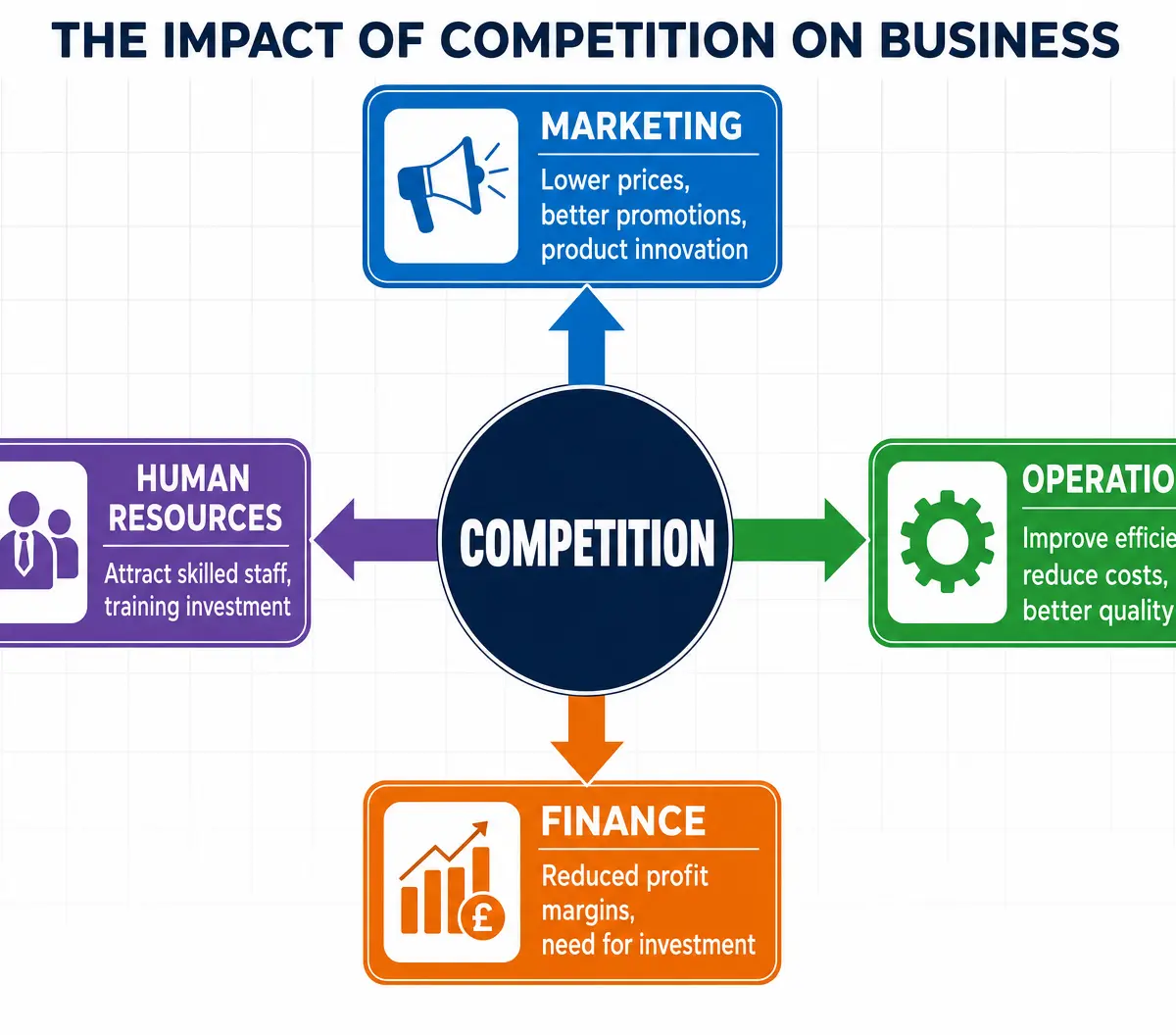
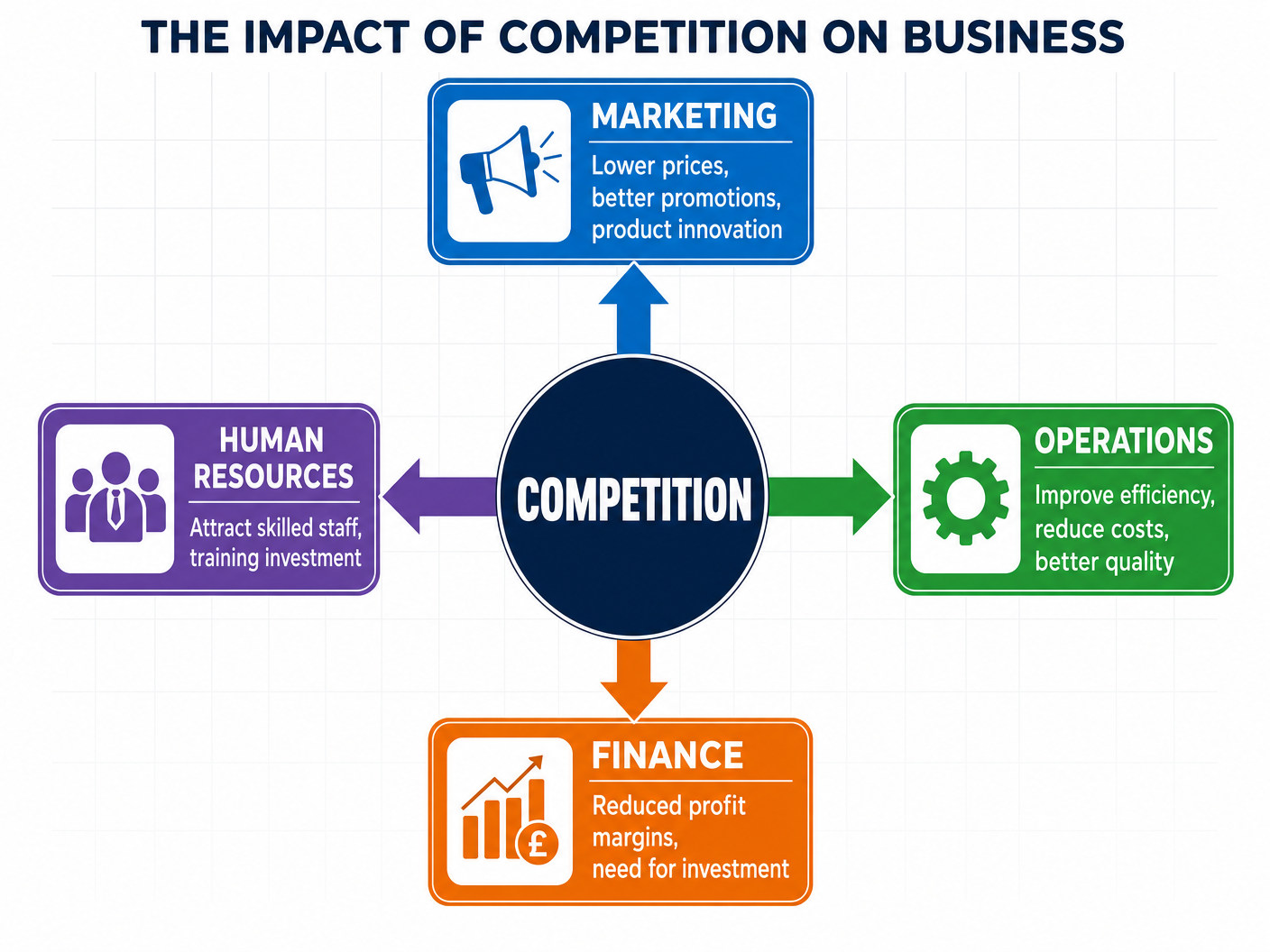
Marketing
- Lower Prices: Businesses may cut prices to attract customers (price wars).
- Increased Promotion: More spending on advertising, special offers, and branding.
- Product Development: Innovating to create a Unique Selling Point (USP) that rivals don't have.
Operations
- Efficiency: Businesses must produce goods at a lower cost to maintain profit margins if prices are forced down.
- Quality Control: Improving product quality to stand out from competitors.
- Customer Service: Offering faster delivery or better after-sales support.
Human Resources
- Recruitment: Fighting to hire the most skilled staff in the industry.
- Training: Investing in staff to improve customer service and productivity.
- Retention: Offering better pay or conditions to stop staff leaving for competitors.
Finance
- Profit Margins: Often squeezed as businesses lower prices but face higher marketing costs.
- Investment: More capital needed to fund new technology, marketing campaigns, or product development.
Business Risk and Uncertainty
Understanding the Difference
- Risk: The possibility of a negative outcome (e.g., financial loss, business failure). Risks can often be calculated or planned for.
- Uncertainty: Unpredictable external events that a business cannot control or easily foresee (e.g., a global pandemic, sudden changes in government legislation).
Why Entrepreneurs Take Risks
Despite the risks, entrepreneurs start businesses for several reasons:
- Profit: The potential for financial reward.
- Independence: The desire to be their own boss.
- Passion: A strong belief in a product or idea.
- Opportunity: Identifying a gap in the market.
Strategies to Minimise Risk
Businesses cannot eliminate risk entirely, but they can minimise it.
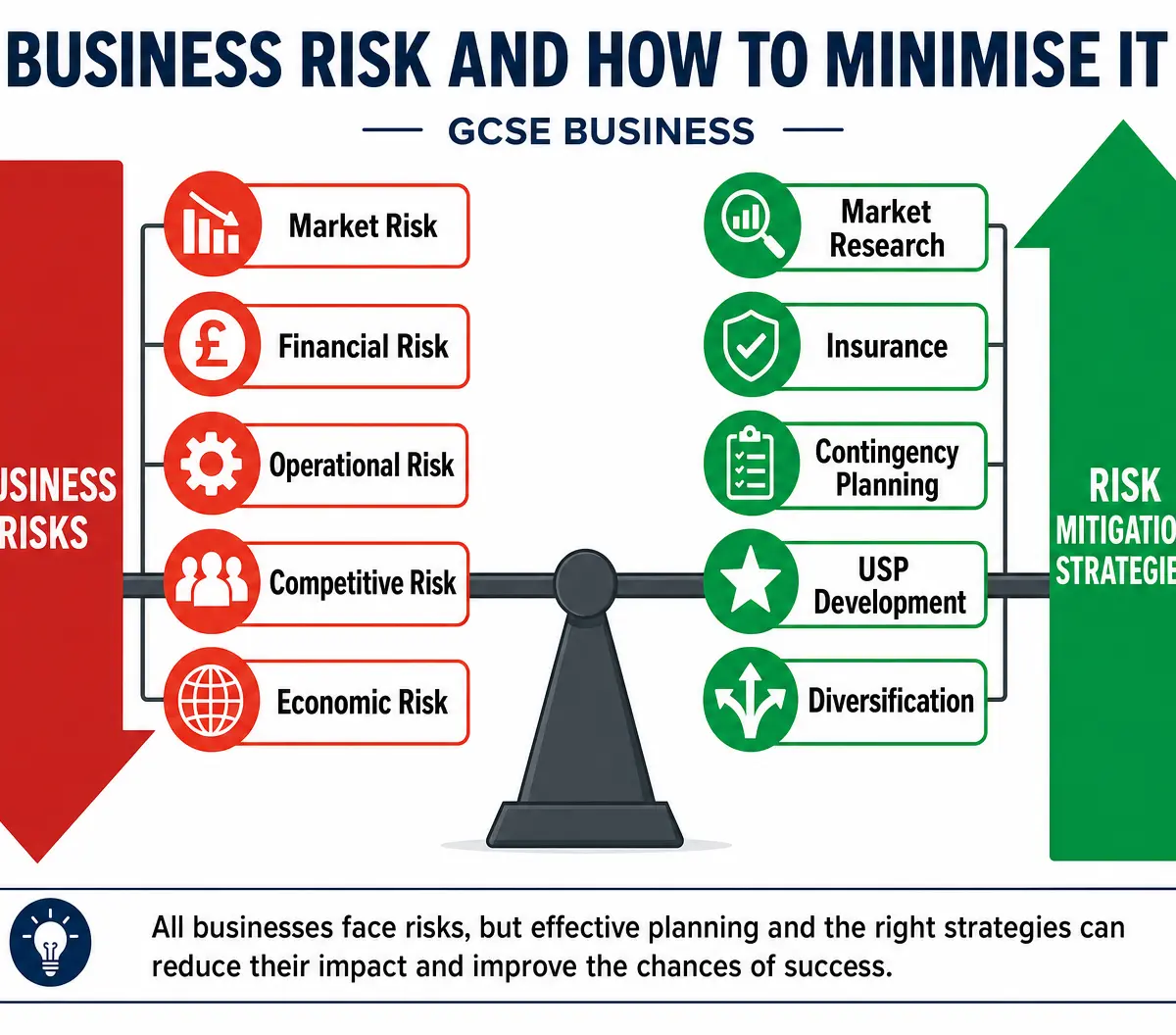
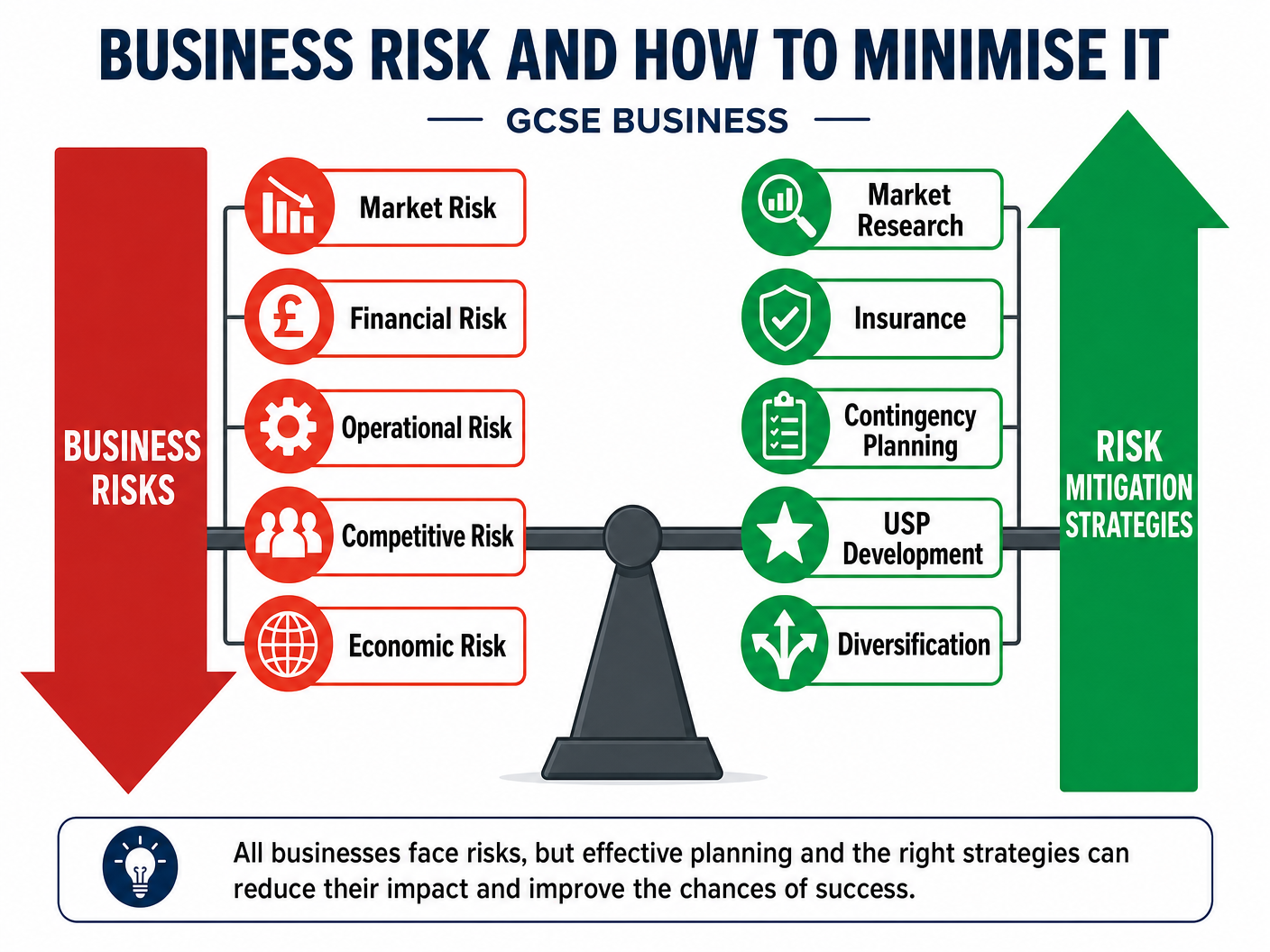
- Market Research: Gathering data on customer needs and competitors before launching a product.
- Business Planning: Creating a detailed plan covering finance, marketing, and operations.
- Insurance: Protecting against financial loss from specific events (e.g., fire, theft, public liability).
- Contingency Planning: Having a backup plan if things go wrong.
- Developing a USP: Making the product unique so it is less vulnerable to direct competition.
- Diversification: Selling different products in different markets so if one fails, the others can compensate.
Visual Resources
2 diagrams and illustrations
Interactive Diagrams
1 interactive diagram to visualise key concepts
Conceptual Flow Outline
How increased competition impacts the four functional areas of a business.
Worked Examples
3 worked examples — open one to explore the question and available guidance.
Practice Questions
Try the question, then reveal an answer plan or example response
State two reasons why an entrepreneur might start a business despite the risks involved. (2 marks)
Hint: Think of the acronym P-I-P-O.
Explain how developing a Unique Selling Point (USP) can help a business minimise risk. (3 marks)
Hint: Point → Explain → Consequence. How does a USP protect a business from competitors?
Analyse the impact on the Human Resources function of a supermarket if a new rival supermarket opens nearby. (6 marks)
Hint: Think about recruitment, retention, and training. Build chains of reasoning.
Explain one difference between risk and uncertainty. (2 marks)
Hint: Which one can be planned for, and which one is out of the business's control?
A small bakery is facing increased competition from a new bakery opening on the same street. The owner is considering two options to respond: Option 1: Lower all prices by 10%. Option 2: Spend £500 on a local advertising campaign. Justify which option the owner should choose. (9 marks)
Hint: Evaluate both options. Think about the impact on profit margins vs the impact on brand awareness. Make a clear choice.
Exam technique
How to turn what you know into marks
How to approach the question
Always look for the specific business context in the question. Highlight the name of the business and what they sell. Your answer MUST refer to this context.
How to structure your answer
- Analyse questions
- Identify the issue → Build a chain of reasoning using connectives ('therefore', 'leading to') → Link back to the specific business scenario.
- Explain questions
- Point → Explain how/why → Consequence for the business (e.g., impact on profit, sales, or costs).
- Evaluate questions
- State benefit/advantage → State drawback/disadvantage → Provide a final, justified judgement based on the specific business situation.
Timing
Approximately 1 minute per mark. Spend 1-2 minutes planning 9-mark or 12-mark questions.
Common pitfalls
- Defining 'competition' but failing to explain its impact on the business.
- Giving generic answers that don't mention the specific business in the case study.
- Confusing 'risk' (which can be calculated and planned for) with 'uncertainty' (which is unpredictable).
What the command words want
- Analyse
- Show cause and effect. How does A lead to B, and what does that mean for C?
- Explain
- Make a point and develop it with a reason or consequence.
- State / Identify
- One word or a short sentence. No explanation needed.
- Evaluate / Justify
- Look at both sides of an argument and make a final decision, explaining WHY you made that decision.
Watch or listen (optional)
Test your understanding of Competitive environment
Active recall beats re-reading. Take an instant quiz now to test what you’ve learned and lock it into long-term memory.
7 days Premium · Then the free plan continues · No card, no charge