Subject: Business | Level: GCSE | Exam Board: AQA
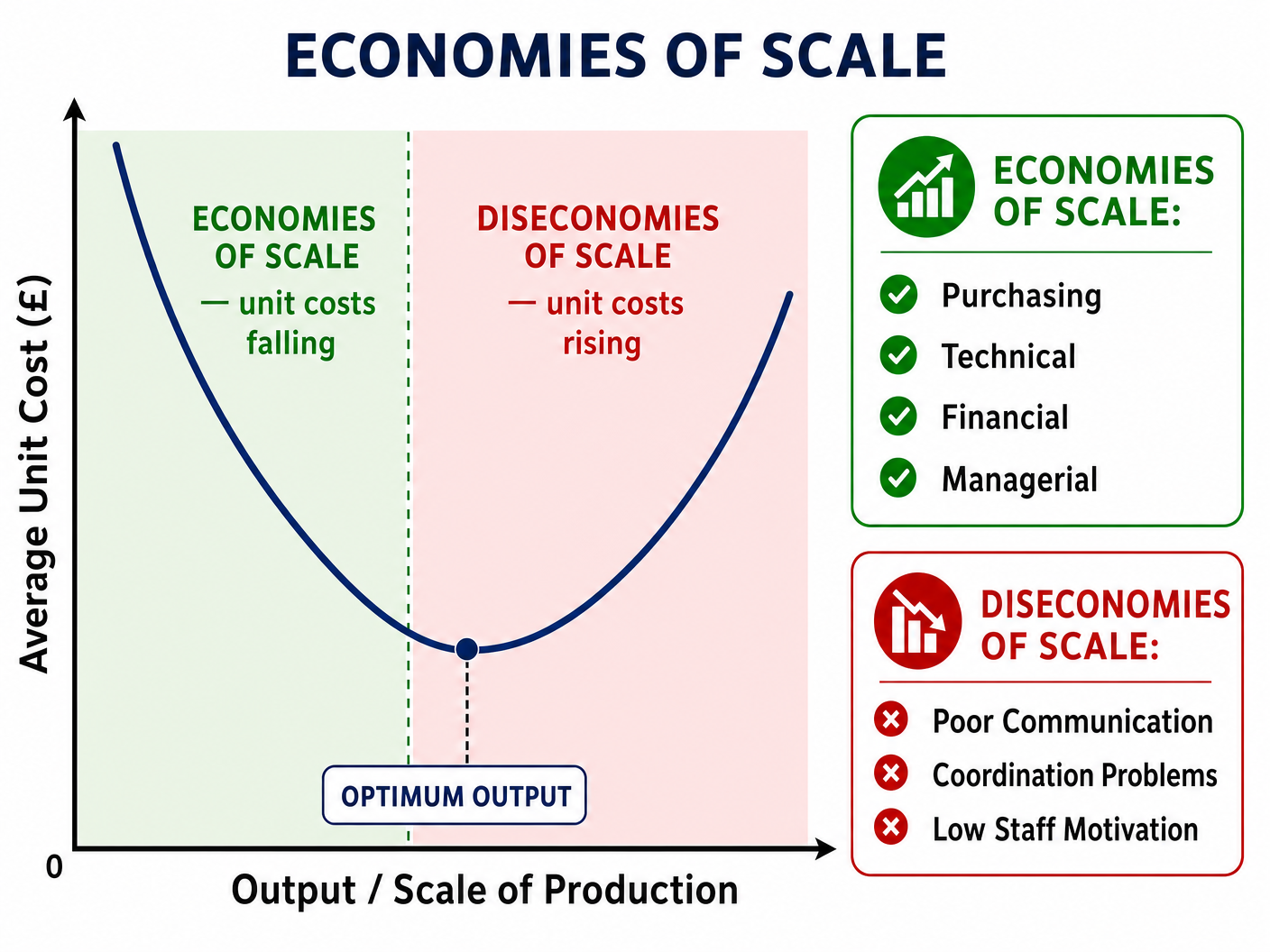
This topic covers the fundamental ways businesses grow, either organically from within or externally through mergers and takeovers. Understanding how expansion impacts average unit costs—through economies and diseconomies of scale—is crucial for maximising marks in GCSE Business exams.
Revision Notes & Key Concepts
Revision Podcast Transcript
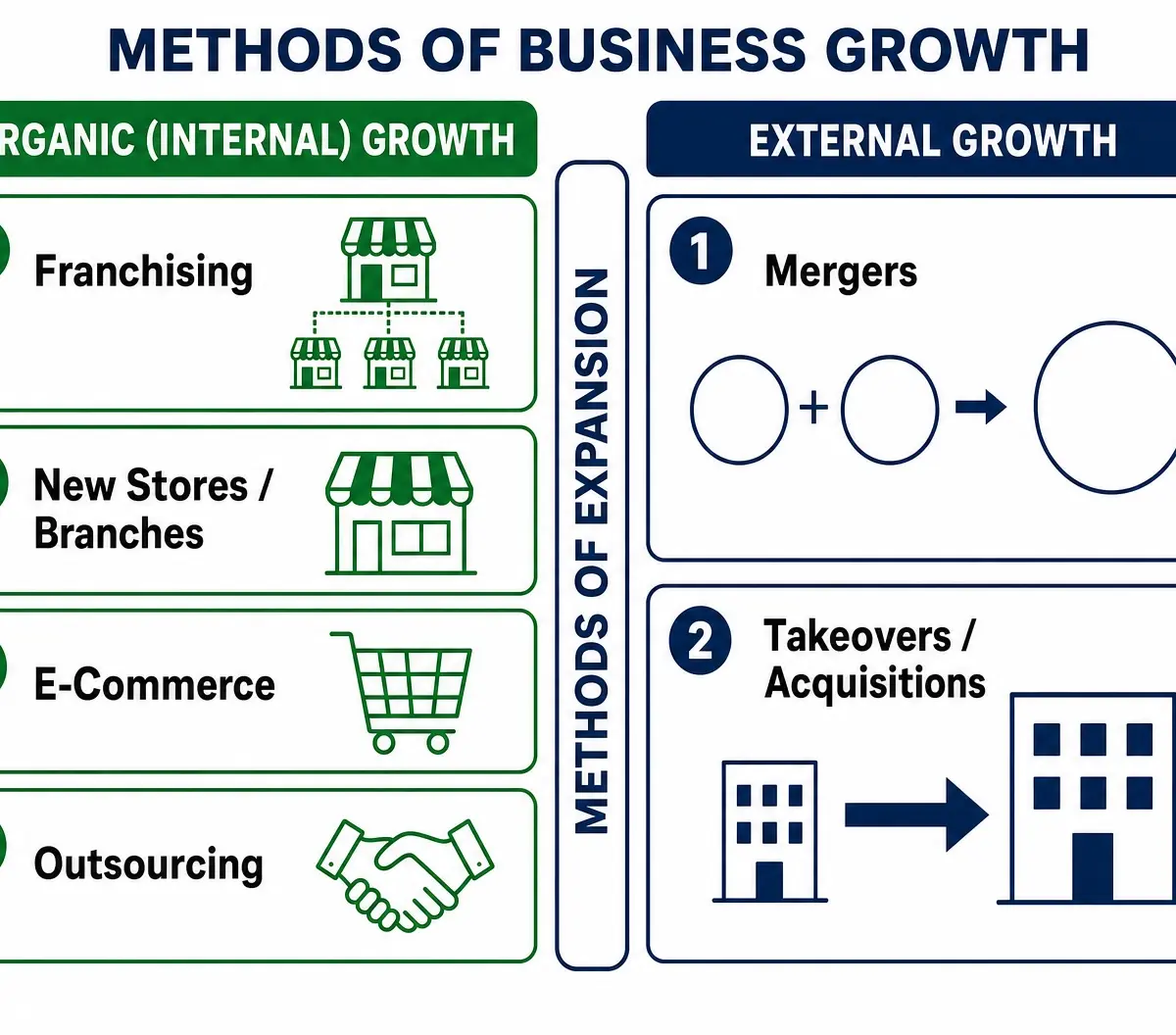
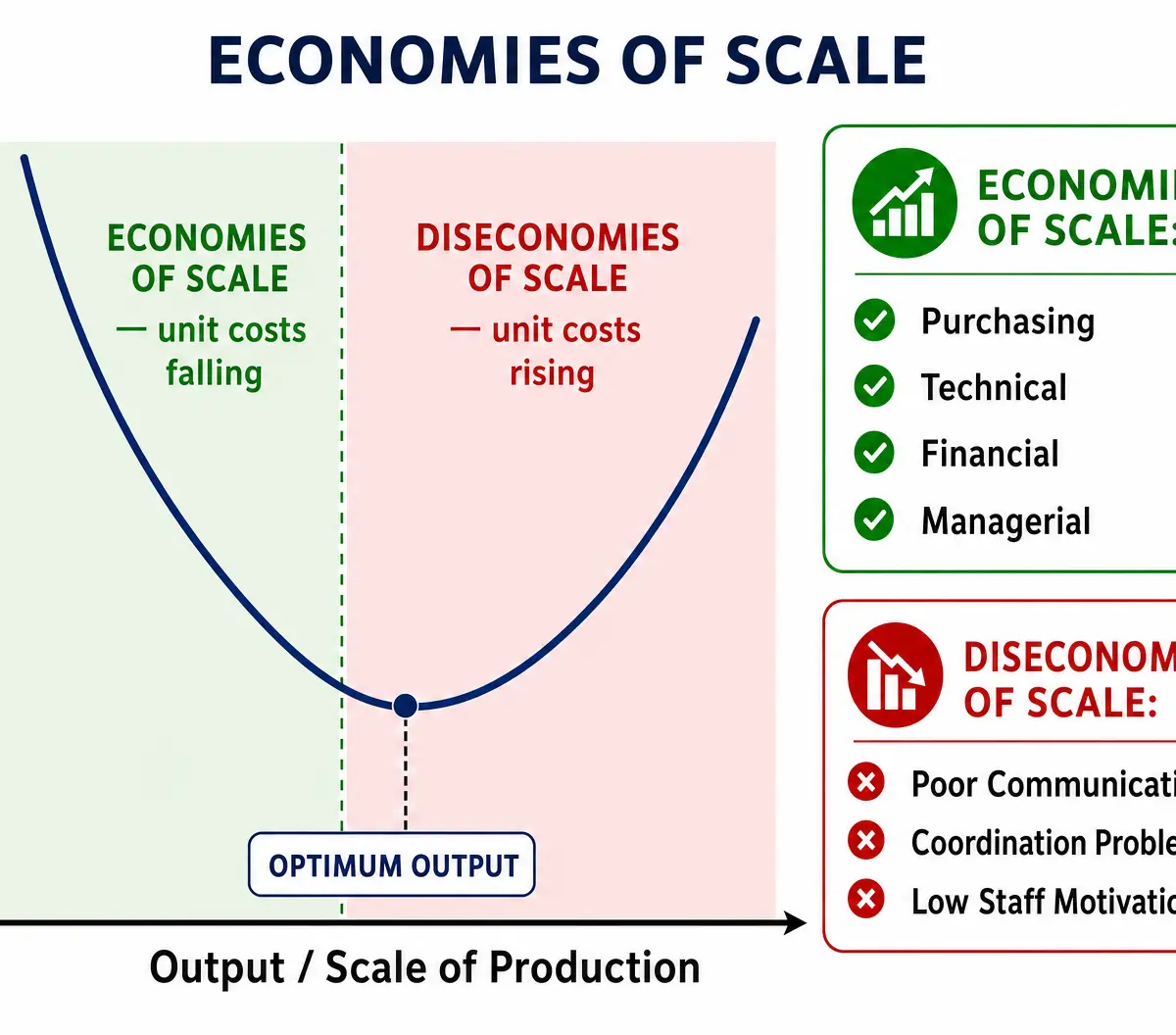
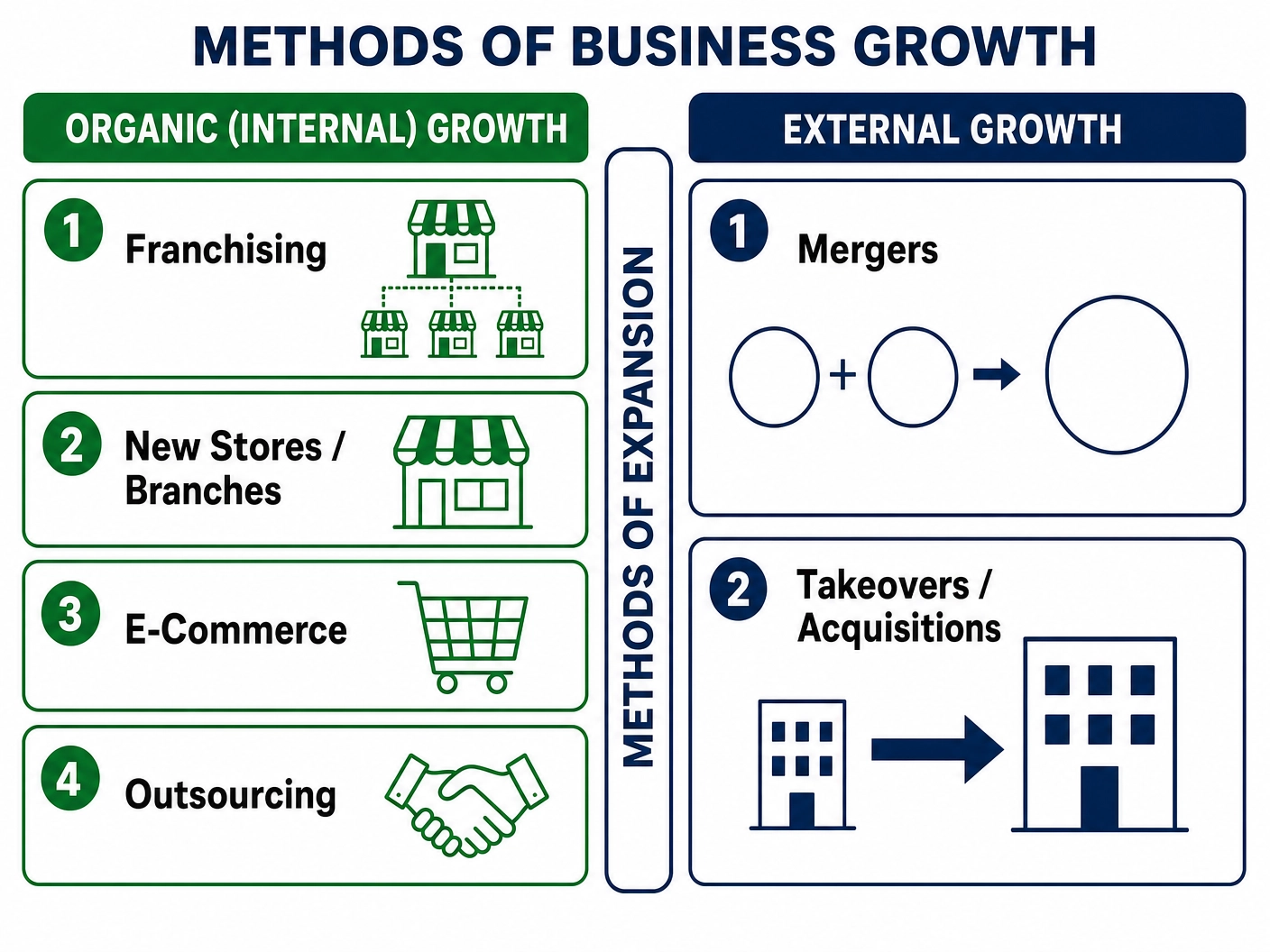
Welcome to Business Boost, your GCSE revision podcast. I am your tutor, and today we are diving into one of the most important topics in your Business Studies course: Expanding a Business. Whether you are sitting AQA, Edexcel, OCR, or another board, this topic comes up again and again in the exam. By the end of this episode, you will know exactly how to nail those questions and pick up every available mark. So grab a pen, get comfortable, and let us get started. CORE CONCEPTS. Let us start with the big picture. Why do businesses want to grow in the first place? Bigger businesses can often charge lower prices, earn higher profits, and dominate their market. Growth gives a business more power over its suppliers, its competitors, and its customers. Examiners love it when candidates can explain the motivation behind growth, not just describe it. So always ask yourself: why would a business owner choose to expand? Now, there are two main types of growth, and this is where a lot of students lose marks by mixing them up. Let us be crystal clear. The first type is ORGANIC GROWTH, sometimes called internal growth. This is when a business grows from within, using its own resources. Think of it as a plant growing from its own roots. There are four key methods of organic growth you need to know. Number one: opening new stores or branches. A business like Greggs, the bakery chain, grows organically by opening new outlets across the UK. Each new store increases sales revenue and market share. Number two: franchising. This is a brilliant one for the exam. In franchising, the original business, called the franchisor, allows another person, the franchisee, to run a branch using the brand name and business model. McDonald's is the classic example. The franchisor gets income from franchise fees and royalties without taking on all the risk. The franchisee gets a proven business model. It is a win-win, and examiners love it when you can explain both sides. Number three: e-commerce. Selling online allows a business to reach customers 24 hours a day, 7 days a week, without the cost of physical stores. A small business that previously only sold locally can suddenly sell nationally or even globally. This dramatically increases the potential market size. Number four: outsourcing. This is when a business pays another company to carry out certain tasks, like IT support, payroll, or manufacturing, rather than doing them in-house. It can reduce costs and allow the business to focus on what it does best. Now, the second type of growth is EXTERNAL GROWTH, and this is where things get really interesting. External growth happens when a business joins with or takes over another business. There are two methods here. The first is a MERGER. This is when two businesses agree to combine and form a single new business. Both companies come together voluntarily. The second is a TAKEOVER, also called an acquisition. This is when one business buys a controlling share in another business. A famous example is when Facebook acquired Instagram in 2012 for approximately one billion dollars. Facebook wanted Instagram's user base and technology. That is a classic takeover motive. External growth is faster than organic growth, but it comes with risks, like culture clashes between the two businesses, or paying too much for the acquired company. ECONOMIES AND DISECONOMIES OF SCALE. Now let us talk about one of the most important concepts in this whole topic: economies of scale. This is where a lot of exam marks are available, so pay close attention. As a business grows and produces more output, its average unit cost, that is the cost per item produced, tends to fall. This is called an economy of scale. The formula you need is: Average Unit Cost equals Total Costs divided by Output. Write that down. Let us say a factory produces 1,000 units at a total cost of ten thousand pounds. The average unit cost is ten pounds. Now if it doubles output to 2,000 units and total costs only rise to fifteen thousand pounds, the average unit cost falls to seven pounds fifty. That is an economy of scale in action. There are four types of economies of scale you should know. First, PURCHASING ECONOMIES, also called bulk buying. When a business buys raw materials in large quantities, it can negotiate lower prices per unit from suppliers. Supermarkets like Tesco do this brilliantly. Second, TECHNICAL ECONOMIES. Larger businesses can afford more efficient machinery and technology. A large car manufacturer can use robotic assembly lines that a small garage simply could not afford. The machinery spreads its cost over millions of units. Third, FINANCIAL ECONOMIES. Larger businesses are seen as lower risk by banks, so they can borrow money at lower interest rates. This reduces their costs compared to smaller competitors. Fourth, MANAGERIAL ECONOMIES. As a business grows, it can employ specialist managers, a dedicated HR director, a finance director, a marketing director, rather than one person trying to do everything. Specialists are more efficient. But here is the crucial twist, and this is where candidates often lose marks. If a business grows too large, costs can actually start to rise again. This is called DISECONOMIES OF SCALE. Why does this happen? Three main reasons. First, POOR COMMUNICATION. In a very large business, messages have to travel through many layers of management. Instructions get lost, misunderstood, or delayed. This causes inefficiency and mistakes, both of which cost money. Second, COORDINATION PROBLEMS. It becomes harder to coordinate thousands of workers across multiple sites and departments. Projects overrun, deadlines are missed, and resources are wasted. Third, LOW STAFF MOTIVATION. Workers in very large organisations can feel like just a number. They feel disconnected from the business's goals, leading to lower productivity, higher absenteeism, and higher staff turnover, all of which increase costs. The key message: there is an optimum size for every business, the point at which average unit costs are at their lowest. Beyond that point, diseconomies of scale kick in. EXAM TIPS AND COMMON MISTAKES. Here are the most important tips for picking up marks on this topic. Tip one: Always use the term unit cost correctly. Do not just say costs go down. Say the average unit cost per item falls as output increases. Examiners are specifically looking for this precision. Tip two: When a question asks you to explain a method of growth, use the PEEL structure. Point, state the method. Evidence, give a real-world example. Explanation, explain how it helps the business grow. Link, connect it back to the question. Tip three: Do not confuse organic and external growth. Organic growth comes from within the business. External growth involves joining with or buying another business. Tip four: When discussing diseconomies of scale, always link to a specific management problem: communication, coordination, or motivation. Do not just say the business gets too big. Examiners want to see that you understand why costs rise. Tip five: For calculation questions on average unit cost, show your working clearly. Even if you get the final answer wrong, you may still earn method marks for showing the correct formula. Tip six: Think about the four functional areas: Operations, Human Resources, Marketing, and Finance. When a business expands, it affects all four. Examiners reward candidates who can link expansion to these areas. Common mistake number one: Saying franchising is external growth. It is NOT. Franchising is organic growth because the original business is growing using its own brand and model. Common mistake number two: Calculating average unit cost incorrectly. Remember: Total Costs divided by Output. Not profit. Not revenue. Total costs. Common mistake number three: Describing diseconomies of scale as simply costs go up. You must explain why: poor communication, coordination problems, or reduced motivation. QUICK-FIRE RECALL QUIZ. Time for a quick-fire quiz! Pause the podcast after each question and try to answer before I reveal it. Question one: What is the formula for average unit cost? The answer is: Total Costs divided by Output. Question two: Name two methods of organic growth. Franchising, new stores, e-commerce, or outsourcing. Any two of those. Question three: What is the difference between a merger and a takeover? A merger is when two businesses agree to combine voluntarily. A takeover is when one business buys a controlling share in another. Question four: Name two causes of diseconomies of scale. Poor communication, coordination problems, or low staff motivation. Any two. Question five: What type of economy of scale involves buying raw materials in large quantities? A purchasing economy, also called bulk buying. SUMMARY AND SIGN-OFF. Let us wrap up. Today we have covered the two main types of business growth: organic growth, including franchising, new stores, e-commerce, and outsourcing, and external growth through mergers and takeovers. We have explored economies of scale and why average unit costs fall as output increases, including the four types: purchasing, technical, financial, and managerial. And we have looked at diseconomies of scale, caused by poor communication, coordination problems, and low staff motivation. Remember the key formula: Average Unit Cost equals Total Costs divided by Output. Remember the mnemonic PTFM for the four economies of scale: Purchasing, Technical, Financial, Managerial. And always, always use precise business terminology in your answers. You have got this. Keep revising, keep practising past paper questions, and I will see you in the next episode of Business Boost. Good luck!
Key Terms & Definitions
- Organic Growth
- Expansion from within a business, for example by opening new stores or launching e-commerce.
- External Growth
- Expansion by joining with or buying another business (mergers and takeovers).
- Economies of Scale
- The reduction in average unit costs as a business increases its scale of production.
- Diseconomies of Scale
- The increase in average unit costs that occurs when a business grows too large and becomes inefficient.
- Franchising
- When a business (franchisor) allows another operator (franchisee) to trade under its name for a fee.
- Average Unit Cost
- Total costs divided by the total output (number of items produced).
Worked Examples
Worked Example
Question: Explain one benefit to a business of using franchising as a method of growth. (3 marks)
Solution: One benefit of franchising is that the business (franchisor) can expand rapidly without having to raise large amounts of capital (1 mark). This is because the franchisee pays the setup costs for the new branch (1 mark). As a result, the franchisor increases its brand presence and market share with lower financial risk (1 mark).
Worked Example
Question: A factory has total costs of £50,000 when producing 10,000 units. Calculate the average unit cost. Show your workings. (2 marks)
Solution: Average Unit Cost = Total Costs ÷ Output Average Unit Cost = £50,000 ÷ 10,000 Average Unit Cost = £5.00
Worked Example
Question: Assess the impact on a business of experiencing diseconomies of scale. (10 marks)
Solution: Diseconomies of scale occur when a business grows so large that its average unit costs begin to rise. One significant impact of this is poor communication. As the hierarchy grows, messages take longer to pass between senior management and shop-floor workers. This can lead to misunderstood instructions and costly mistakes, directly increasing the average cost per unit. Furthermore, a massive workforce can lead to low staff motivation. Employees may feel alienated and disconnected from the business's core objectives. Demotivated staff are less productive and more likely to leave, which increases recruitment and training costs for the HR department. However, the severity of this impact depends on the quality of management. If the business implements decentralisation or invests in better internal communication technology, it might mitigate these coordination problems. Ultimately, if diseconomies of scale are not addressed, the rising unit costs will force the business to either increase its prices—making it less competitive—or accept lower profit margins.
Practice Questions
Question: Evaluate whether a takeover is the best method of growth for a successful regional supermarket chain looking to expand nationally. (12 marks)
Answer:
Question: Explain how poor communication can lead to diseconomies of scale. (3 marks)
Answer:
Question: State two methods of organic growth. (2 marks)
Answer:
Question: A business produces 5,000 units at a total cost of £25,000. It expands production to 10,000 units, and total costs rise to £40,000. Calculate the change in average unit cost and state whether the business has experienced economies or diseconomies of scale. (4 marks)
Answer:
Question: Explain one reason why a business might choose to grow via e-commerce. (3 marks)
Answer: