AQA · GCSE · Business
Course version: 8132 · Version from Sept 2017
Finance
Master the crucial calculations and concepts of GCSE Business Finance. This guide covers everything from cash flow forecasting to break-even analysis, ensuring you have the tools to evaluate financial decisions and secure top marks.
- 4 min read
- 3 worked examples
- 5 practice questions
- 6 key terms
Check what you remember
Read the wording for your board, then hide it and explain Retained Profit in your own words. Rough notes are fine. This is a self-check, with no mark or grade.
Reference: AQA
Profit kept within the business from previous years to reinvest, rather than being distributed to owners/shareholders.
Study Notes
Overview

Welcome to Topic 3.6: Finance. This section of the GCSE Business specification is heavily weighted towards quantitative skills (AO2) and evaluation (AO3). Examiners expect candidates to not only perform calculations accurately but also to interpret the results within a specific business context. You will explore how businesses raise capital, manage their cash flow, calculate profit and loss, and assess their overall financial health using key statements.
Key Financial Concepts
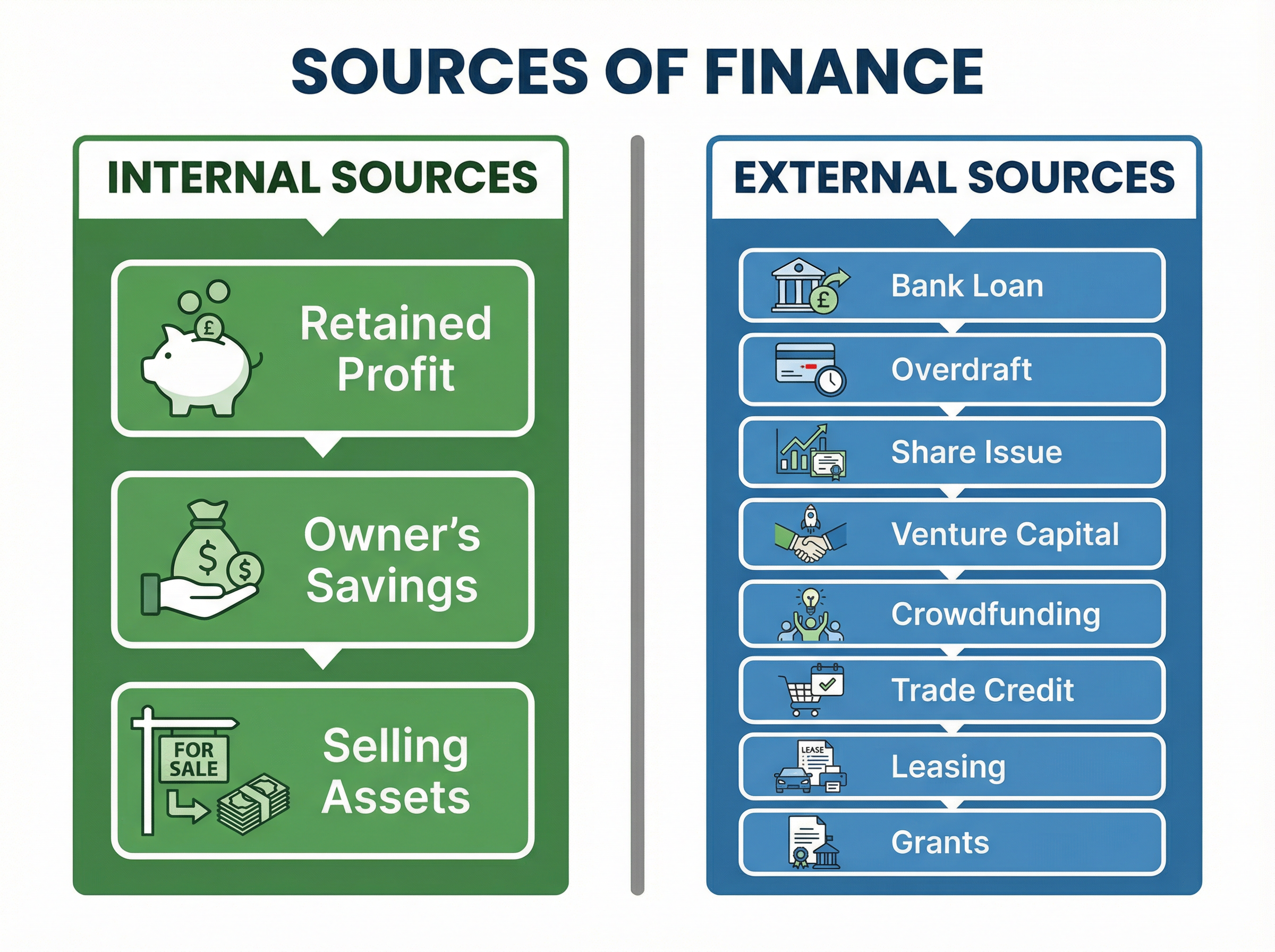
Sources of Finance
Every business needs capital to start, operate, and grow. Examiners frequently ask candidates to evaluate the most appropriate source of finance for a given scenario.
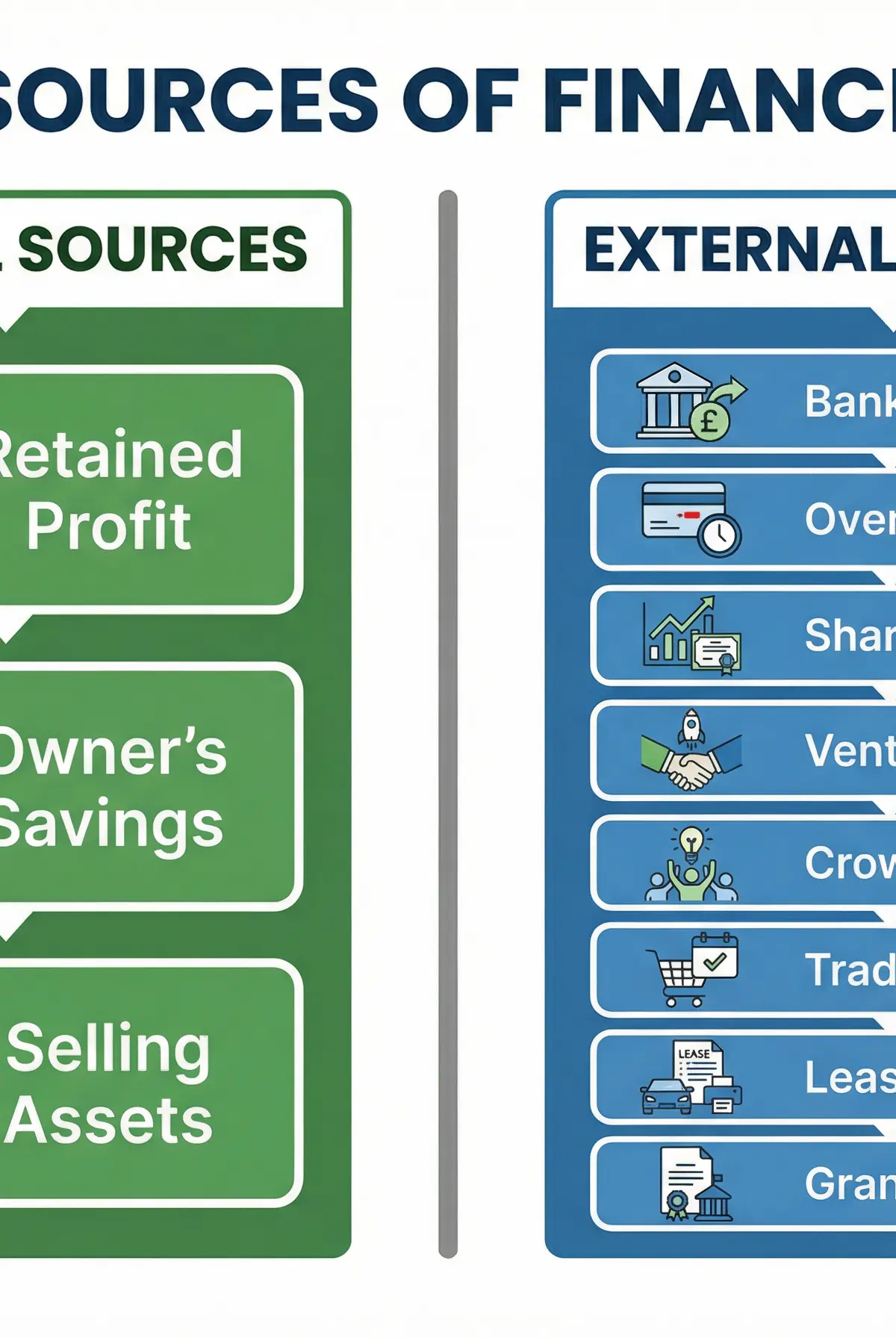
Internal Sources:
- Retained Profit: Profit kept in the business after tax and dividends. It's cheap (no interest) but may not be sufficient for large investments.
- Selling Assets: Disposing of unwanted machinery or buildings to raise cash.
- Owner's Savings: Personal funds invested by the entrepreneur.
External Sources:
- Bank Loan: A fixed amount borrowed and repaid with interest over time. Suitable for long-term assets.
- Overdraft: A short-term facility allowing a business to withdraw more than its bank balance. High interest rates apply.
- Share Issue: Selling shares to raise capital (limited companies only). Does not need to be repaid, but dilutes ownership.
- Venture Capital: Investment from specialists in exchange for equity.
- Crowdfunding: Raising small amounts from a large number of people online.
- Trade Credit: Buying goods and paying for them later (e.g., 30 days).
Cash Flow Forecasting
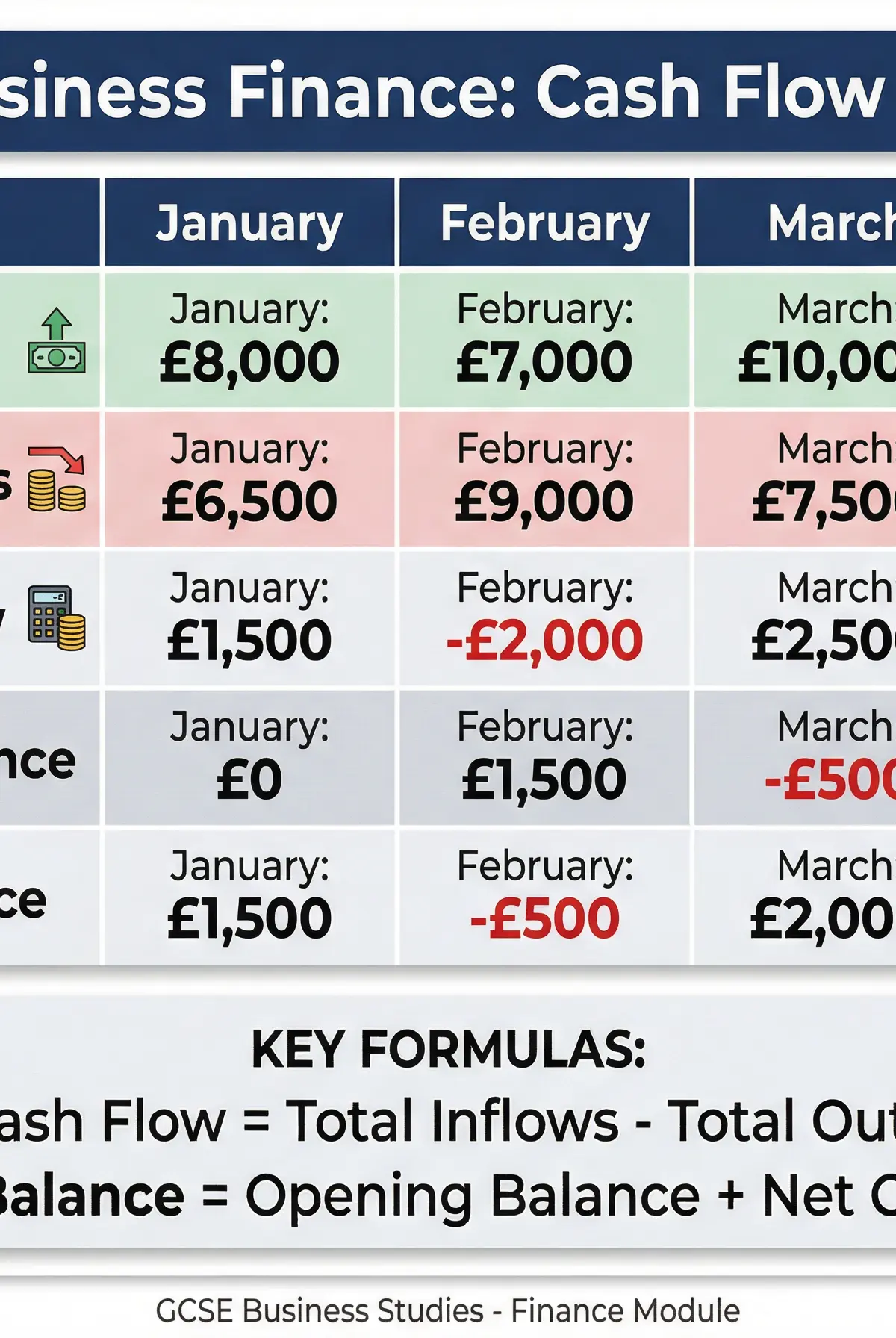
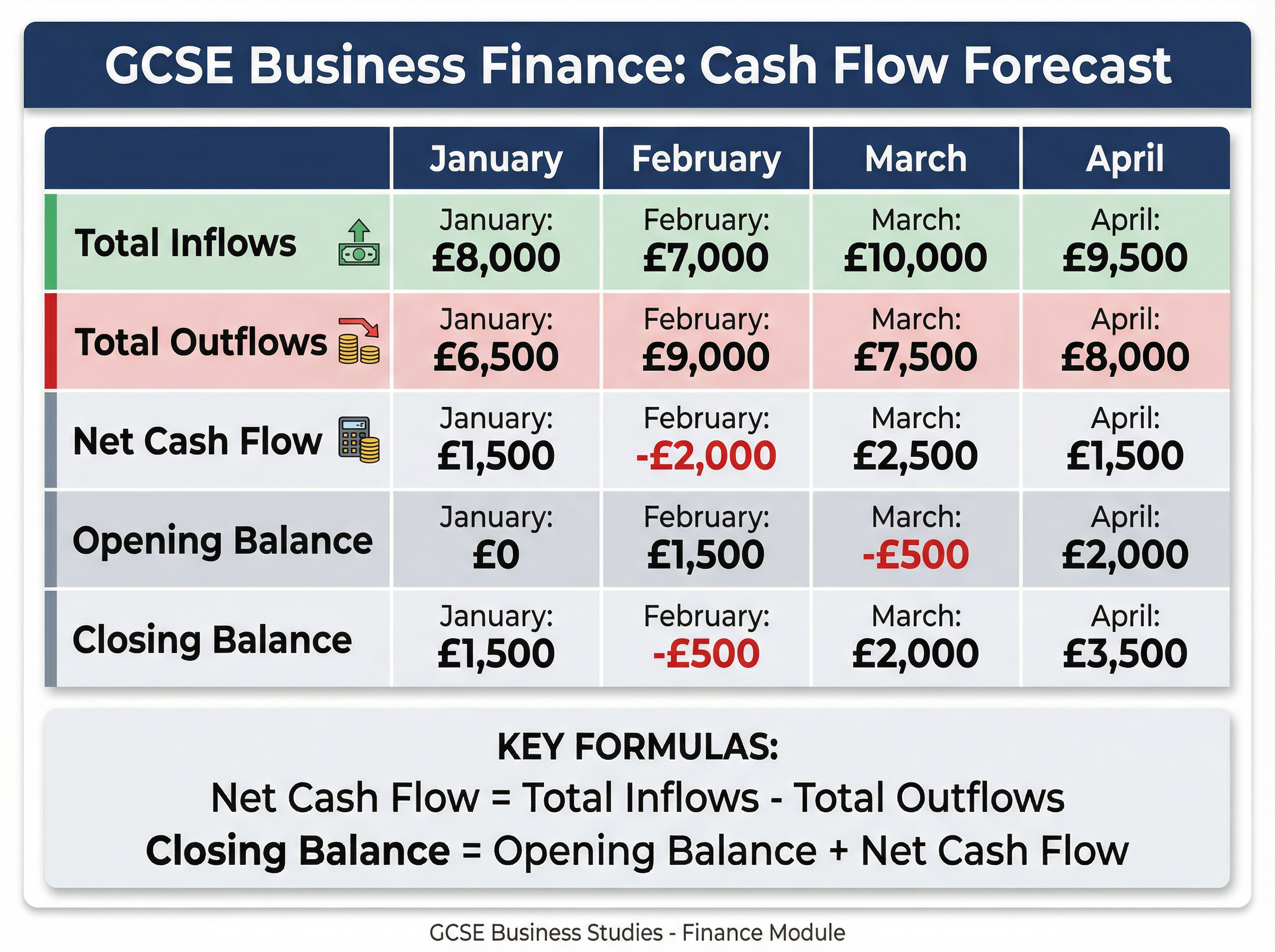
A cash flow forecast predicts the inflows and outflows of cash over a future period. It is crucial for identifying potential liquidity problems before they occur.
Key Formulae:
- Net Cash Flow = Total Inflows - Total Outflows
- Closing Balance = Opening Balance + Net Cash Flow
Examiner Tip: A common mistake is confusing cash flow with profit. A business can be profitable but still fail due to poor cash flow (e.g., if customers delay payment).
Costs, Revenue, and Profit
Understanding the relationship between costs and revenue is fundamental to calculating profit.
- Revenue = Selling Price × Quantity Sold
- Total Costs = Fixed Costs + Variable Costs
- Profit = Total Revenue - Total Costs
Profit Margins measure how efficiently a business converts sales into profit:
- Gross Profit Margin = (Gross Profit ÷ Revenue) × 100
- Net Profit Margin = (Net Profit ÷ Revenue) × 100
Break-Even Analysis
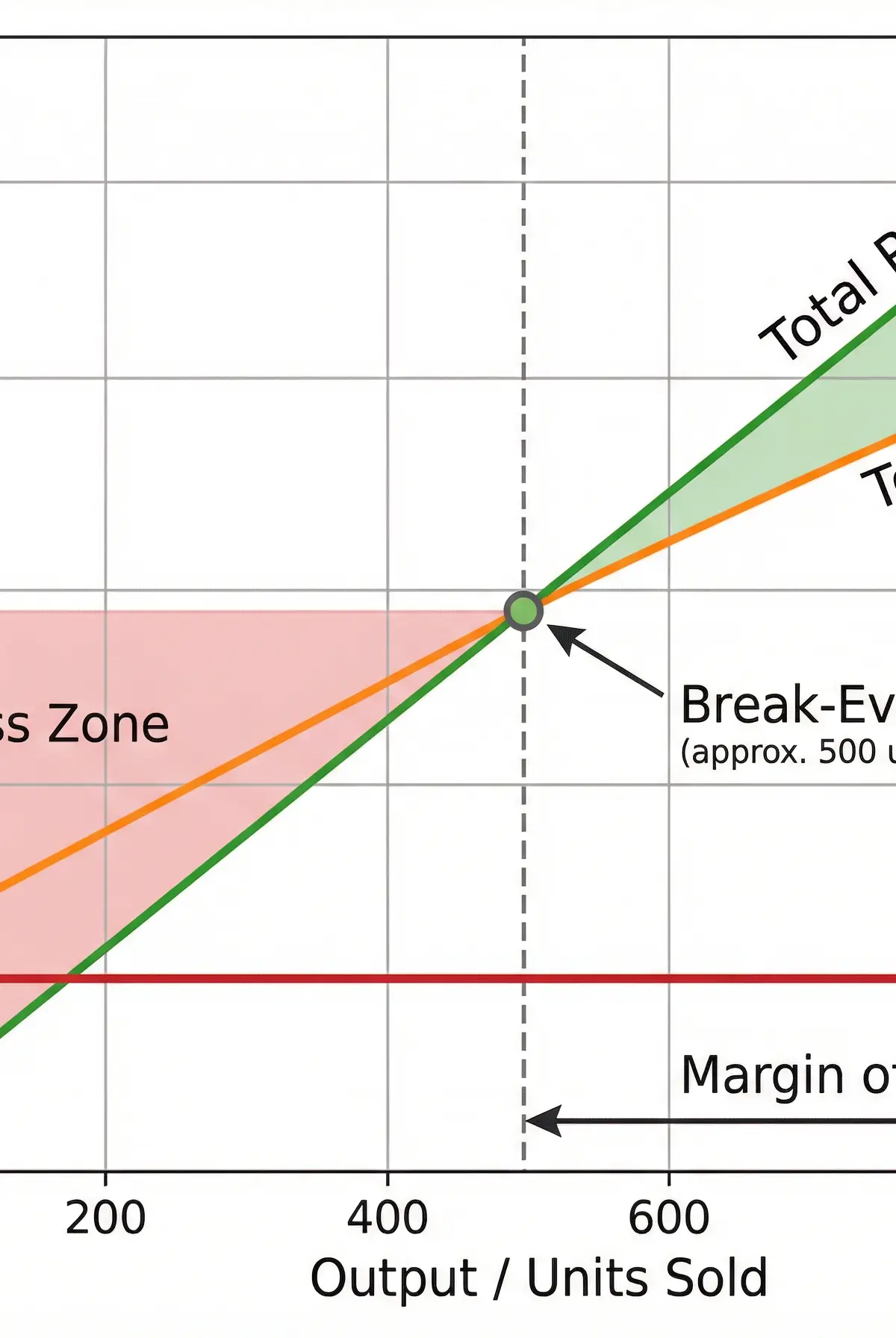
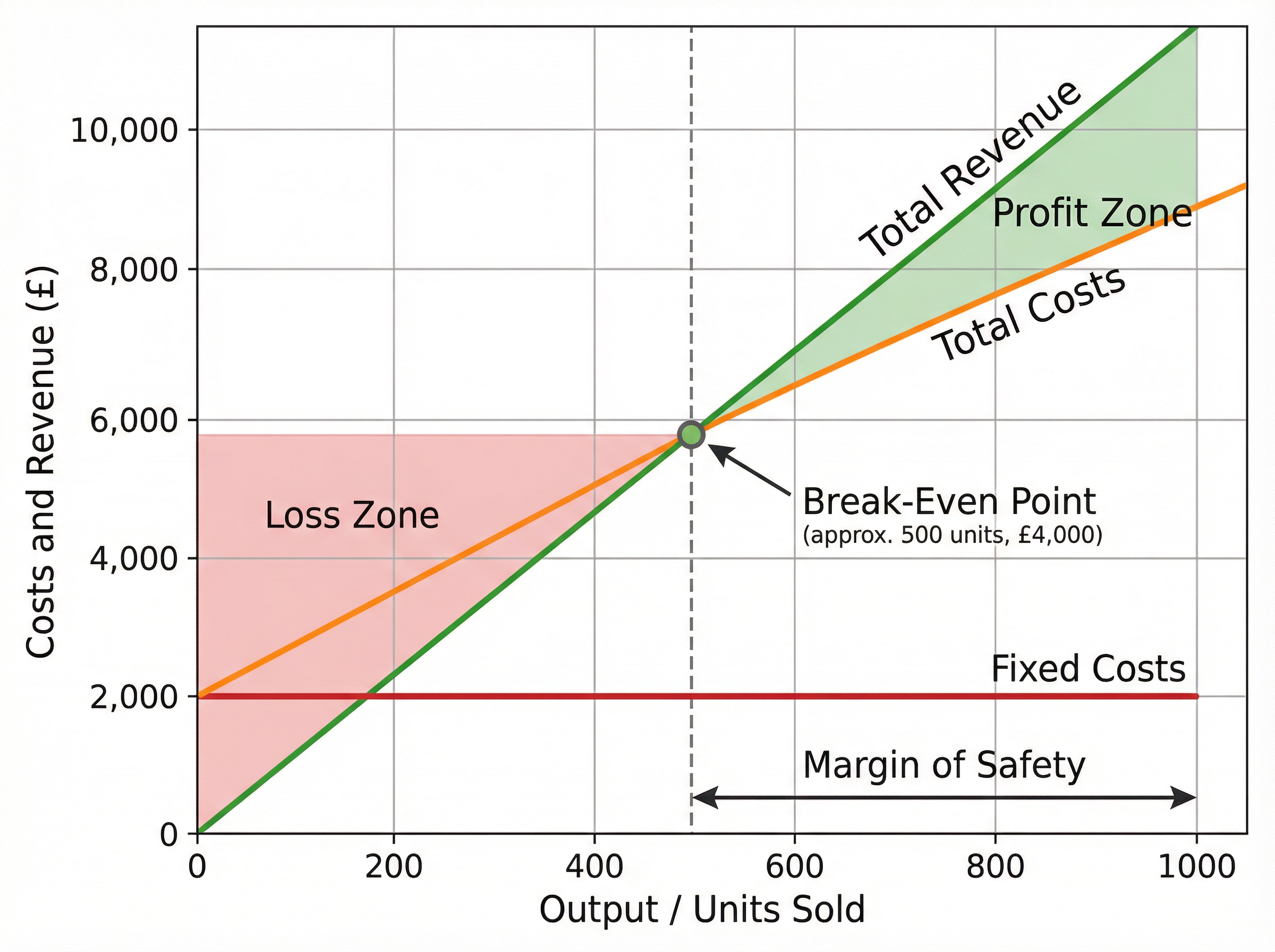
The break-even point is the level of output where total revenue equals total costs. At this point, the business makes neither a profit nor a loss.
- Contribution per Unit = Selling Price - Variable Cost per Unit
- Break-Even Output = Fixed Costs ÷ Contribution per Unit
- Margin of Safety = Actual Output - Break-Even Output
Average Rate of Return (ARR)
ARR compares the average annual profit of an investment with the initial cost, expressed as a percentage. It helps businesses decide whether an investment is worthwhile.
- ARR = (Average Annual Profit ÷ Cost of Investment) × 100
Financial Statements
- Income Statement (Profit & Loss Account): Shows revenue, costs, and profit over a period of time (usually a year).
- Statement of Financial Position (Balance Sheet): A snapshot of what the business owns (assets) and owes (liabilities) on a specific date.
Podcast Episode
Listen to the complete audio guide for Topic 3.6 Finance, featuring detailed explanations, exam tips, and a quick-fire recall quiz.
Worked Examples
3 worked examples — open one to explore the question and available guidance.
Practice Questions
Try the question, then reveal an answer plan or example response
A coffee shop sells 1,200 cups of coffee a month at £3.00 each. The variable cost per cup is £0.50. Fixed costs are £2,000 per month. Calculate the monthly profit. (4 marks)
Hint: Calculate Total Revenue, then Total Costs, then subtract Costs from Revenue.
Explain one benefit to a business of producing a cash flow forecast. (3 marks)
Hint: Think about foresight and planning. What does it allow a manager to see in advance?
An entrepreneur is starting a new tech business and needs £50,000. Evaluate whether crowdfunding or a bank loan is the most suitable source of finance. (9 marks)
Hint: Consider the risk profile of a start-up. Do banks like risk? What are the marketing benefits of crowdfunding?
A business is considering buying a new delivery van for £15,000. It expects the van to generate total profits of £6,000 over its 3-year lifespan. Calculate the Average Rate of Return (ARR). (4 marks)
Hint: First, find the average annual profit. Then divide by the cost and multiply by 100.
Calculate the Gross Profit Margin for a business with Revenue of £120,000 and Cost of Sales of £45,000. (3 marks)
Hint: You need to calculate Gross Profit first before you can find the margin.
Exam technique
How to turn what you know into marks
How to approach the question
Always identify the command word and the context. If a specific business is named, your answer MUST refer to it.
How to structure your answer
- Explain questions
- Point → Explanation → Development (use 'therefore' or 'this leads to')
- Evaluate questions
- Option A pros/cons → Option B pros/cons → Supported judgement answering 'which is best and why?'
- Calculate questions
- State formula → Show working → State final answer with correct units (£, %, units)
Timing
Approximately 1 minute per mark. For calculation questions, write down the formula first.
Common pitfalls
- Confusing cash flow with profit.
- Forgetting to include units (e.g., writing '500' instead of '£500' or '500 units').
- Writing generic evaluations that don't reference the specific business scenario provided.
What the command words want
- Analyse
- Examine a scenario in detail, looking at causes, consequences, and impacts on the business.
- Explain
- Give a reason and develop it logically with a chain of reasoning.
- Evaluate
- Make a reasoned judgement based on evidence. Consider both sides before concluding.
- Calculate
- Perform the maths. Always show your working for partial marks if the final answer is wrong.
Watch or listen (optional)
Test your understanding of Finance
Active recall beats re-reading. Take an instant quiz now to test what you’ve learned and lock it into long-term memory.
7 days Premium · Then the free plan continues · No card, no charge