AQA · GCSE · Business
Course version: 8132 · Version from Sept 2017
Financial terms and calculations
Master the financial foundations of business decision-making. This guide covers essential calculations from break-even analysis to investment appraisal, equipping you with the precise knowledge examiners demand.
- 3 min read
- 3 worked examples
- 5 practice questions
- 6 key terms
Check what you remember
Read the wording for your board, then hide it and explain Fixed Costs in your own words. Rough notes are fine. This is a self-check, with no mark or grade.
Reference: AQA
Costs that do not change with the level of output.
Study Notes
Overview
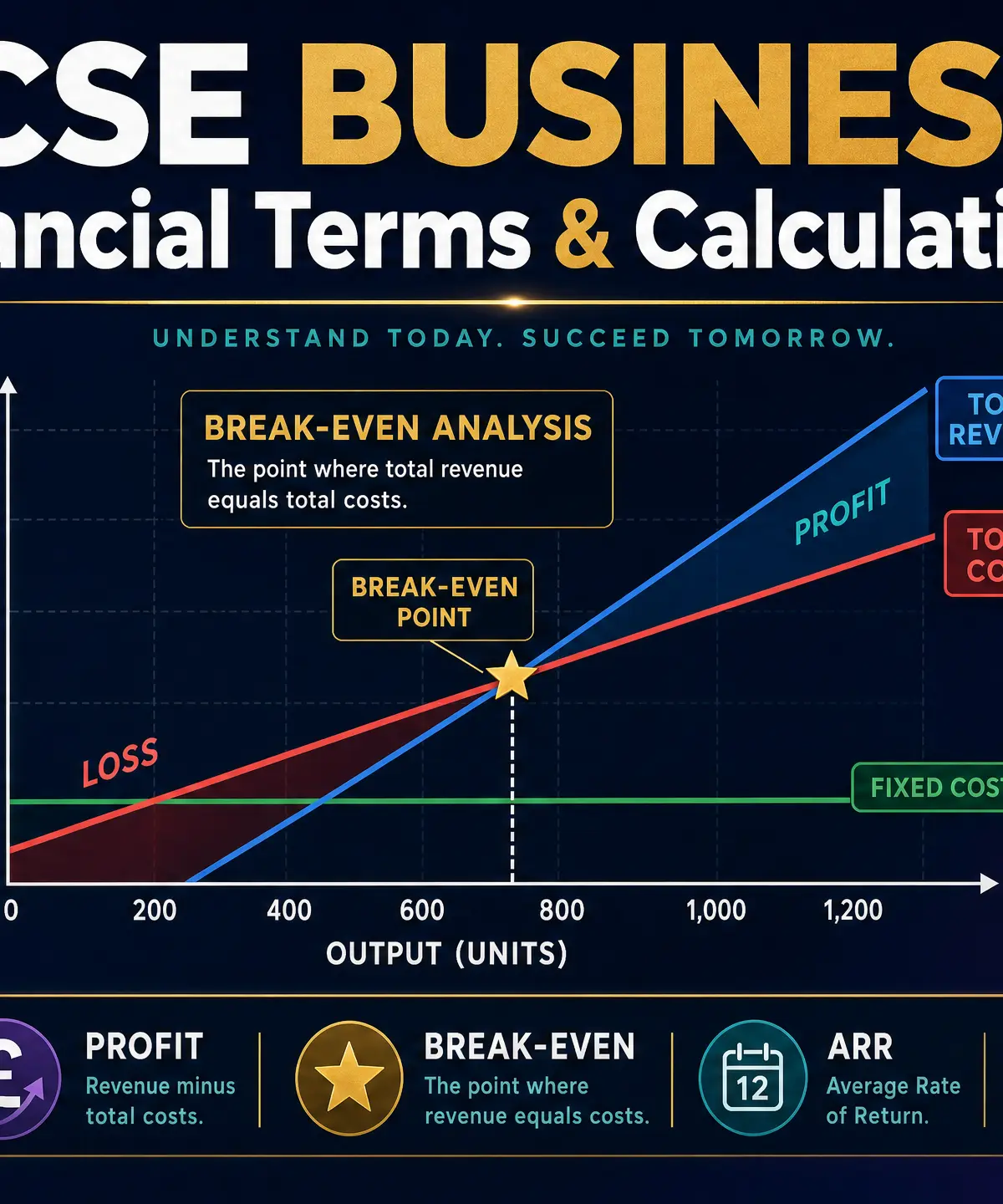
Financial terms and calculations form the bedrock of business decision-making and are heavily tested across all GCSE Business specifications. Examiners expect candidates not just to memorize formulas, but to apply them accurately to business scenarios, interpret data from charts, and make justified recommendations based on financial outcomes. This topic covers the distinction between fixed and variable costs, the calculation of revenue and profit, the interpretation of break-even analysis, and the evaluation of investments using the Average Rate of Return (ARR). Mastery of these concepts is essential for accessing high marks in both short calculation questions and extended evaluation responses.
Listen to the companion podcast for a detailed walkthrough of these concepts:
Core Financial Concepts
Costs
Fixed Costs (FC): Costs that do not vary with the level of output in the short term (e.g., rent, insurance, management salaries).
Variable Costs (VC): Costs that change directly in proportion to the level of output (e.g., raw materials, piece-rate labour).
Total Costs (TC): The sum of fixed and variable costs at a specific level of output.
Formula: TC = FC + VC
Revenue and Profit
Revenue (TR): The total income generated from the sale of goods or services.
Formula: Total Revenue = Selling Price × Quantity Sold
Profit/Loss: The financial surplus or deficit remaining after all costs have been deducted from revenue.
Formula: Profit = Total Revenue - Total Costs
(If the result is negative, the business has made a loss)
Break-Even Analysis
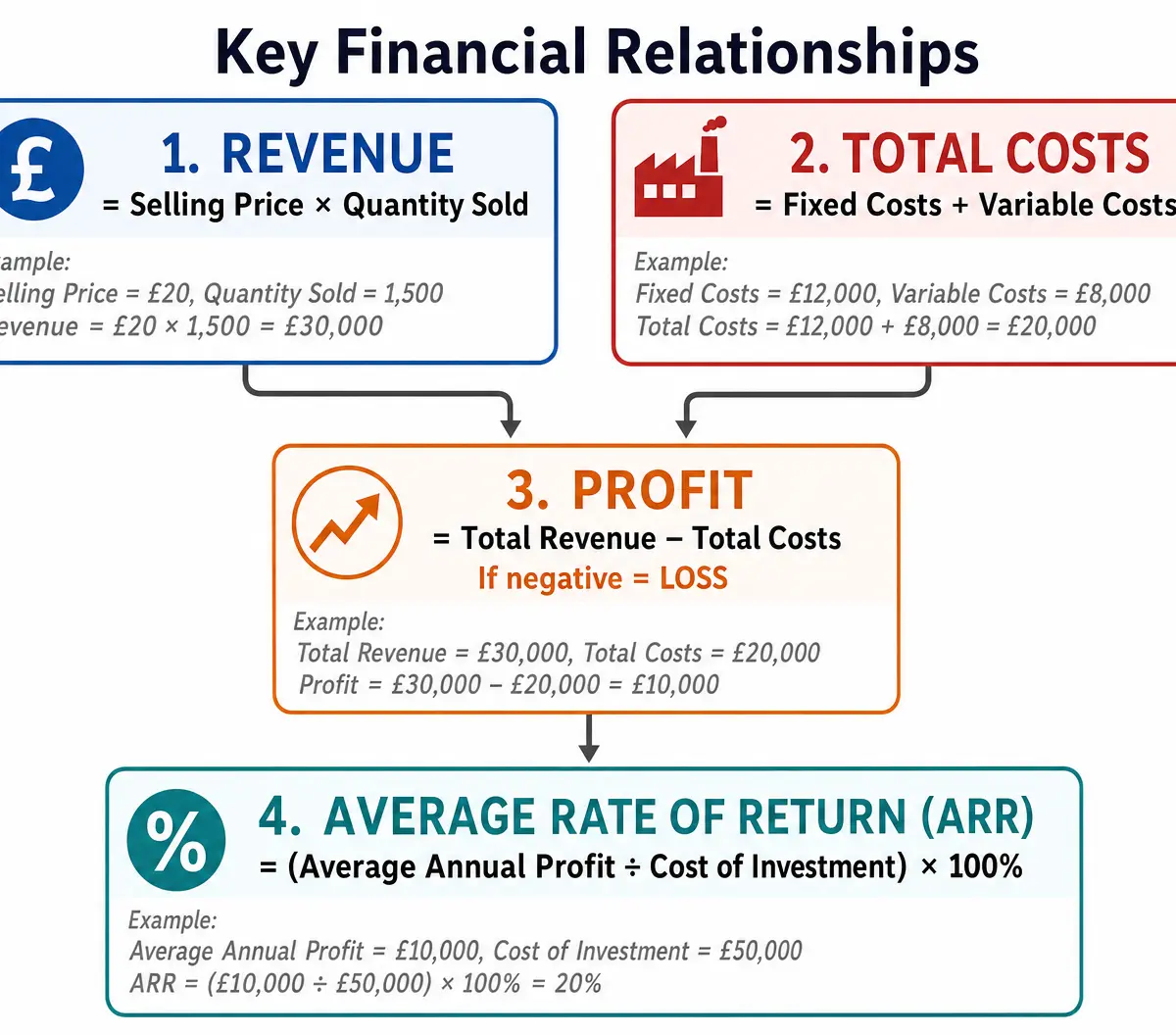
Break-even analysis is a crucial tool for determining the minimum level of output required for a business to survive.
Break-Even Point (BEP): The level of output where total revenue exactly equals total costs, resulting in neither a profit nor a loss.
Margin of Safety: The difference between the current level of output and the break-even output. It indicates how much sales can fall before the business starts making a loss.
Formula: Margin of Safety = Current Output - Break-Even Output

Examiner Tip: You are rarely asked to draw a break-even chart from scratch. Instead, focus on interpreting given charts—identifying the break-even point where the TR and TC lines intersect, and reading the margin of safety accurately from the x-axis.
Average Rate of Return (ARR)
ARR is used to compare the profitability of different investment projects.
Average Rate of Return (ARR): Calculates the average annual profit of an investment as a percentage of the initial cost.
Formula: ARR = (Average Annual Profit ÷ Cost of Investment) × 100
Calculation Steps:
- Calculate total profit over the life of the investment (Total Returns - Cost of Investment).
- Divide total profit by the number of years to find Average Annual Profit.
- Divide Average Annual Profit by the Cost of Investment.
- Multiply by 100 to express as a percentage.
Interactive Diagrams
1 interactive diagram to visualise key concepts
Conceptual Flow Outline
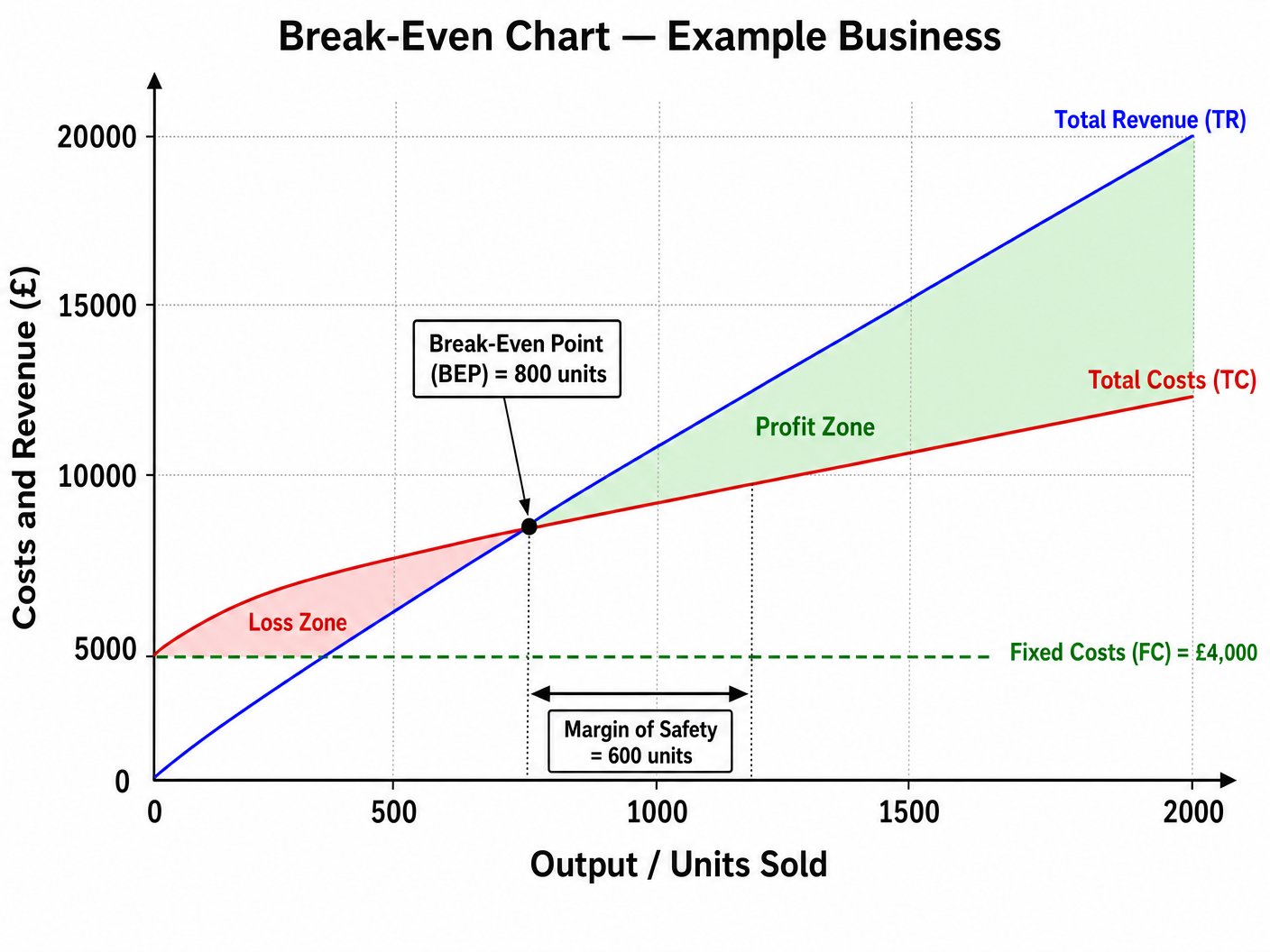
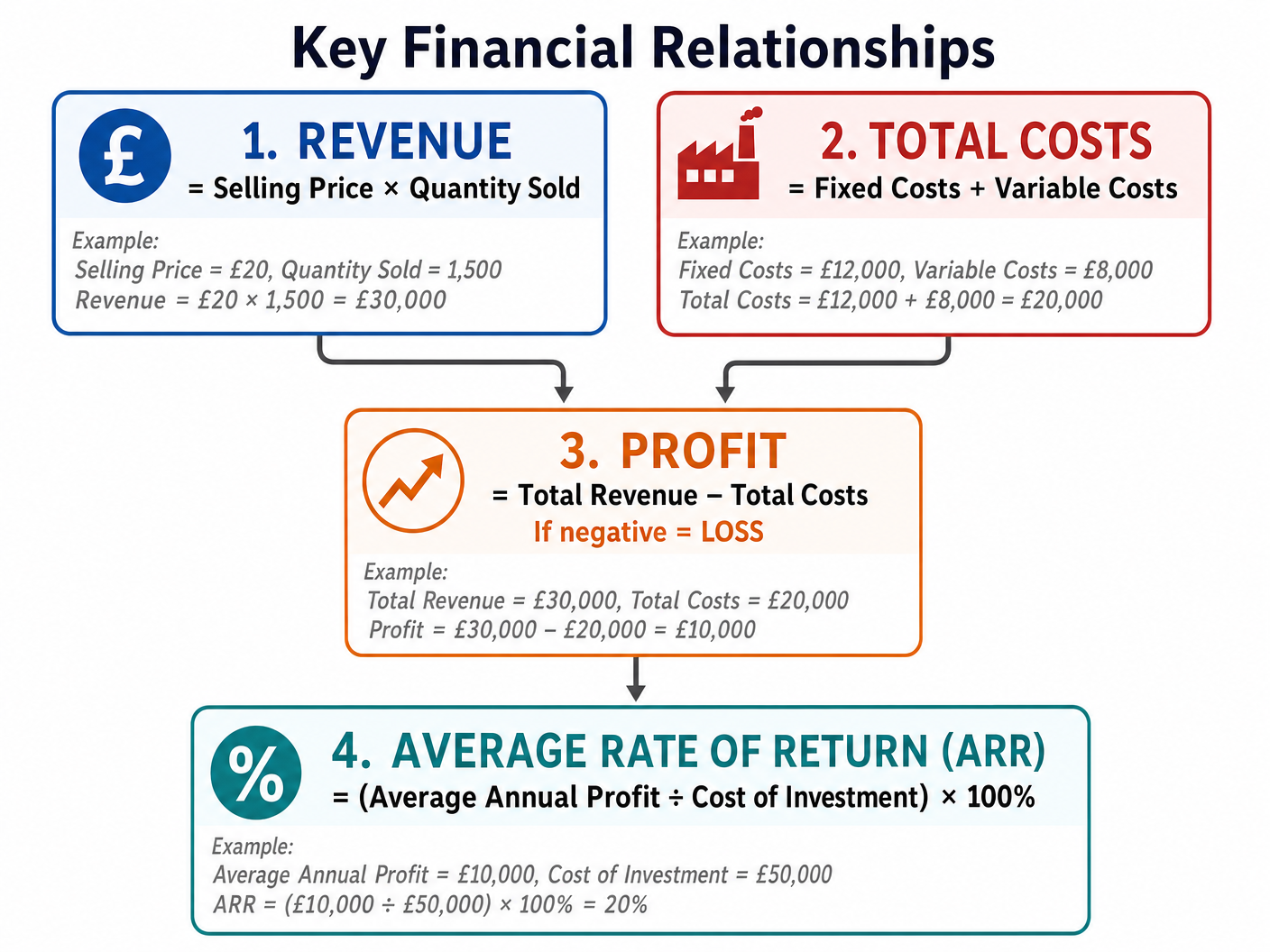
The relationship between revenue, costs, and profit.
Worked Examples
3 worked examples — open one to explore the question and available guidance.
Practice Questions
Try the question, then reveal an answer plan or example response
A bakery sells cakes for £3 each. Fixed costs are £500 per month. Variable costs are £1 per cake. Calculate the profit or loss if the bakery sells 400 cakes in a month. (4 marks)
Hint: Calculate Total Revenue, then Total Costs, then subtract TC from TR.
Explain one impact on a business's break-even point if its fixed costs increase. (3 marks)
Hint: Think about what happens to the Total Costs line on the chart.
A business is considering a £40,000 investment that will generate £15,000 profit in total over 3 years. Calculate the Average Rate of Return (ARR). (3 marks)
Hint: Find the average annual profit first, then divide by the investment cost.
Identify the margin of safety if a business breaks even at 500 units and is currently producing 750 units. (1 mark)
Hint: Current output minus break-even output.
Assess whether a business should proceed with an investment that has an ARR of 4%, when the bank interest rate is 5%. (6 marks)
Hint: Compare the return from the business investment to the guaranteed return from the bank.
Exam technique
How to turn what you know into marks
How to approach the question
Always show working for calculations; always state units (£, %, units).
How to structure your answer
- Essay questions
- Define key term → Argue benefits in context → Argue drawbacks in context → Conclude with a justified judgement.
- Explain questions
- State the point, explain how it impacts the business, link back to the specific context.
- Calculation questions
- State formula → Substitute numbers → Calculate intermediate steps → State final answer with units.
Timing
Approximately 1 minute per mark, plus planning time for longer questions
Common pitfalls
- Confusing fixed costs with variable costs in scenarios.
- Reading the break-even point from the y-axis (revenue/costs) instead of the x-axis (output).
- Forgetting to multiply by 100 to turn ARR into a percentage.
- Writing 'it makes more money' instead of using precise terms like 'increases profit margin'.
What the command words want
- Explain
- Make a point and develop it with a logical chain of reasoning (this leads to... therefore...).
- Evaluate
- Provide a balanced argument (pros and cons) applied to the specific business, ending with a supported overall judgement.
- Identify
- State the correct answer directly from the data or chart; no explanation needed.
- Calculate
- Show all working steps and include the correct unit.
Watch or listen (optional)
Test your understanding of Financial terms and calculations
Active recall beats re-reading. Take an instant quiz now to test what you’ve learned and lock it into long-term memory.
7 days Premium · Then the free plan continues · No card, no charge