AQA · GCSE · Business
Course version: 8132 · Version from Sept 2017
Human resources
Master the Human Resources function, the backbone of any successful business. This guide covers organisational structures, recruitment, training, and motivation—essential concepts that examiners frequently test in high-mark evaluation questions.
- 6 min read
- 3 worked examples
- 5 practice questions
- 6 key terms
Check what you remember
Read the wording for your board, then hide it and explain Chain of Command in your own words. Rough notes are fine. This is a self-check, with no mark or grade.
Reference: AQA
The line of authority within a business along which communication passes.
Study Notes

Overview
Human Resources (HR) is the functional area of a business responsible for managing its employees. Without the right people, in the right roles, with the right skills and motivation, a business cannot achieve its objectives. Examiners love this topic because it links directly to business performance, costs, and productivity. Candidates are expected to understand the impact of different organisational structures, evaluate the benefits of internal versus external recruitment, and analyse how training and motivation methods improve staff retention and output. A strong understanding of HR will help you tackle high-mark evaluation questions with confidence.
Podcast Revision Session
Listen to our 10-minute deep dive into Human Resources, covering all the core concepts, common mistakes, and a quick-fire recall quiz.
Organisational Structures
An organisational structure shows how a business is arranged, indicating the chain of command and span of control.
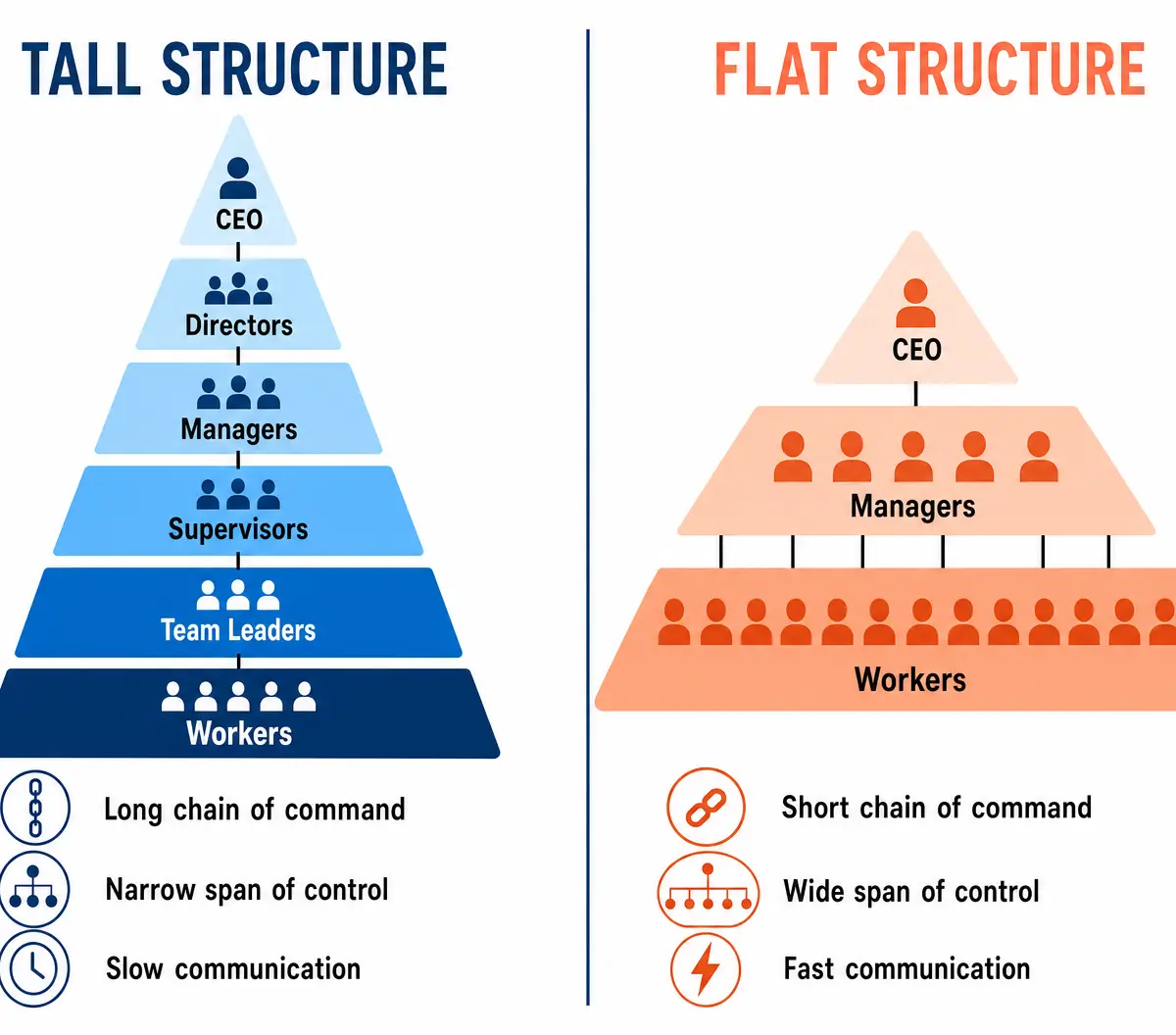
Tall Structures
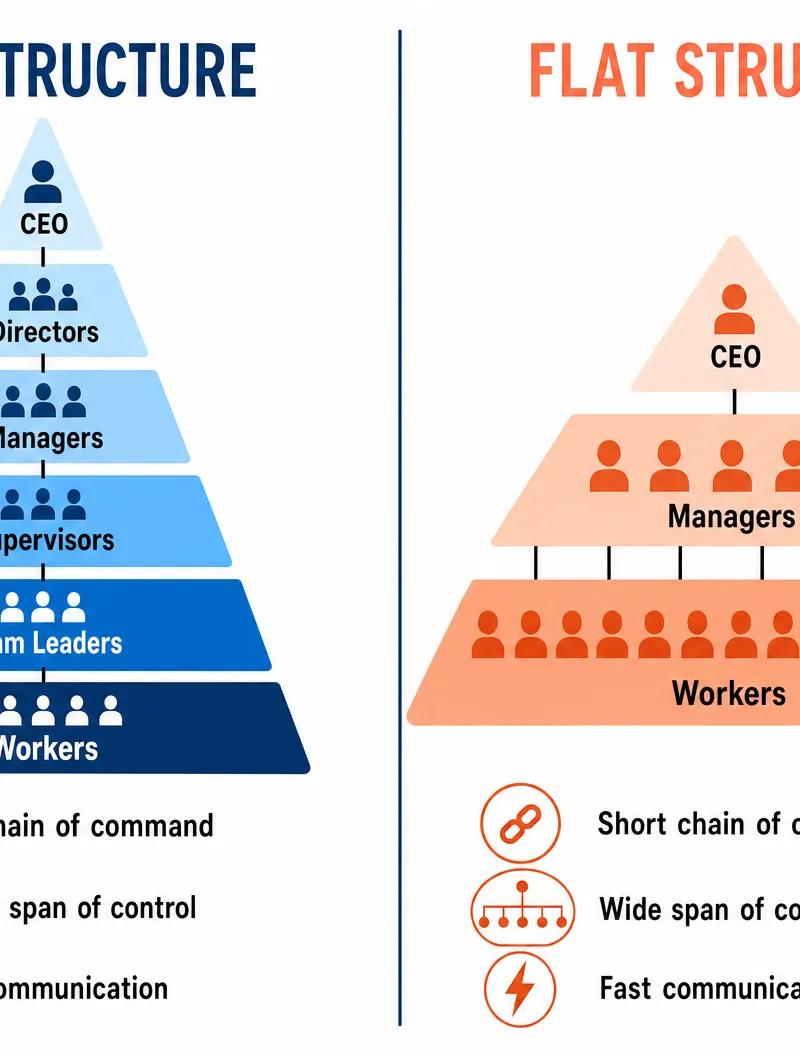
Features: Many layers of management, long chain of command, narrow span of control.
Impact: Communication can be slow due to the many layers. However, managers can closely supervise their small teams. Often more expensive due to higher management salaries.
Flat Structures
Features: Few layers of management, short chain of command, wide span of control.
Impact: Communication is faster. Managers have more subordinates, which can lead to delegation and increased employee responsibility, but managers may become overworked.
Key Concepts
- Chain of Command: The line of authority from the top of the hierarchy to the bottom.
- Span of Control: The number of subordinates directly reporting to a manager.
- Delayering: Removing a layer of management to flatten the structure, cut costs, and improve communication speed.
- Delegation: Passing authority down the hierarchy to give subordinates more responsibility.
Recruitment and Selection
Recruitment is the process of finding and hiring new employees.
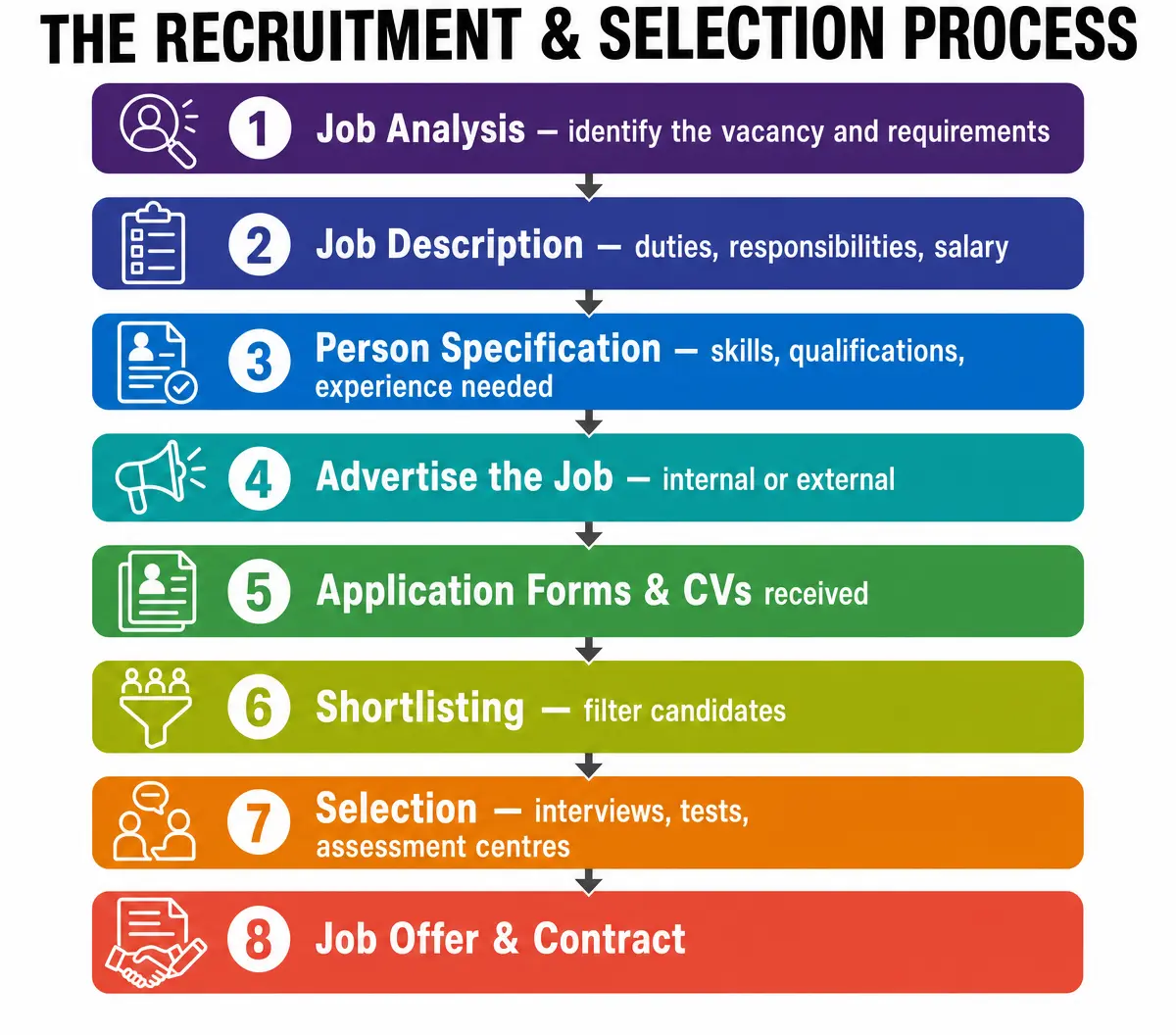
The Process
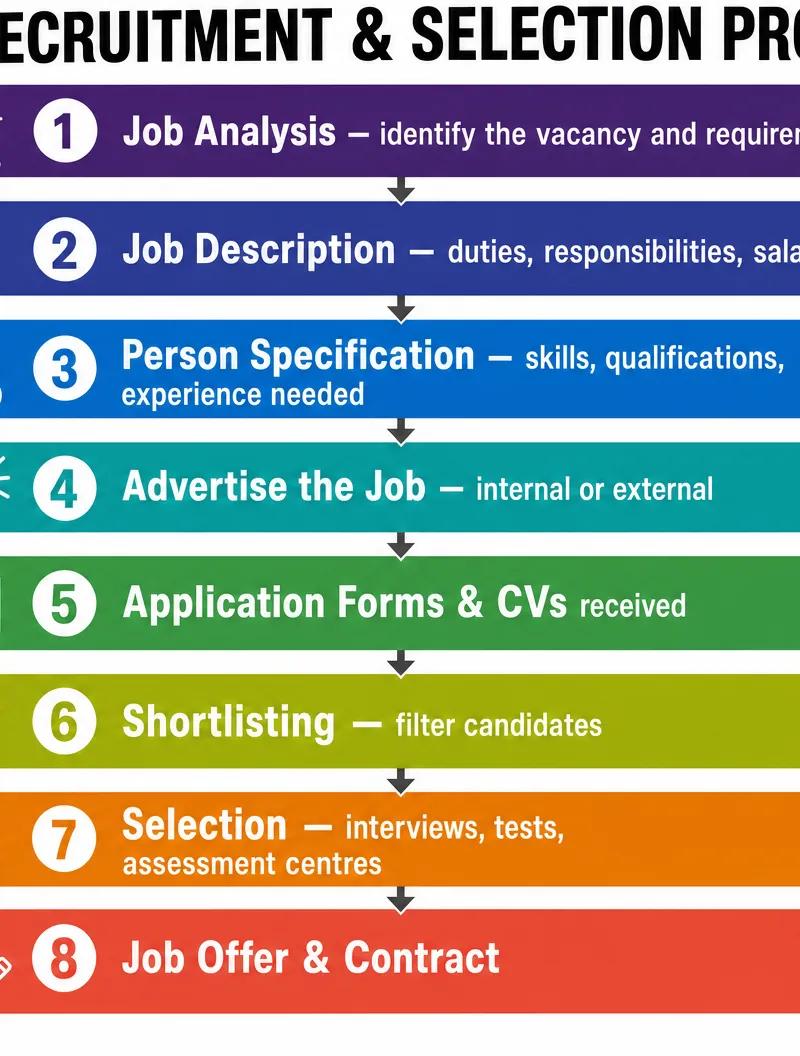
- Job Analysis: Identifying the vacancy and its requirements.
- Job Description: A document outlining the duties, responsibilities, and conditions of the role.
- Person Specification: A document detailing the ideal candidate's skills, qualifications, and experience.
- Advertising: Promoting the vacancy internally or externally.
- Shortlisting: Selecting the best candidates from the applications.
- Selection: Using interviews, tests, or assessment centres to choose the successful candidate.
Internal vs External Recruitment
Internal Recruitment: Hiring someone already working within the business.
- Advantages: Cheaper, faster, motivates staff through promotion, candidate is already familiar with the business.
- Disadvantages: Creates another vacancy elsewhere, limits new ideas entering the business.
External Recruitment: Hiring someone from outside the business.
- Advantages: Brings in fresh ideas and skills, wider pool of candidates.
- Disadvantages: More expensive (advertising/agency fees), takes longer, candidate needs time to settle in.
Contracts of Employment
- Full-time: Typically 35+ hours a week.
- Part-time: Fewer hours than full-time, offering flexibility for both the business and the employee.
- Job Share: Two employees share the duties and hours of one full-time role.
- Zero-hours: The employer does not guarantee a minimum number of hours. Provides high flexibility for the business but income uncertainty for the worker.
Training
Training ensures employees have the skills needed to perform their jobs effectively.
Induction Training
Given to new employees to help them settle in, covering health and safety, company policies, and introductions to colleagues.
On-the-job Training
Learning while performing the actual job, often through shadowing or mentoring.
- Advantages: Cheaper, directly relevant to the role.
- Disadvantages: Bad habits can be passed on, trainer's productivity may drop.
Off-the-job Training
Learning away from the workplace, such as at a college or online course.
- Advantages: Taught by specialists, employee is not distracted by work duties.
- Disadvantages: More expensive, employee is away from the workplace so productivity is lost during training.
Motivation
Motivation is the desire to work hard and perform well. Highly motivated staff lead to higher productivity, better quality work, and lower staff turnover.
Financial Methods
- Salary/Wage: Basic pay.
- Bonus: Extra pay for reaching a target.
- Commission: Percentage of sales revenue paid to the salesperson.
- Profit Sharing: Employees receive a share of the business's profits.
Non-Financial Methods
- Job Enrichment: Giving employees more challenging and interesting tasks.
- Job Rotation: Moving employees between different tasks to reduce boredom.
- Fringe Benefits: Perks such as a company car, health insurance, or gym membership.
- Flexible Working: Allowing employees to choose their hours or work from home.
Legislation
HR decisions must comply with the law:
- Equality Act 2010: Prevents discrimination in recruitment, pay, and promotion based on protected characteristics (e.g., age, gender, race).
- National Minimum Wage / National Living Wage: Sets the legal minimum hourly rate of pay.
Visual Resources
2 diagrams and illustrations
Interactive Diagrams
1 interactive diagram to visualise key concepts
Conceptual Flow Outline
The Recruitment and Selection Process Flowchart
Worked Examples
3 worked examples — open one to explore the question and available guidance.
Practice Questions
Try the question, then reveal an answer plan or example response
A national supermarket chain is looking to hire a new Store Manager. Evaluate whether they should use internal or external recruitment. (9 marks)
Hint: Provide a balanced argument discussing the pros and cons of both methods, linking to the context of a supermarket chain, and end with a clear recommendation.
Explain one reason why a business might use off-the-job training. (3 marks)
Hint: State the reason, explain it, and show the benefit to the business.
State two types of employment contract. (2 marks)
Hint: Just name them, no explanation needed.
Explain how delayering could affect the motivation of the remaining employees. (4 marks)
Hint: Consider both positive and negative impacts on motivation.
A manufacturing business pays its production line workers the National Minimum Wage. Analyse the impact on the business of using only financial methods of motivation. (6 marks)
Hint: Build a chain of reasoning showing the effects of relying solely on money to motivate staff.
Exam technique
How to turn what you know into marks
How to approach the question
Read the case study carefully and highlight key business characteristics (e.g., size, industry, financial situation) to use in your application.
How to structure your answer
- Explain questions
- State the point clearly, then use 'This means that...' or 'Therefore...' to develop the explanation.
- Evaluate questions
- Paragraph 1: Benefit in context. Paragraph 2: Drawback in context. Paragraph 3: Justified conclusion answering the question.
Timing
Approximately 1 minute per mark.
Common pitfalls
- Confusing internal and external recruitment.
- Writing generic answers without linking to the specific business context provided in the case study.
- Failing to reach a conclusion in 'evaluate' or 'to what extent' questions.
- Discussing complex motivational theories (like Maslow) when the specification only requires practical methods.
What the command words want
- Analyse
- Build a logical chain of reasoning showing causes and effects.
- Explain
- Give a reason/point and develop it to show the impact on the business.
- Evaluate
- Provide a balanced argument (pros and cons) in context, followed by a supported judgement.
- State/Identify
- Provide a simple, direct answer. No explanation needed.
Watch or listen (optional)
Test your understanding of Human resources
Active recall beats re-reading. Take an instant quiz now to test what you’ve learned and lock it into long-term memory.
7 days Premium · Then the free plan continues · No card, no charge