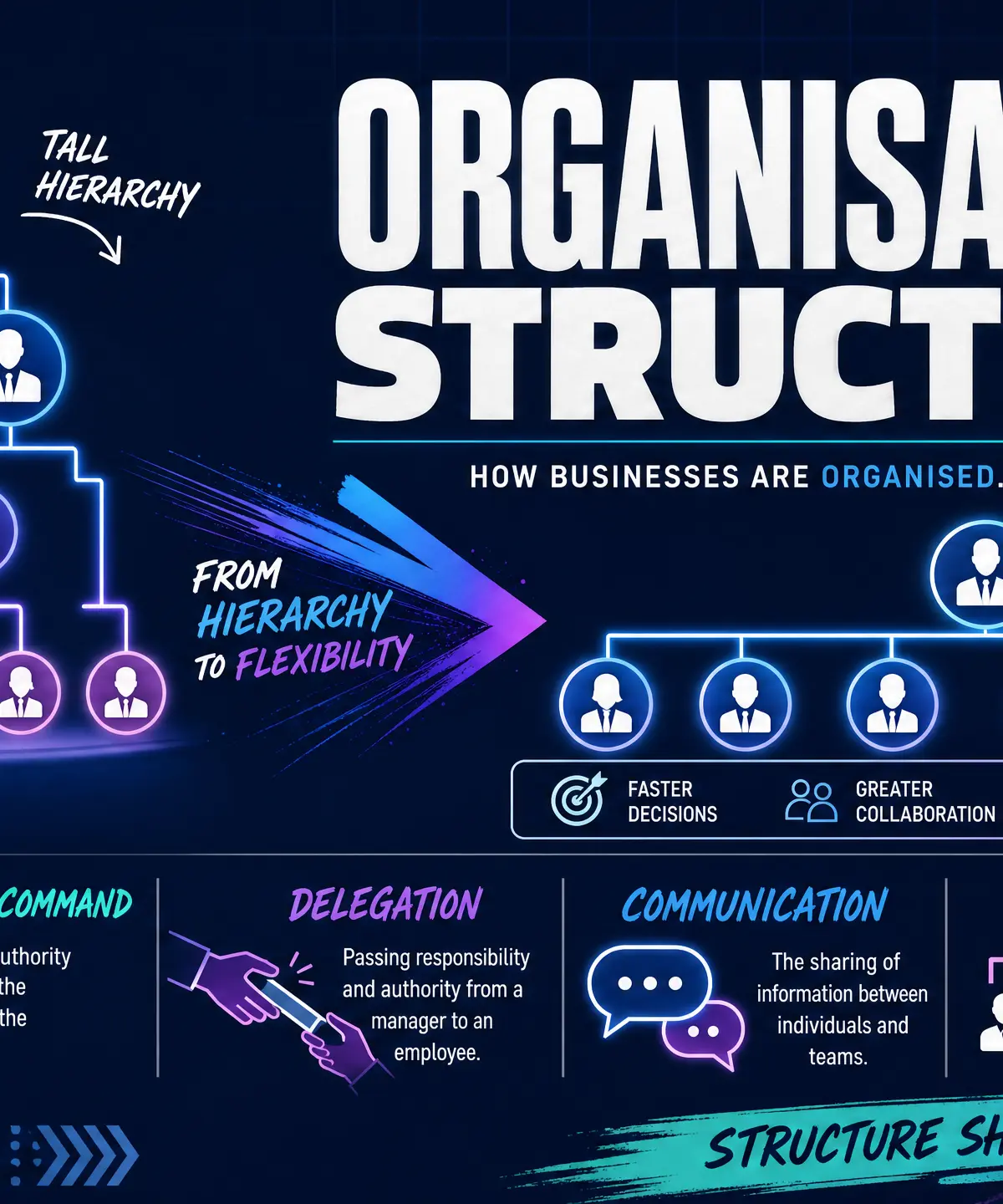
Organisational structures Revision Notes

    Subject: Business | Level: GCSE | Exam Board: AQA

    Mastering Organisational Structures is crucial for GCSE Business, as examiners frequently test your understanding of how businesses are organised internally. This guide covers the essential concepts of span of control, chain of command, delegation, and delayering, helping you secure top marks in both short-answer and extended analysis questions.

    Revision Notes & Key Concepts

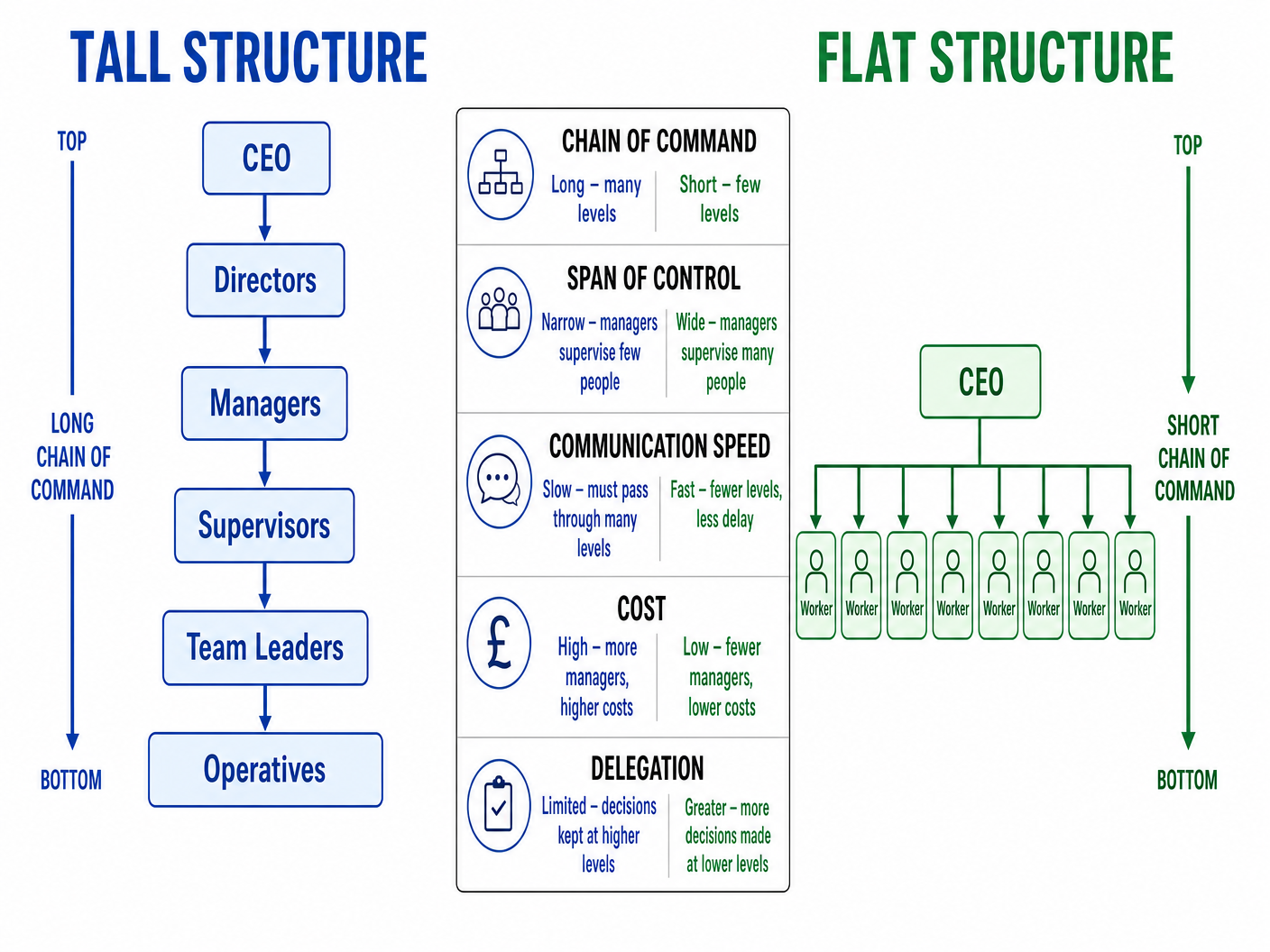
    ![Organisational Structures](https://xnnrgnazirrqvdgfhvou.supabase.co/storage/v1/object/public/study-guide-assets/guide_0d69ca69-a383-4857-b217-49b3ecf3d60b/header_image.png) ## Overview Welcome to the study of Organisational Structures. This topic is fundamental to understanding how a business operates internally. Examiners expect candidates to not only define key terms like 'span of control' and 'chain of command' but also to analyse how different structures (tall vs. flat) impact communication, motivation, and efficiency. Every business, from a local independent coffee shop to a massive multinational corporation like Tesco, relies on a structure to coordinate its workforce. Your ability to apply these concepts to specific business scenarios is what will elevate your answers into the highest mark bands. Let's break down the core components you need to know. ## Core Concepts ![The 5 Core Concepts](https://xnnrgnazirrqvdgfhvou.supabase.co/storage/v1/object/public/study-guide-assets/guide_0d69ca69-a383-4857-b217-49b3ecf3d60b/key_concepts_diagram.png) ### 1. Span of Control **Definition**: The number of subordinates (employees) who report directly to a single manager. **Key Details**: - A **wide** span of control means one manager oversees many employees. This is cheaper but can lead to less supervision. - A **narrow** span of control means a manager oversees few employees. This allows for closer supervision but increases management costs. **Examiner Tip**: Always link span of control to costs and supervision levels. Examiners award credit for understanding the trade-off between the two. ### 2. Chain of Command **Definition**: The line of authority that moves from the top of a hierarchy to the lowest level. **Key Details**: - It shows how instructions are passed down and how information flows up. - A **long** chain of command can result in slow communication and distorted messages. ### 3. Delegation **Definition**: Passing authority and responsibility for a task down to a subordinate. **Key Details**: - Empowers employees and builds their skills. - Frees up managers to focus on strategic tasks. - **Risk**: If the subordinate is untrained, mistakes can occur. ### 4. Delayering **Definition**: The removal of one or more levels of hierarchy from an organisational structure. **Key Details**: - **Advantages**: Reduces costs (fewer management salaries) and speeds up communication. - **Disadvantages**: Can cause job insecurity, lower morale, and increase the workload for remaining managers. ### 5. Communication **Definition**: The process of exchanging information between individuals or departments. **Key Details**: - Structure directly impacts communication. Flatter structures generally facilitate faster, more accurate communication than tall structures. ## Types of Organisational Structure ![Tall vs Flat Structures](https://xnnrgnazirrqvdgfhvou.supabase.co/storage/v1/object/public/study-guide-assets/guide_0d69ca69-a383-4857-b217-49b3ecf3d60b/tall_vs_flat_diagram.png) ### Tall Structures **Characteristics**: Many levels of hierarchy, narrow spans of control, long chains of command. **Impact**: - **Pros**: Clear promotion paths, close supervision. - **Cons**: High management costs, slow communication, workers may feel alienated. ### Flat Structures **Characteristics**: Few levels of hierarchy, wide spans of control, short chains of command. **Impact**: - **Pros**: Lower costs, faster communication, greater employee empowerment. - **Cons**: Managers may be overstretched, fewer opportunities for promotion. ## Audio Revision Listen to our comprehensive 10-minute podcast covering all these concepts with examiner tips and a quick-fire quiz: ![Organisational Structures Revision Podcast](https://xnnrgnazirrqvdgfhvou.supabase.co/storage/v1/object/public/study-guide-assets/guide_0d69ca69-a383-4857-b217-49b3ecf3d60b/organisational_structures_podcast.mp3)

    Revision Podcast Transcript

    GCSE Business Studies Podcast — Organisational Structures Episode Duration: Approximately 10 minutes Voice: Warm, enthusiastic, knowledgeable female tutor --- [INTRO — 1 minute] Hello and welcome back to your GCSE Business revision podcast! I'm so glad you're here, because today we are covering one of the most important and frequently examined topics in the entire GCSE Business specification — Organisational Structures. Now, I know what some of you might be thinking: "It's just a chart of who reports to who." But trust me, examiners absolutely love this topic. It comes up in every single paper, in every format — from two-mark definitions right through to six-mark analysis questions. And the students who really nail it are the ones who understand not just what these structures look like, but WHY businesses choose them and what the CONSEQUENCES are. So in the next ten minutes, we're going to cover everything you need: the key concepts, the differences between tall and flat structures, how structure affects communication, and I'll give you some brilliant exam tips and a quick-fire quiz at the end. Let's go! --- [CORE CONCEPTS — 5 minutes] Let's start with the basics. An organisational structure is simply the way a business arranges its people and jobs so that its work can be performed and its goals can be met. Think of it like a blueprint for how a business is run from the inside. Now, there are five key concepts you absolutely must know for your exam. I want you to think of the acronym S-C-D-D-C — Span, Chain, Delegation, Delayering, Communication. Let's go through each one. First up: Span of Control. This is the number of people a manager is directly responsible for. So if a manager has five workers reporting to them, their span of control is five. A WIDE span of control means one manager oversees many people. A NARROW span of control means one manager oversees just a few. Now here's the key exam point: a wide span of control can save money because you need fewer managers, but it can also mean workers get less attention and supervision. A narrow span means closer supervision, but it costs more because you need more managers. Second: Chain of Command. This is the line of authority from the very top of the organisation — usually the Chief Executive or owner — all the way down to the workers at the bottom. Every instruction, every decision, travels down this chain. The longer the chain, the more levels there are between the top and the bottom. This matters massively for communication, which we'll come back to. Third: Delegation. This is when a manager passes responsibility and authority for a task down to a subordinate — someone below them. Good delegation empowers employees, builds their skills, and frees up managers to focus on more strategic decisions. But — and this is a big but — if a manager delegates to someone who isn't ready or capable, mistakes can happen. Examiners love asking you to evaluate the benefits AND risks of delegation. Fourth: Delayering. This is the process of removing one or more layers of management from the hierarchy. Businesses do this to cut costs — fewer managers means lower wages — and to speed up communication. If there are fewer levels for a message to pass through, it gets from the top to the bottom faster. However, delayering can also mean the remaining managers have a wider span of control, which increases their workload. It can also cause redundancies, which affects staff morale. Fifth and finally: Communication. The structure of an organisation has a DIRECT impact on how well information flows. In a tall structure with many layers, messages can get distorted or delayed as they pass through each level — a bit like Chinese whispers. In a flat structure with fewer levels, communication is faster and more direct. This is why many modern businesses have moved towards flatter structures. Now let's talk about the two main types of structure: TALL and FLAT. A TALL organisational structure has many levels of hierarchy. Imagine a tall, narrow pyramid. At the top is the CEO. Below them are Directors. Then Managers. Then Supervisors. Then Team Leaders. Then the workers at the very bottom. This creates a long chain of command and a narrow span of control at each level. The advantages? Clear lines of authority, close supervision, and clear promotion pathways for staff. The disadvantages? Slow communication, high costs due to many layers of management, and workers at the bottom may feel disconnected from decision-making. A FLAT organisational structure has very few levels. Imagine a wide, shallow pyramid. The CEO is at the top, and below them — directly — are the workers. Very few or no middle managers. This creates a short chain of command and a wide span of control. The advantages? Faster communication, lower costs, and workers feel more empowered because they have more responsibility. The disadvantages? Managers can be overstretched because they're responsible for so many people, and there are fewer promotion opportunities for staff, which can affect motivation. Here's a real-world example to help this stick. Think about a small independent coffee shop. The owner might have just three or four staff reporting directly to them. That's a flat structure — short chain of command, wide span of control. Now think about a large supermarket chain like Tesco. There are store managers, department managers, team leaders, supervisors, and then the shop floor staff. That's a tall structure — many levels, narrow span of control at each level. --- [EXAM TIPS AND COMMON MISTAKES — 2 minutes] Right, let's talk exam technique. This is where marks are won and lost. Tip number one: Always APPLY your answer to the business in the question. Examiners give zero credit for generic statements. Don't just say "a flat structure improves communication." Say "a flat structure would improve communication for this small family business because there are fewer levels for messages to pass through, meaning the owner's instructions reach staff more quickly." See the difference? You've applied it. Tip number two: Know your command words. If the question says "State" or "Identify," you just need a one or two word answer — no explanation needed. If it says "Explain," you need to give a reason — use the word "because" or "therefore" to force yourself to develop your point. If it says "Analyse" or "Discuss," you need to look at both sides — advantages AND disadvantages. If it says "Evaluate" or "Justify," you need to make a judgement and support it with evidence. Tip number three: The most common mistake I see is candidates confusing span of control and chain of command. Remember — span of control is HORIZONTAL (how many people report to ONE manager). Chain of command is VERTICAL (how many LEVELS from top to bottom). Draw a quick sketch in your exam if it helps. Tip number four: For any question about delayering, always mention TWO effects: the benefit (lower costs, faster communication) AND the drawback (wider span of control, potential redundancies, lower morale). Examiners are looking for balanced analysis. Tip number five: When evaluating tall versus flat structures, always consider the SIZE and TYPE of business. A small business suits a flat structure. A large multinational suits a tall structure. Examiners reward contextual judgement. --- [QUICK-FIRE RECALL QUIZ — 1 minute] Okay, quiz time! I'll ask the question, give you three seconds to think, then give the answer. Ready? Question one: What does span of control mean? ... It's the number of people a manager is directly responsible for. Question two: What is the chain of command? ... The line of authority from the top to the bottom of an organisation. Question three: What is delayering? ... Removing layers of management to create a flatter structure. Question four: Give ONE advantage of a flat structure. ... Faster communication, lower costs, or more empowered employees — any one of those is correct. Question five: Give ONE disadvantage of a tall structure. ... Slow communication, high costs, or workers feeling disconnected — any one of those gets the mark. How did you do? If you got all five, brilliant — you've got the basics nailed. If you missed any, go back and re-read those definitions before your exam. --- [SUMMARY AND SIGN-OFF — 1 minute] Let's wrap up with your five key takeaways from today. One: Organisational structure is how a business arranges its people and roles to achieve its goals. Two: The five key concepts are Span of Control, Chain of Command, Delegation, Delayering, and Communication — remember S-C-D-D-C. Three: Tall structures have many levels, narrow spans of control, and slow communication. Flat structures have few levels, wide spans of control, and fast communication. Four: Delayering reduces costs and speeds up communication but can increase workload and reduce morale. Five: Always apply your answers to the specific business in the question — that's what gets you into the higher mark bands. That's it for today's episode! Make sure you test yourself using the practice questions in your study guide, and remember — the more you actively recall this information, the better it sticks. Good luck with your revision, and I'll see you in the next episode!

    Key Terms & Definitions

    Organisational Structure
    The way a business arranges its employees and roles to achieve its objectives.
    Span of Control
    The number of subordinates directly reporting to a manager.
    Chain of Command
    The line of authority from the top of the hierarchy to the bottom.
    Delegation
    Passing authority down the hierarchy to a subordinate.
    Delayering
    Removing a layer of management from the organisational structure.
    Hierarchy
    The levels of management and authority within a business.

    Worked Examples

    Practice Questions

    Organisational structures

    AQA
    GCSE
    Business

    Mastering Organisational Structures is crucial for GCSE Business, as examiners frequently test your understanding of how businesses are organised internally. This guide covers the essential concepts of span of control, chain of command, delegation, and delayering, helping you secure top marks in both short-answer and extended analysis questions.

    4
    Min Read
    3
    Examples
    2
    Questions
    6
    Key Terms
    🎙 Podcast Episode
    Organisational structures
    0:00-0:00

    Study Notes

    Organisational Structures

    Overview

    Welcome to the study of Organisational Structures. This topic is fundamental to understanding how a business operates internally. Examiners expect candidates to not only define key terms like 'span of control' and 'chain of command' but also to analyse how different structures (tall vs. flat) impact communication, motivation, and efficiency.

    Every business, from a local independent coffee shop to a massive multinational corporation like Tesco, relies on a structure to coordinate its workforce. Your ability to apply these concepts to specific business scenarios is what will elevate your answers into the highest mark bands. Let's break down the core components you need to know.

    Core Concepts
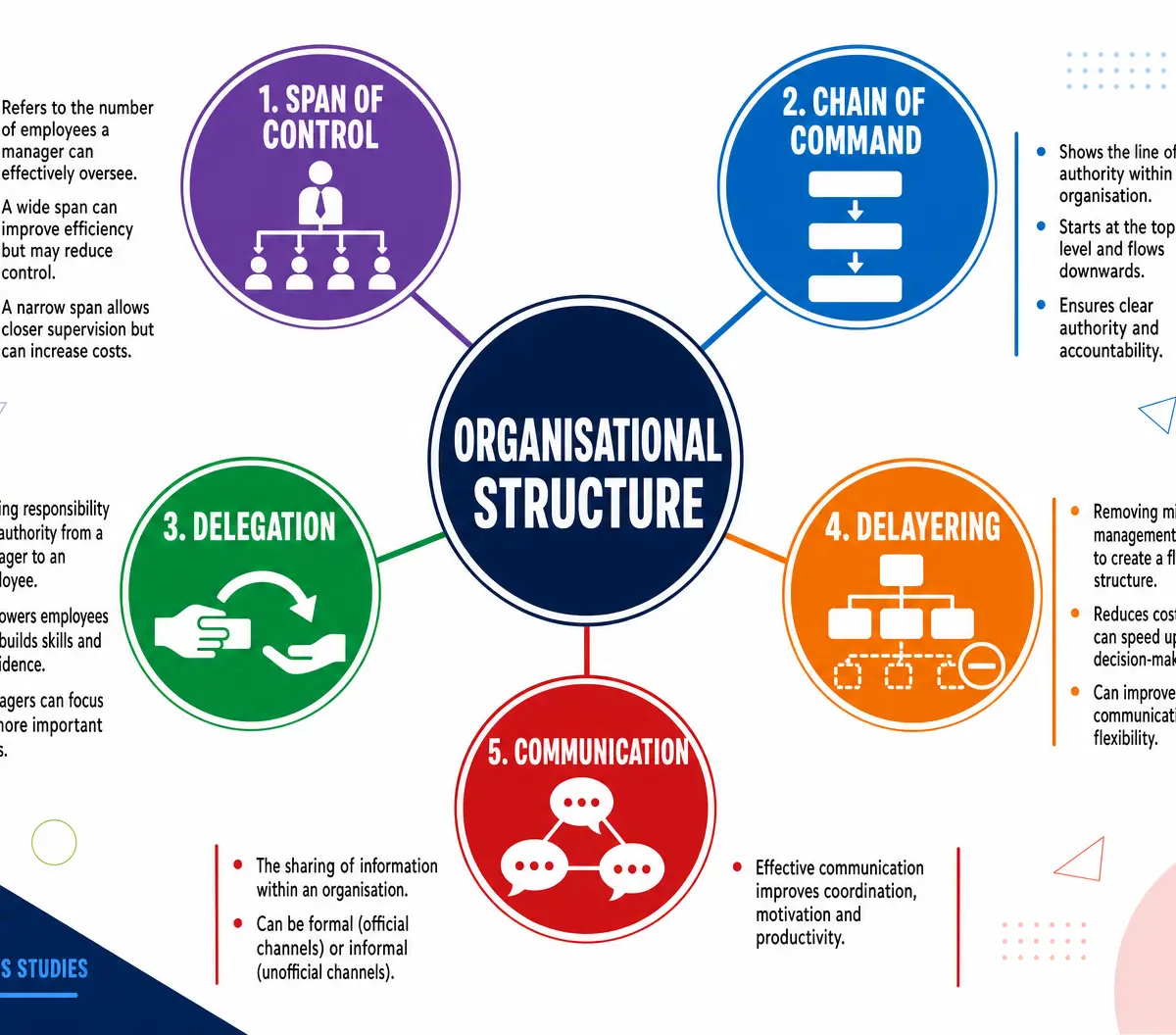
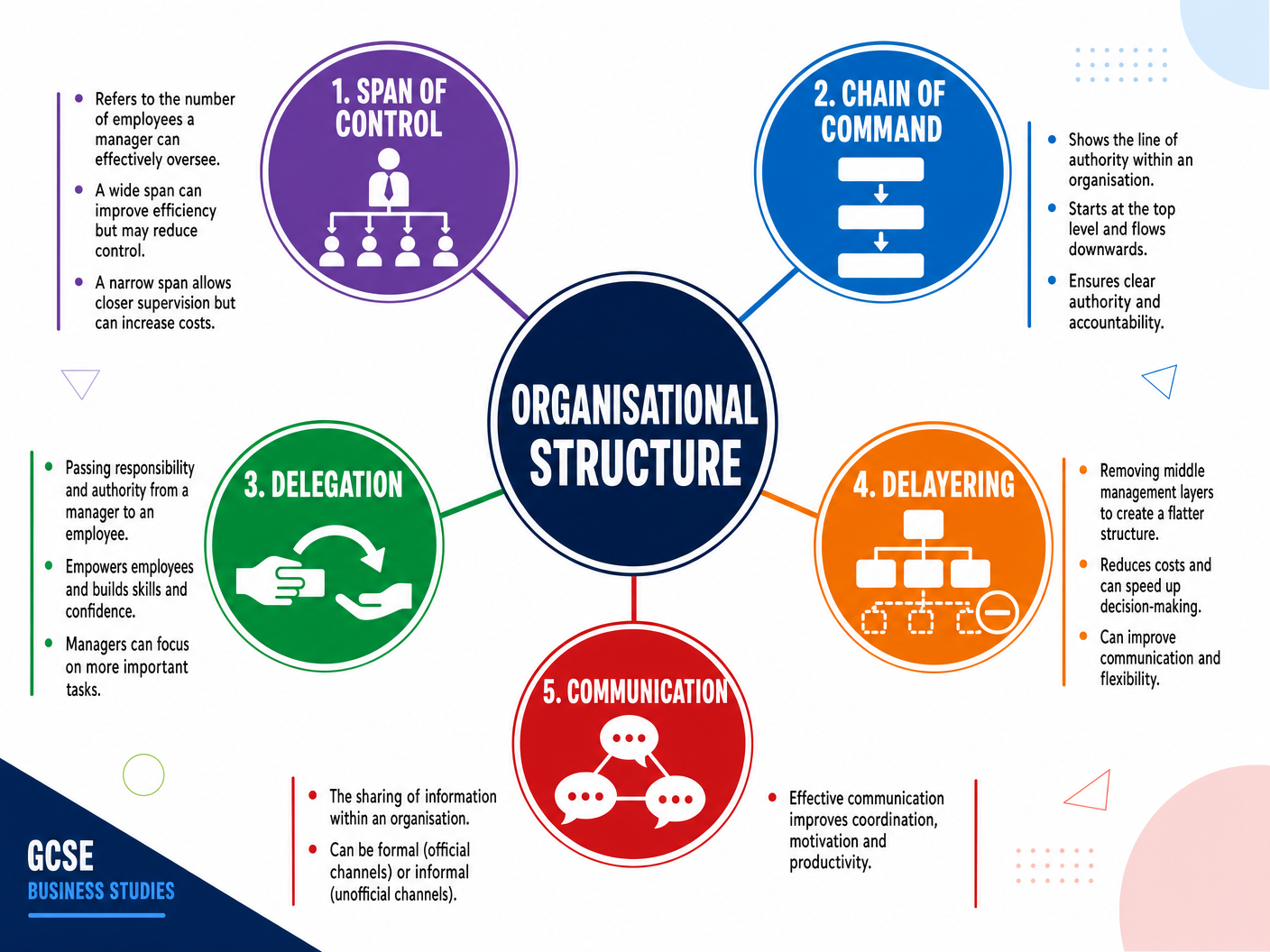
    The 5 Core Concepts

    1. Span of Control

    Definition: The number of subordinates (employees) who report directly to a single manager.

    Key Details:

    • A wide span of control means one manager oversees many employees. This is cheaper but can lead to less supervision.
    • A narrow span of control means a manager oversees few employees. This allows for closer supervision but increases management costs.

    Examiner Tip: Always link span of control to costs and supervision levels. Examiners award credit for understanding the trade-off between the two.

    2. Chain of Command

    Definition: The line of authority that moves from the top of a hierarchy to the lowest level.

    Key Details:

    • It shows how instructions are passed down and how information flows up.
    • A long chain of command can result in slow communication and distorted messages.

    3. Delegation

    Definition: Passing authority and responsibility for a task down to a subordinate.

    Key Details:

    • Empowers employees and builds their skills.
    • Frees up managers to focus on strategic tasks.
    • Risk: If the subordinate is untrained, mistakes can occur.

    4. Delayering

    Definition: The removal of one or more levels of hierarchy from an organisational structure.

    Key Details:

    • Advantages: Reduces costs (fewer management salaries) and speeds up communication.
    • Disadvantages: Can cause job insecurity, lower morale, and increase the workload for remaining managers.

    5. Communication

    Definition: The process of exchanging information between individuals or departments.

    Key Details:

    • Structure directly impacts communication. Flatter structures generally facilitate faster, more accurate communication than tall structures.

    Types of Organisational Structure
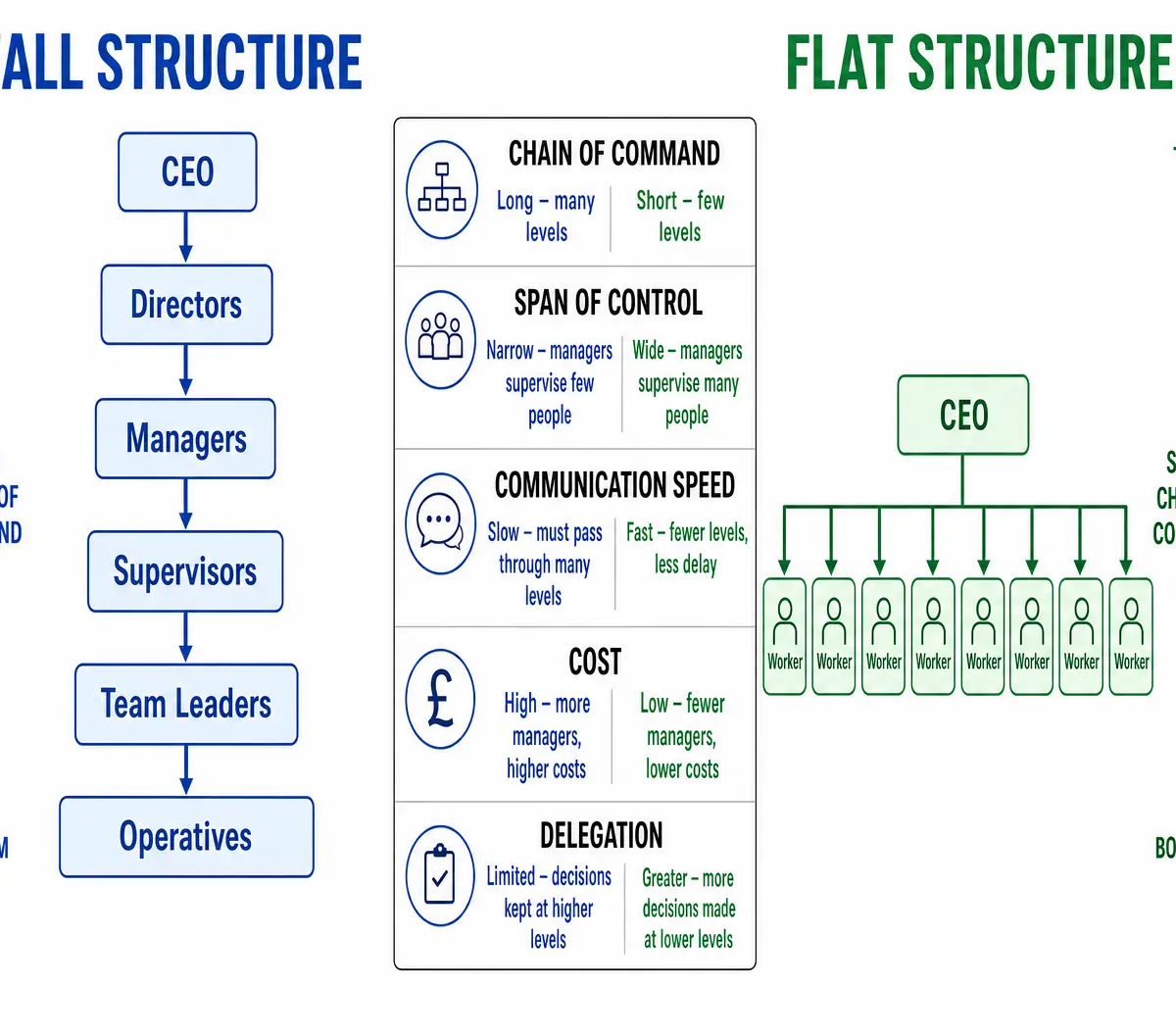
    Tall vs Flat Structures

    Tall Structures

    Characteristics: Many levels of hierarchy, narrow spans of control, long chains of command.

    Impact:

    • Pros: Clear promotion paths, close supervision.
    • Cons: High management costs, slow communication, workers may feel alienated.

    Flat Structures

    Characteristics: Few levels of hierarchy, wide spans of control, short chains of command.

    Impact:

    • Pros: Lower costs, faster communication, greater employee empowerment.
    • Cons: Managers may be overstretched, fewer opportunities for promotion.

    Audio Revision

    Listen to our comprehensive 10-minute podcast covering all these concepts with examiner tips and a quick-fire quiz:
    Organisational Structures Revision Podcast

    Visual Resources

    2 diagrams and illustrations

    The 5 Core Concepts
    The 5 Core Concepts
    Tall vs Flat Structures
    Tall vs Flat Structures

    Interactive Diagrams

    1 interactive diagram to visualise key concepts

    A simple tall chain of command

    Worked Examples

    3 detailed examples with solutions and examiner commentary

    Practice Questions

    Test your understanding — click to reveal model answers

    Q1

    Explain one disadvantage to a business of having a wide span of control. (3 marks)

    3 marks
    standard

    Hint: Think about the manager's workload and how closely they can monitor staff.

    Q2

    Evaluate whether a small, newly established graphic design agency should use a flat organisational structure. (9 marks)

    9 marks
    hard

    Hint: Discuss the benefits (speed, cost) against the drawbacks (manager workload), and make a final judgement based on it being a 'small, newly established' business.

    Explore this topic further

    View Topic PageAll Business Topics

    Key Terms

    Essential vocabulary to know