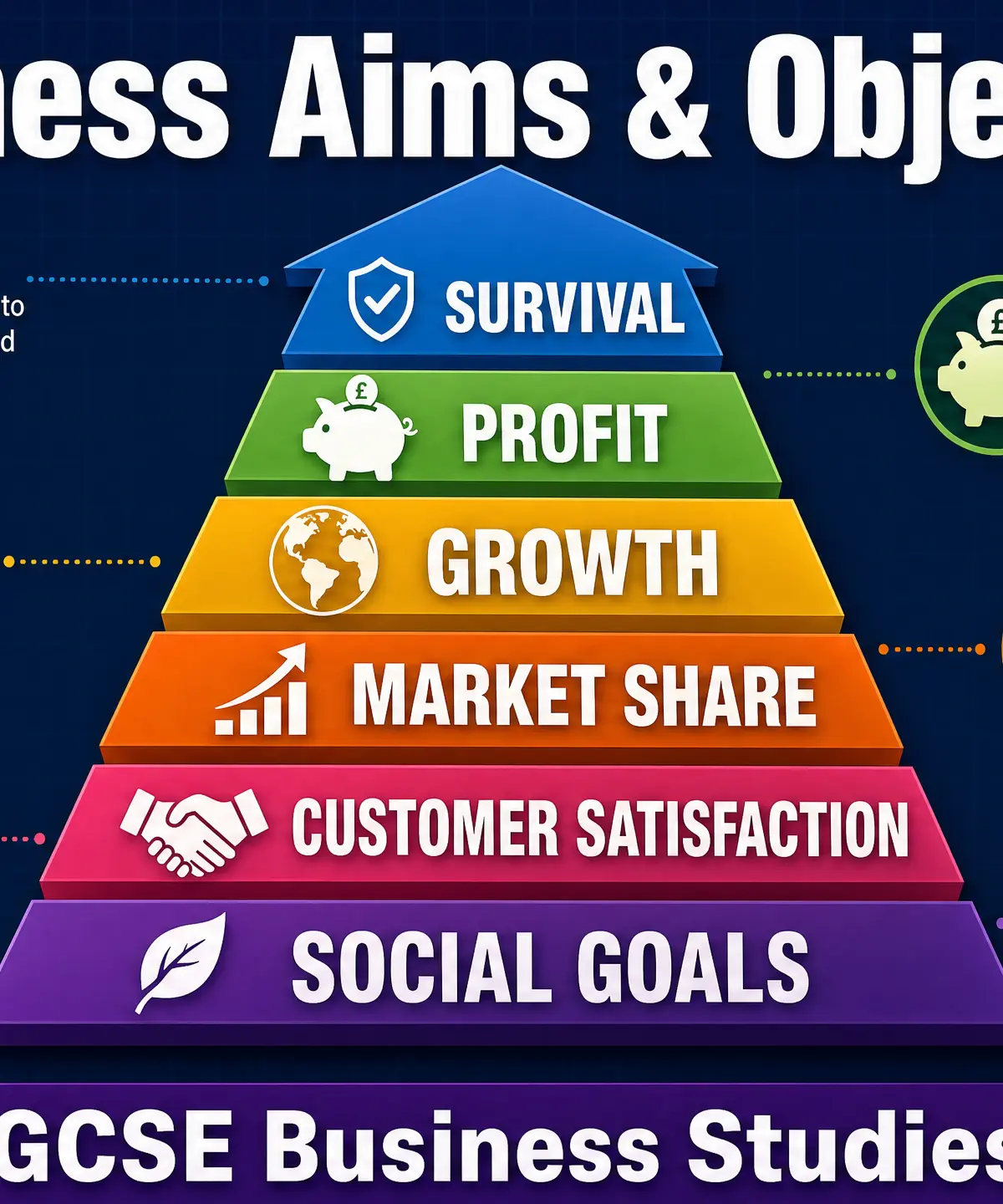
Setting business aims and objectives Revision Notes

    Subject: Business | Level: GCSE | Exam Board: AQA

    Master the foundation of business strategy by understanding why businesses set aims and objectives. Learn how to distinguish between broad aims and SMART objectives, and discover how business size, sector, and lifecycle stage influence these crucial decisions.

    Revision Notes & Key Concepts

    ![Header image for Setting Business Aims and Objectives](https://xnnrgnazirrqvdgfhvou.supabase.co/storage/v1/object/public/study-guide-assets/guide_be6b39dc-a2a2-4fc5-9782-8cf3676a9239/header_image.png) ## Overview Setting aims and objectives is the starting point for any business, whether it's a small local start-up or a multinational PLC. This topic is foundational for GCSE Business; it provides the context for almost every other decision a business makes, from marketing strategies to financial planning. Examiners expect candidates to clearly distinguish between broad, long-term **aims** and specific, measurable **objectives**. More importantly, you must be able to apply this knowledge to different business contexts. A common pitfall is giving generic answers without considering the specific size, ownership type, or competitive environment of the business in the case study. ### Listen to the Podcast ![Revision Podcast: Aims and Objectives](https://xnnrgnazirrqvdgfhvou.supabase.co/storage/v1/object/public/study-guide-assets/guide_be6b39dc-a2a2-4fc5-9782-8cf3676a9239/setting_business_aims_and_objectives_podcast.mp3) ## Key Concepts ### Aims vs Objectives Many candidates lose marks by confusing these two terms. * **Business Aim**: The overarching, long-term goal of the business. It provides direction. For example, 'to be the leading provider of eco-friendly packaging in the UK'. * **Business Objective**: A specific, measurable step taken to achieve the aim. Objectives should follow the **SMART** criteria. For example, 'to increase sales of recycled boxes by 15% within the next 12 months'. ![Aims vs Objectives](https://xnnrgnazirrqvdgfhvou.supabase.co/storage/v1/object/public/study-guide-assets/guide_be6b39dc-a2a2-4fc5-9782-8cf3676a9239/aims_vs_objectives_diagram.png) ### SMART Objectives For an objective to be effective, it should be SMART: * **Specific**: Clearly defined. * **Measurable**: Can be quantified (e.g., in £ or %). * **Achievable**: Possible to attain with current resources. * **Realistic**: Relevant to the business and its market. * **Time-bound**: Has a clear deadline. ![SMART Objectives](https://xnnrgnazirrqvdgfhvou.supabase.co/storage/v1/object/public/study-guide-assets/guide_be6b39dc-a2a2-4fc5-9782-8cf3676a9239/smart_objectives_diagram.png) ### Main Types of Business Objectives Candidates must be familiar with seven key objectives: 1. **Survival**: The primary objective for most new start-ups. In the first year of trading, avoiding failure and maintaining positive cash flow is critical. 2. **Profit Maximisation**: Making as much profit as possible. Profit is total revenue minus total costs. This is essential for rewarding owners and funding future growth. 3. **Growth**: Expanding the business. This could be domestic (more stores in the UK) or international. Growth can lead to economies of scale. 4. **Market Share**: The proportion of total sales in a market held by one business. Increasing market share often means taking customers away from competitors. 5. **Customer Satisfaction**: Meeting or exceeding customer expectations. High satisfaction leads to customer loyalty and positive word-of-mouth. 6. **Social and Ethical Objectives**: Operating in a way that benefits society or the environment. This is the primary aim of social enterprises and charities, but is increasingly important for all businesses (Corporate Social Responsibility). 7. **Shareholder Value**: Maximising the return for investors through rising share prices and dividend payments. This is the dominant objective for Public Limited Companies (PLCs). ### How Objectives Change Examiners frequently test your understanding of how objectives evolve. Objectives are not static; they change based on: * **Business Lifecycle**: A start-up focuses on survival. An established business focuses on profit and growth. A mature PLC might focus on shareholder value and ethical goals. * **Business Type**: A sole trader may just want to earn a living wage. A charity aims to maximise its social impact, not profit. * **External Environment**: During an economic recession, even a large, established business might revert its objective back to survival. ![Objectives across the Business Lifecycle](https://xnnrgnazirrqvdgfhvou.supabase.co/storage/v1/object/public/study-guide-assets/guide_be6b39dc-a2a2-4fc5-9782-8cf3676a9239/business_lifecycle_objectives.png)

    Revision Podcast Transcript

    SEGMENT 1 - INTRO (approximately 1 minute) Hello and welcome to your GCSE Business revision podcast. I'm your tutor, and today we're diving into one of the most foundational topics in the whole specification: Setting Business Aims and Objectives. Whether you're revising for AQA, Edexcel, or OCR, this topic comes up every single year, and the good news is, once you truly understand it, it's one of the most straightforward ways to pick up marks in the exam. So, grab a pen, get comfortable, and let's get started. By the end of this episode, you'll be able to define aims and objectives, explain why they differ between businesses, and — crucially — write the kind of exam answers that examiners love. Let's go. SEGMENT 2 - CORE CONCEPTS PART 1 (approximately 2.5 minutes) First things first. What is the difference between a business aim and a business objective? This is the number one mistake candidates make in the exam — they use these two terms interchangeably, and that costs marks. A business aim is the long-term, overarching goal of the business. It's broad, it's aspirational, and it gives the business its overall direction. Think of it like a destination on a map. For example, a business might aim "to become the leading coffee shop brand in the United Kingdom." That's an aim — it tells you where the business wants to go, but it doesn't tell you exactly how to get there. A business objective, on the other hand, is a specific, measurable step that helps the business work towards its aim. Objectives are often described using the SMART framework — Specific, Measurable, Achievable, Realistic, and Time-bound. So, using our coffee shop example, an objective might be: "To open 50 new stores in the UK within the next two years." That's specific, it's measurable, it's time-bound — it's a proper objective. Now let's talk about the main types of business objectives you need to know for your exam. There are seven key ones, and I want you to be able to name and explain all of them. Number one: Survival. This is the most basic objective, and it's typically the priority for new start-up businesses. When a business first launches, it's in a vulnerable position — it has limited cash flow, it's building its customer base, and it faces fierce competition from established rivals. Survival simply means staying in business and avoiding failure. Think about a brand new independent restaurant that's just opened — their first priority isn't profit, it's making sure they're still open in six months' time. Number two: Profit maximisation. Once a business has survived its early stages, profit becomes the focus. Profit is the money left over after all costs have been paid. Profit maximisation means making as much profit as possible. This is particularly important for private limited companies and public limited companies, where the owners and shareholders expect a financial return on their investment. Number three: Growth. A business might set an objective to grow — either domestically, by expanding within the UK, or internationally, by entering new overseas markets. Growth can mean increasing the number of outlets, expanding the product range, or acquiring other businesses. Companies like Amazon and McDonald's are classic examples of businesses that have pursued aggressive growth objectives. Number four: Market share. Market share is the percentage of total sales in a market that a business holds. For example, if the total UK smartphone market is worth ten billion pounds and one company sells two billion pounds' worth of phones, that company has a twenty percent market share. Businesses often set objectives to increase their market share because a higher share means more customers choosing you over your competitors. SEGMENT 3 - CORE CONCEPTS PART 2 (approximately 2.5 minutes) Let's continue with the remaining objectives. Number five: Customer satisfaction. Not all objectives are purely financial. Customer satisfaction means ensuring that customers are happy with the products or services they receive. Businesses that prioritise customer satisfaction often invest heavily in staff training, after-sales service, and product quality. John Lewis is a great example — their famous motto, "Never Knowingly Undersold," reflects a deep commitment to customer satisfaction. High customer satisfaction leads to repeat business and positive word-of-mouth, which ultimately supports long-term profitability. Number six: Social and ethical objectives. Some businesses, particularly not-for-profit organisations, charities, and social enterprises, prioritise social or ethical goals over profit. A social enterprise like The Big Issue exists to provide employment and support for homeless people — profit is a means to an end, not the end itself. Even large commercial businesses increasingly set ethical objectives, such as reducing their carbon footprint, sourcing materials sustainably, or paying workers a living wage. The Body Shop built its entire brand around ethical sourcing and environmental responsibility. Number seven: Shareholder value. For large public limited companies — PLCs — that are listed on the stock exchange, a key objective is to maximise shareholder value. This means increasing the share price and paying regular dividends to shareholders. Companies like Tesco, BP, and Barclays are all accountable to their shareholders and must demonstrate that the business is being run in a way that protects and grows their investment. Now here's something really important that examiners want to see: the understanding that objectives change as a business evolves. A brand new start-up will almost certainly prioritise survival above everything else. As it grows and becomes profitable, it might shift its focus to profit maximisation and market share. A large, well-established multinational might then turn its attention to social responsibility and shareholder value. The stage of the business lifecycle is a key factor in determining which objective is most appropriate. Objectives also differ based on the type of business. A not-for-profit organisation like Oxfam will never have profit maximisation as its primary objective — its mission is humanitarian. A sole trader running a local plumbing business might simply want to earn a comfortable living. A PLC like Unilever must balance the demands of millions of shareholders with its corporate social responsibility commitments. SEGMENT 4 - EXAM TIPS AND COMMON MISTAKES (approximately 2 minutes) Right, let's talk exam technique. This is where I see candidates throwing away marks, and I want to make sure that doesn't happen to you. Tip number one: Always read the case study carefully and link your answer to the specific business described. Examiners call this "applying knowledge to context," and it's worth marks at every level. If the question gives you a case study about a small family-run bakery that has just started trading, your answer about objectives must reference that context. Don't just write a generic answer about profit maximisation — explain why survival is more likely to be the priority for a new, small business with limited resources. Tip number two: Don't assume profit is the only measure of success. This is one of the most common mistakes. Examiners are specifically looking for candidates who understand that success can be measured in multiple ways — customer satisfaction scores, market share percentage, employee wellbeing, environmental impact. If a question asks you to evaluate whether a business has been successful, consider all of these dimensions. Tip number three: Know your command words. "State" means give a brief answer — one or two words or a sentence. "Explain" means give a reason and develop it — use the word "because" or "therefore" to show your reasoning. "Analyse" means explore the causes and effects in depth. "Evaluate" means weigh up both sides and reach a justified conclusion. Each command word tells you exactly how much depth is expected. Tip number four: Avoid the common confusion between aims and objectives. If a question asks you to "state one business objective," don't write "to be successful" — that's an aim, not an objective. Write something specific and measurable, like "to increase revenue by fifteen percent within twelve months." Tip number five: For six-mark or eight-mark evaluation questions, always include a conclusion. Examiners award marks for judgement — you need to say which factor is most important and why, or whether you agree or disagree with a statement, and justify your position. SEGMENT 5 - QUICK-FIRE RECALL QUIZ (approximately 1 minute) Time for a quick-fire quiz! Pause the podcast after each question and try to answer before I give you the answer. Question one: What does the S in SMART objectives stand for? ... The answer is Specific. Question two: Name two objectives that a new start-up business is most likely to prioritise. ... Survival and profit. Question three: What is market share? ... The percentage of total sales in a market held by one business. Question four: Give one example of a non-financial business objective. ... Customer satisfaction, social responsibility, or ethical goals — any of these is correct. Question five: Why might a PLC prioritise shareholder value as an objective? ... Because it is accountable to shareholders who have invested money and expect a financial return. How did you do? If you struggled with any of those, go back and re-read that section of your notes. SEGMENT 6 - SUMMARY AND SIGN-OFF (approximately 1 minute) Let's wrap up with a quick summary of everything we've covered today. Business aims are long-term, broad goals that give a business its overall direction. Business objectives are specific, measurable steps — ideally SMART — that help a business work towards its aims. The seven key objectives are: survival, profit maximisation, growth, market share, customer satisfaction, social and ethical objectives, and shareholder value. Objectives differ based on the size, type, and stage of the business. Not-for-profit organisations prioritise social goals over profit. Objectives change as a business evolves through its lifecycle. And in the exam, always link your answer to the specific context of the business in the case study. That's it for today's episode. Keep revising, keep practising past papers, and remember — every mark counts. Good luck, and I'll see you in the next episode!

    Key Terms & Definitions

    Business Aim
    The overarching, long-term goal of a business.
    Business Objective
    A specific, measurable target set to help achieve a business aim.
    Survival
    The objective of keeping the business operating and avoiding failure.
    Profit Maximisation
    The objective of making as much profit as possible (Total Revenue - Total Costs).
    Market Share
    The percentage of total sales in a market held by one specific business.
    Social Enterprise
    A business with primarily social objectives whose surpluses are principally reinvested for that purpose.

    Worked Examples

    Practice Questions

    Setting business aims and objectives

    AQA
    GCSE
    Business

    Master the foundation of business strategy by understanding why businesses set aims and objectives. Learn how to distinguish between broad aims and SMART objectives, and discover how business size, sector, and lifecycle stage influence these crucial decisions.

    4
    Min Read
    3
    Examples
    5
    Questions
    6
    Key Terms
    🎙 Podcast Episode
    Setting business aims and objectives
    0:00-0:00

    Study Notes

    Header image for Setting Business Aims and Objectives

    Overview

    Setting aims and objectives is the starting point for any business, whether it's a small local start-up or a multinational PLC. This topic is foundational for GCSE Business; it provides the context for almost every other decision a business makes, from marketing strategies to financial planning. Examiners expect candidates to clearly distinguish between broad, long-term aims and specific, measurable objectives. More importantly, you must be able to apply this knowledge to different business contexts. A common pitfall is giving generic answers without considering the specific size, ownership type, or competitive environment of the business in the case study.

    Listen to the Podcast

    Revision Podcast: Aims and Objectives

    Key Concepts

    Aims vs Objectives

    Many candidates lose marks by confusing these two terms.

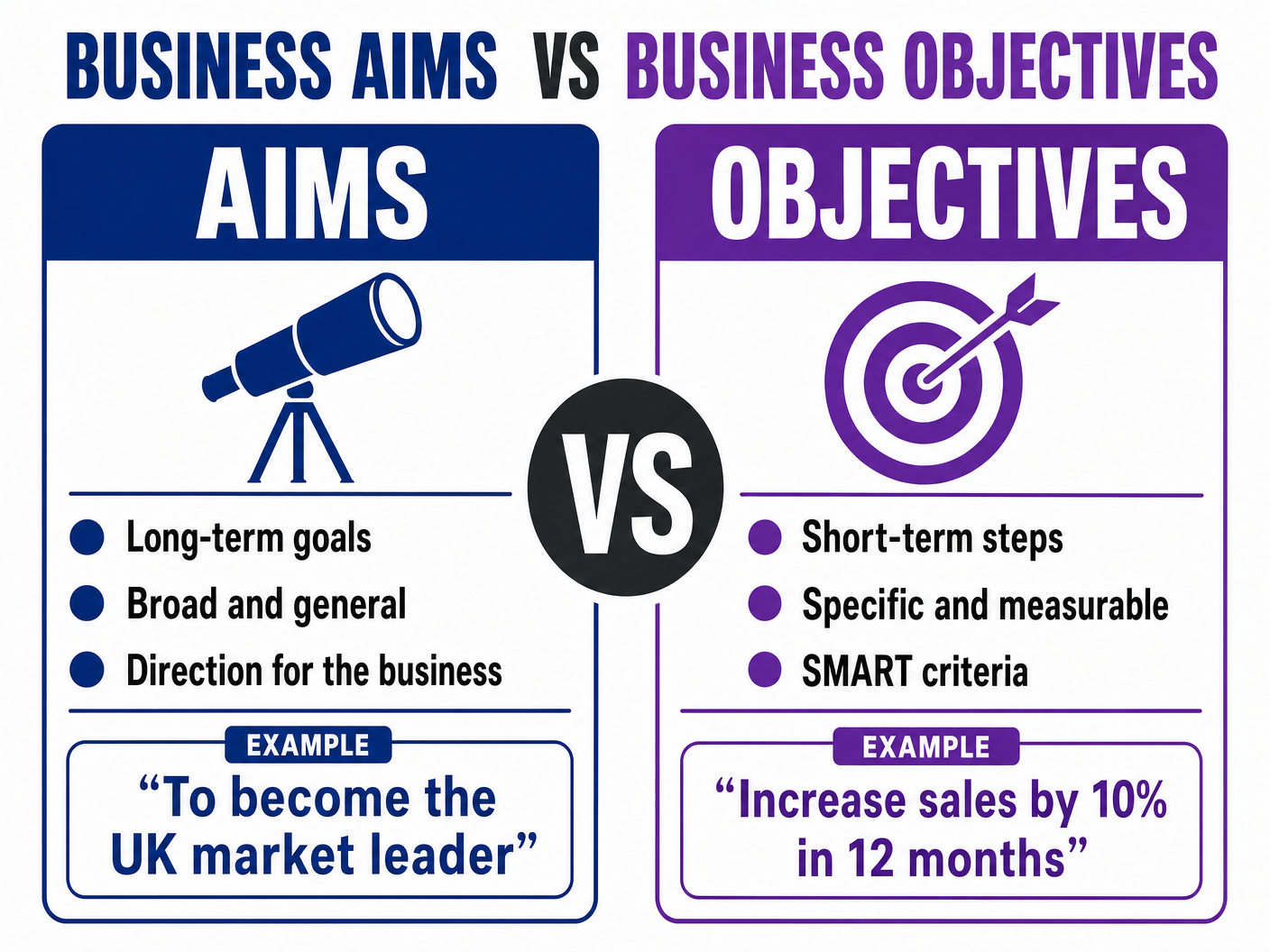
    • Business Aim: The overarching, long-term goal of the business. It provides direction. For example, 'to be the leading provider of eco-friendly packaging in the UK'.
    • Business Objective: A specific, measurable step taken to achieve the aim. Objectives should follow the SMART criteria. For example, 'to increase sales of recycled boxes by 15% within the next 12 months'.
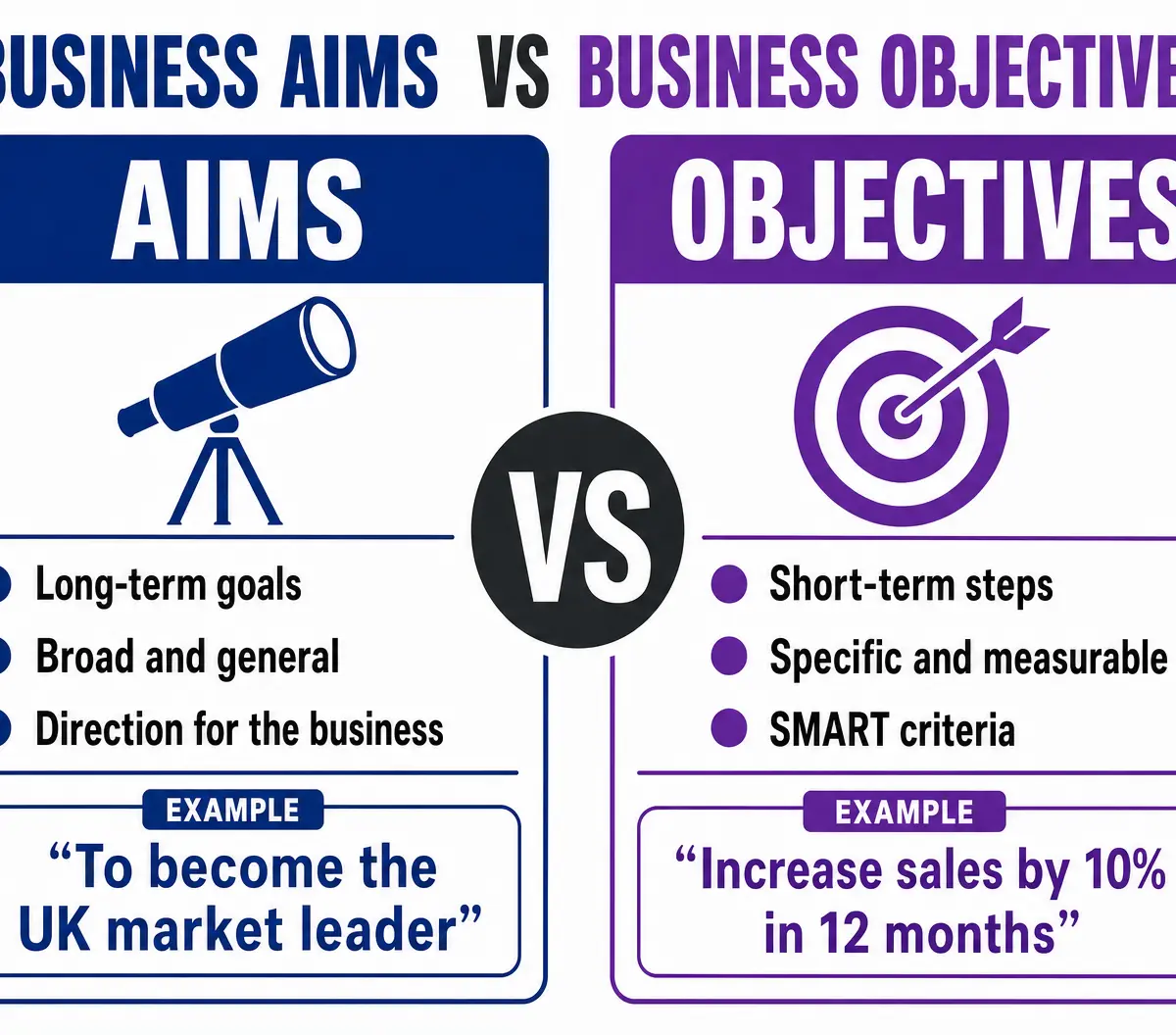
    Aims vs Objectives

    SMART Objectives

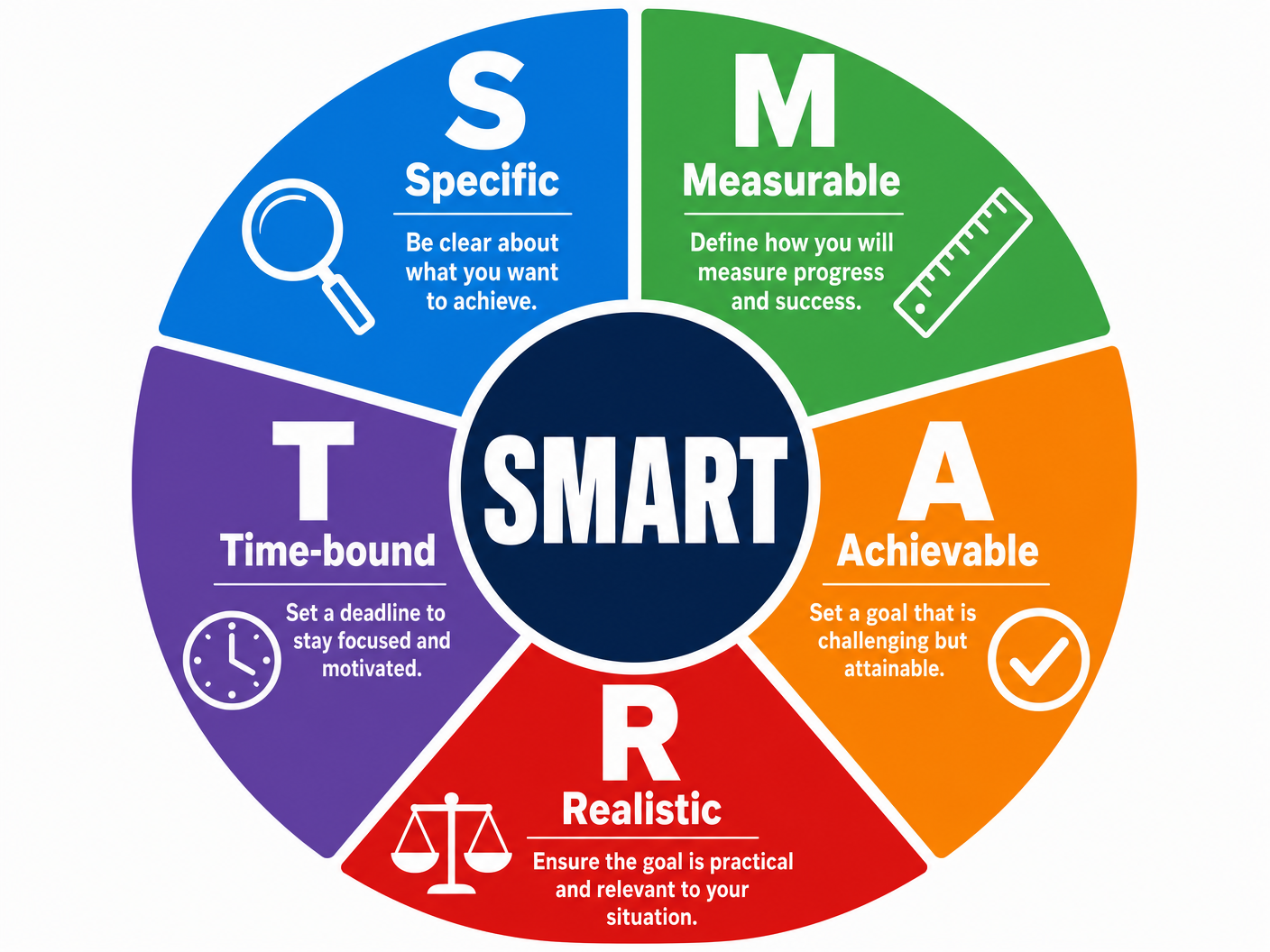
    For an objective to be effective, it should be SMART:

    • Specific: Clearly defined.
    • Measurable: Can be quantified (e.g., in £ or %).
    • Achievable: Possible to attain with current resources.
    • Realistic: Relevant to the business and its market.
    • Time-bound: Has a clear deadline.

    SMART Objectives

    Main Types of Business Objectives

    Candidates must be familiar with seven key objectives:

    1. Survival: The primary objective for most new start-ups. In the first year of trading, avoiding failure and maintaining positive cash flow is critical.
    2. Profit Maximisation: Making as much profit as possible. Profit is total revenue minus total costs. This is essential for rewarding owners and funding future growth.
    3. Growth: Expanding the business. This could be domestic (more stores in the UK) or international. Growth can lead to economies of scale.
    4. Market Share: The proportion of total sales in a market held by one business. Increasing market share often means taking customers away from competitors.
    5. Customer Satisfaction: Meeting or exceeding customer expectations. High satisfaction leads to customer loyalty and positive word-of-mouth.
    6. Social and Ethical Objectives: Operating in a way that benefits society or the environment. This is the primary aim of social enterprises and charities, but is increasingly important for all businesses (Corporate Social Responsibility).
    7. Shareholder Value: Maximising the return for investors through rising share prices and dividend payments. This is the dominant objective for Public Limited Companies (PLCs).

    How Objectives Change

    Examiners frequently test your understanding of how objectives evolve. Objectives are not static; they change based on:

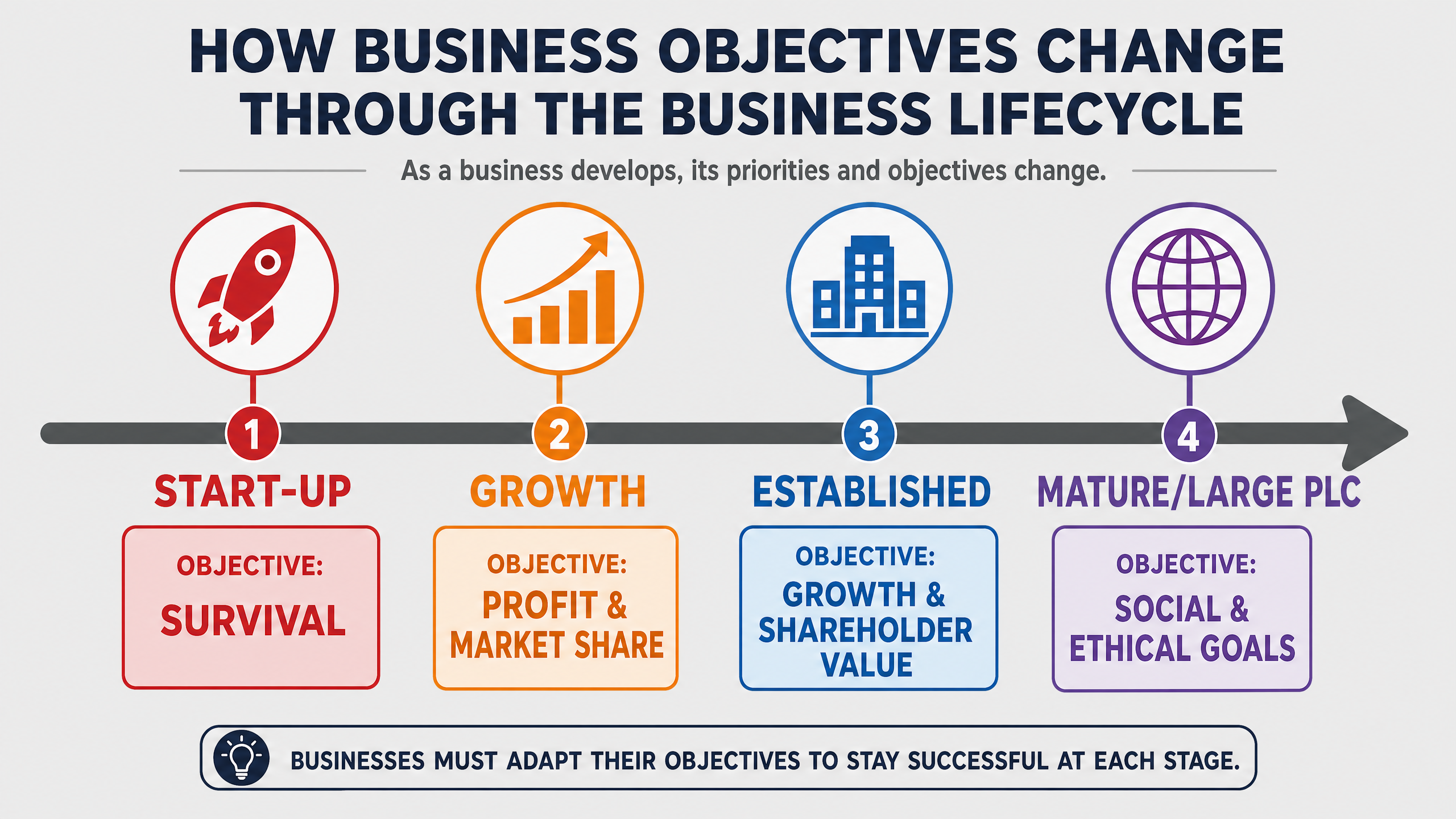
    • Business Lifecycle: A start-up focuses on survival. An established business focuses on profit and growth. A mature PLC might focus on shareholder value and ethical goals.
    • Business Type: A sole trader may just want to earn a living wage. A charity aims to maximise its social impact, not profit.
    • External Environment: During an economic recession, even a large, established business might revert its objective back to survival.
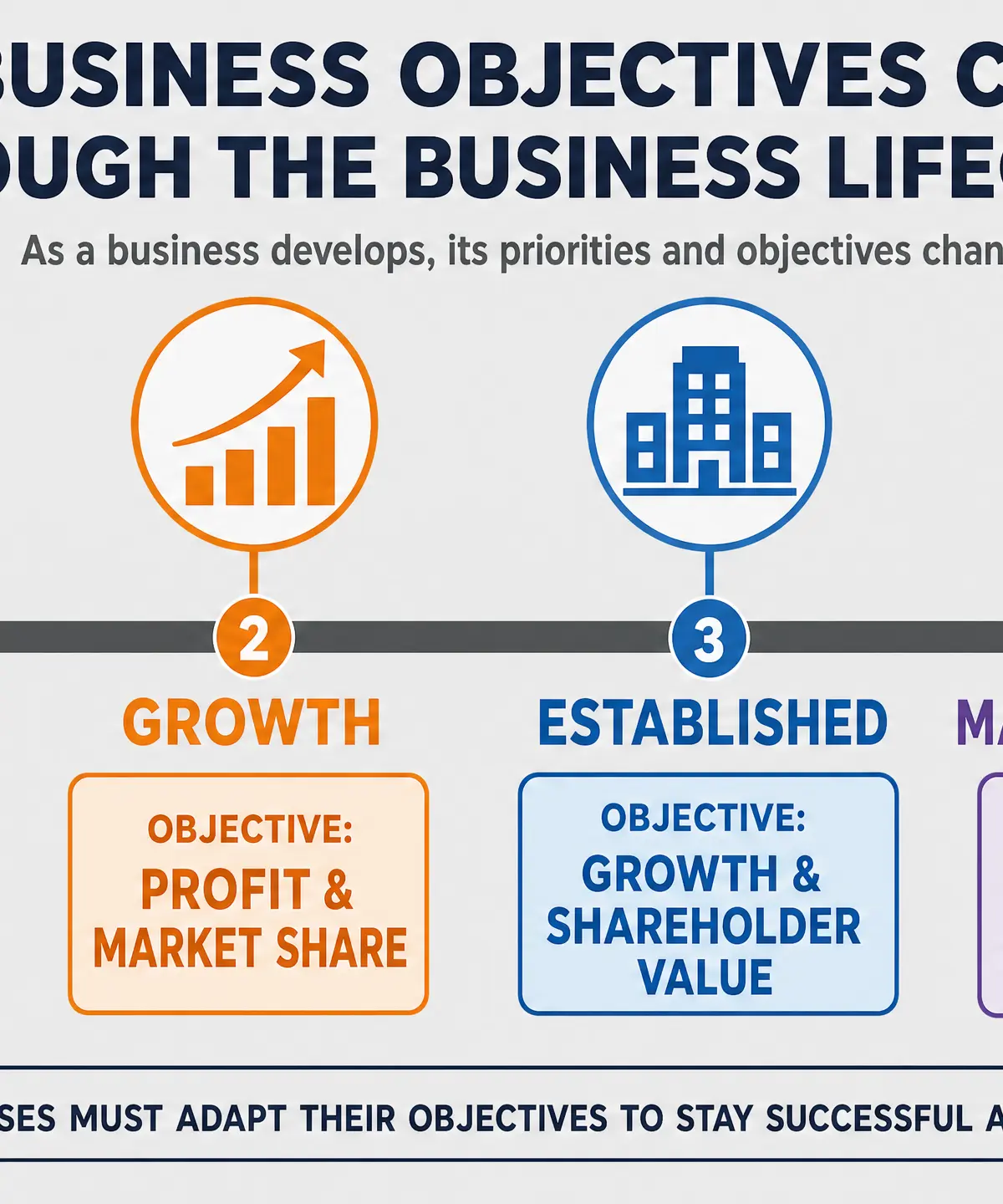
    Objectives across the Business Lifecycle

    Visual Resources

    3 diagrams and illustrations

    Aims vs Objectives
    Aims vs Objectives
    Objectives across the Business Lifecycle
    Objectives across the Business Lifecycle
    SMART Objectives
    SMART Objectives

    Worked Examples

    3 detailed examples with solutions and examiner commentary

    Practice Questions

    Test your understanding — click to reveal model answers

    Q1

    Explain how the objectives of a large multinational PLC might differ from those of a local charity. (6 marks)

    6 marks
    standard

    Hint: Focus on ownership and purpose. Who owns a PLC and what do they want? What is the purpose of a charity?

    Q2

    State two features of a SMART objective. (2 marks)

    2 marks
    easy

    Hint: Think of the acronym SMART.

    Q3

    Explain why a business might change its objective from survival to growth. (3 marks)

    3 marks
    standard

    Hint: What has to happen for a business to no longer worry about survival?

    Q4

    Evaluate the importance of setting social and ethical objectives for a large clothing retailer. (9 marks)

    9 marks
    hard

    Hint: Consider both the benefits (reputation, sales) and drawbacks (costs, lower profit margins) of ethical sourcing.

    Q5

    Define the term 'market share'. (2 marks)

    2 marks
    easy

    Hint: It's a percentage of the whole.

    Explore this topic further

    View Topic PageAll Business Topics

    Key Terms

    Essential vocabulary to know