AQA · GCSE · Business
Course version: 8132 · Version from Sept 2017
Training
Training is the engine that drives business growth and employee motivation. In this guide, you will discover why businesses invest in their workforce and how different training methods impact productivity, quality, and retention.
- 5 min read
- 3 worked examples
- 5 practice questions
- 6 key terms
Check what you remember
Read the wording for your board, then hide it and explain Training in your own words. Rough notes are fine. This is a self-check, with no mark or grade.
Reference: AQA
The process of increasing the knowledge and skills of the workforce to enable them to perform their jobs effectively.
Study Notes
Overview
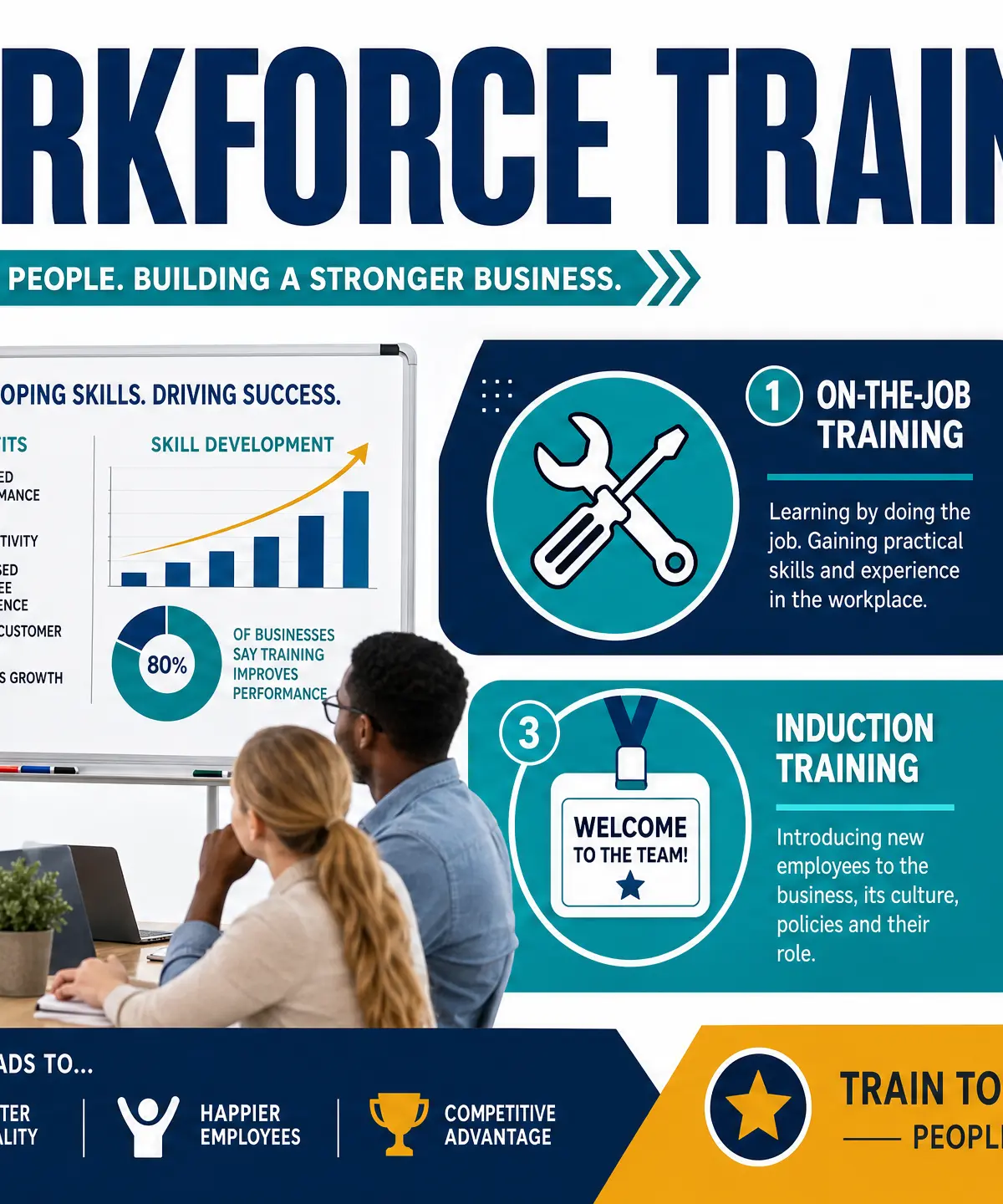
Workforce training is a critical topic in GCSE Business Studies. Examiners expect you to understand not just what training is, but why businesses invest in it and how different training methods impact the business. This topic connects directly to human resources, motivation, productivity, and ultimately, business success and profitability. You need to be able to evaluate the costs versus the benefits of training, and apply your knowledge to specific business scenarios.
The Importance of Training
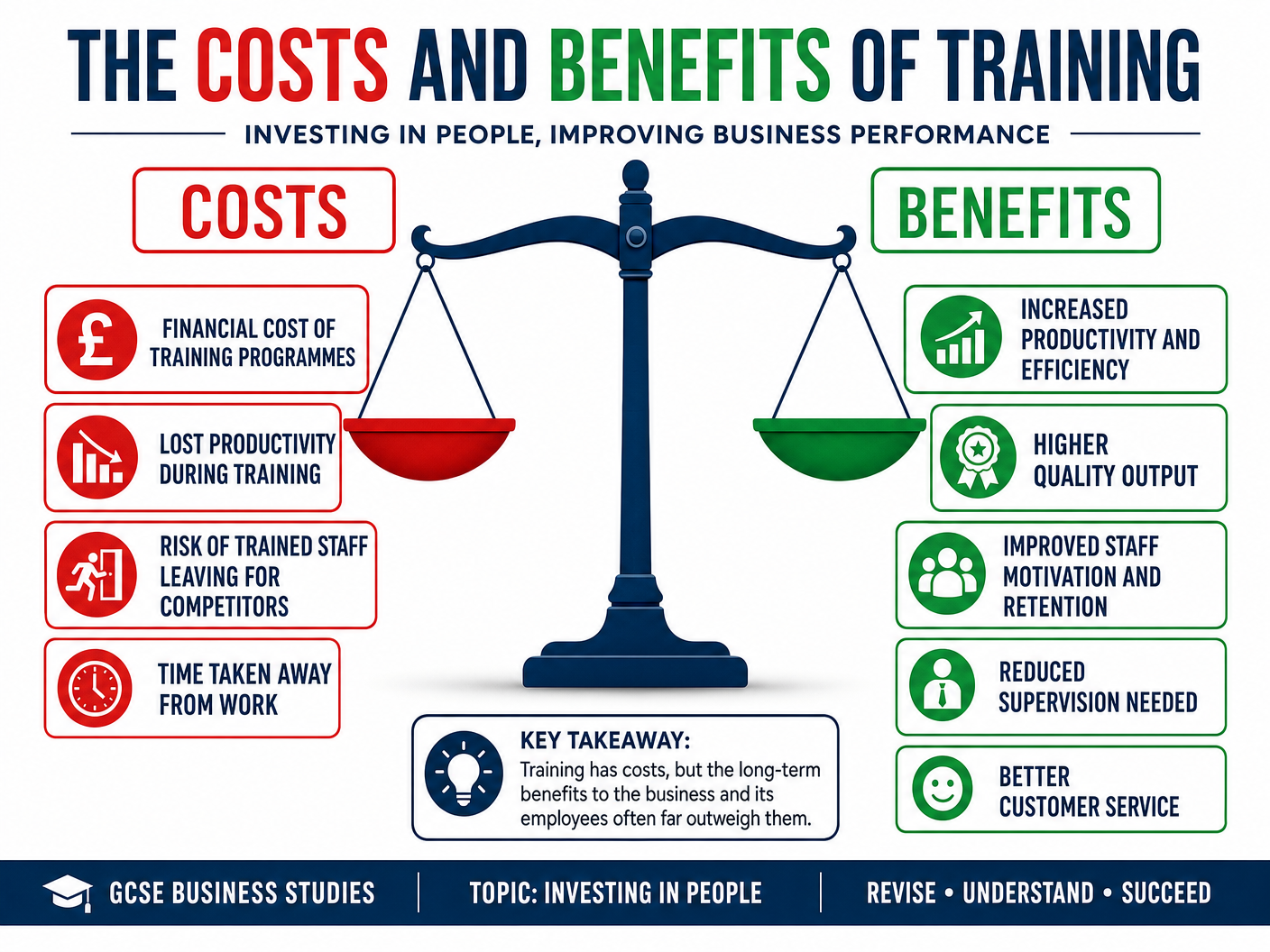
Training is the process of increasing the knowledge and skills of the workforce to enable them to perform their jobs effectively. But why do businesses spend money on this?
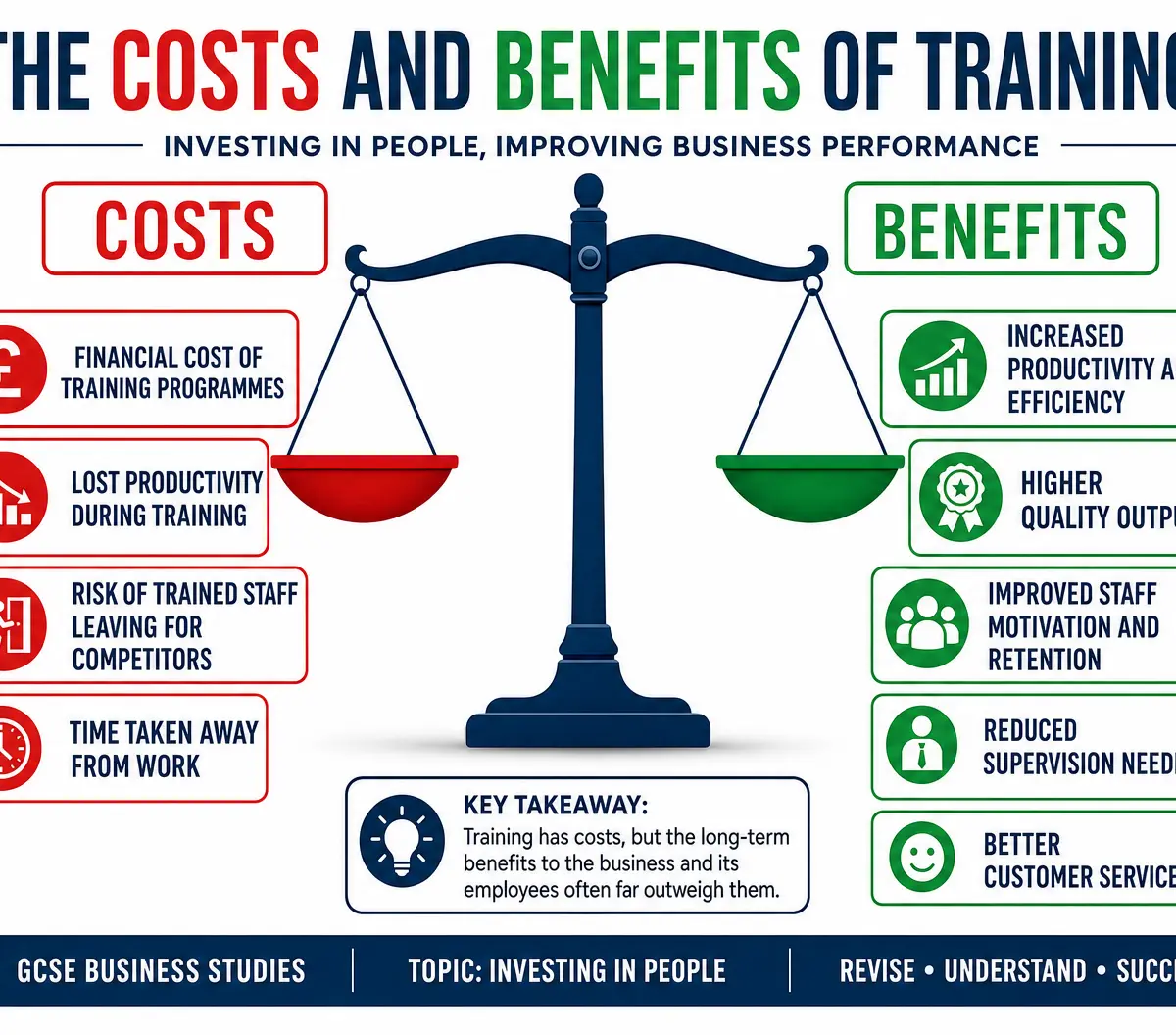
1. Increased ProductivityWell-trained employees can work faster and more efficiently. They make fewer mistakes, which reduces waste and lowers unit costs.
2. Higher Quality OutputTraining ensures employees understand quality standards and how to achieve them. This leads to better products or services, resulting in higher customer satisfaction and fewer returns or complaints.
3. Improved Staff Motivation and RetentionWhen a business invests in training, employees feel valued. This satisfies higher-level needs (think Maslow's hierarchy or Herzberg's two-factor theory), leading to increased motivation. Motivated staff are less likely to leave, which reduces the significant costs associated with recruiting and selecting new staff.
4. Flexibility and Change ManagementTraining allows a business to adapt to changes, such as new technology or new legislation. A multi-skilled workforce can also cover for absent colleagues, increasing flexibility.
5. Reduced Need for SupervisionTrained staff can work more independently, allowing managers to focus on strategic tasks rather than constantly monitoring employees.
Types of Training
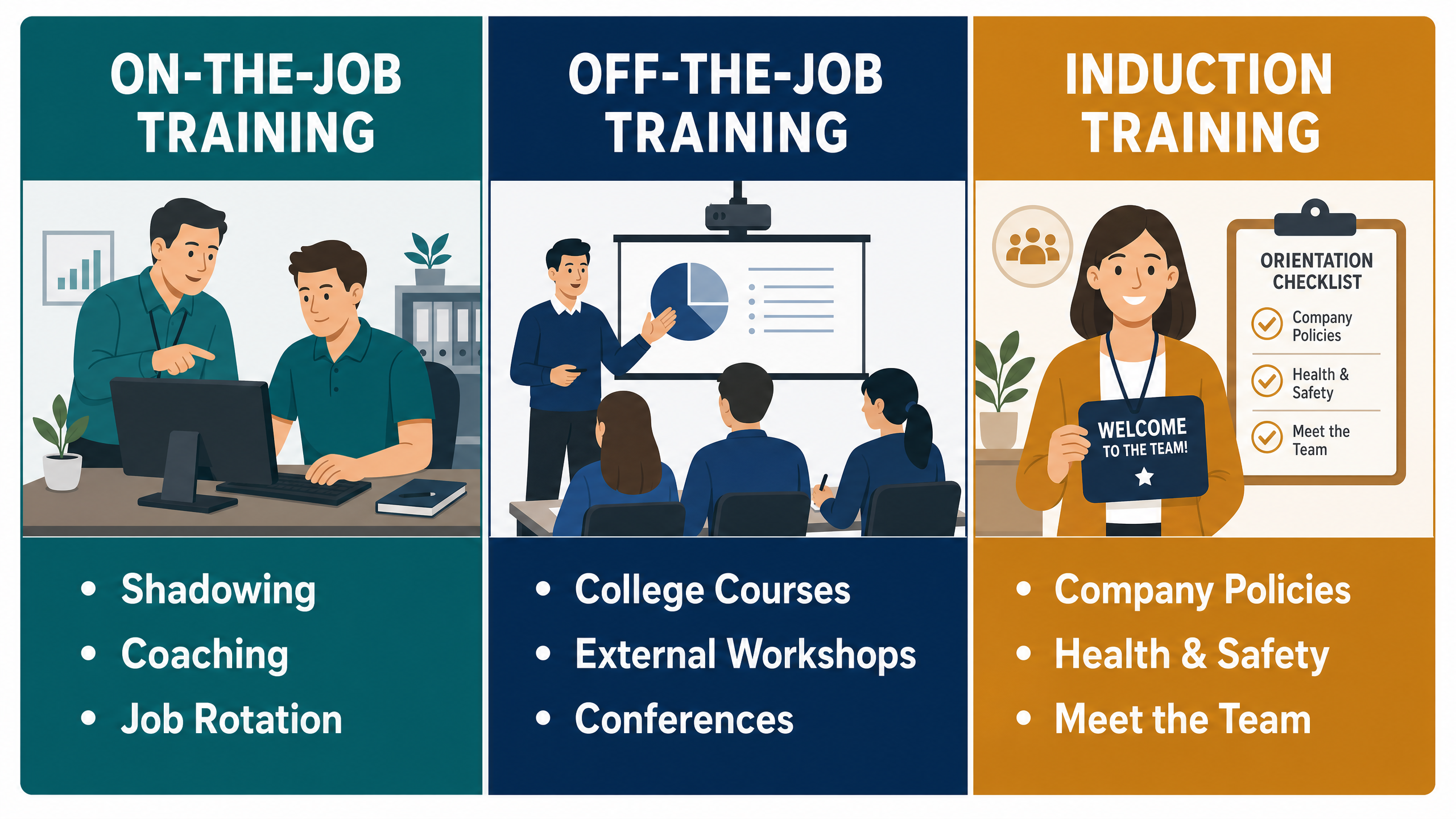
Examiners frequently ask you to compare different types of training or recommend the best type for a specific situation. There are three main categories you must know:
1. Induction Training
What it is: Training given to new employees when they first join a business.
What it covers:
- Introduction to the company culture and history
- Health and safety procedures (often a legal requirement)
- Tour of the premises and introduction to colleagues
- Explanation of company policies (e.g., IT policy, absence policy)
- Basic role expectations
Why it matters: It helps new starters settle in quickly, reduces anxiety, and ensures they understand basic procedures, which reduces the risk of accidents or early mistakes. Crucially, a good induction reduces early staff turnover.
2. On-the-Job Training
What it is: Training that takes place while doing the job, in the actual workplace.
Common methods:
- Shadowing: Watching an experienced colleague perform the job.
- Coaching/Mentoring: Being guided through tasks by a supervisor or experienced peer.
- Job Rotation: Moving between different roles to gain a broader understanding of the business.
Advantages:
- Cost-effective (no travel or external course fees)
- Training is directly relevant to the specific job and business
- The employee is still producing output while learning
- Easy to organize at short notice
Disadvantages:
- Quality depends entirely on the trainer; bad habits can be passed on
- The trainer's own productivity will decrease while they are teaching
- The learning environment may be noisy or full of distractions
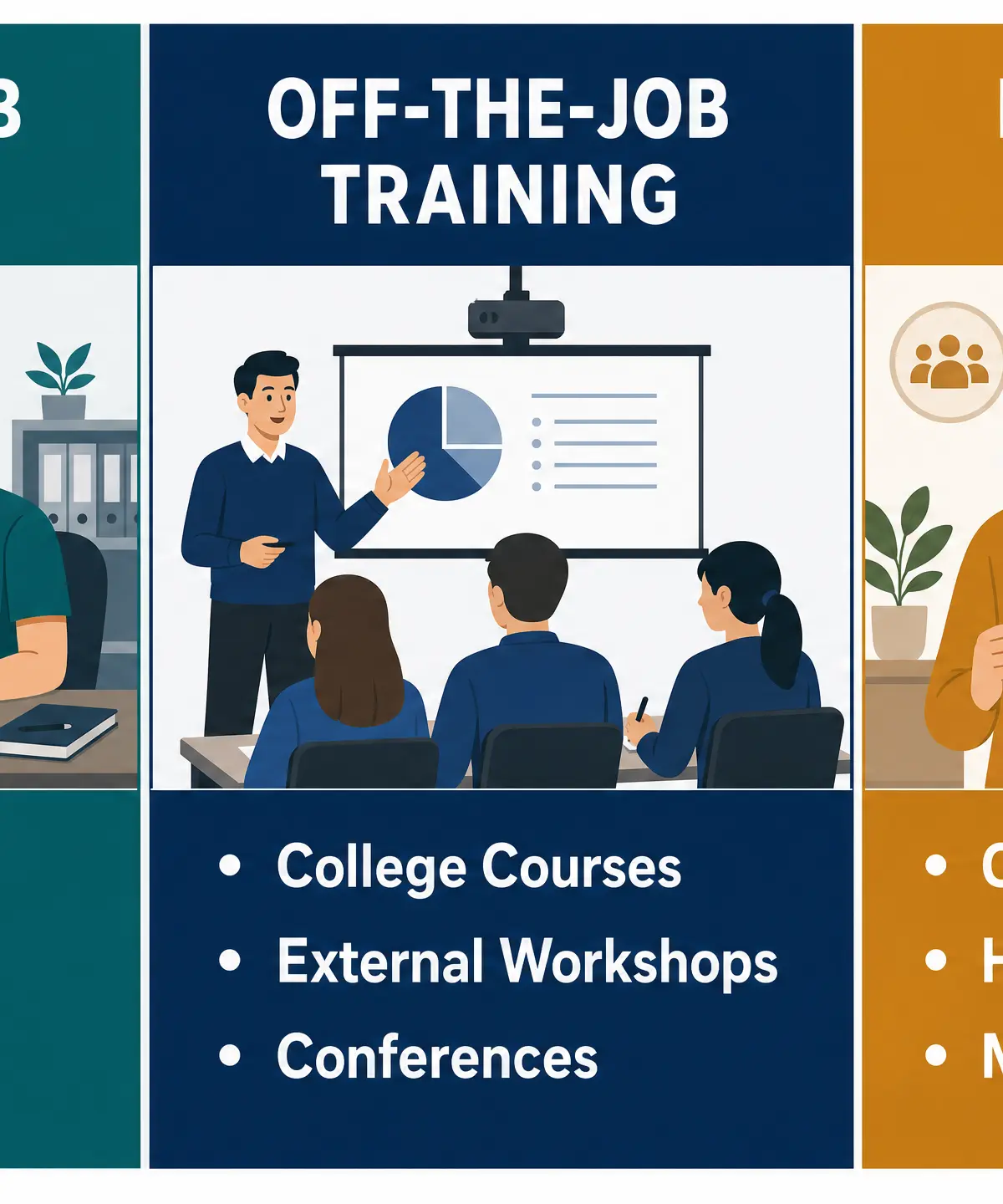
3. Off-the-Job Training
What it is: Training that takes place away from the employee's normal workplace.
Common methods:
- College or university courses (e.g., studying for a professional qualification)
- External workshops or seminars
- Online e-learning modules completed away from the desk
- Dedicated training centres run by the business
Advantages:
- Delivered by specialists or experts, ensuring high quality
- Employees can focus entirely on learning without workplace distractions
- Can bring new ideas and outside perspectives into the business
- Employees may gain recognized qualifications, which is highly motivating
Disadvantages:
- Generally much more expensive than on-the-job training (course fees, travel, accommodation)
- The employee is away from work, meaning zero productivity during the training period
- The training might not be perfectly tailored to the specific business's systems
- Risk that highly trained employees may leave for a better job elsewhere
Listen to the Podcast
For a deep dive into this topic, including exam tips and a quick-fire quiz, listen to our 10-minute revision podcast:
Visual Resources
2 diagrams and illustrations
Interactive Diagrams
1 interactive diagram to visualise key concepts
Conceptual Flow Outline
The Training Decision Flowchart
Worked Examples
3 worked examples — open one to explore the question and available guidance.
Practice Questions
Try the question, then reveal an answer plan or example response
Explain one way that effective training can help a business to reduce its costs. (3 marks)
Hint: Think about mistakes, waste, or staff leaving.
A fast-food chain is opening a new branch and has hired 20 new staff members who have never worked in catering before. Recommend which type of training the business should use before the restaurant opens. (6 marks)
Hint: Consider the specific needs of new staff and the legal requirements of food handling.
State two disadvantages of off-the-job training. (2 marks)
Hint: Think about money and where the employee is.
Explain how training can improve employee motivation. (3 marks)
Hint: Think about how it feels when an employer invests in you.
Analyse the impact of poor induction training on a business. (6 marks)
Hint: Follow the chain of consequences: what happens to the employee, and then what happens to the business?
Exam technique
How to turn what you know into marks
How to approach the question
Always look for the business context in the question. If it mentions a specific type of business, your answer MUST refer to that context to access application marks.
How to structure your answer
- State questions
- Keep it brief. One sentence or bullet point is enough.
- Explain questions
- BLT: Because, Leading to, Therefore. Make your point, explain it, and show the impact on the business.
- Evaluate questions
- AJIM: Application (use the context), Justification (explain points), Integration (link points together), Meaningful Conclusion (make a final decision).
Timing
Approximately 1 minute per mark.
Common pitfalls
- Giving generic answers that don't link to the business scenario provided.
- Confusing induction training with on-the-job training.
- Failing to make a final judgement in evaluation questions.
What the command words want
- Analyse
- Show a chain of reasoning. Explain the causes and consequences of a business decision.
- Explain
- Give a reason or advantage/disadvantage, and use connectives like 'because' or 'which leads to' to develop the point.
- State/Name
- Give a simple fact. Do not waste time explaining.
- Evaluate/Recommend
- Look at both sides (pros and cons), apply it to the scenario, and make a clear, justified final decision.
Watch or listen (optional)
Test your understanding of Training
Active recall beats re-reading. Take an instant quiz now to test what you’ve learned and lock it into long-term memory.
7 days Premium · Then the free plan continues · No card, no charge