Pearson Edexcel · GCSE · Business
Topic 1.1 Enterprise and entrepreneurship
Dive into the exciting world of enterprise and entrepreneurship, the driving force behind the UK economy. Master the key characteristics of successful entrepreneurs, understand how they spot gaps in the market, and learn to evaluate the crucial balance between risk and reward for your GCSE Business exam.
- 7 min read
- 3 worked examples
- 5 practice questions
- 6 key terms
Study Notes
Overview

Welcome to Topic 1.1: Enterprise and Entrepreneurship. This foundational topic explores what it means to be an entrepreneur and why enterprise is vital to the economy. Examiners expect candidates to demonstrate a clear understanding of the characteristics of successful entrepreneurs, the methods used to identify business opportunities, and the delicate balance between the risks and rewards of starting a new venture. You will need to apply these concepts to various business scenarios, moving beyond simple definitions to analyze impacts and evaluate decisions.
Listen to the companion podcast for a comprehensive review of this topic:

The Concept of Enterprise
Enterprise refers to the willingness of an individual or an organisation to take risks, show initiative, and undertake new ventures. It is the mindset that drives people to start businesses, develop innovative products, or find more efficient ways of operating. Enterprise is not merely about starting a company; it represents a proactive approach to problem-solving and value creation.
An entrepreneur is an individual who organises, manages, and assumes the financial risks of a business enterprise. They are the catalyst for business activity, bringing together resources (such as capital, labour, and materials) to produce goods or services in the hope of generating a profit.
Characteristics of an Entrepreneur
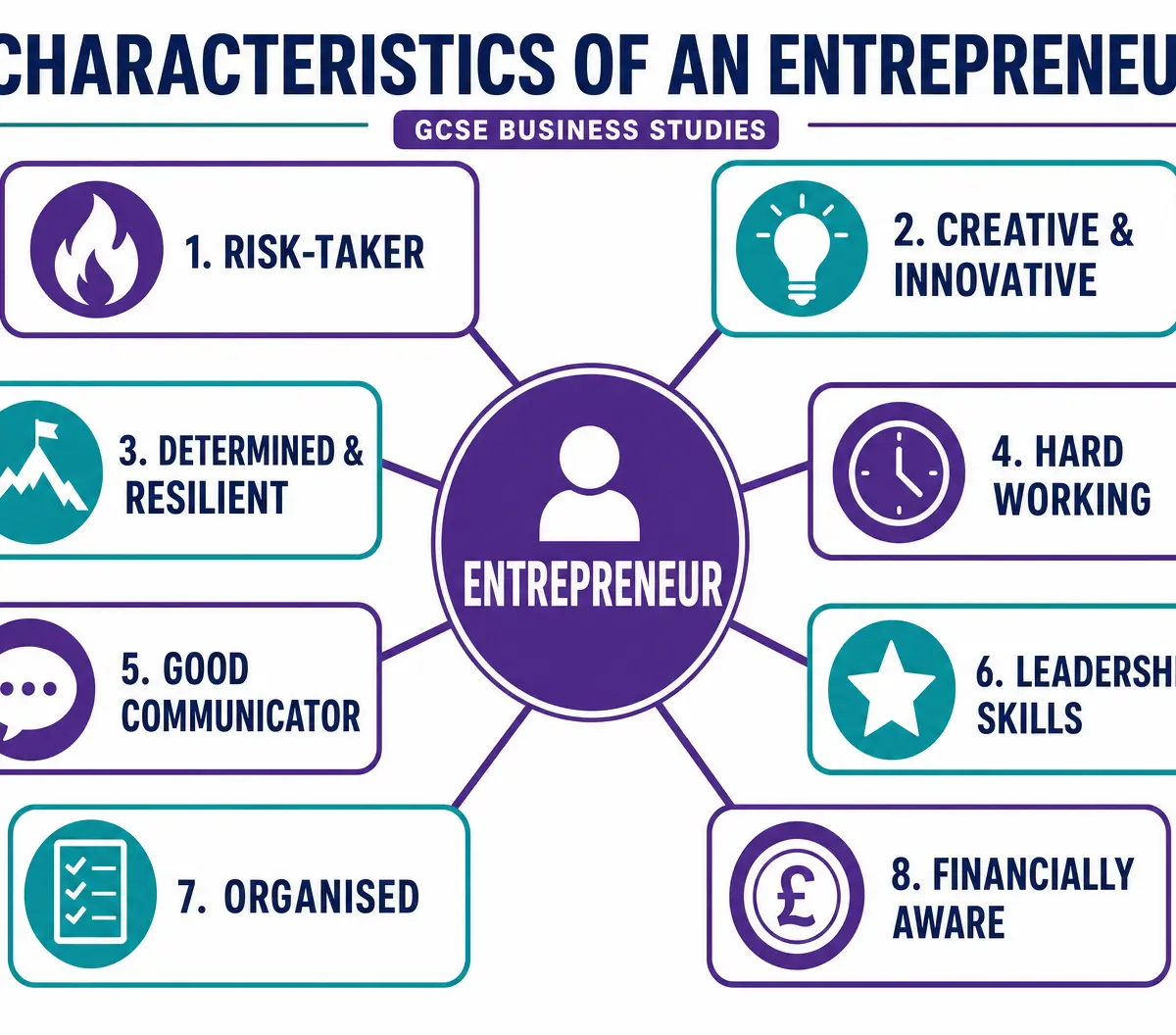
Examiners frequently test candidates' knowledge of entrepreneurial characteristics. To achieve high marks, you must be able to identify these traits and explain why they are important for business success. Key characteristics include:
- Risk-taker: Willing to invest personal time and money despite the possibility of failure.
- Creative and Innovative: Able to generate new ideas, spot market gaps, and develop unique solutions to customer problems.
- Determined and Resilient: Capable of persevering through setbacks, rejections, and difficult trading conditions.
- Hard-working: Prepared to put in the long hours required to establish and grow a new business.
- Good Leader: Able to motivate, inspire, and manage employees effectively.
- Organised: Skilled at planning, prioritising tasks, and managing time efficiently.
- Financially Aware: Understands the importance of cash flow, costs, pricing, and profit margins.
- Good Communicator: Able to articulate a vision, negotiate with suppliers, and persuade customers and investors.
Examiner Tip: Do not confuse an entrepreneur with an intrapreneur. An intrapreneur exhibits entrepreneurial characteristics (like innovation and initiative) but operates within an existing organisation. Crucially, the intrapreneur does not bear the personal financial risk of the venture; the organisation does.
Identifying Business Opportunities
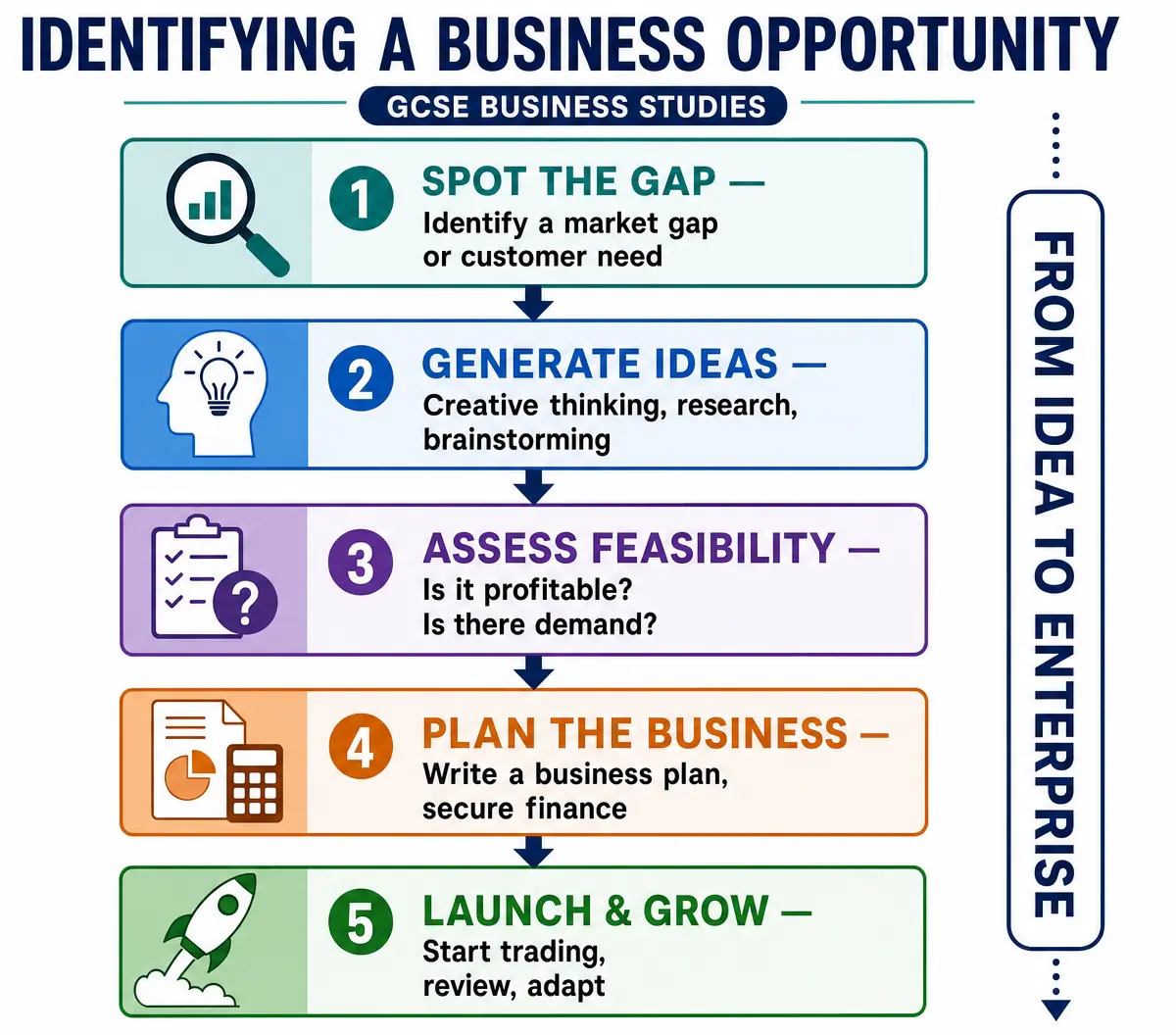
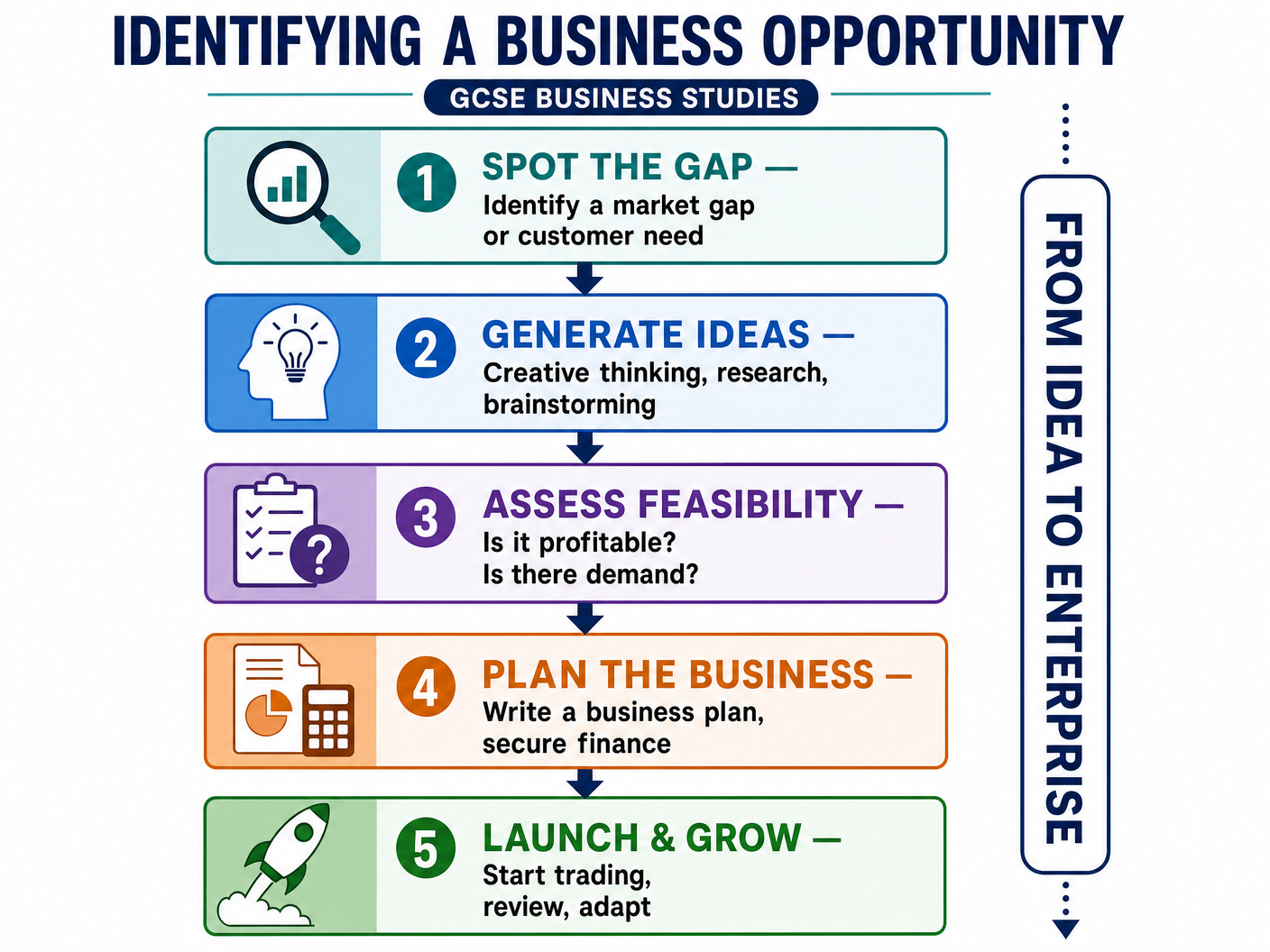
A critical skill for any entrepreneur is the ability to identify a viable business opportunity. This typically involves spotting a gap in the market—an unmet customer need or a segment of the market that is currently underserved by existing businesses.
Entrepreneurs identify opportunities through various methods:
- Personal Experience: Noticing a problem in their own lives and developing a solution.
- Market Trends: Observing shifts in consumer behaviour (e.g., the rise of eco-friendly products) and creating offerings to meet this new demand.
- Market Research: Conducting surveys, focus groups, or analyzing secondary data to understand what customers want and what they are willing to pay.
- Innovation: Developing entirely new products or significantly improving existing ones.
Once an opportunity is identified, the entrepreneur must assess its feasibility. Is there sufficient demand? Can the product be produced at a cost that allows for a profit margin? What are the potential risks? This assessment forms the basis of a business plan.
Risk and Reward
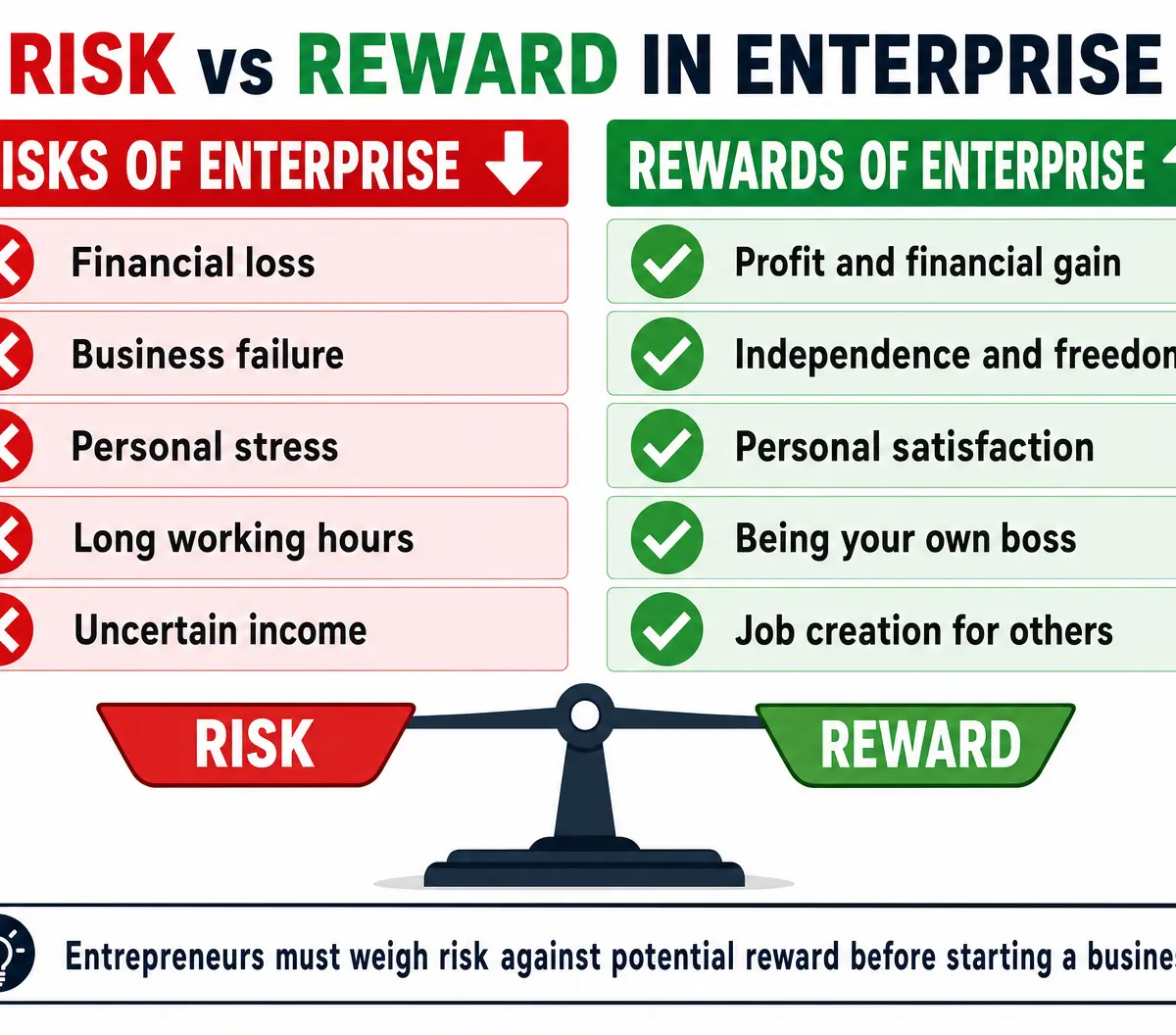
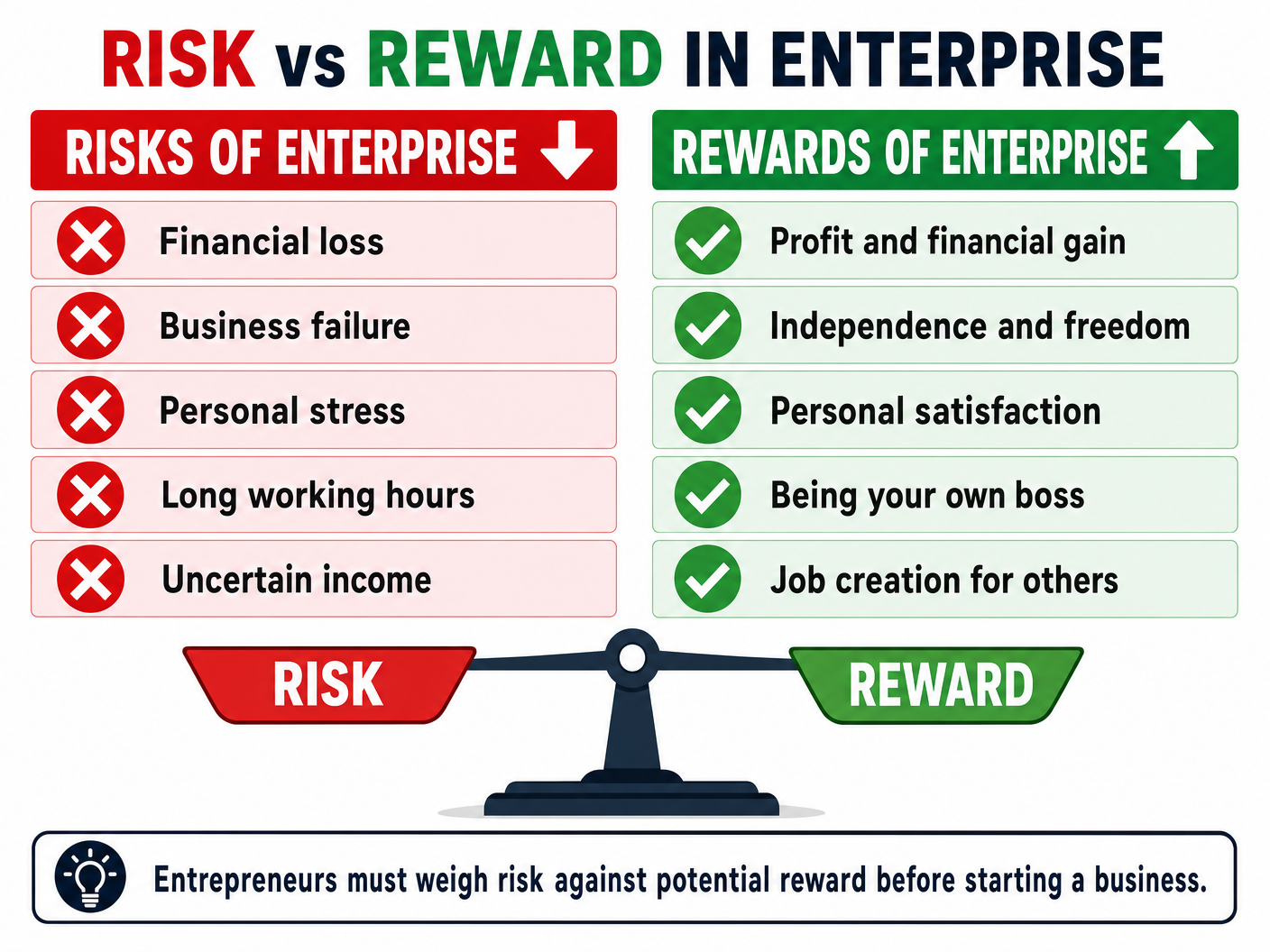
Every new business venture involves a balance between risk and potential reward. Examiners expect candidates to be able to assess both sides of this equation, particularly in evaluation questions.
The Risks of Enterprise
- Financial Loss: The entrepreneur may lose the capital they have invested if the business fails. This is often personal savings.
- Business Failure: The reality is that many new businesses fail within their first few years due to poor cash flow, lack of demand, or strong competition.
- Personal Stress: The pressure of running a business, managing finances, and making critical decisions can take a significant toll on an entrepreneur's mental health.
- Long Working Hours: Especially in the early stages, entrepreneurs often work much longer hours than typical employees, impacting their work-life balance.
- Uncertain Income: Unlike an employee with a guaranteed salary, an entrepreneur's income can fluctuate wildly depending on the success of the business.
The Rewards of Enterprise
- Profit: The primary financial reward. If revenue exceeds costs, the entrepreneur keeps the profit (or reinvests it to grow the business).
- Independence: The ability to be one's own boss, make independent decisions, and set one's own schedule.
- Personal Satisfaction: The immense pride and sense of achievement that comes from building a successful business from scratch.
- Job Creation: The satisfaction of providing employment opportunities for others and contributing to the local community.
The Role of Enterprise in the Economy
Enterprise is essential for a healthy economy. New businesses create jobs, which reduces unemployment and increases consumer spending power. They drive innovation, leading to better products and more efficient production methods. The increased competition from new entrants forces existing businesses to improve their offerings and keep prices competitive. Furthermore, successful businesses generate tax revenue (through corporation tax, income tax from employees, etc.), which the government uses to fund public services.
Because of these benefits, the government actively supports enterprise through various initiatives, such as the Start Up Loans scheme, tax incentives for investors, and providing advice and guidance to new business owners.
Visual Resources
3 diagrams and illustrations
Interactive Diagrams
1 interactive diagram to visualise key concepts
Conceptual Flow Outline
The process of developing a business opportunity.
Worked Examples
3 worked examples — open one to explore the question and available guidance.
Practice Questions
Test your understanding — click to reveal model answers
Which of the following is a characteristic of an entrepreneur? (1 mark)
A) Risk-averse
B) Lacks initiative
C) Innovative
D) Prefers guaranteed income
Hint: Think about the traits needed to start something new.
Explain one difference between an entrepreneur and an intrapreneur. (3 marks)
Hint: Focus on who bears the financial consequences if the project fails.
Explain two ways an entrepreneur might identify a business opportunity. (6 marks)
Hint: You need two separate points, each developed with an explanation of how it leads to a business idea.
Sarah is considering leaving her secure job as a teacher to start her own tutoring business. Evaluate whether the potential rewards of starting her own business outweigh the risks. (12 marks)
Hint: You must discuss both risks and rewards, apply them specifically to Sarah's situation (tutoring), and reach a justified conclusion.
State one way the government supports enterprise in the UK. (1 mark)
Hint: Think about financial schemes or advice provided to new businesses.