Pearson Edexcel · GCSE · Business
Topic 1.3 Putting a business idea into practice
Master the financial foundations of starting a business. Learn how to calculate profit, forecast cash flow, and secure the right sources of finance to turn an idea into reality.
- 4 min read
- 3 worked examples
- 5 practice questions
- 6 key terms
Study Notes

Overview
Putting a business idea into practice requires more than just a good product; it demands sound financial planning. This topic covers the critical transition from an idea to a trading entity. Candidates must understand how to set SMART objectives, calculate revenue, costs, and profit, forecast cash flow, and choose appropriate sources of finance. Examiners expect you to not only know the formulas but to apply them to specific business scenarios, recommending actions based on financial data.

Business Aims and Objectives
Aims: The overall, long-term goal of the business (e.g., to become the market leader).
Objectives: Specific, measurable targets set to help achieve the aim. The best objectives are SMART (Specific, Measurable, Achievable, Realistic, Time-bound).
Why it matters: Objectives provide direction, motivate staff, and allow success to be measured. They change over time: a start-up focuses on survival, while an established business focuses on growth or profit maximisation.
Revenue, Costs, and Profit
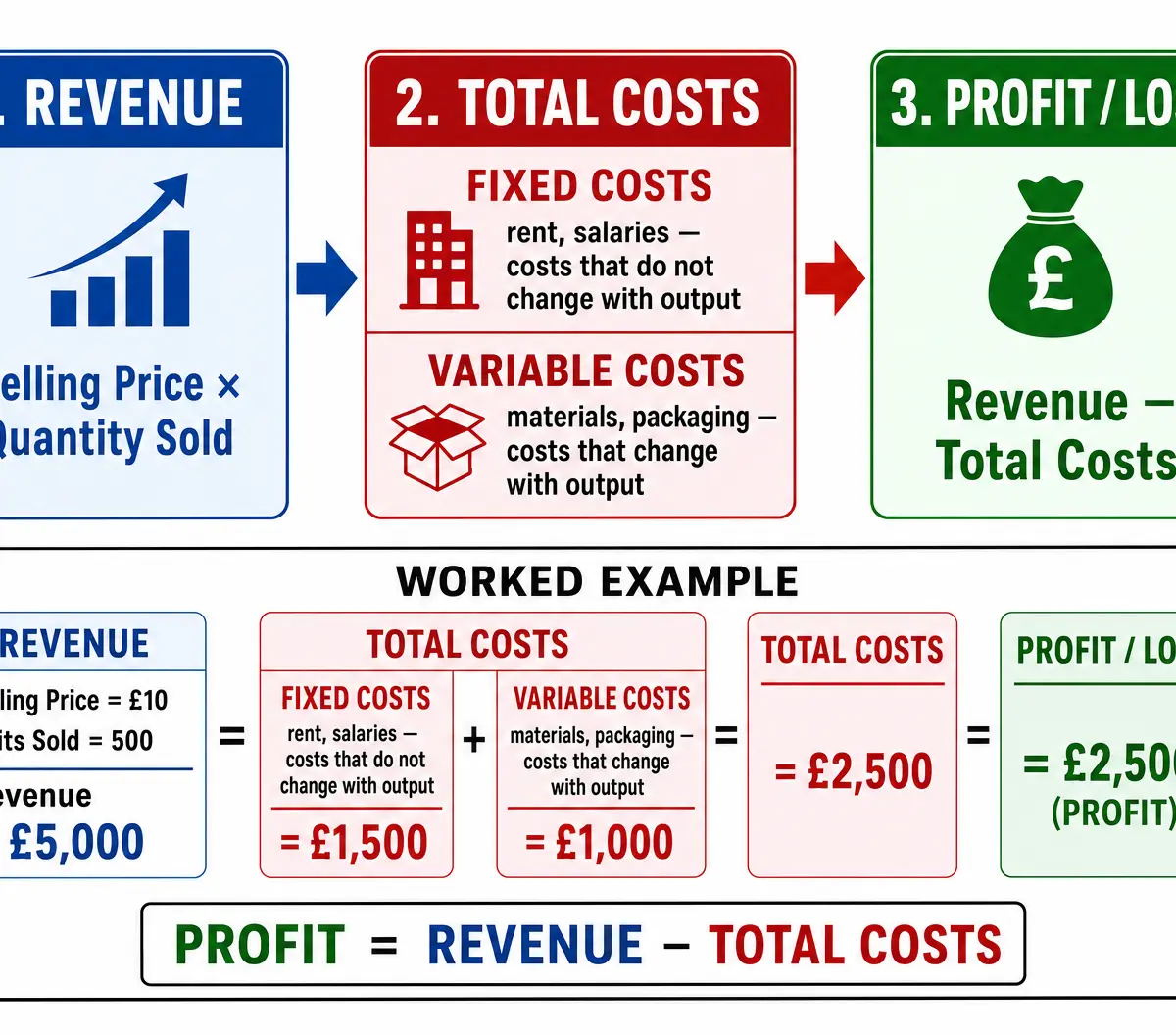
Revenue: The money coming in from sales.
Formula: Selling Price × Quantity Sold
Costs: The expenses involved in running the business.
- Fixed Costs: Costs that do not change with output (e.g., rent, salaries).
- Variable Costs: Costs that change directly with output (e.g., raw materials, packaging).
- Formula: Total Costs = Fixed Costs + Variable Costs
Profit: The financial reward for risk-taking.
Formula: Profit = Revenue - Total Costs
Why it matters: Understanding these figures allows a business to calculate its break-even point and make informed pricing decisions.
Cash Flow Forecasting
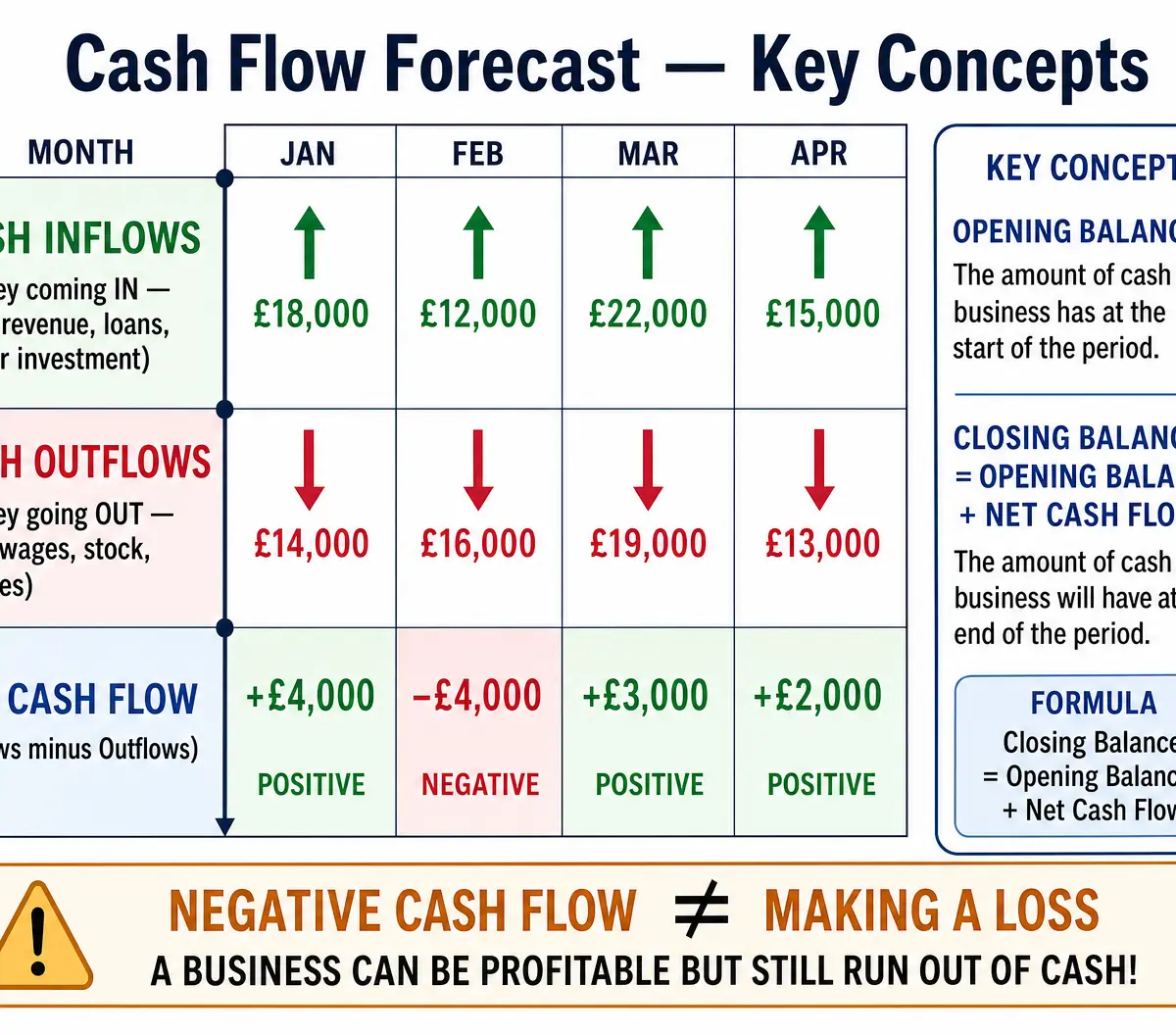
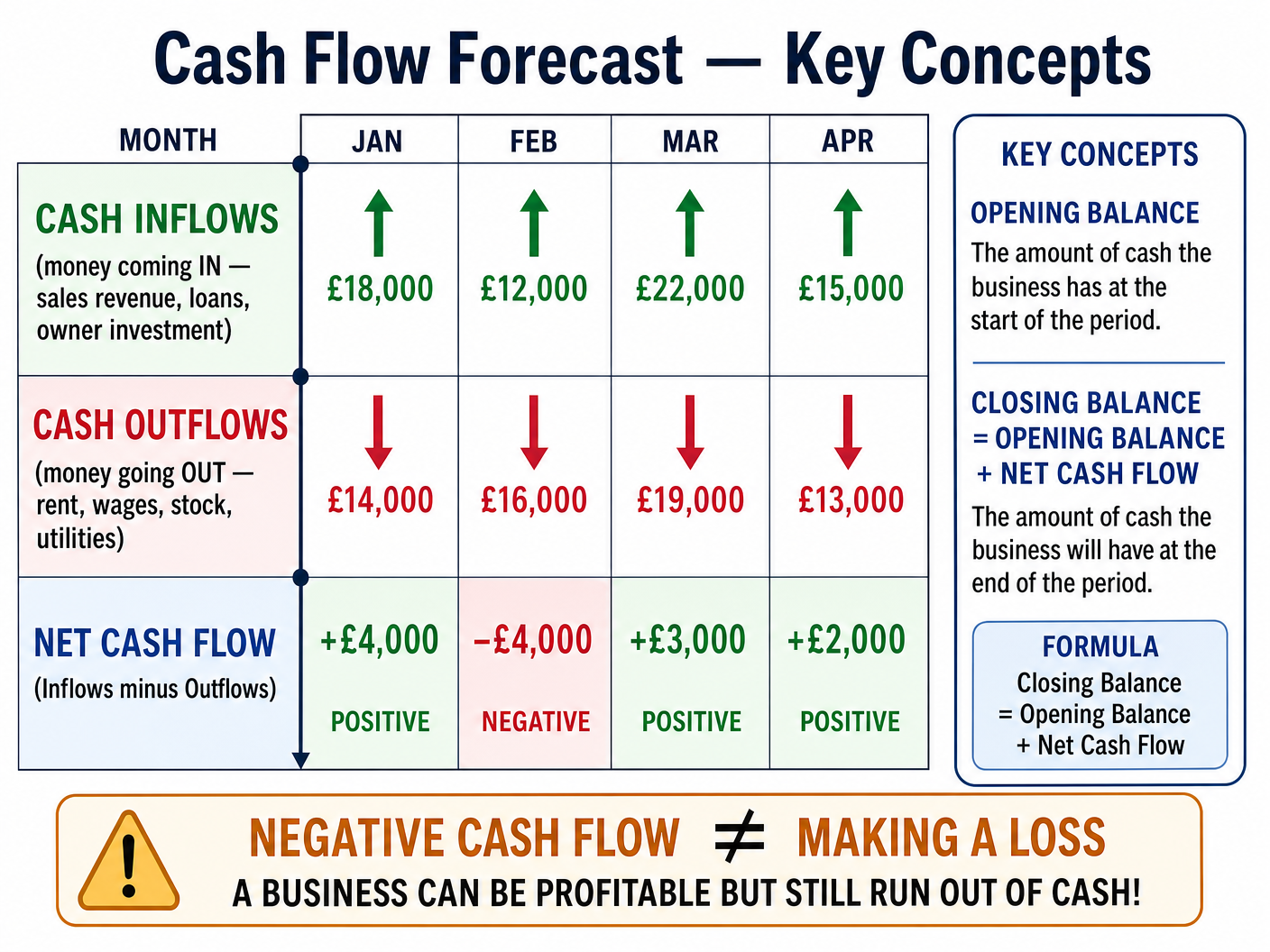
Cash Flow: The movement of money into and out of the business over a period of time.
Net Cash Flow: Inflows minus Outflows.
Closing Balance: Opening Balance + Net Cash Flow.
Why it matters: A business can be profitable but still fail if it runs out of cash to pay its short-term debts. Examiners frequently test the distinction between cash flow and profit.
Sources of Finance
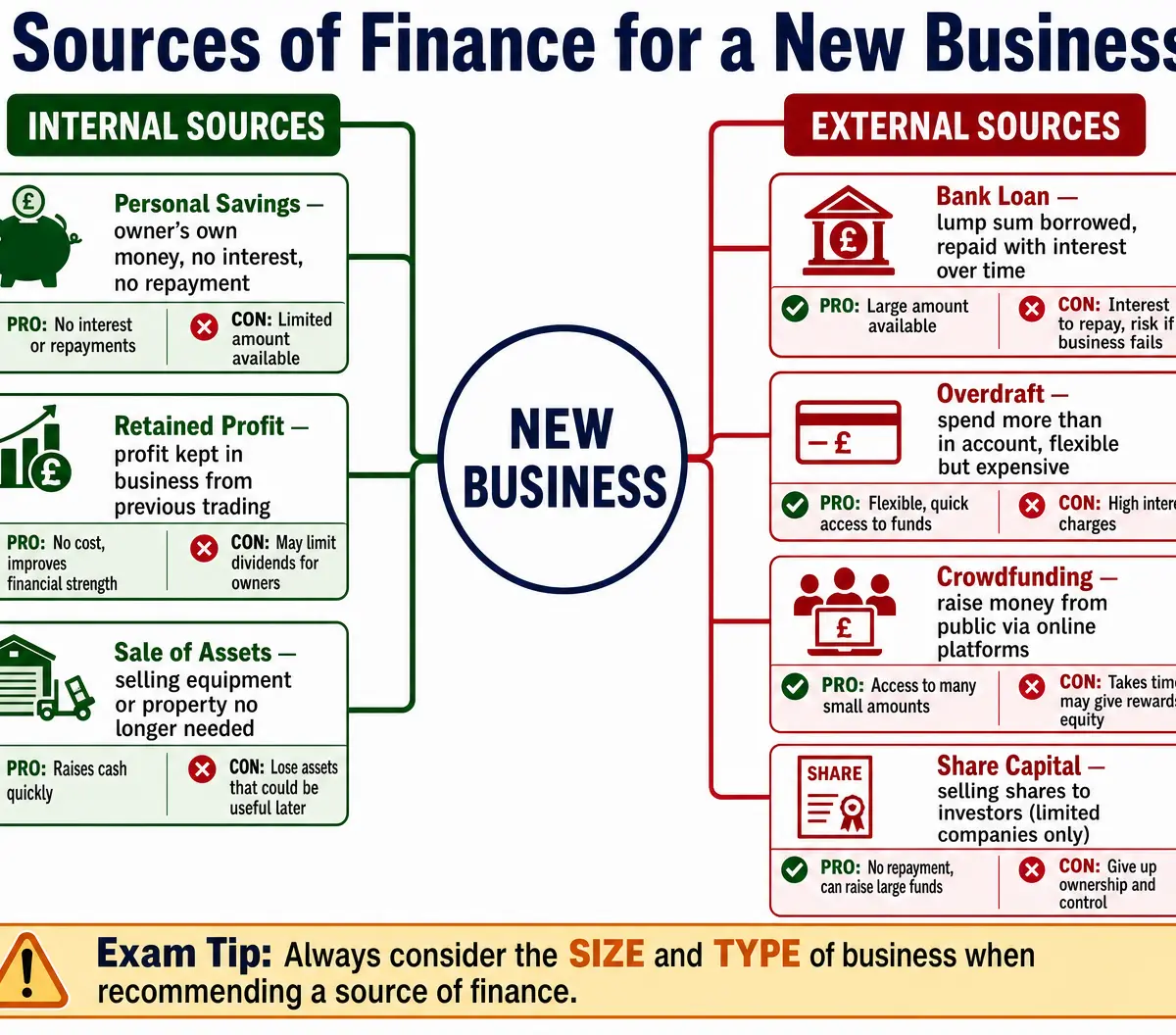
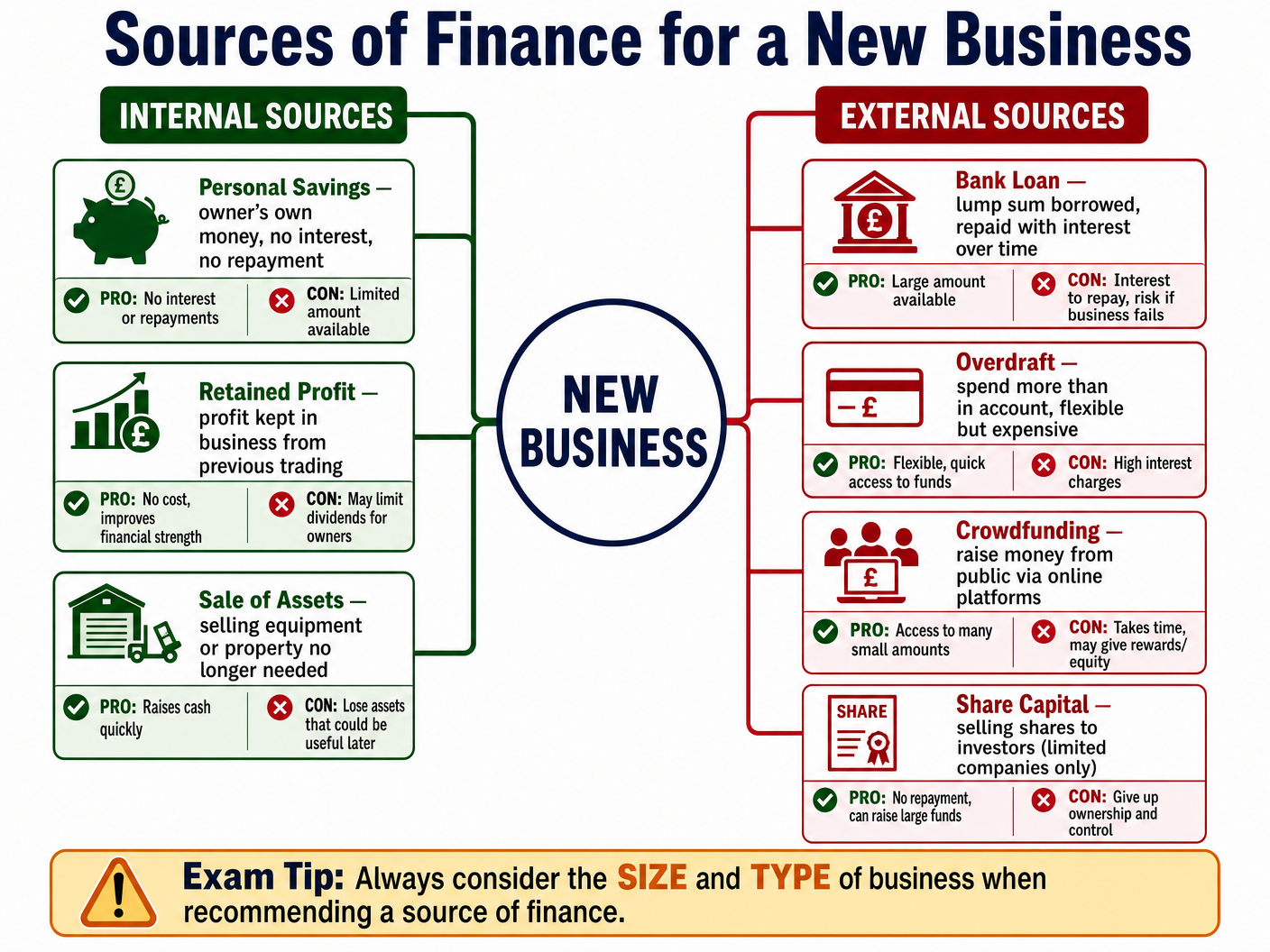
Internal Sources: Generated from within the business (e.g., personal savings, retained profit, sale of assets).
External Sources: Raised from outside the business (e.g., bank loan, overdraft, share capital, crowdfunding).
Why it matters: Different sources are suitable for different needs. An overdraft is for short-term cash flow problems, while a bank loan is for long-term asset purchases. Examiners expect you to recommend the right source based on the business's size, legal structure, and financial position.
Visual Resources
3 diagrams and illustrations
Interactive Diagrams
1 interactive diagram to visualise key concepts
Conceptual Flow Outline
The process of putting a business idea into practice
Worked Examples
3 worked examples — open one to explore the question and available guidance.
Practice Questions
Test your understanding — click to reveal model answers
A business has opening balance of £2,000, total inflows of £5,000, and total outflows of £6,000. Calculate the closing balance. (2 marks)
Hint: Calculate net cash flow first, then add to opening balance.
Explain one impact on a business of having a negative cash flow. (3 marks)
Hint: Think about what happens when you can't pay your bills.
State two internal sources of finance. (2 marks)
Hint: Money that comes from within the business or its owners.
A sole trader wants to open a second shop. Evaluate whether they should use a bank loan or crowdfunding. (9 marks)
Hint: Consider the amount needed, the cost of borrowing, and the time/effort required.
Calculate the break-even output if selling price is £10, variable cost is £4, and fixed costs are £1,200. (3 marks)
Hint: Contribution = Selling Price - Variable Cost. Break-even = Fixed Costs / Contribution.