Pearson Edexcel · GCSE · Business
Topic 2.2 Making marketing decisions
Marketing isn't just advertising; it's the heartbeat of a successful business. Topic 2.2 explores how businesses research their customers, segment their markets, and balance the 4Ps of the marketing mix to drive sales and stay ahead of competitors.
- 5 min read
- 3 worked examples
- 5 practice questions
- 7 key terms
Study Notes

Overview
Topic 2.2: Making Marketing Decisions is a core component of the GCSE Business specification. It moves beyond the external factors influencing a business and focuses on the internal, strategic choices managers make to identify, anticipate, and satisfy customer needs profitably. Examiners expect candidates to not only define marketing concepts but to apply them to specific business contexts provided in the source material. A strong understanding of how the elements of the marketing mix (Product, Price, Place, Promotion) interrelate is crucial for accessing higher-level marks in evaluation questions.
Listen to our revision podcast to reinforce your learning:

Market Research
Market research is the systematic collection, analysis, and evaluation of data relating to customer preferences, competitors, and the market. It reduces the risk of business failure.
Primary vs Secondary Research
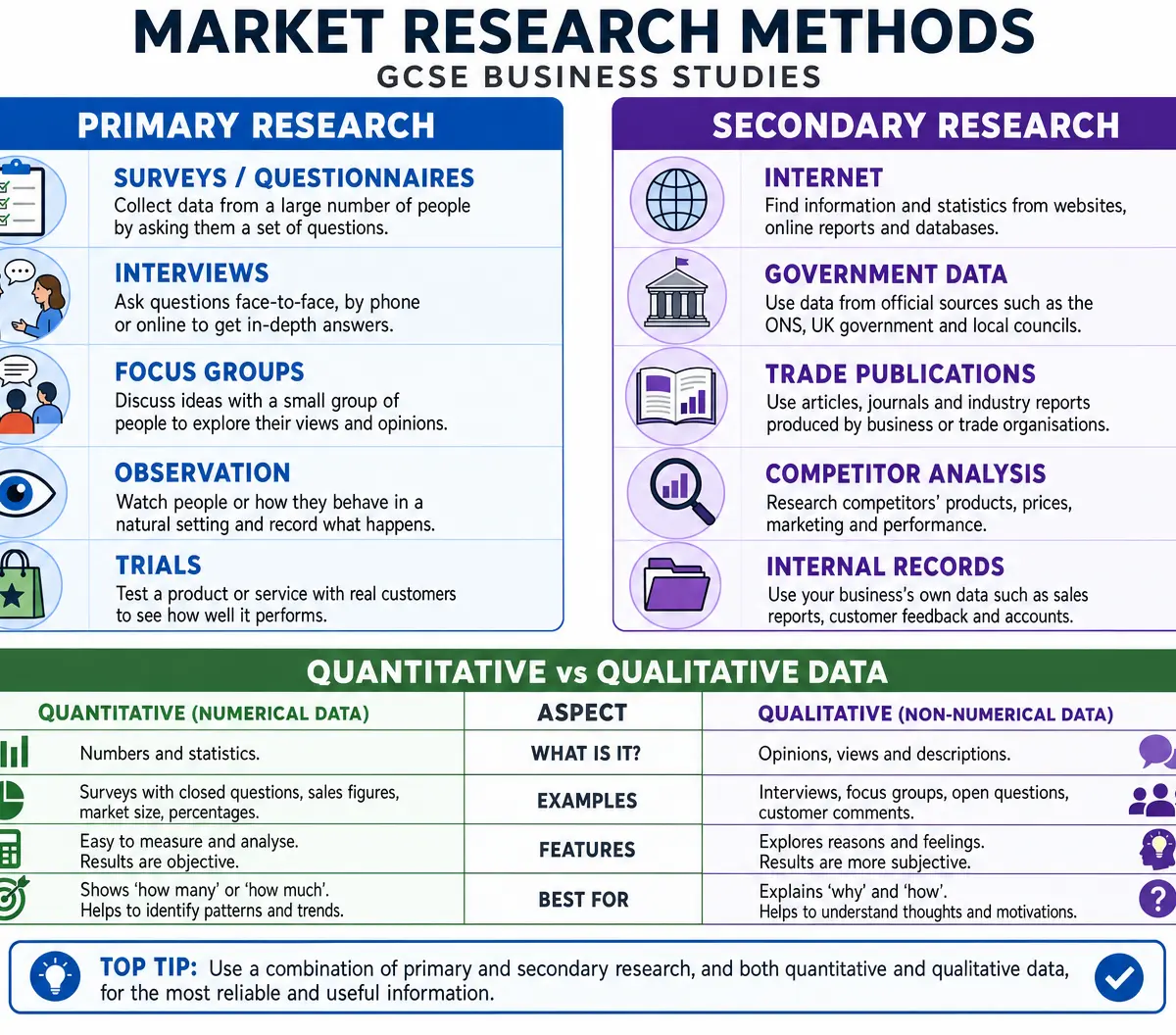
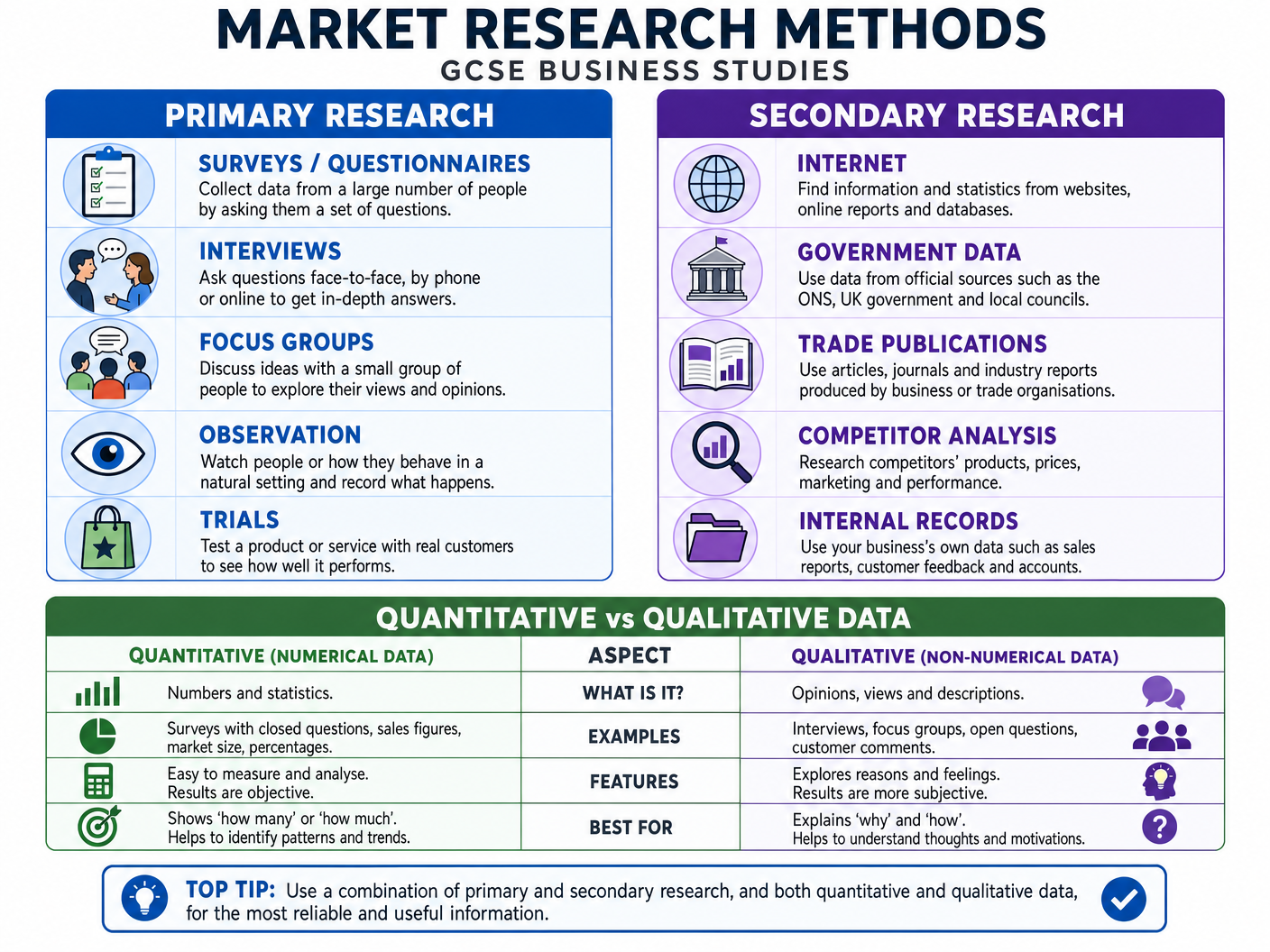
Primary (Field) Research: Gathering new, original data directly for a specific purpose.
- Methods: Questionnaires, interviews, focus groups, observation, test marketing.
- Advantages: Up-to-date, specific to the business's exact needs, competitors cannot access it.
- Disadvantages: Time-consuming, expensive, requires expertise to design without bias.
Secondary (Desk) Research: Analysing existing data that has already been collected for another purpose.
- Methods: Internet research, government statistics (e.g., ONS), trade journals, internal sales data, competitor reports.
- Advantages: Quick to access, often free or cheap, provides a good overview of the market.
- Disadvantages: May be out-of-date, not specific to the business's exact question, available to competitors.
Quantitative vs Qualitative Data
Examiners frequently test the distinction between these data types:
- Quantitative: Numerical data (e.g., "75% of customers prefer the new flavour"). Easy to analyse and display in charts, but lacks depth.
- Qualitative: Non-numerical data focusing on opinions and feelings (e.g., "Customers felt the packaging looked cheap"). Provides deep insights into why customers behave a certain way, but is harder to analyse and subjective.
Market Segmentation
Segmentation involves dividing a broad target market into smaller, more defined subsets of consumers who share common needs, interests, or characteristics. This allows a business to tailor its marketing mix effectively.
Common Segmentation Methods:
- Demographic: Age, gender, income, occupation.
- Geographic: Location (local, national, international, urban vs rural).
- Psychographic: Lifestyle, values, personality.
- Behavioural: Buying habits, brand loyalty, usage rate.
Examiner Tip: When evaluating segmentation, note that it allows for targeted marketing (reducing wasted advertising spend) but can be expensive to research and develop specific products for multiple segments.
The Marketing Mix (The 4Ps)
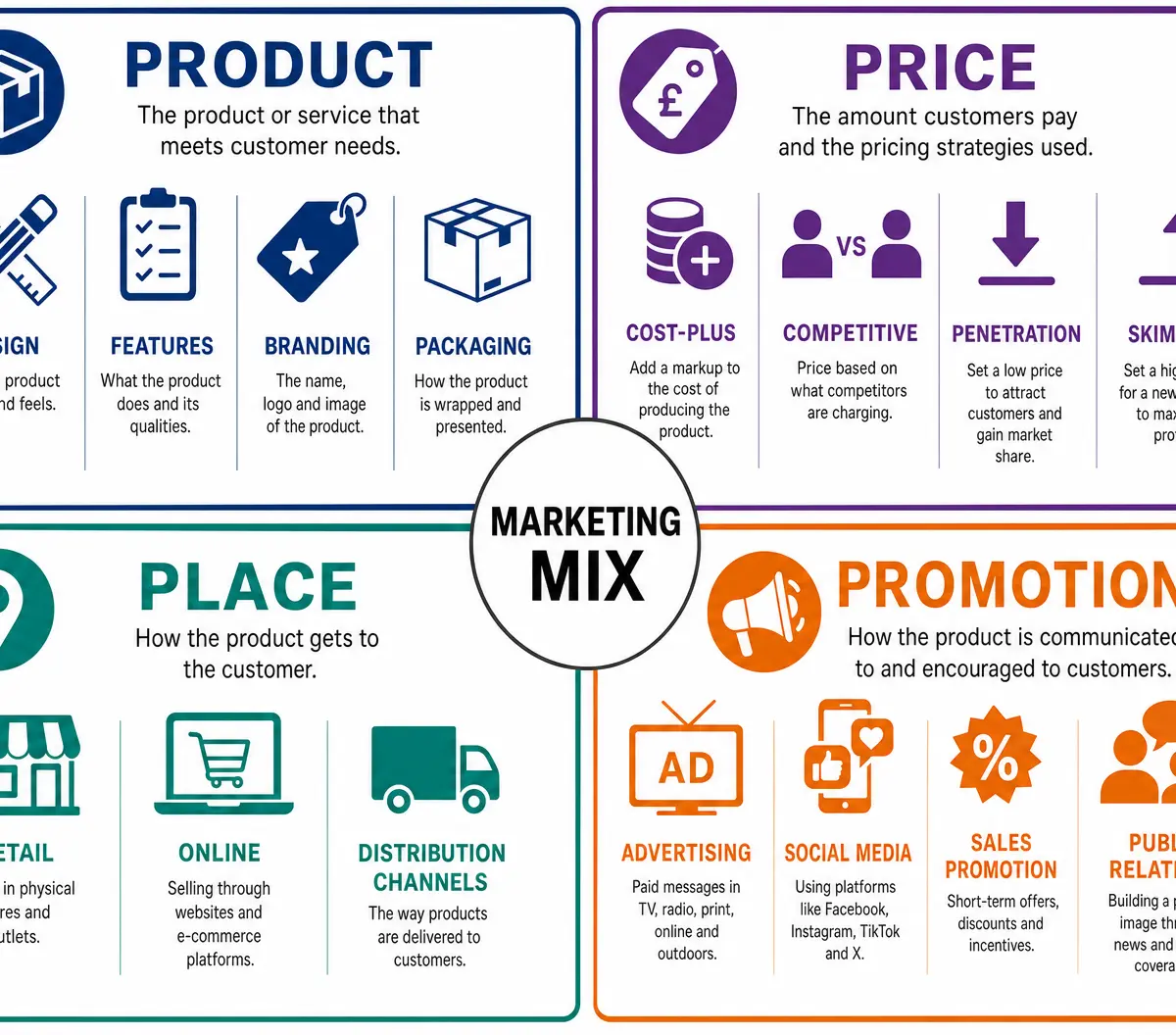
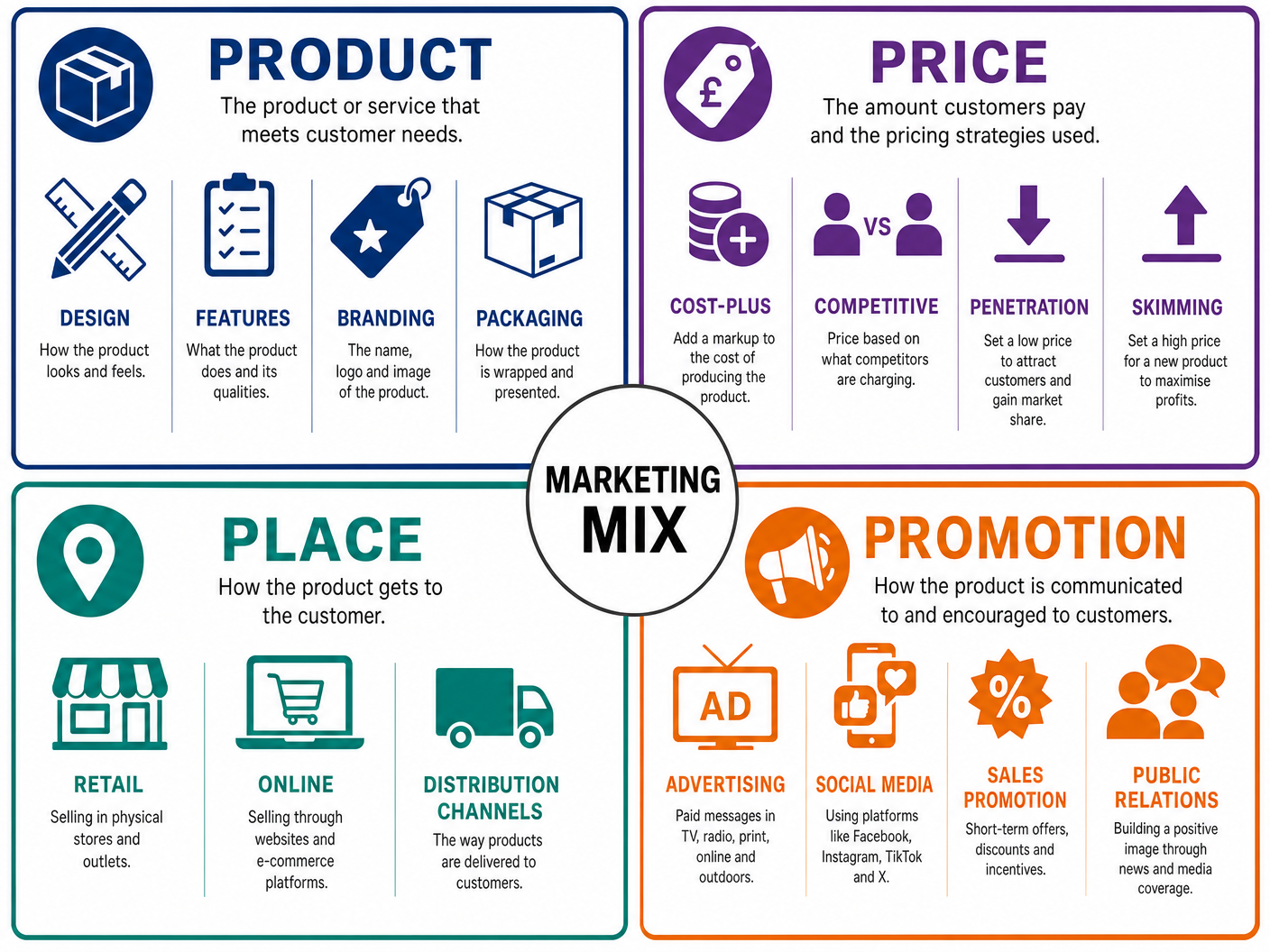
The marketing mix is the combination of four elements that a business uses to achieve its marketing objectives. Examiners look for candidates who understand that these four elements must be integrated and consistent.
1. Product
The good or service being sold. Key decisions involve design, features, quality, branding, and packaging. A product must meet customer needs better than rivals. Product differentiation (creating a Unique Selling Point or USP) allows a business to charge a premium price.
2. Price
The amount a customer pays. Candidates must understand several pricing strategies:
- Cost-plus pricing: Adding a percentage markup to the cost of producing the product. Simple, but ignores competitor prices.
- Competitive pricing: Setting prices in line with rivals. Used in highly competitive markets.
- Penetration pricing: Setting an initially low price to attract customers and gain market share quickly, before raising it later.
- Price skimming: Setting a high initial price for a highly differentiated or innovative product to maximise profit from early adopters, before lowering it later.
3. Place
How the product is distributed to the customer. This includes physical retail stores, e-commerce (online), and using intermediaries like wholesalers. The rise of multi-channel distribution (e.g., buying online and collecting in-store) is a key modern trend.
4. Promotion
How the business communicates with the market. Methods include:
- Advertising: Paid communication (TV, social media, print).
- Sales Promotion: Short-term incentives (BOGOF, discounts, loyalty cards).
- Public Relations (PR): Managing the brand's image in the media.
- Sponsorship: Paying to associate the brand with an event or person.
Integration of the Mix
If a business sells a luxury, high-quality Product, it must use price skimming or a premium Price, distribute it through exclusive Places (high-end boutiques, not discount stores), and use high-quality Promotion (glossy magazines, targeted social media). If one 'P' is wrong, the strategy fails.
Worked Examples
3 worked examples — open one to explore the question and available guidance.
Practice Questions
Test your understanding — click to reveal model answers
State two methods of primary market research. (2 marks)
Hint: Think of methods where the business collects new data directly from people.
Explain one disadvantage of using secondary market research. (3 marks)
Hint: Consider the relevance and age of data that already exists.
Explain how the 'Place' element of the marketing mix has been affected by e-commerce. (3 marks)
Hint: How do businesses distribute goods differently now compared to just having high street shops?
A technology company is launching a highly advanced, innovative new smartphone. It has invested heavily in research and development. Recommend whether the company should use price skimming or competitive pricing for the launch. (9 marks)
Hint: Consider the nature of the product (innovative) and the need to recover R&D costs.
Analyse the impact on a business of having an integrated marketing mix. (6 marks)
Hint: What happens when Product, Price, Place, and Promotion all send the same message to the consumer?