OCR · GCSE · Business
Course version: J204 · Version from Sept 2019
Market research
Market research is the foundation of every successful business decision, separating profitable ventures from costly failures. By understanding customer needs and market trends, businesses can reduce risk and spot lucrative opportunities before their competitors.
- 4 min read
- 3 worked examples
- 5 practice questions
- 6 key terms
Check what you remember
Read the wording for your board, then hide it and explain Market Research in your own words. Rough notes are fine. This is a self-check, with no mark or grade.
Reference: OCR
The process of gathering, analysing and interpreting information about a market, a product, or its customers.
Study Notes
Overview
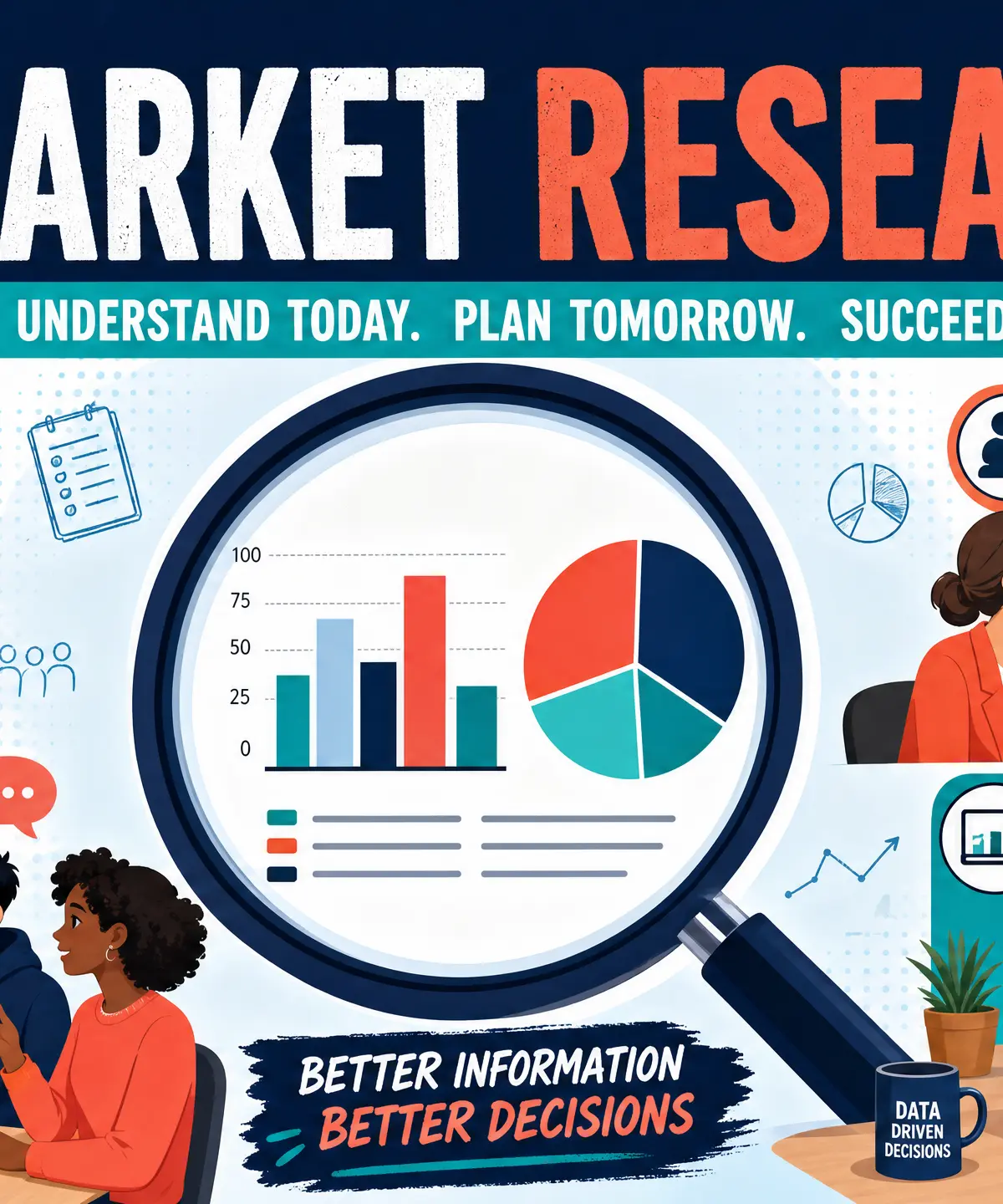
Market research is the systematic process of gathering, recording, and analysing information about customers, competitors, and the market itself. In the business world, making decisions based on guesswork is a fast track to failure. Market research provides the hard data and customer insights needed to reduce risk, identify gaps in the market, and ensure products actually meet customer needs. For your GCSE exam, examiners don't just want you to list research methods; they expect you to justify which method is most appropriate for a specific business scenario given its budget, size, and objectives.
Listen to the companion podcast to consolidate your learning:
The Purpose of Market Research
Before diving into methods, you must understand why businesses conduct research:
- To identify customer needs: What do customers want? What problems need solving?
- To spot gaps in the market: Finding unfulfilled customer needs that competitors have missed.
- To reduce risk: Testing ideas before spending thousands of pounds on a full launch.
- To make informed decisions: Using data rather than intuition to guide pricing, promotion, and product development.
Primary Research (Field Research)
Primary research involves collecting new, original data directly for the business's specific needs. It is gathered first-hand.
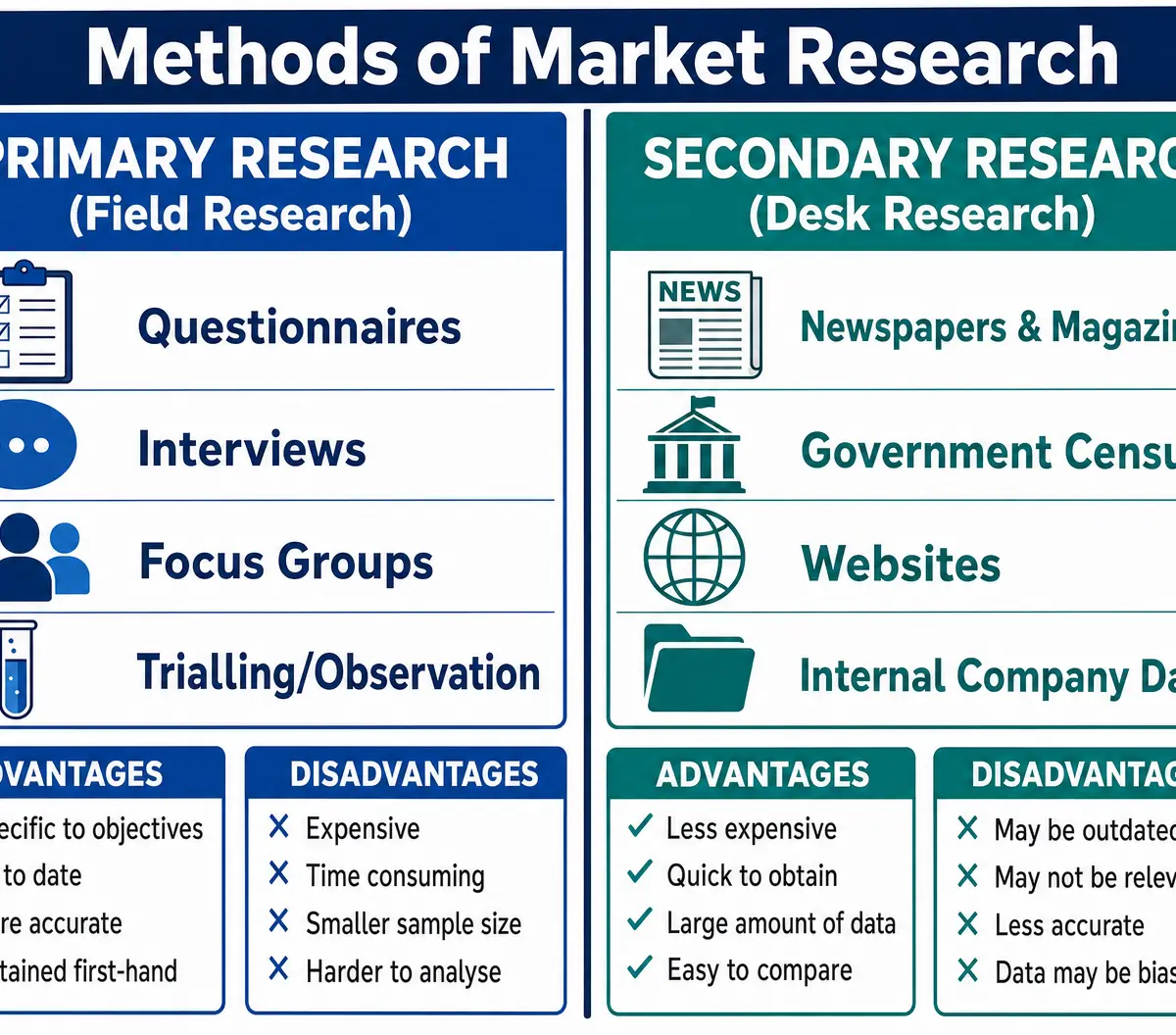
Questionnaires and Surveys
What it is: A set of written questions given to a sample of people (online, postal, or face-to-face).
Advantages: Can reach a large audience cheaply (especially online); easy to analyse if closed questions are used.
Disadvantages: Response rates can be low; poorly worded questions can lead to inaccurate data.
Interviews
What it is: Face-to-face or telephone conversations asking detailed questions.
Advantages: Allows for detailed, in-depth responses; interviewer can clarify misunderstandings.
Disadvantages: Time-consuming and expensive; smaller sample size.
Focus Groups
What it is: A small group of people (usually 6-10) brought together to discuss a product or idea.
Advantages: Provides rich qualitative data; participants can bounce ideas off each other.
Disadvantages: Expensive to run; dominant personalities can skew the group's opinions.
Trialling and Observation
What it is: Testing a product in a limited area or watching customer behaviour in-store.
Advantages: Shows actual behaviour rather than what people say they will do.
Disadvantages: Competitors can see what you are doing; only tests a small segment of the market.
Secondary Research (Desk Research)
Secondary research involves using existing data that has already been collected by someone else for another purpose.
Newspapers and Magazines
What it is: Trade journals and national press.
Usefulness: Good for understanding general market trends and competitor activity.
Government Census
What it is: Official demographic data collected every 10 years.
Usefulness: Excellent for understanding population age, income levels, and household sizes in specific areas.
Websites and Market Reports
What it is: Competitor websites, or reports from agencies like Mintel.
Usefulness: Provides detailed industry analysis, though professional reports can be expensive to purchase.
Internal Company Data
What it is: Past sales figures, customer databases, loyalty card data.
Usefulness: Free and immediately available; highly relevant to the specific business.
Qualitative vs Quantitative Data
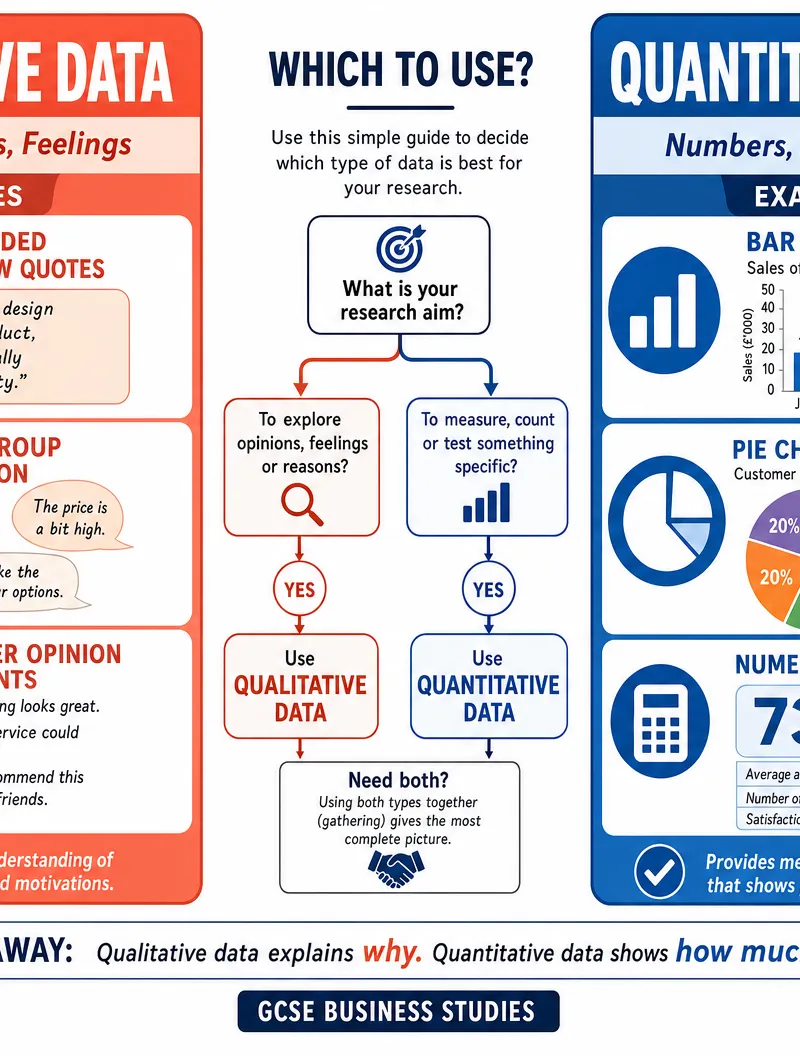
Examiners frequently test your ability to distinguish between these two types of data.
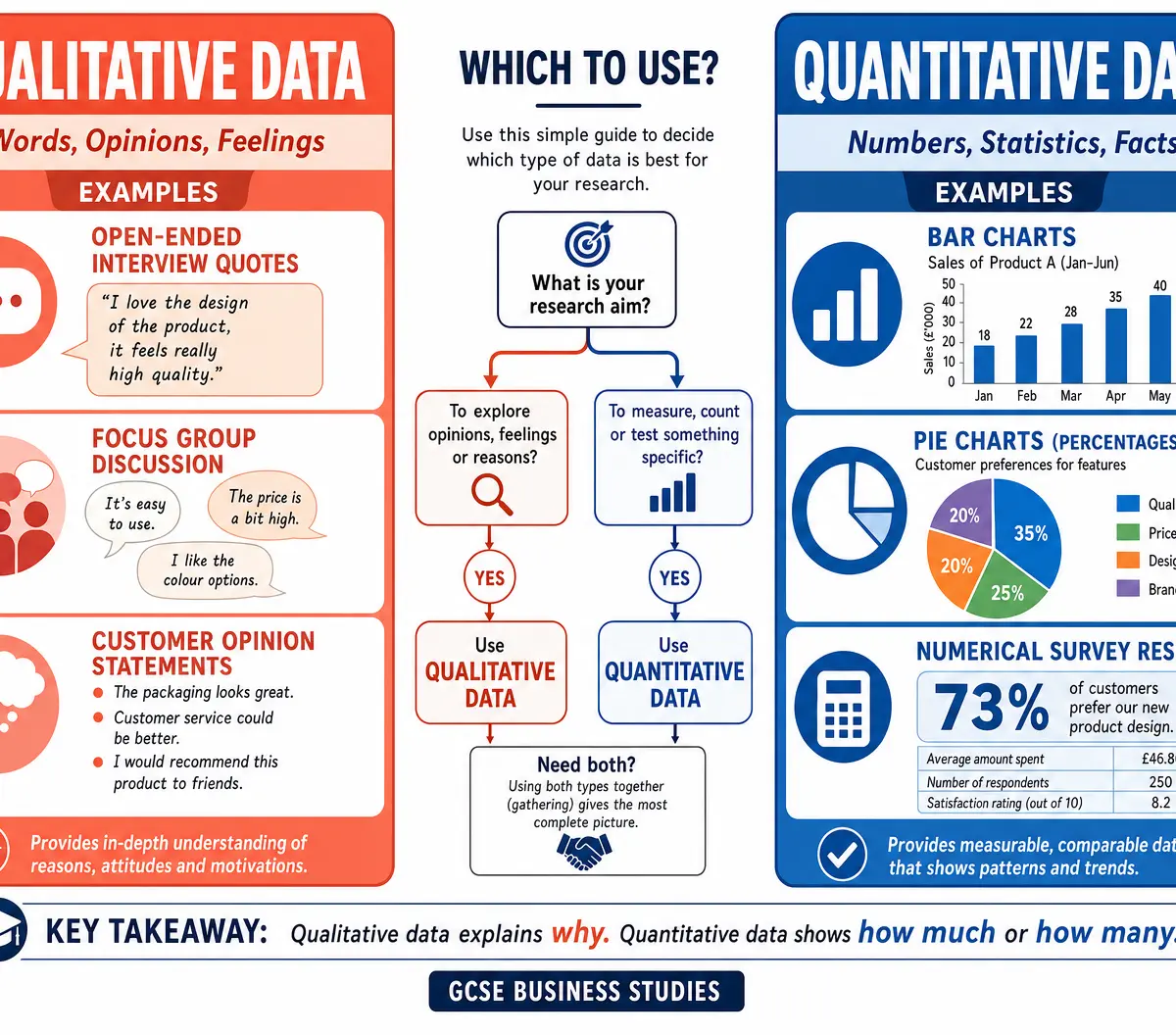
Quantitative Data
What it is: Numerical data that can be measured, counted, and expressed in charts or graphs (e.g., "75% of customers prefer the red packaging").
Best for: Answering "How many?" or "How much?" Identifying broad trends.
Qualitative Data
What it is: Descriptive data based on opinions, feelings, and attitudes (e.g., "Customers felt the red packaging looked cheaper than the blue").
Best for: Answering "Why?" Understanding customer motivations and emotions.
Visual Resources
2 diagrams and illustrations
Interactive Diagrams
1 interactive diagram to visualise key concepts
Conceptual Flow Outline
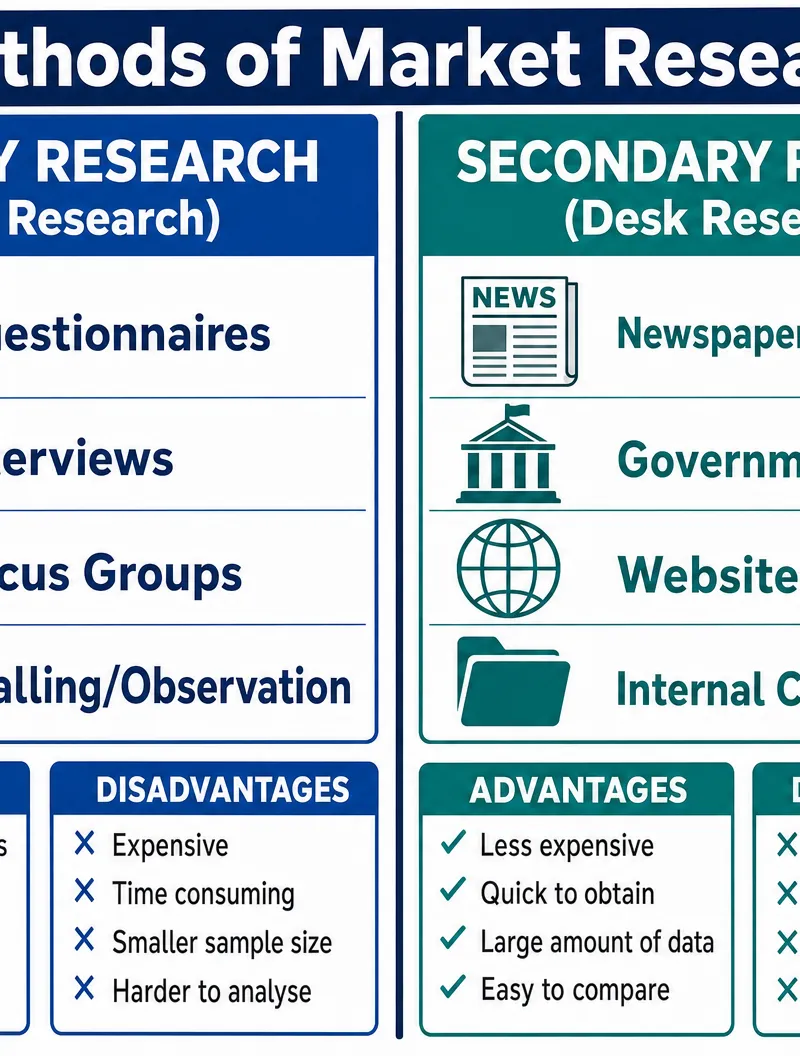
The structure of Market Research methods
Worked Examples
3 worked examples — open one to explore the question and available guidance.
Practice Questions
Try the question, then reveal an answer plan or example response
Explain two reasons why a business might conduct market research before launching a new product. (6 marks)
Hint: Think about risk and customer needs. You need two distinct points, each fully explained.
Evaluate the usefulness of focus groups for a local independent café wanting to change its menu. (9 marks)
Hint: Discuss the pros of focus groups, the cons, and then conclude based on the specific context of a *local independent café*.
Which of the following is an example of quantitative data? A) Customer reviews on a website B) A focus group transcript C) 65% of customers rating a service as 'Excellent' D) An interview with a store manager. (1 mark)
Hint: Quantitative means quantity - look for numbers.
Explain one disadvantage of using a questionnaire with closed questions. (2 marks)
Hint: What do closed questions stop the customer from doing?
A tech company is developing a revolutionary new type of smartwatch that has never been seen before. State whether they should rely mostly on internal secondary data or primary research. Give one reason for your answer. (2 marks)
Hint: If the product has never been seen before, does existing data exist?
Exam technique
How to turn what you know into marks
How to approach the question
Always look for the business context in the question. Is it a local plumber or a multinational tech firm? Your recommended research methods must match their budget and scale.
How to structure your answer
- Explain questions
- State the point, explain how it works, and link it to the specific business context.
- Evaluate questions
- Give the pros, give the cons, and conclude with a final judgement based on the most important factor.
- Recommend questions
- Analyse option A in context, analyse option B in context, provide a justified conclusion stating why one is better than the other.
Timing
Approximately 1 minute per mark.
Common pitfalls
- Mixing up primary and secondary research definitions.
- Suggesting expensive primary research (like focus groups) for small start-ups with no budget.
- Failing to give a conclusion in 9 or 12 mark 'Recommend' or 'Evaluate' questions.
What the command words want
- Analyse
- Show the causes and consequences. How does this research impact the business's success?
- Explain
- Make a point and develop it. Use connective words like 'because' or 'therefore'.
- State/Identify
- Short, factual answers. No explanation needed.
- Recommend/Evaluate
- Requires a balanced argument and a final, justified judgement.
Watch or listen (optional)
Test your understanding of Market research
Active recall beats re-reading. Take an instant quiz now to test what you’ve learned and lock it into long-term memory.
A week of Premium from your first lesson · Then the free plan continues · No card, no charge