OCR · GCSE · Business
Course version: J204 · Version from Sept 2019
People
Master the 'People' topic for GCSE Business Studies, covering everything from organisational structures to motivation theories. This guide provides examiner-focused insights, helping you apply HR concepts to real business scenarios to secure top marks.
- 5 min read
- 3 worked examples
- 5 practice questions
- 6 key terms
Check what you remember
Read the wording for your board, then hide it and explain Span of Control in your own words. Rough notes are fine. This is a self-check, with no mark or grade.
Reference: OCR
The number of subordinates a manager is directly responsible for.
Study Notes

Overview
The 'People' topic is a core component of GCSE Business Studies, exploring how businesses manage their most valuable asset: human resources. Examiners expect you to understand how organisational structures, recruitment processes, motivation theories, training, and employment law impact business performance. Crucially, top marks are awarded not just for knowing these concepts, but for applying them to specific business contexts provided in the exam stimulus. Whether it's a small local bakery or a multinational corporation, your ability to tailor HR strategies to the scenario is key.
Organisational Structures
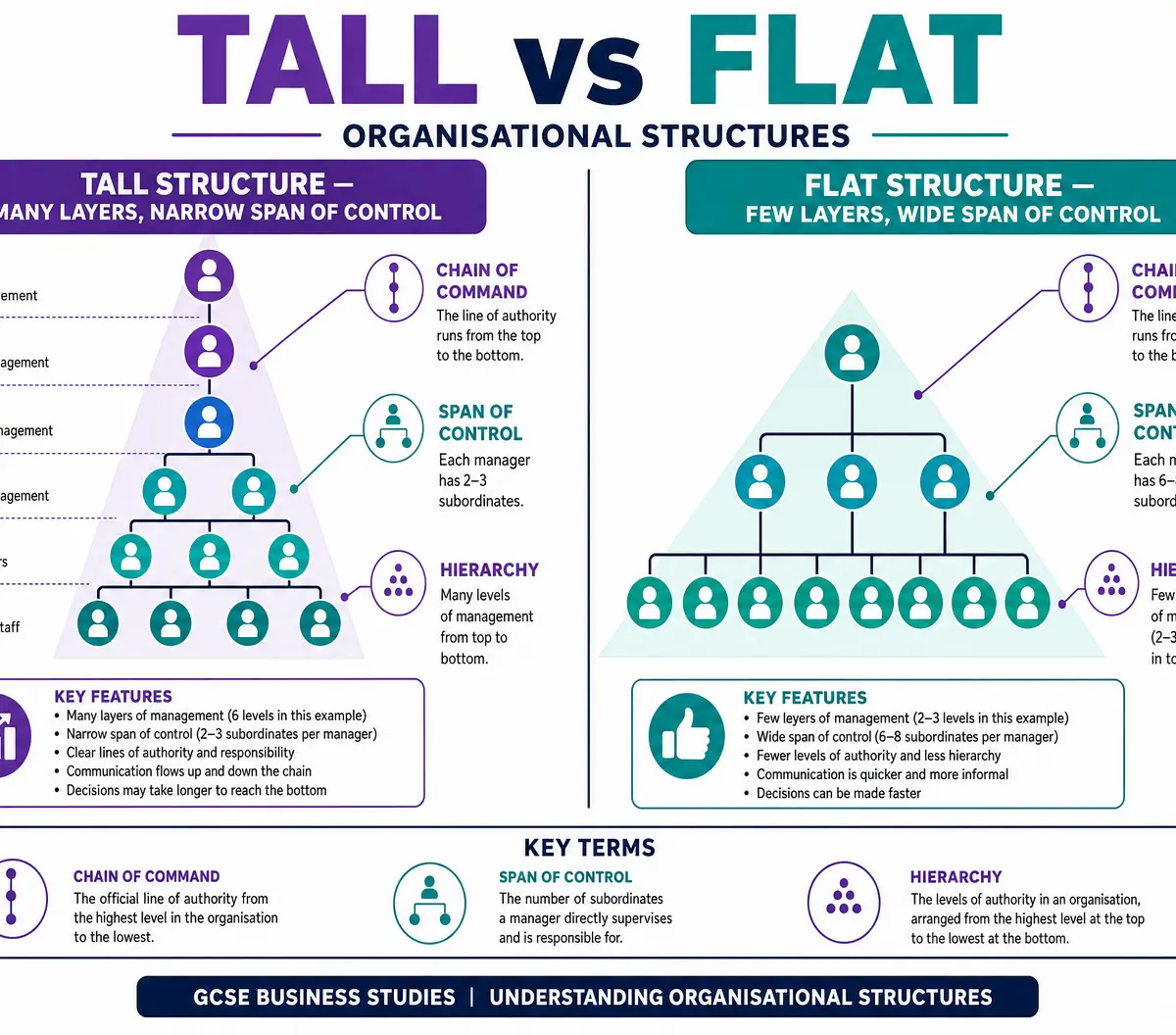
Businesses need a structure to define roles, responsibilities, and the chain of command. The two primary structures you must understand are Tall and Flat.
Tall Structures
Key Features: Many layers of hierarchy, narrow span of control (e.g., 2-3 subordinates per manager), long chain of command.
Impact on Business: Communication can be slow as messages pass through many levels. However, there are clear lines of supervision and numerous promotion opportunities for staff.
Flat Structures
Key Features: Few layers of hierarchy, wide span of control (e.g., 6-10 subordinates per manager), short chain of command.
Impact on Business: Communication is faster and decisions can be made more quickly. Employees often feel more empowered and trusted, though managers may become overloaded with too many direct reports.
Recruitment and Selection
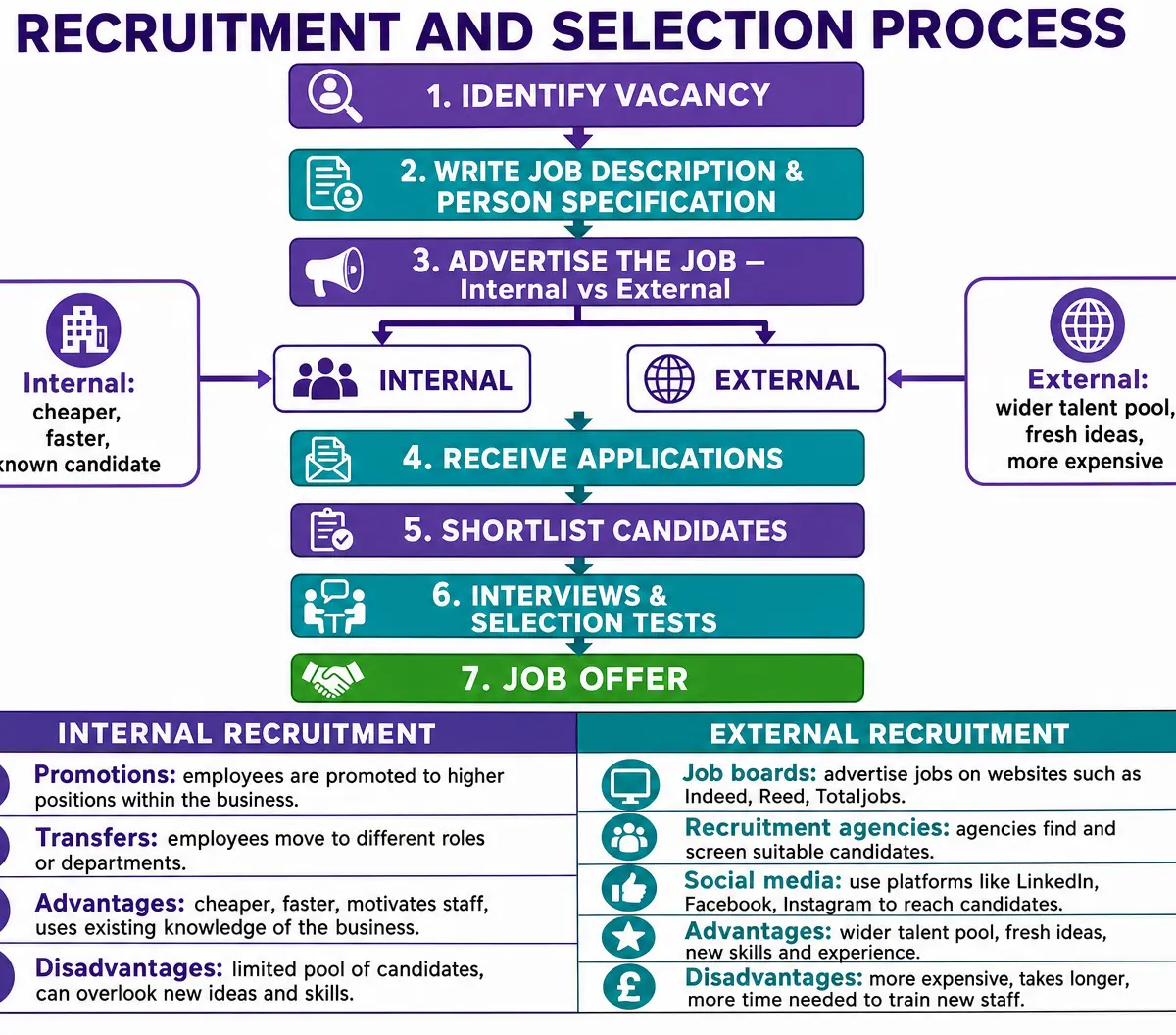
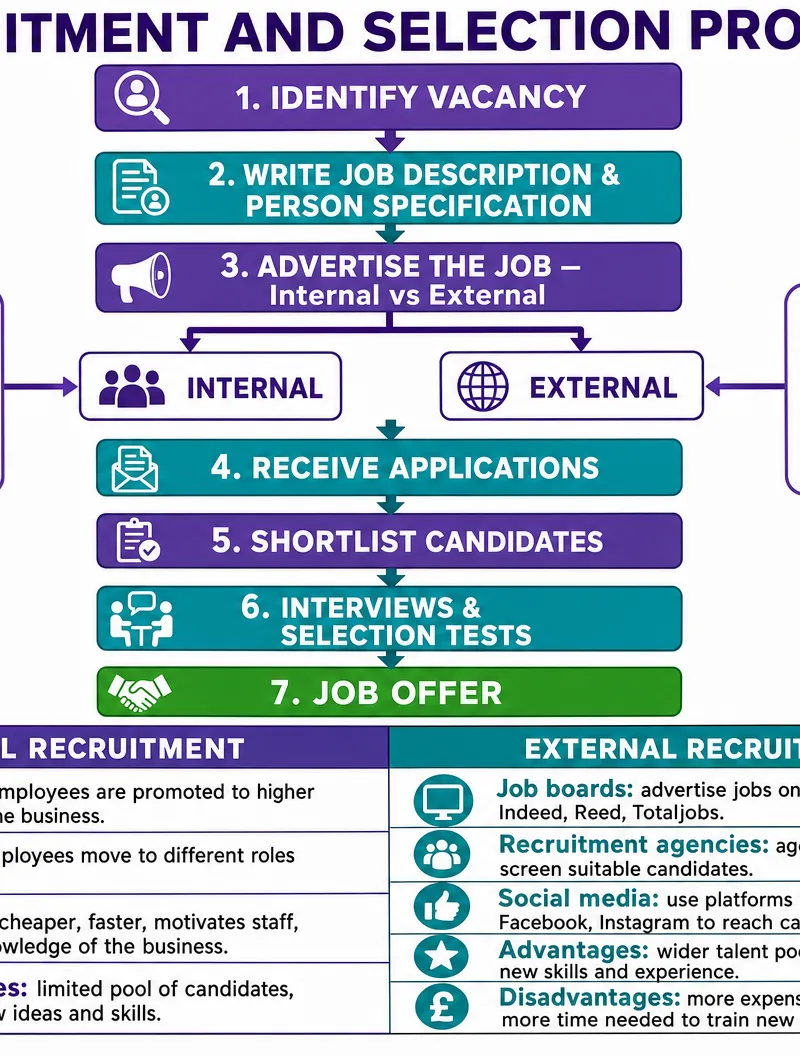
Finding the right people is critical for business success. The process involves identifying a vacancy, creating documents, advertising, shortlisting, and interviewing.
Job Description vs. Person Specification
- Job Description: Outlines the duties, responsibilities, and tasks involved in the job.
- Person Specification: Details the qualifications, skills, and experience the ideal candidate should possess.
Internal vs. External Recruitment
- Internal Recruitment: Hiring from within the existing workforce (e.g., promotion). It is cheaper, faster, and the candidate already knows the business culture. However, it leaves another vacancy to fill and doesn't bring in new ideas.
- External Recruitment: Hiring from outside the business. It brings in fresh perspectives and a wider talent pool, but it is more expensive, takes longer, and carries a higher risk of the candidate not fitting in.
Motivation Theories
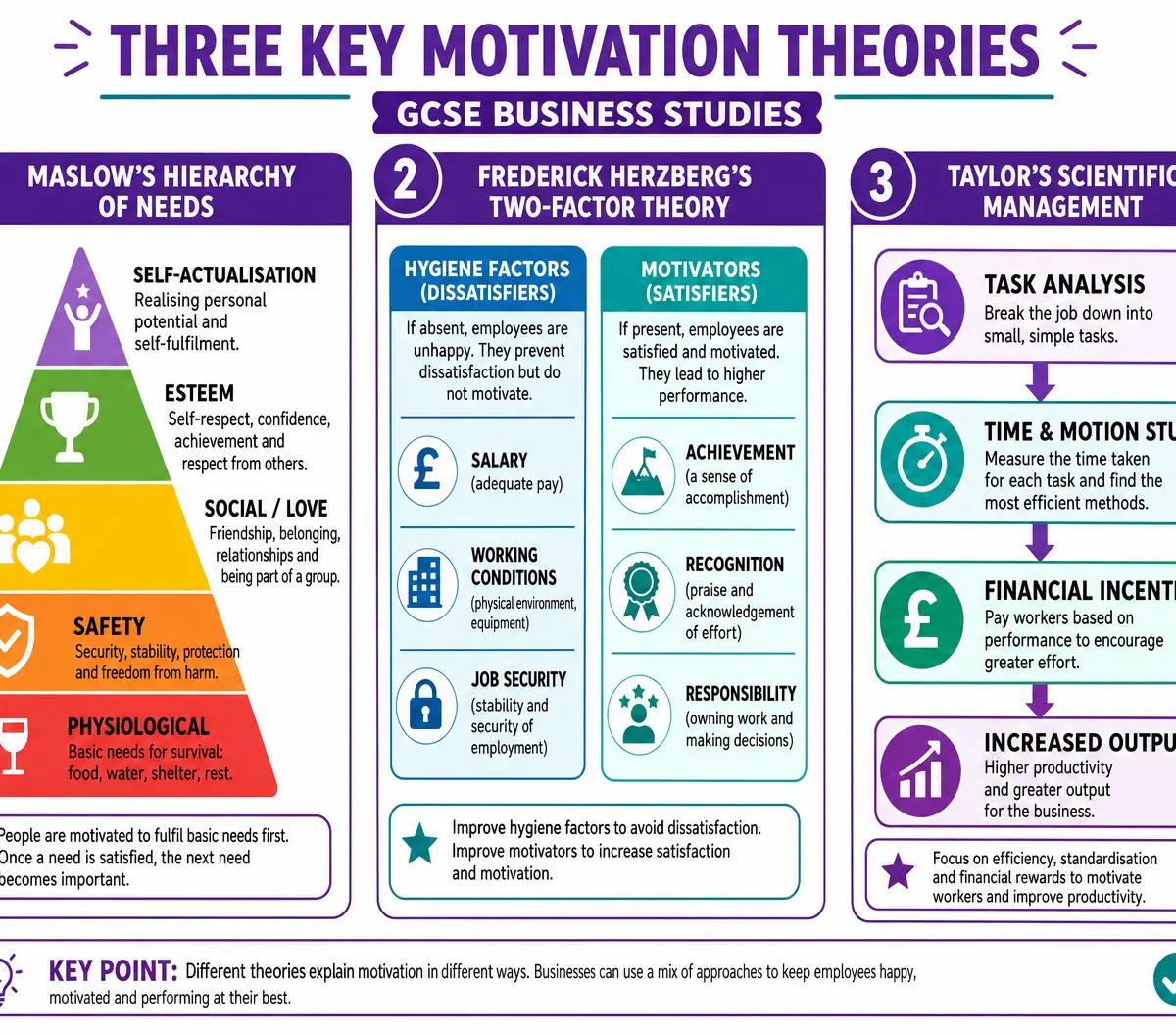
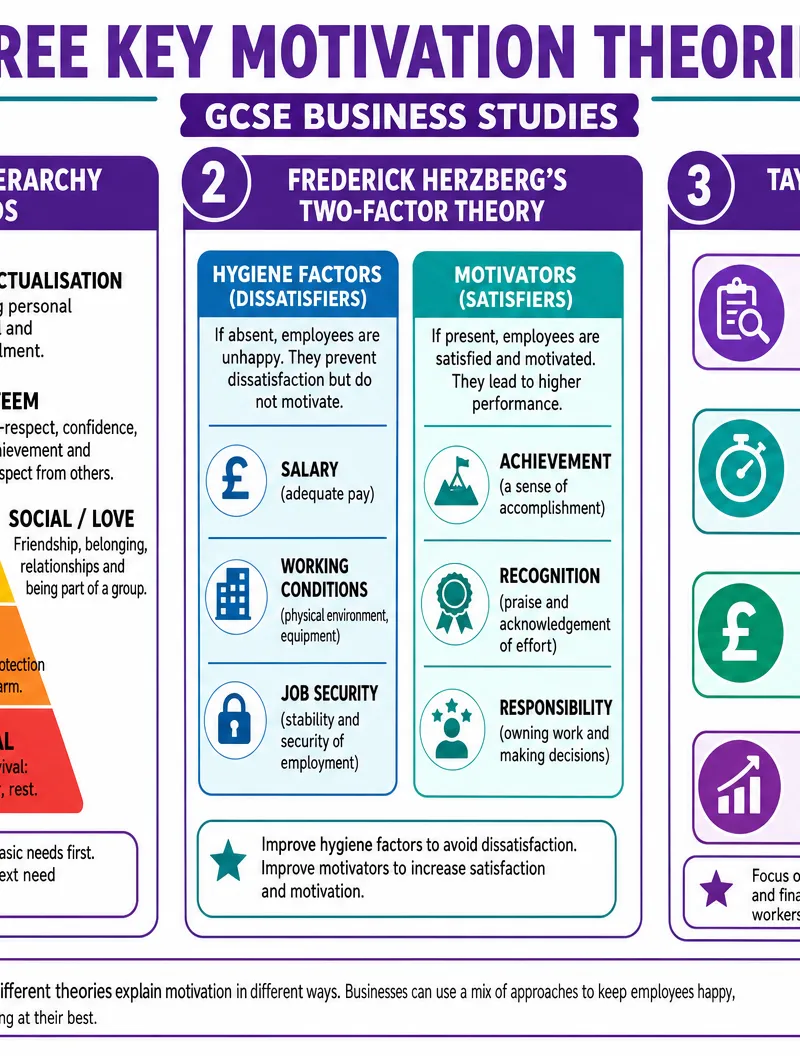
Motivated employees are more productive, provide better customer service, and are less likely to leave the business. You need to know three key theories:
1. Taylor (Scientific Management)
Frederick Taylor believed workers are motivated primarily by money. He advocated breaking jobs into small, repetitive tasks and paying workers based on their output (piece-rate pay). This works well in manufacturing but ignores social and psychological needs.
2. Maslow (Hierarchy of Needs)
Abraham Maslow proposed that people have five levels of needs: Physiological, Safety, Social, Esteem, and Self-Actualisation. A business must satisfy lower-level needs (like a basic wage) before higher-level needs (like recognition) can motivate the employee.
3. Herzberg (Two-Factor Theory)
Frederick Herzberg identified two sets of factors:
- Hygiene Factors: Pay, working conditions, job security. These do not motivate, but their absence causes dissatisfaction.
- Motivators: Achievement, recognition, responsibility. These actively drive performance and satisfaction.
Training and Development
Training improves employee skills, leading to higher productivity and better quality work.
- On-the-Job Training: Learning while performing the role (e.g., shadowing an experienced colleague). It is cost-effective and directly relevant, but bad habits can be passed on, and mistakes might impact customers.
- Off-the-Job Training: Learning away from the workplace (e.g., at a college or training centre). It is usually delivered by experts and allows focused learning, but it is expensive and the employee is away from their normal duties.
Employment Law
Businesses must comply with legislation designed to protect employees:
- Equality Act 2010: Protects workers from discrimination based on age, gender, race, disability, etc.
- National Minimum Wage Act: Ensures employers pay a legal minimum hourly rate.
- Health and Safety at Work Act 1974: Requires employers to provide a safe working environment and adequate training.
Revision Podcast
Listen to this 10-minute podcast for a comprehensive review of the topic, including exam tips and a quick-fire recall quiz.
Worked Examples
3 worked examples — open one to explore the question and available guidance.
Practice Questions
Try the question, then reveal an answer plan or example response
State two protected characteristics under the Equality Act 2010. (2 marks)
Hint: Think about reasons why someone might be unfairly treated at work.
Explain one reason why a business might choose to use off-the-job training instead of on-the-job training. (3 marks)
Hint: Focus on the quality of the training and who is delivering it.
A manufacturing company pays its factory workers using a piece-rate system. Analyse the impact of this payment method on the business. (6 marks)
Hint: Use Taylor's theory. Consider both the positive impact on output and the potential negative impact on quality.
Evaluate whether internal recruitment is the best method for a hotel chain looking to hire a new hotel manager. (9 marks)
Hint: Compare the benefits of promoting an existing staff member versus bringing in an experienced manager from outside.
Identify two stages of the recruitment process that occur after a job advertisement is placed. (2 marks)
Hint: What does the business do once people start applying?
Exam technique
How to turn what you know into marks
How to approach the question
Always read the stimulus material first and highlight key features of the business (size, industry, current problems).
How to structure your answer
- Essay questions
- AJIM structure: Arguments for, Justification, Issues/Arguments against, Meaningful conclusion.
- Source questions
- Apply knowledge directly to the data/scenario provided.
- Explain questions
- BLT structure: Because, Leading to, Therefore. (Point -> Explanation -> Business Impact)
Timing
Approximately 1 minute per mark, plus planning time for 9 and 12-mark questions.
Common pitfalls
- Failing to apply knowledge to the specific business context provided in the stimulus.
- Confusing Job Description and Person Specification.
- Writing one-sided answers for 'Evaluate' or 'Discuss' questions.
- Describing a motivation theory without explaining HOW the business should use it.
What the command words want
- Analyse
- Examine the impact of an issue or decision on the business in detail.
- Explain
- Make a point and develop it with logical reasoning showing cause and effect.
- Identify/State
- Give a brief, factual answer. No explanation needed.
- Evaluate/Discuss
- Consider both sides of an argument, apply to the context, and provide a justified conclusion.
Watch or listen (optional)
Test your understanding of People
Active recall beats re-reading. Take an instant quiz now to test what you’ve learned and lock it into long-term memory.
A week of Premium from your first lesson · Then the free plan continues · No card, no charge