OCR · GCSE · Business
Course version: J204 · Version from Sept 2019
Production processes
Master the fundamental production processes—job, batch, and flow—that businesses use to transform inputs into finished goods. Understand how technology like automation and robotics is revolutionising manufacturing, and learn how to evaluate the best methods for different business scenarios to secure top marks.
- 6 min read
- 3 worked examples
- 5 practice questions
- 6 key terms
Check what you remember
Read the wording for your board, then hide it and explain Job Production in your own words. Rough notes are fine. This is a self-check, with no mark or grade.
Reference: OCR
A method of production where a single, unique product is made from start to finish to meet specific customer requirements.
Study Notes
Overview
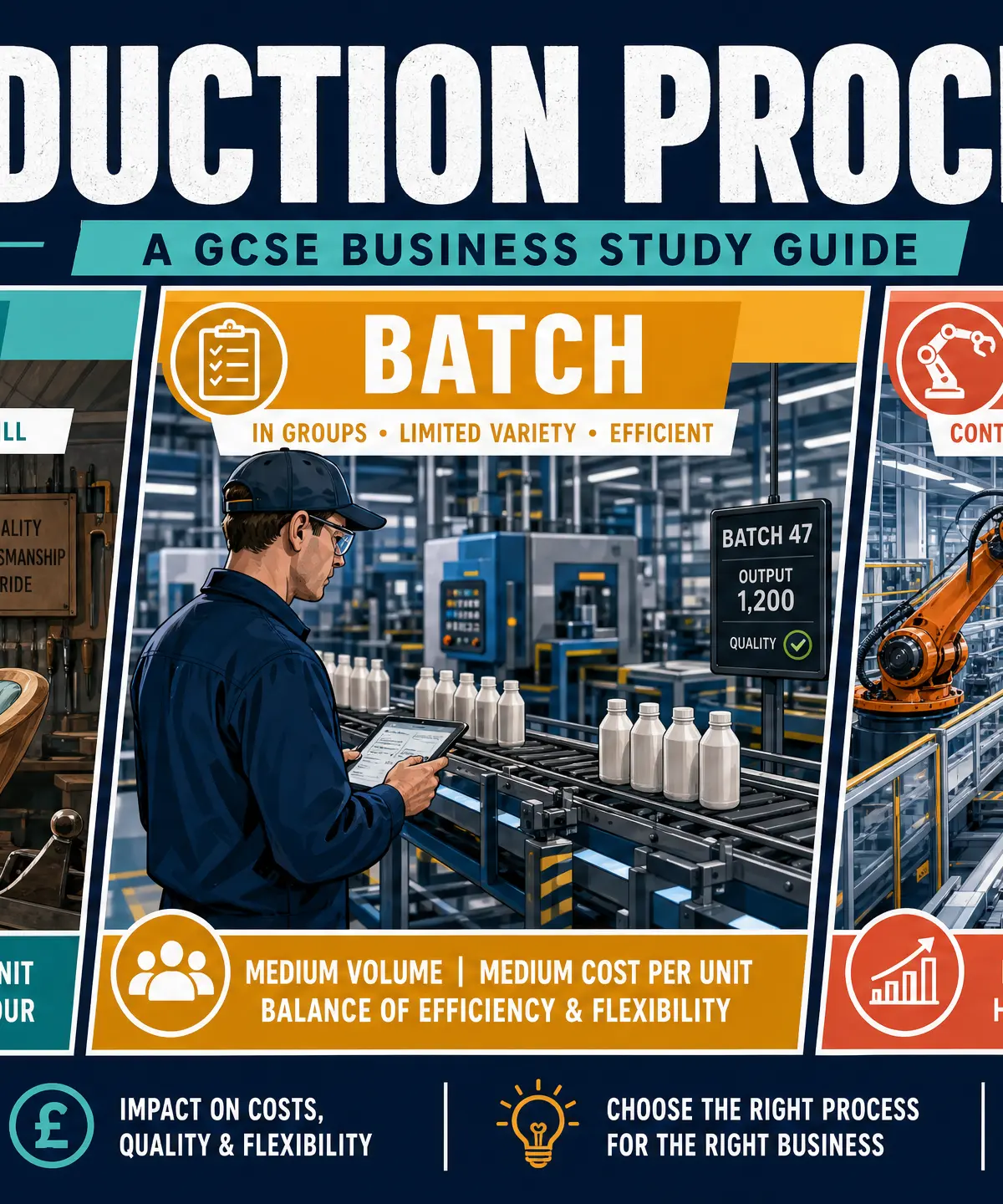
Production processes sit at the very heart of business operations. Every tangible product you buy—from a bespoke tailored suit to a mass-produced car—has been manufactured using a specific method. This study guide covers the three core production methods: job, batch, and flow production. Examiners expect candidates to not only define these methods but to critically evaluate their suitability for different business contexts.
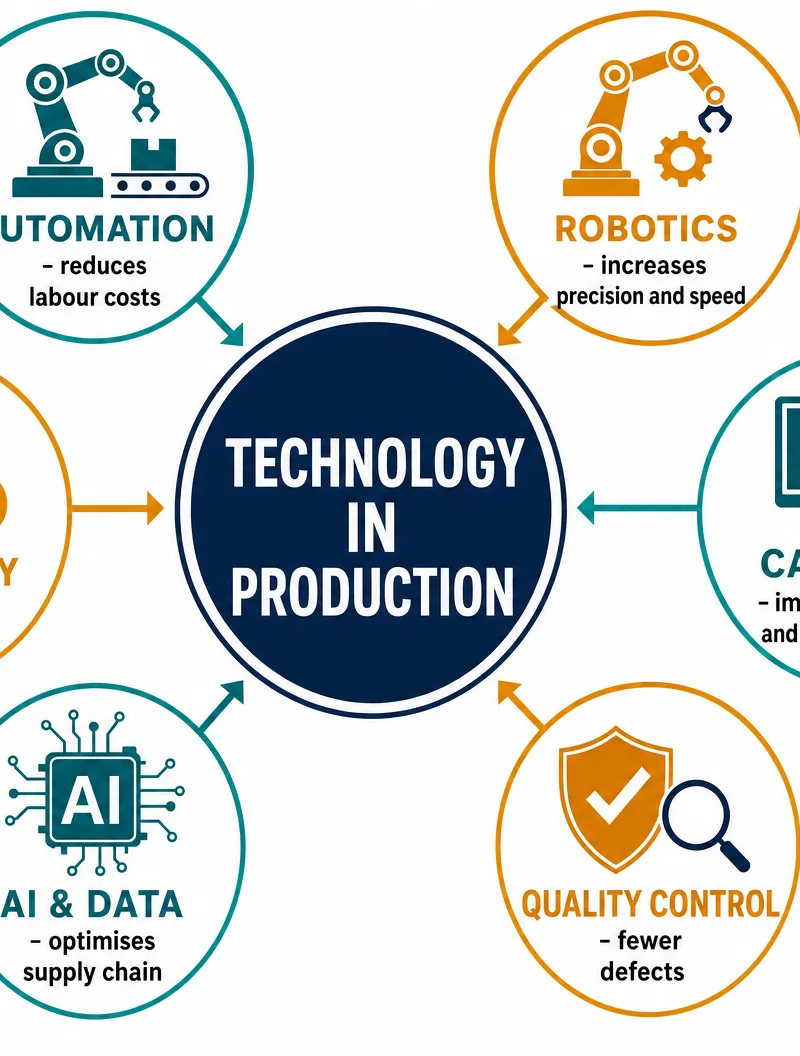
Furthermore, modern business is inseparable from technological advancement. You must understand how automation, robotics, and computer-aided design (CAD) are transforming efficiency, reducing unit costs, and altering the nature of work. Candidates who can confidently link the choice of production method to its impact on cost, quality, and flexibility consistently achieve the highest grades.
Listen to the companion podcast below for a comprehensive audio summary:
Core Production Methods
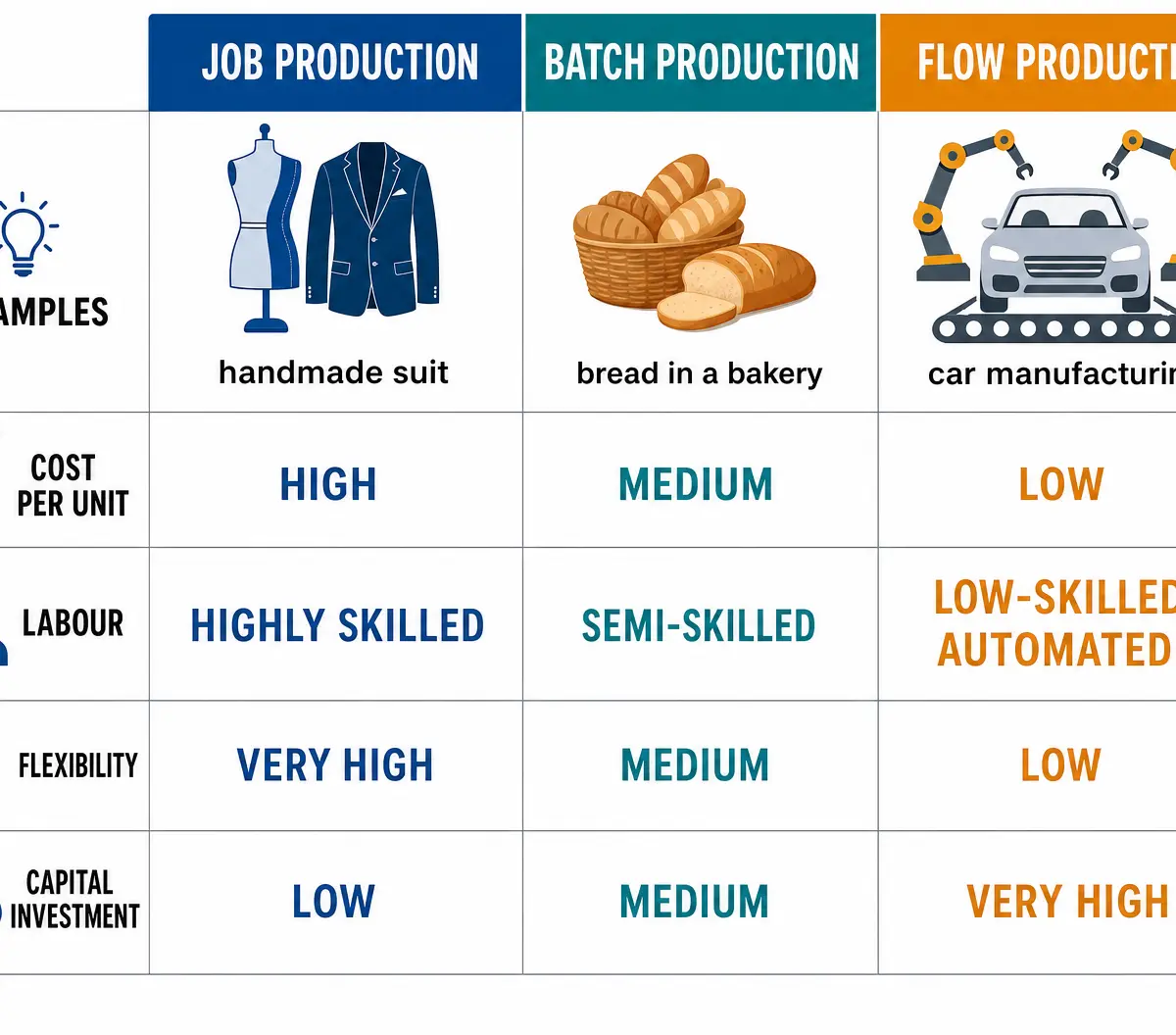
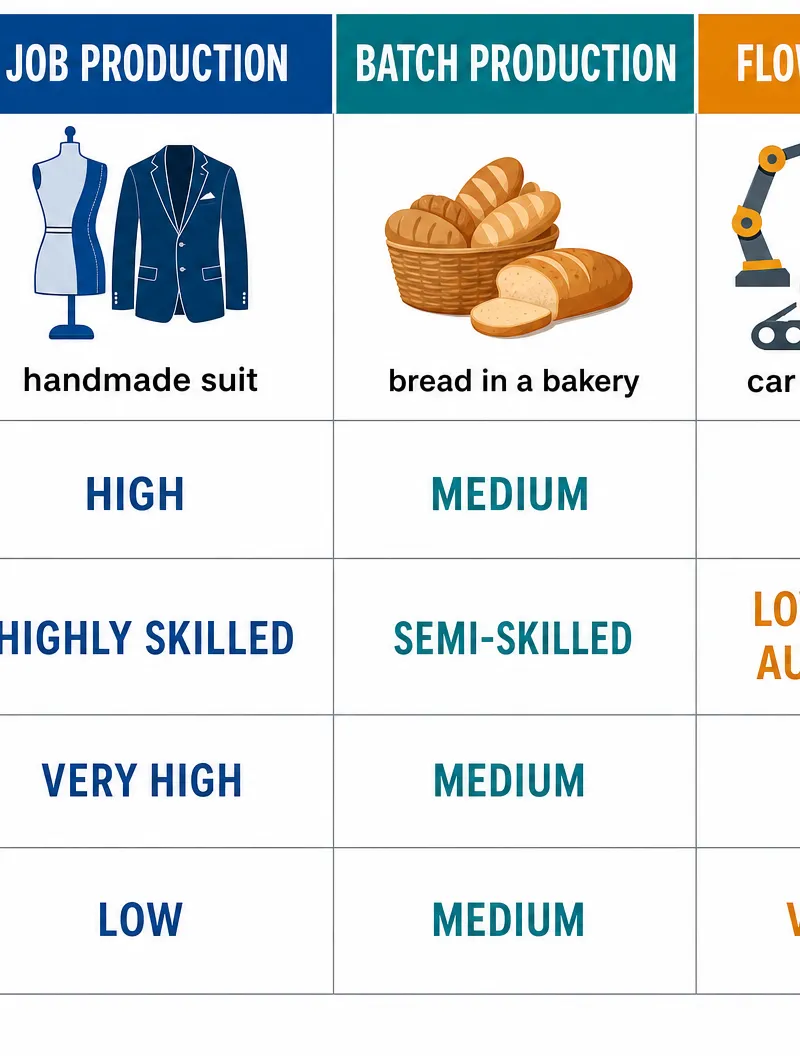
Job Production
Definition: Producing a single, unique, or bespoke item from start to finish to meet specific customer requirements.
Key Characteristics:
- Volume: One-off or very low volume.
- Labour: Requires highly skilled, specialist workers.
- Flexibility: Extremely high; products are tailored exactly to the customer's brief.
- Cost: High cost per unit due to the lack of economies of scale and the time-intensive nature of the work.
Specific Knowledge: Examples include bespoke wedding cakes, tailored suits, architectural designs, and custom-built furniture.
Why it matters: Examiners often ask candidates to justify why a business might use job production despite its high costs. The key is value added—businesses can charge a premium price for unique, high-quality items.
Batch Production
Definition: Producing a set quantity (a 'batch') of identical items together before moving on to produce a different batch.
Key Characteristics:
- Volume: Medium volume.
- Labour: Semi-skilled workers who can operate machinery but also switch between different product runs.
- Flexibility: Medium; allows a business to offer a variety of products (e.g., different flavours or sizes).
- Cost: Lower unit costs than job production, but higher than flow.
Specific Knowledge: Examples include bakeries (making 200 white loaves, then 200 wholemeal), clothing manufacturers (size 10 dresses, then size 12), and furniture makers producing a set of identical chairs.
Why it matters: Batch production balances efficiency with variety. However, candidates must note the disadvantage of downtime—machinery must be stopped, cleaned, and reset between batches, which can reduce overall efficiency.
Flow Production
Definition: Continuous, large-scale production of identical, standardised products on an assembly line.
Key Characteristics:
- Volume: Very high volume (mass production).
- Labour: Often low-skilled workers performing repetitive tasks, or increasingly, fully automated robotic systems.
- Flexibility: Very low; it is difficult and expensive to alter the product design once the line is running.
- Cost: Extremely low cost per unit due to massive economies of scale.
Specific Knowledge: Examples include car manufacturing (e.g., Toyota, Nissan), bottling plants, and consumer electronics assembly.
Why it matters: Flow production is essential for businesses competing on price in mass markets. Candidates should evaluate the high initial capital investment required against the long-term reduction in unit costs.
The Impact of Technology on Production
Modern production is heavily influenced by technological advancements. Examiners reward candidates who can explain the specific impacts of these technologies on a business's operations.
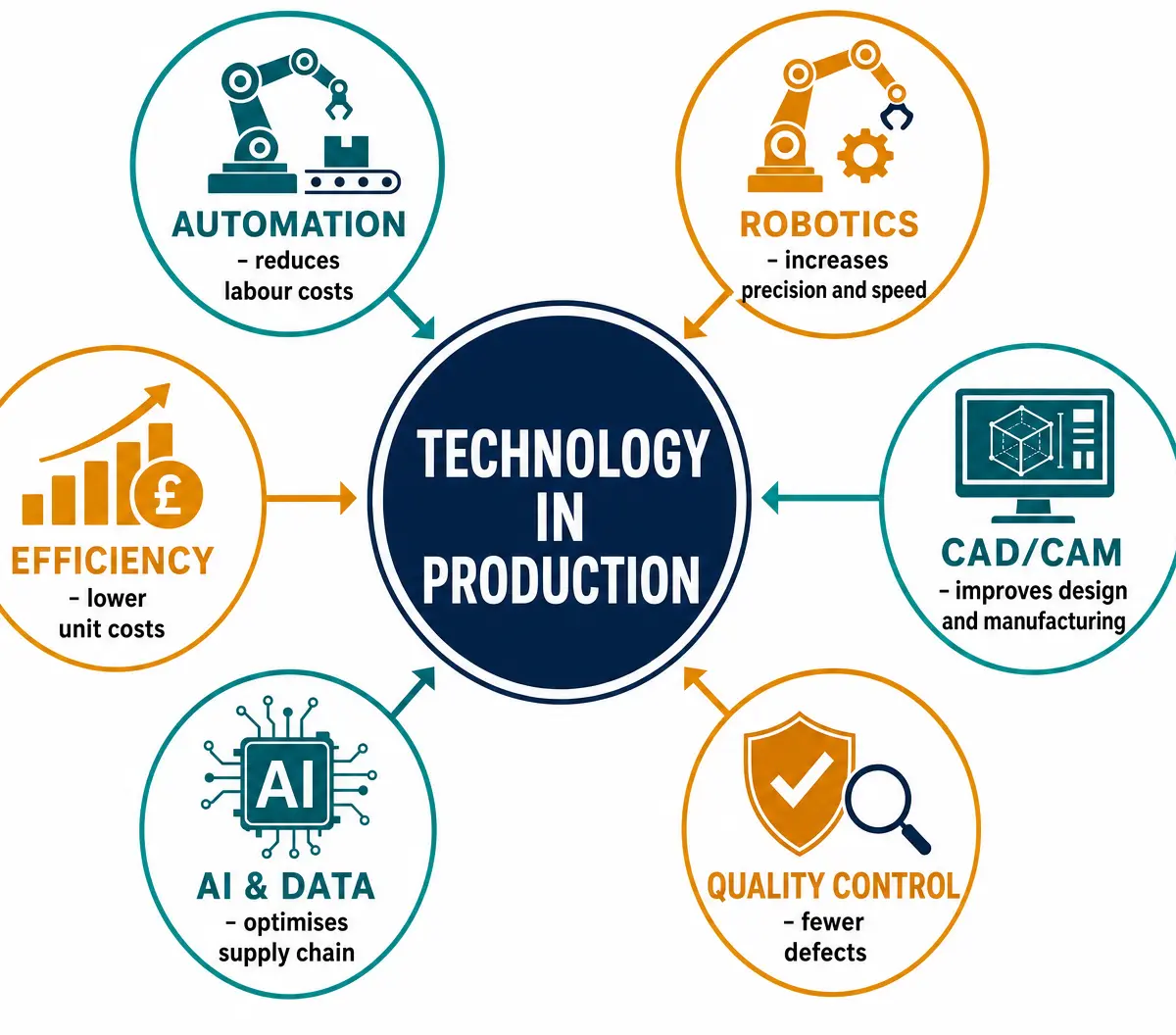
Automation and Robotics
Definition: The use of machines, control systems, and information technologies to optimise productivity in the production of goods.
Impact:
- Efficiency: Machines operate 24/7 without fatigue, significantly increasing output speed.
- Quality: Robots provide exact precision, reducing the defect rate and improving consistency.
- Costs: While initial capital investment is very high, long-term variable costs (specifically labour) are drastically reduced.
- Human Resources: Can lead to redundancies for low-skilled workers, but creates new roles for highly skilled technicians to maintain the machines.
CAD and CAM
Definition: Computer-Aided Design (CAD) involves using software to create precision 2D or 3D models. Computer-Aided Manufacturing (CAM) uses those digital designs to control automated machinery.
Impact:
- Design Phase: CAD allows for rapid prototyping and easy modifications without the cost of physical materials.
- Integration: CAM ensures that the exact specifications designed in CAD are manufactured flawlessly, minimising waste and speeding up the time-to-market.
Second-Order Concepts
Causation
Why do businesses change their production methods? Often, it is driven by business growth. A bakery starting in a kitchen (job production) may move to a small industrial unit (batch production) to meet rising demand, and eventually to a large factory (flow production) to supply national supermarkets.
Consequence
The shift to flow production and automation has profound consequences. While it lowers prices for consumers and increases profit margins for businesses, it also changes the labour market, reducing the need for manual labour and increasing the demand for technical skills.
Significance
Choosing the right production method is significant because it dictates a business's cost structure, pricing strategy, and target market. A mismatch—such as trying to use job production for a mass-market, low-price item—will lead to business failure.
Visual Resources
2 diagrams and illustrations
Interactive Diagrams
1 interactive diagram to visualise key concepts
Conceptual Flow Outline
Decision tree for selecting a production process based on market requirements.
Worked Examples
3 worked examples — open one to explore the question and available guidance.
Practice Questions
Try the question, then reveal an answer plan or example response
A custom bicycle manufacturer currently uses job production. Explain one reason why job production is appropriate for this business. (3 marks)
Hint: Think about what 'custom' means and how job production allows for flexibility.
Analyse the impact on a clothing manufacturer of switching from batch production to flow production. (6 marks)
Hint: Look for a chain of reasoning: what happens to costs, and what happens to flexibility?
State two ways in which the use of robotics can improve quality control in a factory. (2 marks)
Hint: Think about human error versus machine precision.
Evaluate whether a small, local furniture maker should invest in Computer-Aided Design (CAD) software. (9 marks)
Hint: Weigh the benefits of better design against the cost for a *small* business.
Explain how the introduction of automation might affect the workforce of a car manufacturing plant. (4 marks)
Hint: Think about both negative impacts (job losses) and positive impacts (new types of jobs).
Exam technique
How to turn what you know into marks
How to approach the question
Always highlight the name of the business and what they sell in the case study. Every answer from 3 marks upwards MUST refer back to this specific context.
How to structure your answer
- Essay questions
- Introduction setting the scene -> Two developed arguments FOR -> Two developed arguments AGAINST -> Sustained, justified conclusion.
- Explain questions
- Use the BLT structure: Because, Leading to, Therefore. (Point -> Because... -> Leading to... -> Therefore impact on business).
- Evaluate questions
- Paragraph 1: Benefit in context. Paragraph 2: Drawback in context. Paragraph 3: 'It depends on...' conclusion.
Timing
Approximately 1 minute per mark, allowing time to read the case study carefully.
Common pitfalls
- Writing generic textbook definitions without applying them to the business in the question.
- Confusing batch production (which stops between runs) with flow production (which never stops).
- Stating that automation 'saves money' without specifying that it reduces *unit labour costs* but requires high *capital investment*.
What the command words want
- Analyse
- Show a chain of reasoning. How does A lead to B, and how does B impact C?
- Explain
- Make a point and develop it using connective phrases to show the impact on the business.
- State/Identify
- Short, factual answers. No explanation needed.
- Evaluate/Justify
- Provide a balanced argument looking at pros and cons, ending with a clear decision that answers the question.
Watch or listen (optional)
Test your understanding of Production processes
Active recall beats re-reading. Take an instant quiz now to test what you’ve learned and lock it into long-term memory.
A week of Premium from your first lesson · Then the free plan continues · No card, no charge