OCR · GCSE · Business
Course version: J204 · Version from Sept 2019
Recruitment and selection
Master the crucial topic of Recruitment and Selection for GCSE Business. Learn how businesses attract, evaluate, and hire the right people to drive growth and bridge skills gaps, directly targeting the high-mark evaluation questions examiners love.
- 3 min read
- 3 worked examples
- 5 practice questions
- 6 key terms
Check what you remember
Read the wording for your board, then hide it and explain Recruitment in your own words. Rough notes are fine. This is a self-check, with no mark or grade.
Reference: OCR
The process of identifying a vacancy and attracting suitable candidates to apply.
Study Notes
Overview
Recruitment and Selection is a cornerstone of Human Resources in any business. For GCSE Business, this topic is not just about listing methods; examiners expect you to apply these concepts to specific business contexts and evaluate which approach is best. You need to understand why businesses recruit (e.g., to replace leavers, support growth, or fill skills gaps) and clearly distinguish between the process of attracting candidates (recruitment) and choosing the best one (selection). The most successful candidates are those who can link recruitment decisions directly to business objectives, such as reducing costs, improving productivity, or driving innovation.
The Recruitment Process
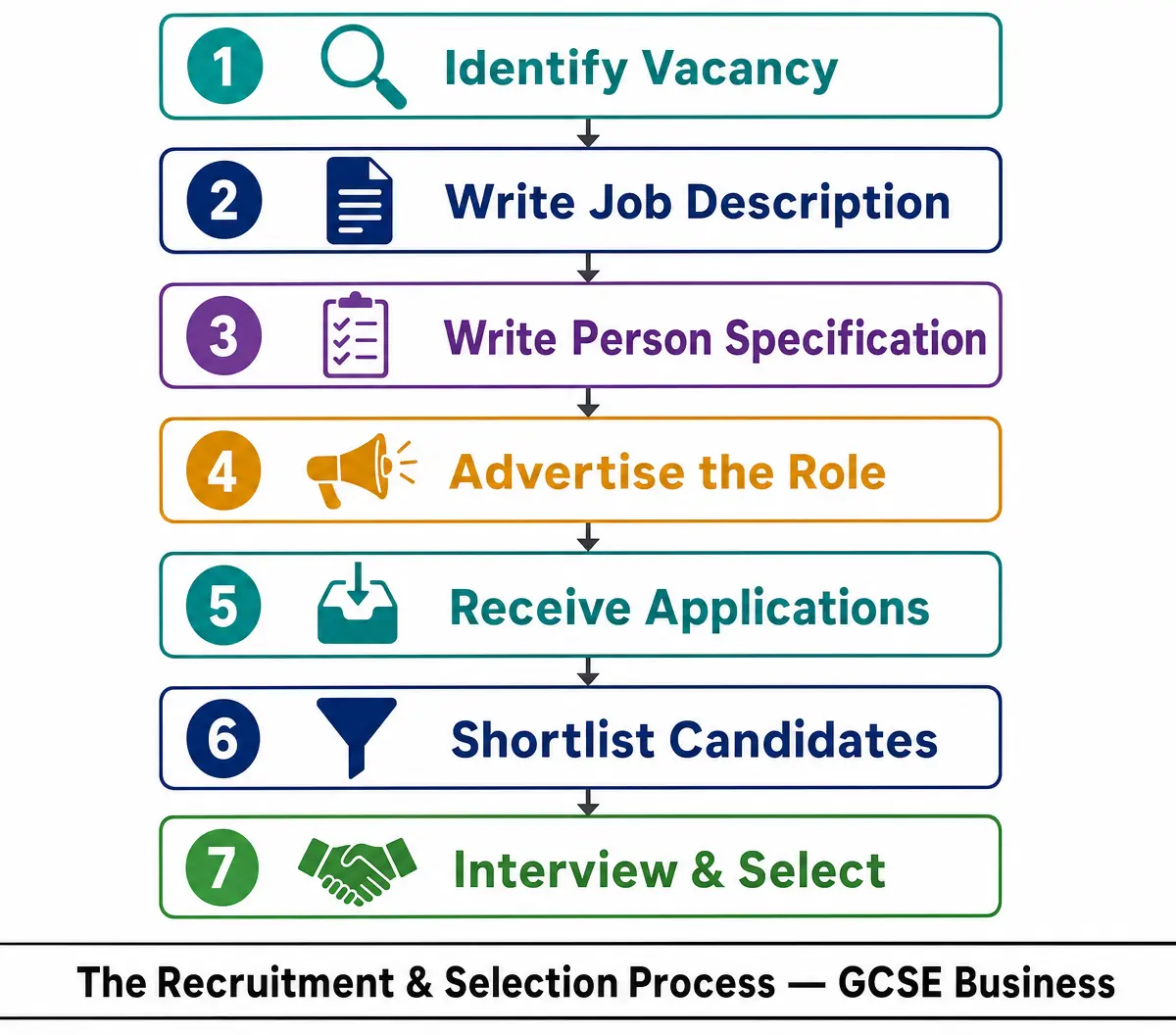
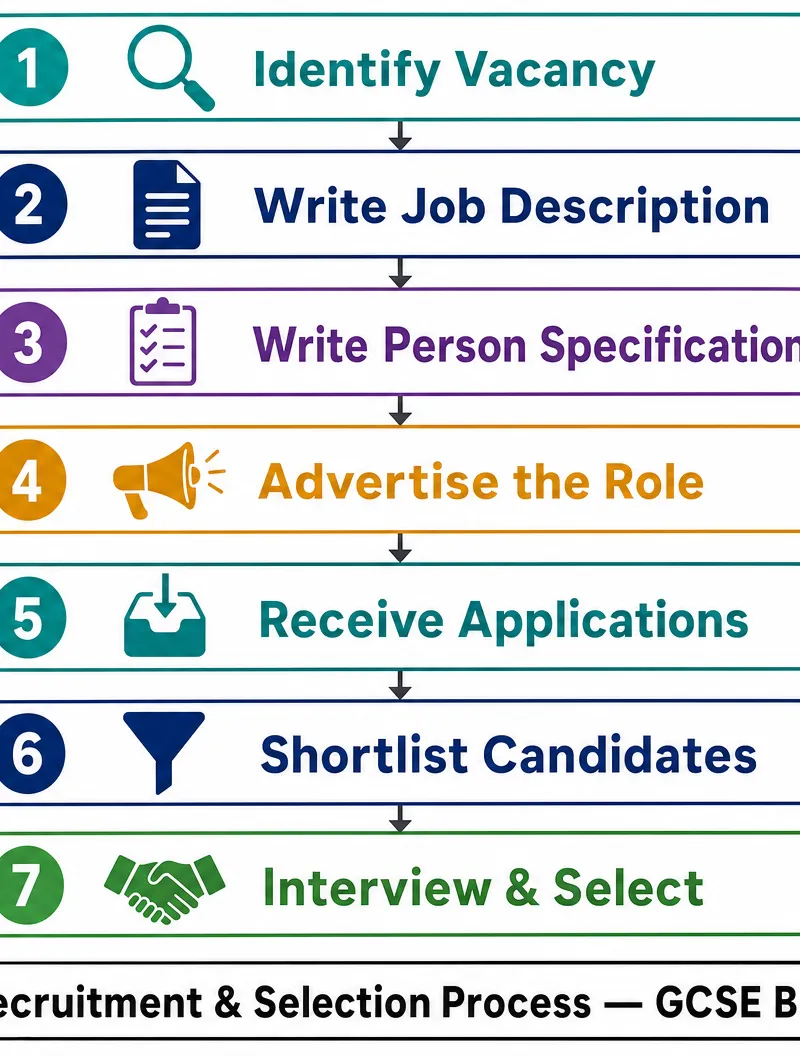
1. Identifying the Vacancy
What it is: The business recognises a need for a new employee. This could be due to a staff member leaving, business expansion, or a lack of specific skills internally.
Why it matters: Examiners often ask why a business is recruiting. Identifying the exact reason helps justify the subsequent recruitment methods chosen.
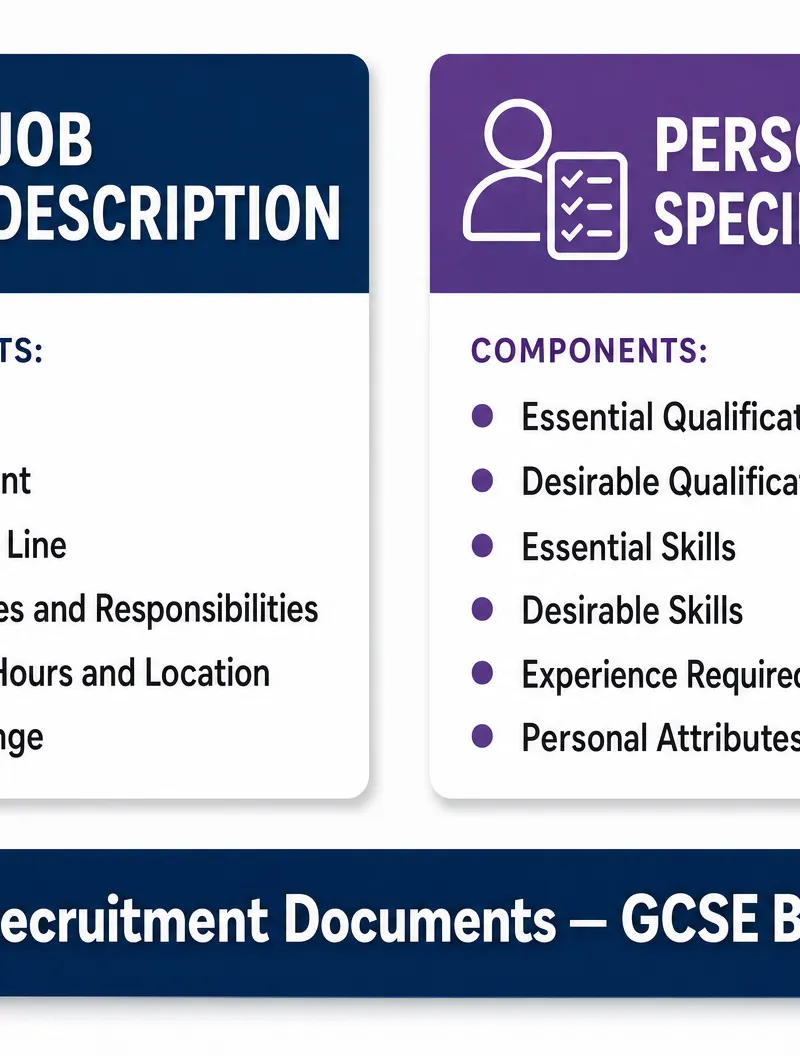
2. Creating Key Documents
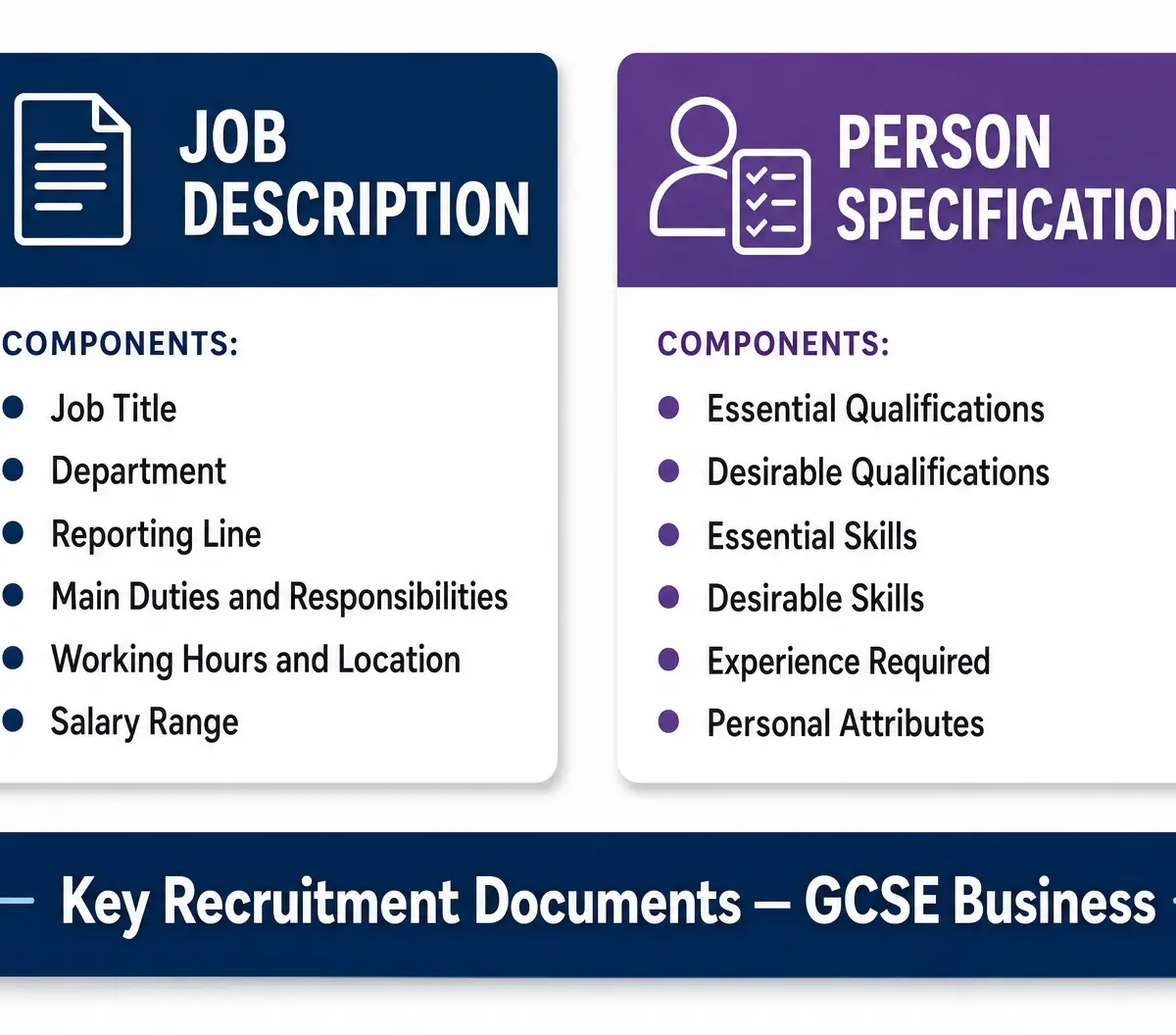
Job Description: A document that outlines the duties, responsibilities, reporting lines, and conditions of the job itself. It is about the role.
Person Specification: A document detailing the ideal candidate, including essential and desirable qualifications, skills, and experience. It is about the person.
Exam Tip: Never confuse these two. Job = Role. Person = Candidate.
Recruitment Methods
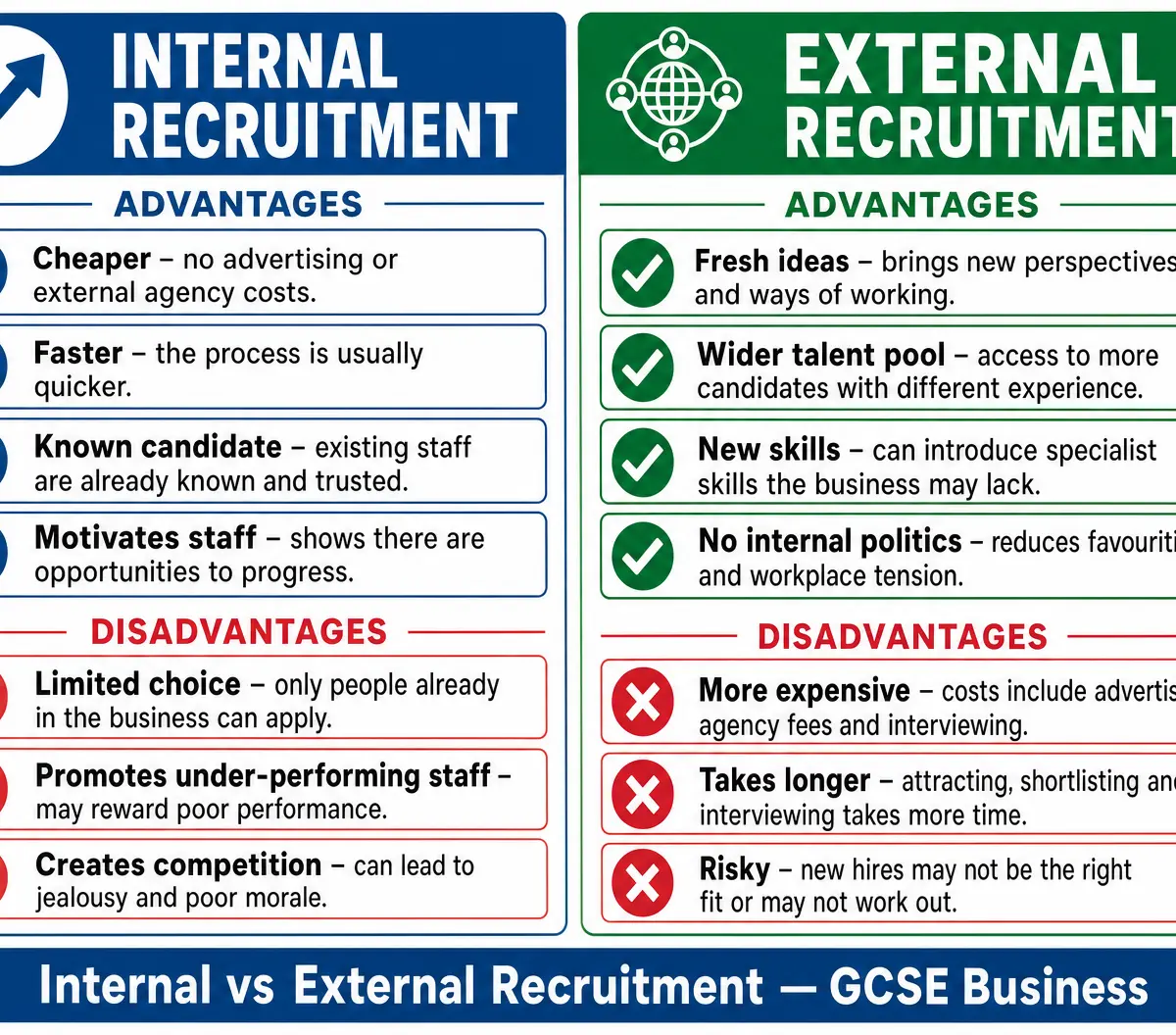
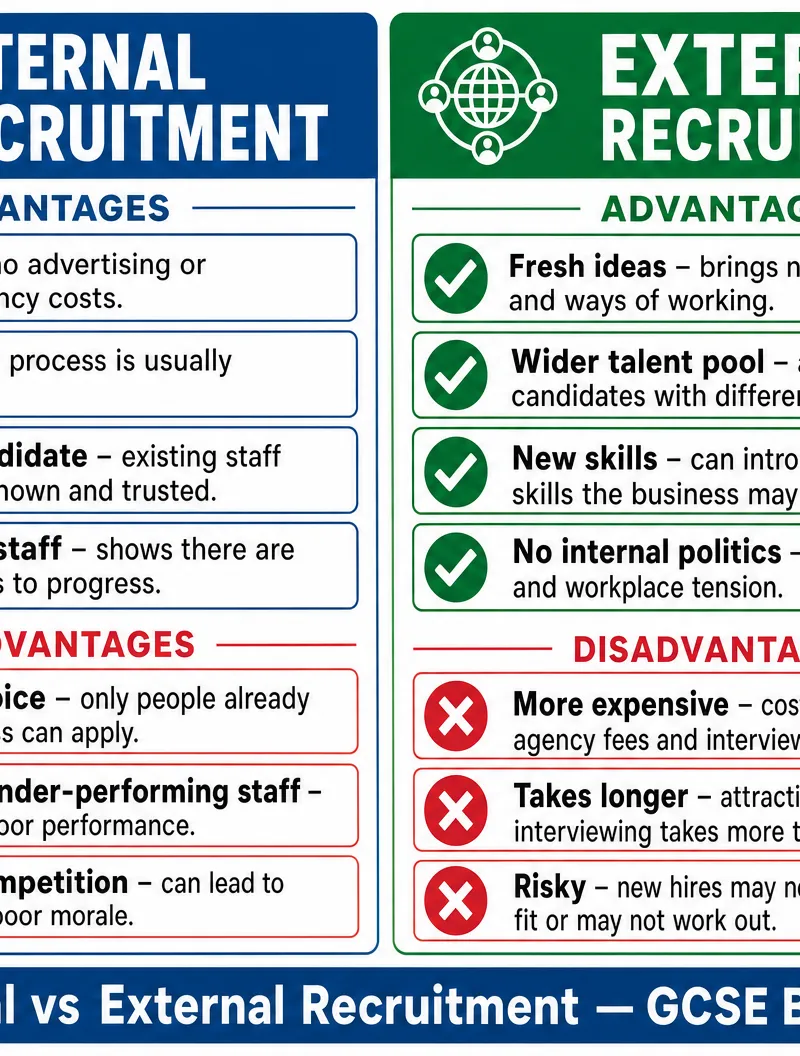
Internal Recruitment
What it is: Filling a vacancy from within the existing workforce (e.g., promotion or transfer).
Advantages: Cheaper (no agency fees), faster, candidate is a known entity, motivates existing staff.
Disadvantages: Limited talent pool, leaves another vacancy to fill, can cause resentment among unselected staff, no fresh ideas.
External Recruitment
What it is: Finding candidates from outside the business using job boards, agencies, or social media.
Advantages: Brings in fresh ideas and new skills, access to a much larger talent pool, avoids internal friction.
Disadvantages: Expensive (advertising/agency fees), time-consuming, higher risk as the candidate is unknown.
Selection Methods
Once candidates apply, the business must select the best fit. Common methods include:
- Interviews: One-on-one or panel discussions.
- Testing: Aptitude tests (skills) or psychometric tests (personality).
- Assessment Centres: A combination of role-plays, group tasks, and interviews.
Podcast Revision
Listen to our 10-minute deep dive into this topic, complete with examiner tips and a quick-fire quiz!
Visual Resources
3 diagrams and illustrations
Interactive Diagrams
1 interactive diagram to visualise key concepts
Conceptual Flow Outline
The Recruitment and Selection Process Flow
Worked Examples
3 worked examples — open one to explore the question and available guidance.
Practice Questions
Try the question, then reveal an answer plan or example response
State two reasons why a business might need to recruit new staff. (2 marks)
Hint: Think about what happens when someone leaves, or when the business gets bigger.
Explain one disadvantage of using internal recruitment. (3 marks)
Hint: What does the business miss out on by only looking at current staff?
Explain the difference between a job description and a person specification. (4 marks)
Hint: Define both clearly, mentioning what each focuses on.
An expanding graphic design agency needs a new Senior Designer. Evaluate whether they should use internal or external recruitment. (9 marks)
Hint: Consider the context: 'expanding' and 'graphic design' (needs creativity/new ideas). Weigh both options.
Identify two methods of selection a business could use after shortlisting candidates. (2 marks)
Hint: How do you test if someone is good for the job?
Exam technique
How to turn what you know into marks
How to approach the question
Always identify the business context first (size, industry, budget) and tailor your points to it.
How to structure your answer
- State questions
- Short, sharp factual answers. No explanation needed.
- Explain questions
- BLT structure: Because, Leading to, Therefore. (Make the point, explain why, state the consequence).
- Recommend questions
- Discuss Option A, Discuss Option B, Make a clear choice, Justify why it is better than the alternative.
Timing
Approximately 1 minute per mark, plus planning time for 9 or 12 mark questions.
Common pitfalls
- Confusing Job Description with Person Specification.
- Confusing Recruitment (attracting) with Selection (choosing).
- Listing advantages/disadvantages without linking them to the specific business in the case study.
What the command words want
- State
- Give a specific fact or piece of information without explanation.
- Analyse
- Examine the impacts or consequences in detail, showing a chain of reasoning.
- Explain
- Make a point and develop it with a consequence or reason.
- Recommend/Justify
- Weigh up options in context and make a supported final decision.
Watch or listen (optional)
Test your understanding of Recruitment and selection
Active recall beats re-reading. Take an instant quiz now to test what you’ve learned and lock it into long-term memory.
A week of Premium from your first lesson · Then the free plan continues · No card, no charge