OCR · GCSE · Business
Course version: J204 · Version from Sept 2019
The role of human resources
Master the core concepts of Human Resources for your GCSE Business exam. This guide covers organisational structures, recruitment, motivation, and employment law, giving you the specific knowledge and examiner tips needed to secure top marks.
- 5 min read
- 3 worked examples
- 5 practice questions
- 6 key terms
Check what you remember
Read the wording for your board, then hide it and explain Span of control in your own words. Rough notes are fine. This is a self-check, with no mark or grade.
Reference: OCR
The number of employees directly managed by one person.
Study Notes

Overview
The Human Resources (HR) function is often described as the engine room of a business. It focuses on managing people — arguably a business's most valuable asset. This topic covers how businesses organise their staff, how they find the right people, how they keep them motivated, and the laws they must follow. Examiners frequently test your ability to link HR decisions to overall business performance, such as how motivated staff improve customer service or how flat structures speed up decision-making. You must be able to evaluate different HR methods and apply them to specific business contexts.
Organisational Structures
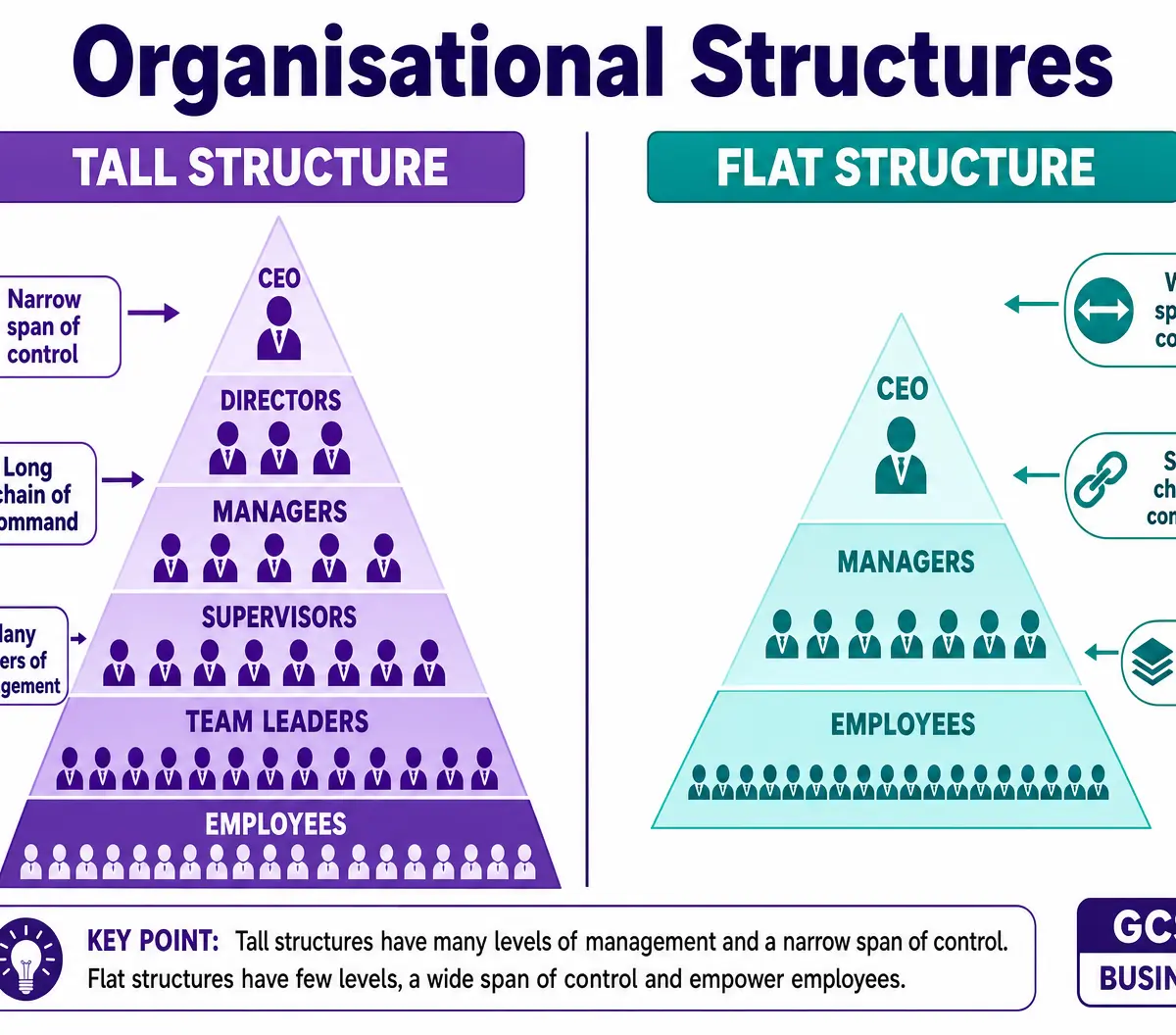
Businesses need a structure to show who is responsible for what and who reports to whom. The two main types you must know are tall structures and flat structures.
Tall Structures
Characteristics: Many layers of management, narrow span of control, long chain of command.
Advantages: Close supervision of staff, clear progression paths for promotion.
Disadvantages: Slow communication from top to bottom, can be expensive due to many management salaries.
Flat Structures
Characteristics: Few layers of management, wide span of control, short chain of command.
Advantages: Fast communication, employees feel empowered and motivated, lower management costs.
Disadvantages: Managers may be overworked, less close supervision of employees.
Ways of Working
Businesses employ people in various ways to suit their needs and the needs of their staff.
- Full-time: Typically 35-40 hours a week.
- Part-time: Fewer hours than full-time, offering flexibility.
- Flexible working: Employees have some choice over their hours (e.g., flexitime).
- Temporary: Employed for a fixed period (e.g., seasonal work).
- Home/Mobile working: Working away from the office, enabled by digital communication.
Recruitment and Selection
Finding the right staff is crucial. High staff turnover is expensive, so getting recruitment right the first time saves money.
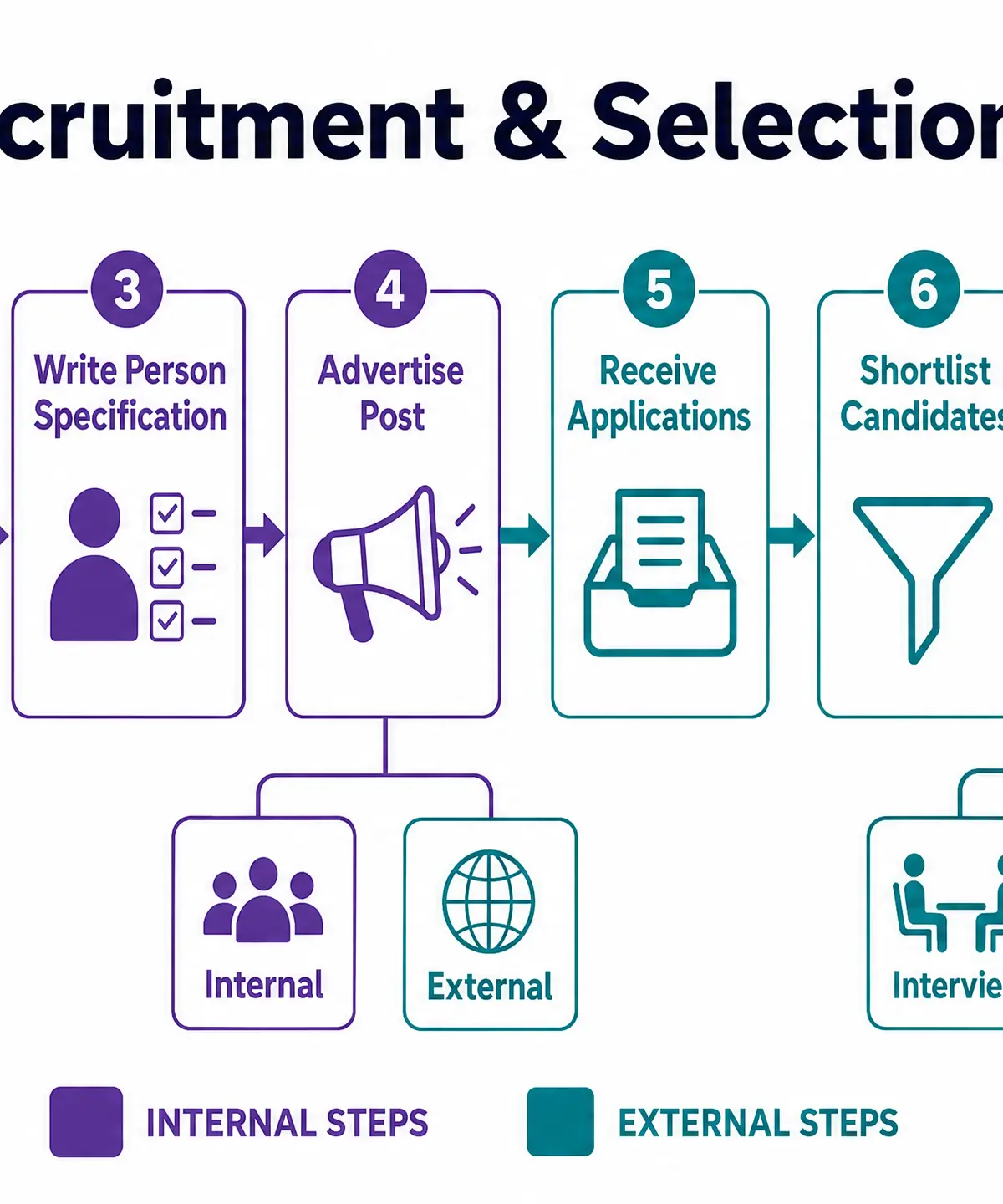
The Documents
- Job Description: Outlines the duties and responsibilities of the role. (It describes the job).
- Person Specification: Outlines the skills, qualifications, and experience required. (It describes the ideal candidate).
Internal vs External Recruitment
Internal Recruitment: Promoting or moving someone already in the business.
- Pros: Cheaper, quicker, candidate knows the business.
- Cons: Creates a vacancy elsewhere, no new ideas brought in.
External Recruitment: Hiring someone from outside the business.
- Pros: Brings in fresh ideas and new skills.
- Cons: Expensive (advertising, agencies), takes longer, higher risk.
Motivation and Retention
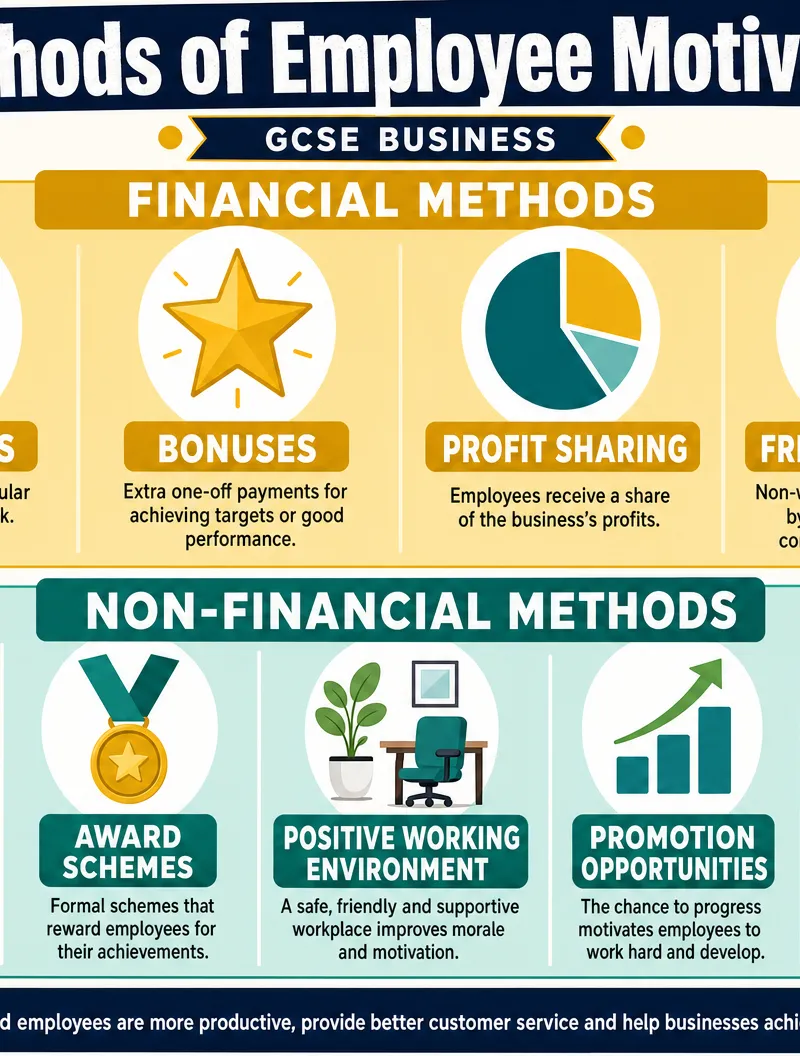
Motivated employees work harder, provide better customer service, and are less likely to leave (higher retention). Businesses use both financial and non-financial methods to motivate staff.
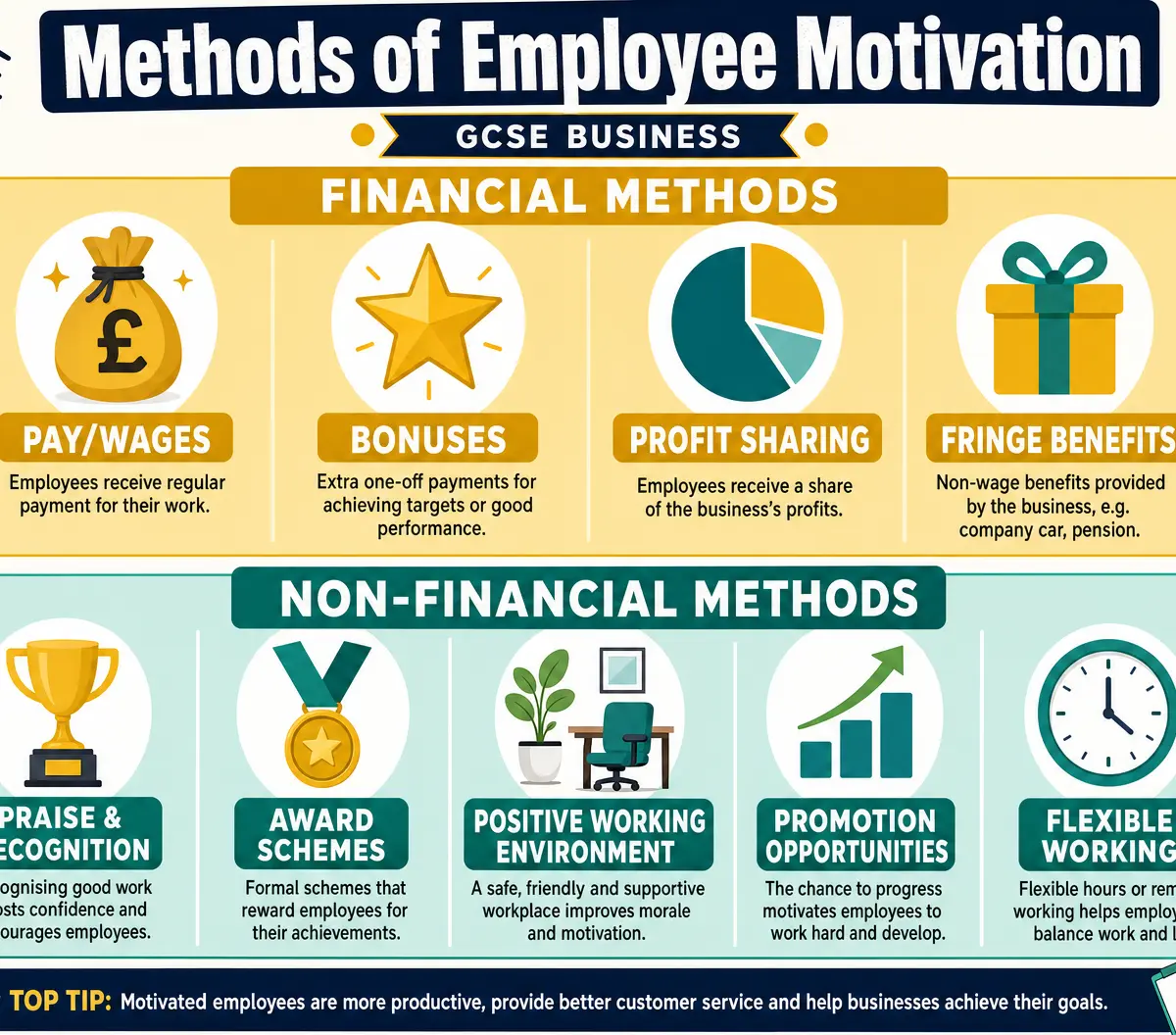
Financial Methods
- Pay/Wages: The basic financial reward.
- Bonuses: Extra payments for achieving targets.
- Profit Sharing: Employees receive a share of business profits.
- Fringe Benefits: Non-cash perks like a company car or gym membership.
Non-Financial Methods
- Praise and Recognition: Acknowledging good work.
- Award Schemes: Formal recognition like 'Employee of the Month'.
- Working Environment: A safe, comfortable, and positive workplace.
- Promotion Opportunities: The chance to advance in the business.
Training and Development
Training gives employees the skills to do their current job, while development prepares them for future roles.
- On-the-job training: Learning while working (e.g., shadowing). Cheaper, but trainer is less productive.
- Off-the-job training: Learning away from the workplace (e.g., college course). Expensive, but taught by specialists.
Employment Law
Businesses must operate legally to avoid fines and reputational damage.
- Equality Act 2010: Protects against discrimination (age, race, gender, disability, religion).
- Working Time Regulations: Limits average working hours to 48 per week.
- National Minimum Wage / Living Wage: Sets the legal minimum hourly pay.
Listen to the Podcast
For a deeper dive into these topics, including exam tips and a quick-fire recall quiz, listen to our 10-minute revision podcast:
Visual Resources
3 diagrams and illustrations


Interactive Diagrams
1 interactive diagram to visualise key concepts
Conceptual Flow Outline
Example of an Organisational Chart showing Chain of Command
Worked Examples
3 worked examples — open one to explore the question and available guidance.
Practice Questions
Try the question, then reveal an answer plan or example response
State two methods of non-financial motivation. (2 marks)
Hint: Think about things that make employees happy that don't involve giving them money directly.
Explain one disadvantage to a business of a tall organisational structure. (3 marks)
Hint: Think about the length of the chain of command and how that affects communication.
Analyse the benefits of providing off-the-job training for employees. (6 marks)
Hint: Consider the quality of the training and the impact on the workplace during the training.
A tech startup is expanding rapidly. Evaluate whether they should use internal or external recruitment for a new senior management role. (9 marks)
Hint: A rapidly expanding tech startup might need new skills, but also needs people who understand their unique culture.
Explain how the Equality Act 2010 impacts a business's recruitment process. (3 marks)
Hint: Think about what a business can and cannot ask or require during recruitment.
Exam technique
How to turn what you know into marks
How to approach the question
Read the context carefully. Every answer above 3 marks must apply specifically to the business mentioned in the question.
How to structure your answer
- Analyse questions
- Two developed paragraphs showing logical chains of reasoning (This means that... which leads to... resulting in...).
- Explain questions
- BLT: Because, Leading to, Therefore (Point → Reason → Consequence).
- Evaluate questions
- Paragraph 1: Argument for. Paragraph 2: Argument against. Paragraph 3: Justified conclusion (It depends on...).
Timing
Approximately 1 minute per mark.
Common pitfalls
- Confusing Job Description and Person Specification.
- Stating that flat structures have a 'short span of control' (they have a WIDE span of control).
- Failing to link HR theories back to business performance (e.g., how motivation affects profit).
What the command words want
- Analyse
- Examine in detail. Show cause and effect.
- Explain
- Give a reason or consequence. Use connective words like 'because' or 'therefore'.
- State/Identify
- Give a simple fact or list item. No explanation needed.
- Evaluate/Justify
- Weigh up both sides of an argument and reach a clear, supported conclusion.
Watch or listen (optional)
Test your understanding of The role of human resources
Active recall beats re-reading. Take an instant quiz now to test what you’ve learned and lock it into long-term memory.
A week of Premium from your first lesson · Then the free plan continues · No card, no charge