OCR · GCSE · Business
Course version: J204 · Version from Sept 2019
Training and development
Training and development are the engines that drive a successful workforce. Understanding how businesses equip their staff with skills, and why they invest in long-term growth, is essential for scoring high marks in GCSE Business.
- 4 min read
- 3 worked examples
- 5 practice questions
- 6 key terms
Check what you remember
Read the wording for your board, then hide it and explain Training in your own words. Rough notes are fine. This is a self-check, with no mark or grade.
Reference: OCR
The process of increasing the knowledge and skills of the workforce to enable them to perform their jobs effectively.
Study Notes

Overview
Training and development sit at the heart of human resources management. In the modern, fast-paced business environment, a company is only as good as its employees. Examiners expect candidates to understand not just what training is, but why it matters to both the business and the individual worker.
Historically, as technology has advanced—from the industrial revolution to the digital age—the need to continuously upskill workers has become a critical competitive advantage. In your exam, you must be able to evaluate the costs and benefits of different training methods, and explain how investing in staff development links directly to motivation, productivity, and profitability.
Key Concepts
Training vs. Development
Training: The process of teaching employees the specific skills and knowledge required to perform their current job effectively.
Development: The longer-term process of enhancing an employee's overall abilities, preparing them for future roles, responsibilities, and career progression.
Why it matters: Examiners frequently ask candidates to distinguish between the two. Training is immediate and task-focused; development is future-focused and person-centric.
Training Methods
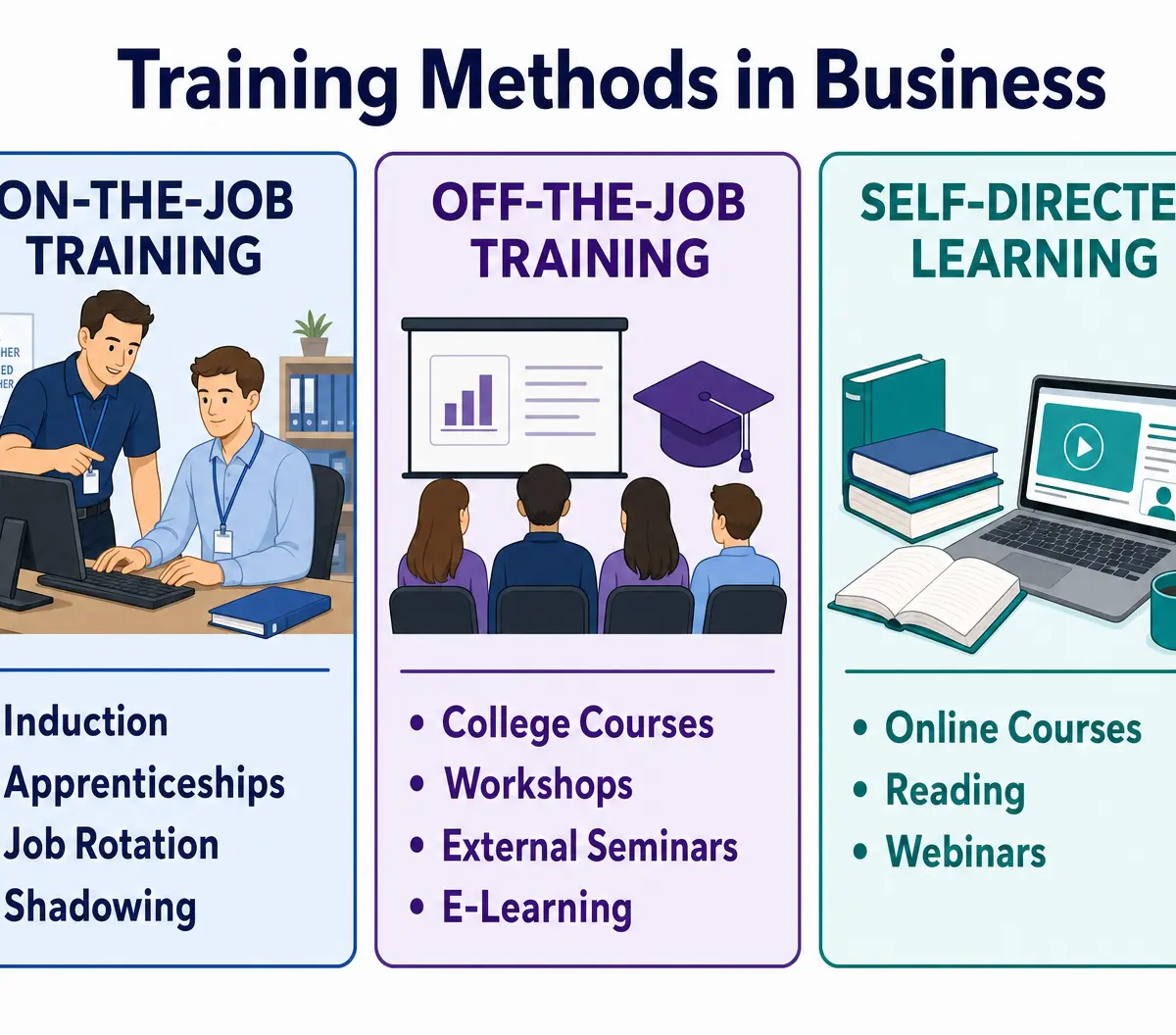
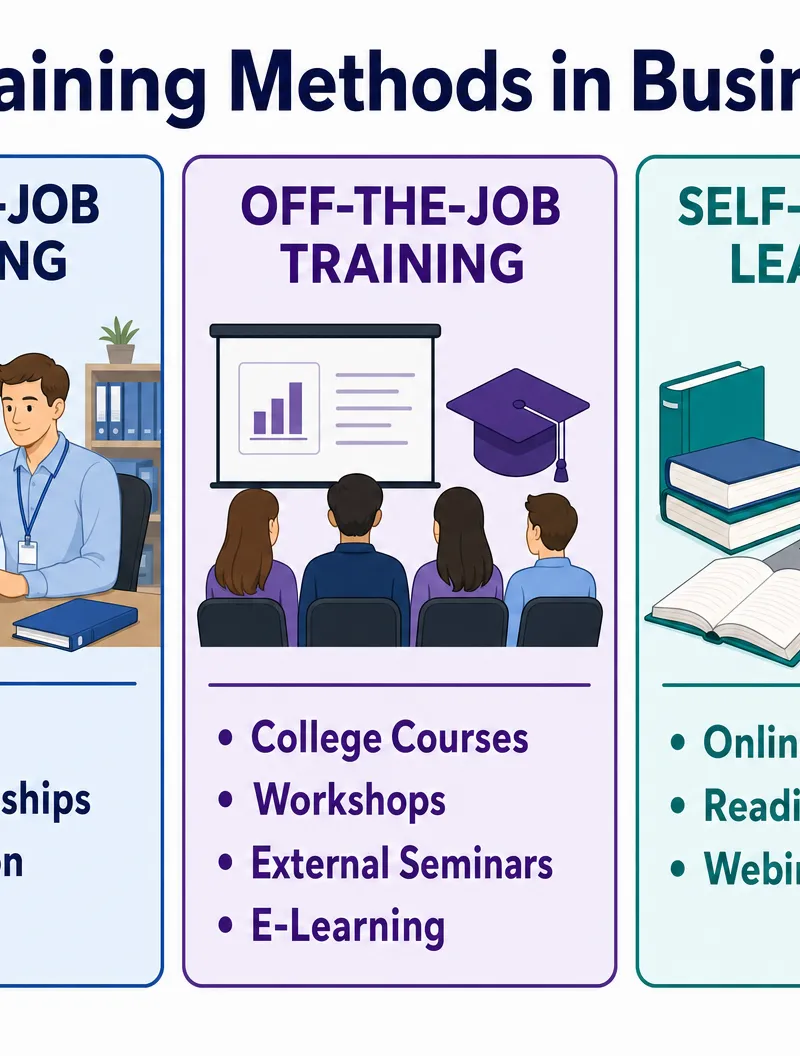
On-the-Job Training
What it is: Training that takes place while the employee is performing their normal duties in the workplace.
Methods:
- Induction: Introducing new hires to the business, its policies, and their role.
- Job Shadowing: Observing an experienced colleague to learn how tasks are performed.
- Mentoring: Long-term guidance from a senior employee.
- Job Rotation: Moving staff between different roles to broaden their skill set.
Impact: It is cost-effective and directly relevant to the role. However, bad habits can be passed on, and it may disrupt normal operations.
Off-the-Job Training
What it is: Training that takes place away from the immediate workplace, often at a college or specialist training centre.
Methods:
- External Courses: Attending a college or university for a formal qualification.
- Workshops/Seminars: Focused, short-term sessions on specific topics.
- E-learning: Online courses that can be completed remotely.
Impact: Provides high-quality, expert instruction without workplace distractions. However, it is generally more expensive, and the business loses the employee's output while they are away.
The Impact of Training
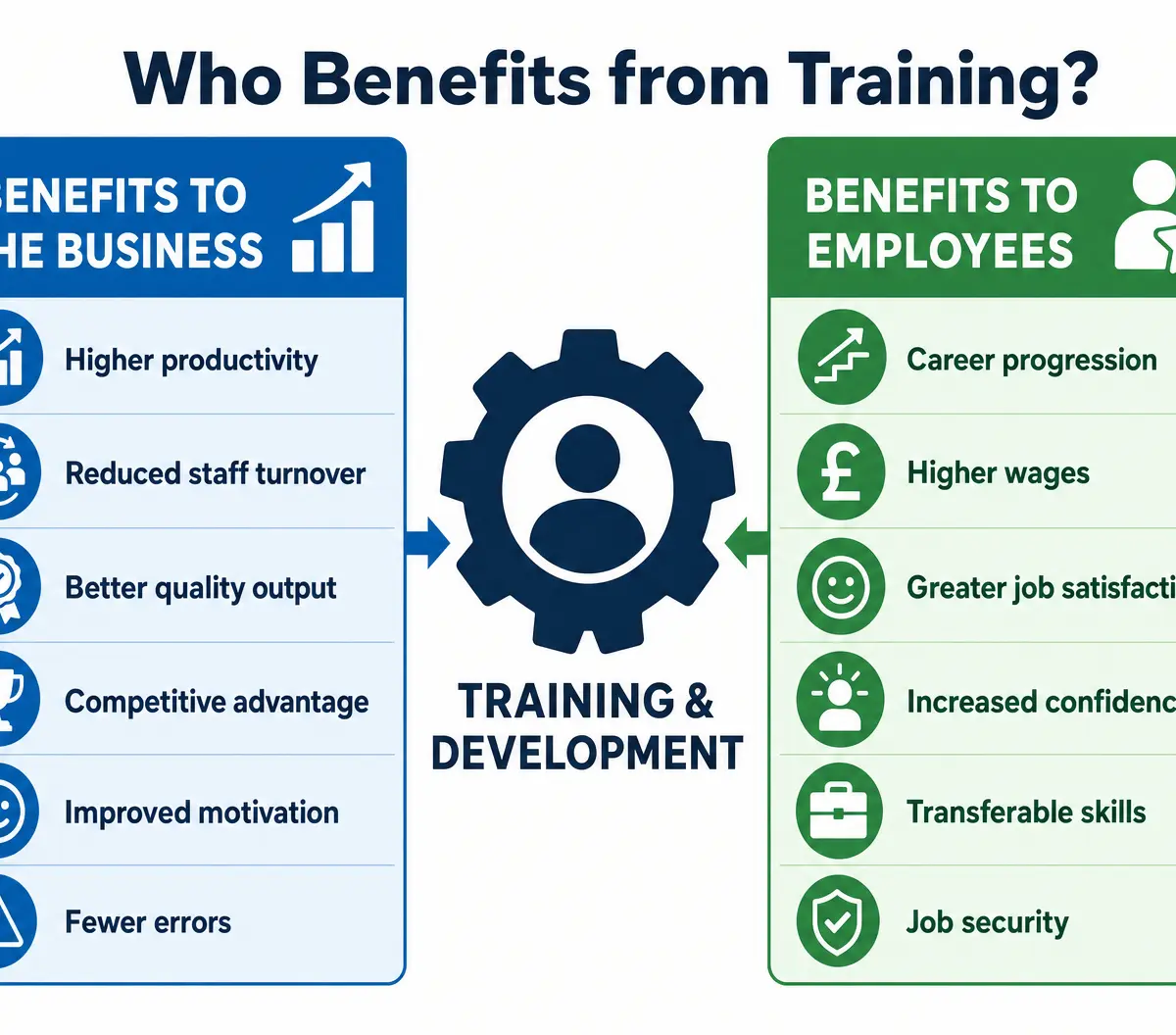
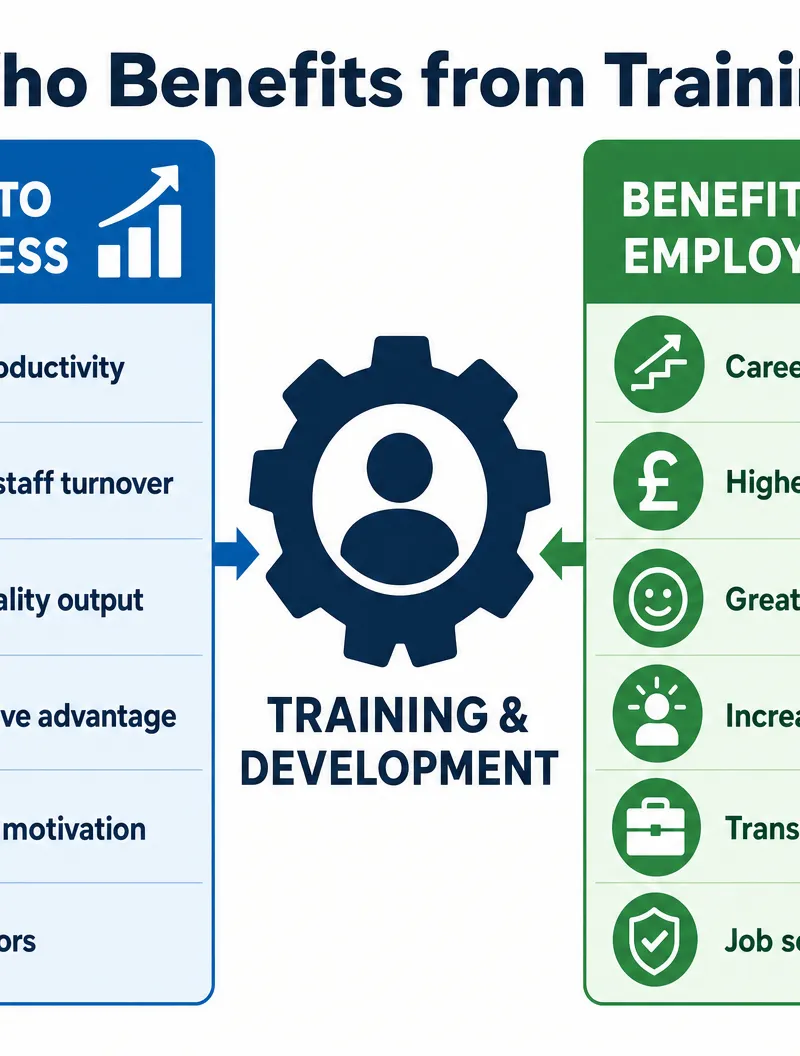
Benefits to the Business
- Higher Productivity: Skilled workers produce more output in less time.
- Better Quality: Fewer mistakes mean higher customer satisfaction and lower wastage costs.
- Reduced Staff Turnover: Employees who feel invested in are less likely to leave, saving recruitment costs.
- Adaptability: A trained workforce can handle new technology and changes in legislation.
Benefits to the Employee
- Motivation: Fulfilling esteem and self-actualisation needs (linking to Maslow and Herzberg).
- Career Progression: Acquiring skills needed for promotion.
- Job Security: Highly skilled workers are more valuable to the firm.
- Higher Earning Potential: Better skills can lead to pay rises or bonuses.
Interactive Diagrams
1 interactive diagram to visualise key concepts
Conceptual Flow Outline
The Training Decision Process
Worked Examples
3 worked examples — open one to explore the question and available guidance.
Practice Questions
Try the question, then reveal an answer plan or example response
State two reasons why a business might decide to retrain its existing staff. (2 marks)
Hint: Think about changes in the external environment or the business's operations.
Explain one disadvantage to a business of using on-the-job training. (3 marks)
Hint: Consider the quality of the training and the impact on the person delivering it.
Explain how training can improve employee motivation. (3 marks)
Hint: Link your answer to motivational theory or the psychological impact on the worker.
A small independent café, 'The Daily Grind', is hiring three new baristas. Evaluate whether they should use on-the-job or off-the-job training. (9 marks)
Hint: Apply your knowledge to a *small* business with practical, hands-on roles.
Explain the difference between training and development. (4 marks)
Hint: Use comparative language and focus on the timeframe (current vs future).
Exam technique
How to turn what you know into marks
How to approach the question
Always highlight the command word and the business context in the question before writing.
How to structure your answer
- Explain questions
- PEEL structure: Point, Evidence/Example, Explanation, Link to business impact.
- Evaluate questions
- Contextualised introduction → Argument for Option A → Argument for Option B → Justified Conclusion.
- Distinguish questions
- Use comparative language ('whereas', 'in contrast', 'on the other hand').
Timing
Approximately 1 minute per mark. Spend 1-2 minutes planning 9+ mark questions.
Common pitfalls
- Listing benefits without explaining *how* they help the business (the chain of reasoning).
- Ignoring the specific business scenario provided in the case study.
- Failing to provide a clear, justified conclusion in 'evaluate' or 'recommend' questions.
What the command words want
- Discuss
- Look at both sides of an argument (e.g., pros and cons). (6 marks)
- Explain
- Make a point and develop it showing cause and effect. (3-4 marks)
- Evaluate
- Analyse both sides in context and make a final judgement. (9-12 marks)
- State/Identify
- Give a simple fact or reason. No explanation needed. (1 mark)
Watch or listen (optional)
Test your understanding of Training and development
Active recall beats re-reading. Take an instant quiz now to test what you’ve learned and lock it into long-term memory.
A week of Premium from your first lesson · Then the free plan continues · No card, no charge