Pearson Edexcel · GCSE · Business
Course version: 1BS0 · Version from Sept 2017
Business stakeholders: Who business stakeholders are and their different
A stakeholder is any individual, group, or organisation that has a direct interest in, or is affected by, the activities and performance of a business.
Checked against the Pearson Edexcel 1BS0 specification (opens in a new tab) on .
- Point 1 of 3
- 4 key terms
Study notes
From the checked teaching notes for this specification point.
The idea
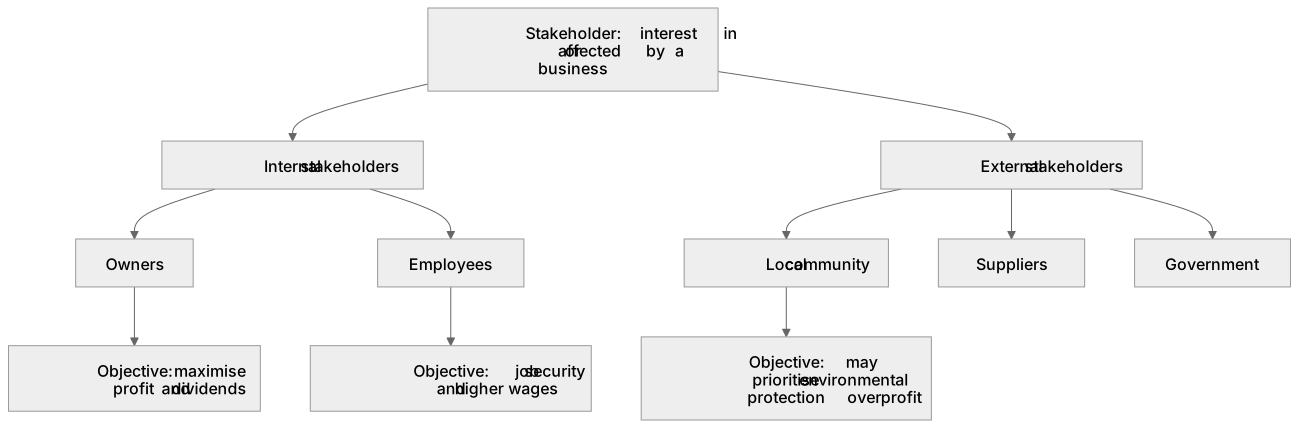
A stakeholder is any individual, group, or organisation that has a direct interest in, or is affected by, the activities and performance of a business. Stakeholders can be internal, such as employees working within the company, or external, such as the local community experiencing the impact of a new factory. Because each group interacts with the business differently, they hold distinct and often conflicting objectives. For example, while owners typically seek to maximise profit and dividends, employees usually prioritise job security and higher wages. Understanding these differing aims is crucial for analysing how business decisions impact various groups and why conflicts arise.
What earns the marks
- Define a stakeholder as anyone with an interest in or who is affected by the operations of a business.
- Distinguish between internal stakeholders (such as owners and workers) and external stakeholders (such as the local community).
- Identify that different stakeholder groups have distinct objectives based on their specific relationship with the business.
- Explain how a single business decision can positively affect one stakeholder group while negatively affecting another.
Common mistakes and how to put them right
Confusing stakeholders with shareholders.
Put it right by stating that shareholders are just one specific type of stakeholder who own part of the business.
Assuming all stakeholders want the business to maximise profit.
Put it right by noting that groups like the local community may prioritise environmental protection over profit.
Believing stakeholders only include people inside the business.
Put it right by including external groups like suppliers and the government.
Exam tips
- Always link the specific stakeholder to their likely objective when evaluating a business decision.
- Use the term 'conflict of interest' when explaining how a decision benefits one stakeholder but harms another.
- When asked for a stakeholder, ensure you choose one relevant to the specific context provided in the case study.
Try the lesson
The start of the Business stakeholders: Who business stakeholders are and their different lesson, made from checked teaching notes for this specification point.
Have a go first
Which of the following best describes what a business stakeholder is?
Listen
A stakeholder is any individual, group, or organisation that has a direct interest in, or is affected by, the activities and performance of a business. Stakeholders can be internal, such as employees working within the company, or external, such as the local community experiencing the impact of a new factory. Because each group interacts with the business differently, they hold distinct and often conflicting objectives. For example, while owners typically seek to maximise profit and dividends, employees usually prioritise job security and higher wages. Understanding these differing aims is crucial for analysing how business decisions impact various groups and why conflicts arise. A strong answer earns marks for these points. Define a stakeholder as anyone with an interest in or who is affected by the operations of a business. Distinguish between internal stakeholders (such as owners and workers) and external stakeholders (such as the local community). Identify that different stakeholder groups have distinct objectives based on their specific relationship with the business. Explain how a single business decision can positively affect one stakeholder group while negatively affecting another. A common slip: Confusing stakeholders with shareholders. Instead, stating that shareholders are just one specific type of stakeholder who own part of the business. Exam tip: Always link the specific stakeholder to their likely objective when evaluating a business decision.
See it
Key words
Say what each word means before you turn the card.
Stakeholder
Try answering aloud or in your head before turning the card.
Internal stakeholders
Try answering aloud or in your head before turning the card.
External stakeholders
Try answering aloud or in your head before turning the card.
Conflict of interest
Try answering aloud or in your head before turning the card.
See every definition
- Stakeholder
- Any individual, group, or organisation that has a direct interest in, or is affected by, the activities and performance of a business.
- Internal stakeholders
- Those such as employees working within the company, or owners and workers, who are inside the business.
- External stakeholders
- Those outside the business, such as the local community experiencing the impact of a new factory, suppliers and the government.
- Conflict of interest
- Arises because each group holds distinct and often conflicting objectives, so a decision can benefit one stakeholder but harm another.
Label the diagram
Some boxes have lost their names. Pick the right name for each number.

1Box 1
2Box 2
3Box 3
There is more to this lesson
The full lesson goes on to check your understanding and help you earn the marks. Create a free account to carry on, with your progress saved.
A week of Premium from your first lesson · Then the free plan continues · No card, no charge
Test your understanding of Business stakeholders: Who business stakeholders are and their different
Active recall beats re-reading. Take an instant quiz now to test what you’ve learned and lock it into long-term memory.
A week of Premium from your first lesson · Then the free plan continues · No card, no charge