Pearson Edexcel · GCSE · Business
Course version: 1BS0 · Version from Sept 2017
Businesses: ● how ethical considerations influence business activity:…
Full specification wording
Ethics, the environment and business: businesses: ● how ethical considerations influence business activity: possible trade-offs between ethics and profit ● how environmental considerations influence business activity: possible trade-offs between the environment, sustainability and profit ● the potential impact of pressure group activity on the marketing mix.
Ethical considerations involve doing what is morally right, such as paying fair wages to overseas suppliers.
Checked against the Pearson Edexcel 1BS0 specification (opens in a new tab) on .
- Point 2 of 2
- 4 key terms
Study notes
From the checked teaching notes for this specification point.
The idea
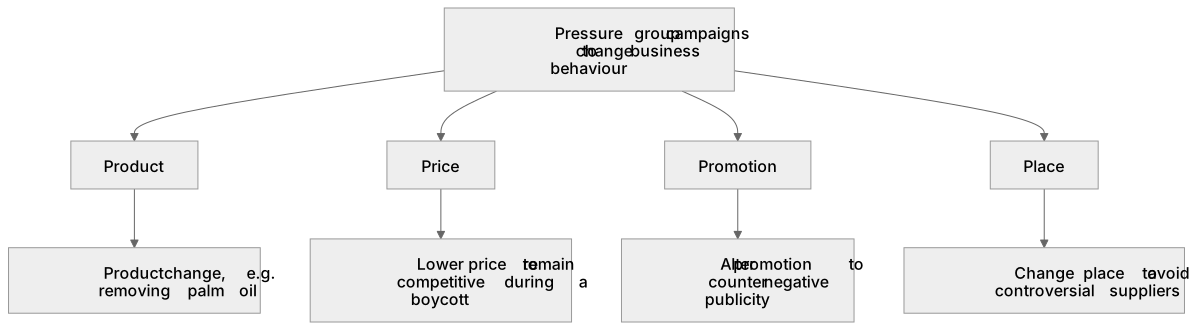
Ethical considerations involve doing what is morally right, such as paying fair wages to overseas suppliers. This often increases costs, creating a trade-off where higher ethical standards reduce short-term profit margins. Similarly, environmental considerations focus on reducing negative impacts, such as using sustainable, biodegradable packaging instead of cheap plastics. This sustainability trade-off also typically raises costs but can attract eco-conscious consumers. Pressure groups are organisations that campaign to change business behaviour. They can impact the marketing mix by forcing a business to change its product (e.g. removing palm oil), lower its price to remain competitive during a boycott, alter its promotion to counter negative publicity, or change its place to avoid controversial suppliers.
What earns the marks
- Define ethical behaviour as actions deemed morally correct that go beyond basic legal requirements.
- Explain the trade-off between ethics or environment and profit: higher costs for sustainable materials or fair wages reduce profit margins unless prices are raised.
- Identify how pressure groups influence the marketing mix, such as forcing product redesigns or altering promotional campaigns to repair brand image.
- Analyse the long-term benefits of ethical and environmental practices, such as improved brand loyalty and competitive advantage, which can offset short-term profit losses.
Common mistakes and how to put them right
Confusing ethical behaviour with legal requirements.
Put it right: State that ethics go beyond what the law demands, such as paying above the minimum wage.
Assuming ethical and environmental actions always reduce overall profit.
Put it right: Recognise that while costs increase, higher sales from a positive brand image can ultimately increase total profit.
Failing to link pressure group activity specifically to the marketing mix.
Put it right: Explicitly state how a pressure group affects Product, Price, Place, or Promotion, rather than just saying they cause trouble.
Exam tips
- When evaluating a trade-off, explicitly weigh the short-term increase in costs against the long-term potential for increased market share.
- Use the 4Ps (Product, Price, Place, Promotion) to structure your answer when asked about the impact of pressure groups.
- Provide a specific example, such as switching to Fairtrade coffee, to illustrate the conflict between ethical sourcing and profit margins.
Try the lesson
The start of the Ethics, the environment and business: businesses: ● how ethical considerations influence business activity: possible trade-offs between ethics and profit ● how environmental considerations influence business activity: possible trade-offs between the environment, sustainability and profit ● the potential impact of pressure group activity on the marketing mix. lesson, made from checked teaching notes for this specification point.
Have a go first
Which of the following is a likely trade-off for a business that decides to use ethically sourced raw materials?
Listen
Ethical considerations involve doing what is morally right, such as paying fair wages to overseas suppliers. This often increases costs, creating a trade-off where higher ethical standards reduce short-term profit margins. Similarly, environmental considerations focus on reducing negative impacts, such as using sustainable, biodegradable packaging instead of cheap plastics. This sustainability trade-off also typically raises costs but can attract eco-conscious consumers. Pressure groups are organisations that campaign to change business behaviour. They can impact the marketing mix by forcing a business to change its product (e.g. removing palm oil), lower its price to remain competitive during a boycott, alter its promotion to counter negative publicity, or change its place to avoid controversial suppliers. A strong answer earns marks for these points. Define ethical behaviour as actions deemed morally correct that go beyond basic legal requirements. Explain the trade-off between ethics or environment and profit: higher costs for sustainable materials or fair wages reduce profit margins unless prices are raised. Identify how pressure groups influence the marketing mix, such as forcing product redesigns or altering promotional campaigns to repair brand image. Analyse the long-term benefits of ethical and environmental practices, such as improved brand loyalty and competitive advantage, which can offset short-term profit losses. A common slip: Confusing ethical behaviour with legal requirements. Instead, state that ethics go beyond what the law demands, such as paying above the minimum wage. Exam tip: When evaluating a trade-off, explicitly weigh the short-term increase in costs against the long-term potential for increased market share.
See it
Key words
Say what each word means before you turn the card.
Business ethics
Try answering aloud or in your head before turning the card.
Environmental sustainability
Try answering aloud or in your head before turning the card.
Profit margins and trade-offs
Try answering aloud or in your head before turning the card.
Pressure groups and the marketing mix
Try answering aloud or in your head before turning the card.
See every definition
- Business ethics
- Actions deemed morally correct that go beyond basic legal requirements, such as paying fair wages to overseas suppliers.
- Environmental sustainability
- Reducing negative impacts, such as using sustainable, biodegradable packaging instead of cheap plastics.
- Profit margins and trade-offs
- Higher costs for sustainable materials or fair wages reduce profit margins unless prices are raised, creating a trade-off between ethics and profit.
- Pressure groups and the marketing mix
- Organisations that campaign to change business behaviour can force a business to change its product, lower its price, alter its promotion or change its place.
Label the diagram
Some boxes have lost their names. Pick the right name for each number.
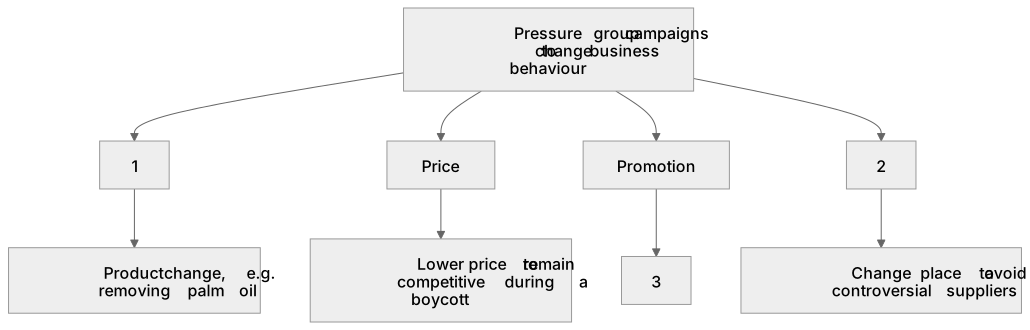
1Box 1
2Box 2
3Box 3
There is more to this lesson
The full lesson goes on to check your understanding and help you earn the marks. Create a free account to carry on, with your progress saved.
A week of Premium from your first lesson · Then the free plan continues · No card, no charge
Test your understanding of Ethics, the environment and business: businesses: ● how ethical considerations influence business activity: possible trade-offs between ethics and profit ● how environmental considerations influence business activity: possible trade-offs between the environment, sustainability and profit ● the potential impact of pressure group activity on the marketing mix.
Active recall beats re-reading. Take an instant quiz now to test what you’ve learned and lock it into long-term memory.
A week of Premium from your first lesson · Then the free plan continues · No card, no charge