Pearson Edexcel · GCSE · Business
Course version: 1BS0 · Version from Sept 2017
Market segmentation: How businesses use market segmentation to target
Market segmentation involves dividing a broad target market into smaller, more defined groups of consumers who share similar characteristics, needs, or interests.
Checked against the Pearson Edexcel 1BS0 specification (opens in a new tab) on .
- Point 1 of 2
- 2 key terms
Study notes
From the checked teaching notes for this specification point.
The idea
Market segmentation involves dividing a broad target market into smaller, more defined groups of consumers who share similar characteristics, needs, or interests. By understanding these distinct segments, businesses can tailor their products, services, and marketing campaigns to meet the specific demands of each group. This targeted approach allows firms to allocate their resources more efficiently, rather than using a mass-marketing strategy that might not appeal to everyone.
For example: A clothing retailer might segment its market to offer different product lines for teenagers and working professionals, ensuring that promotional messages resonate strongly with the intended audience and ultimately increasing sales and customer loyalty.
What earns the marks
- Define market segmentation as the process of dividing a market into distinct groups of buyers with different needs or characteristics.
- Explain that targeting involves selecting one or more of these segments to enter and focus marketing efforts upon.
- Identify that segmentation allows businesses to create tailored marketing mixes that appeal directly to the chosen target market.
- Discuss how effective targeting can lead to increased sales, better customer retention, and more efficient use of marketing budgets.
Common mistakes and how to put them right
The error is using the terms segmentation and targeting interchangeably; the correction is to define segmentation as dividing the market into groups, and targeting as the subsequent step of choosing which specific group to focus marketing efforts on.
The error is stating that segmentation alone automatically increases sales; the correction is to explain that segmentation must be followed by effective targeting and a suitable marketing mix to achieve commercial success.
The error is claiming that mass marketing is always an inferior strategy; the correction is to recognise that mass marketing can be highly effective for generic products, whereas segmentation is better suited for differentiated products.
Exam tips
- Always link the concept of segmentation to how it helps a business meet customer needs more accurately and efficiently.
- Use the context provided in the case study to explain why a business has chosen to target a specific segment rather than the whole market.
- When evaluating segmentation strategies, consider the additional costs involved in researching and developing products for multiple specific target markets.
Try the lesson
The start of the Market segmentation: How businesses use market segmentation to target lesson, made from checked teaching notes for this specification point.
Have a go first
What is the primary reason a business uses market segmentation to target its audience?
Listen
Market segmentation involves dividing a broad target market into smaller, more defined groups of consumers who share similar characteristics, needs, or interests. By understanding these distinct segments, businesses can tailor their products, services, and marketing campaigns to meet the specific demands of each group. This targeted approach allows firms to allocate their resources more efficiently, rather than using a mass-marketing strategy that might not appeal to everyone. For example, a clothing retailer might segment its market to offer different product lines for teenagers and working professionals, ensuring that promotional messages resonate strongly with the intended audience and ultimately increasing sales and customer loyalty. A strong answer earns marks for these points. Define market segmentation as the process of dividing a market into distinct groups of buyers with different needs or characteristics. Explain that targeting involves selecting one or more of these segments to enter and focus marketing efforts upon. Identify that segmentation allows businesses to create tailored marketing mixes that appeal directly to the chosen target market. Discuss how effective targeting can lead to increased sales, better customer retention, and more efficient use of marketing budgets. A common slip: The error is using the terms segmentation and targeting interchangeably. Instead, define segmentation as dividing the market into groups, and targeting as the subsequent step of choosing which specific group to focus marketing efforts on. Exam tip: Always link the concept of segmentation to how it helps a business meet customer needs more accurately and efficiently.
See it

Put it in order
Put these steps in the order they happen.
- 1. Distinct segments sharing similar characteristics, needs or interests
- 2. Market segmentation: divide into smaller, more defined groups
- 3. Broad target market
- 4. Increased sales, better customer retention, more efficient use of marketing budgets
- 5. Tailored marketing mix for the chosen target market
- 6. Targeting: select one or more segments to focus marketing efforts upon
Watch it explained
What is the one idea the video explains? Say it in a sentence.
Read the described scene instead
Market segmentation is the process of dividing a broad target market into smaller, more defined groups of consumers who share similar characteristics, needs, or interests. Rather than treating every buyer as identical, a business identifies distinct groups within the market. Segmentation and targeting are related but different. Segmentation is dividing the market into groups. Targeting is the subsequent step of selecting one or more of those segments to enter and focus marketing efforts upon. A common error is using the two terms interchangeably, but segmentation comes first and targeting follows. Once a business has segmented the market and chosen its target, it can create a tailored marketing mix that appeals directly to that chosen target market. This means adapting products, services and marketing campaigns to meet the specific demands of each group, so promotional messages resonate strongly with the intended audience. Consider a clothing retailer. It might segment its market to offer different product lines for teenagers and for working professionals. Each group has different needs, so the retailer tailors its products and promotional messages to suit each one. Pause here and think: why target two segments rather than the whole market at once? Because tailoring to each group's needs is more likely to increase sales and customer loyalty. Watch for three errors. First, don't use segmentation and targeting interchangeably: segmentation divides the market, targeting chooses where to focus. Second, segmentation alone does not automatically increase sales. It must be followed by effective targeting and a suitable marketing mix to achieve commercial success. Third, mass marketing is not always inferior. It can be highly effective for generic products, whereas segmentation suits differentiated products. Segmentation lets firms allocate resources more efficiently than a mass-marketing strategy that might not appeal to everyone, supporting better customer retention and more efficient use of marketing budgets. In an exam, link segmentation to meeting customer needs accurately, use case-study context to explain why a specific segment was chosen, and evaluate the extra costs of researching and developing products for multiple target markets.
Key words
Say what each word means before you turn the card.
Market segmentation
Try answering aloud or in your head before turning the card.
Targeting
Try answering aloud or in your head before turning the card.
See every definition
- Market segmentation
- Dividing a broad target market into smaller, more defined groups of consumers who share similar characteristics, needs, or interests.
- Targeting
- Selecting one or more of these segments to enter and focus marketing efforts upon.
Label the diagram
Some boxes have lost their names. Pick the right name for each number.
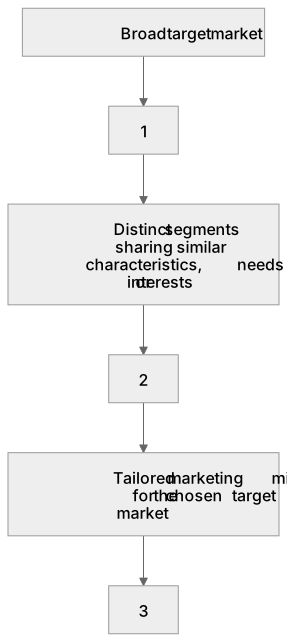
1Box 1
2Box 2
3Box 3
There is more to this lesson
The full lesson goes on to check your understanding and help you earn the marks. Create a free account to carry on, with your progress saved.
A week of Premium from your first lesson · Then the free plan continues · No card, no charge
Test your understanding of Market segmentation: How businesses use market segmentation to target
Active recall beats re-reading. Take an instant quiz now to test what you’ve learned and lock it into long-term memory.
A week of Premium from your first lesson · Then the free plan continues · No card, no charge