Pearson Edexcel · GCSE · Business
Course version: 1BS0 · Version from Sept 2017
The importance of motivation in the workplace: ● attracting employees,…
Full specification wording
Motivation: The importance of motivation in the workplace: ● attracting employees, retaining employees, productivity.
Motivation in the workplace is essential for a business to function efficiently and competitively.
Checked against the Pearson Edexcel 1BS0 specification (opens in a new tab) on .
- Point 1 of 2
Study notes
From the checked teaching notes for this specification point.
The idea
Motivation in the workplace is essential for a business to function efficiently and competitively. A highly motivated workforce is crucial for attracting prospective employees, as a positive corporate reputation draws top talent to the organisation. Once hired, motivation plays a vital role in retaining employees, reducing the disruption and high costs associated with staff turnover. For instance, a firm offering flexible working hours will likely keep its best staff. Crucially, motivation directly drives productivity. Motivated staff work harder, make fewer mistakes, and produce higher quality output in less time, which lowers the unit cost of production and ultimately increases the business's overall profitability.
What earns the marks
- Explaining how a reputation for high motivation and good working conditions helps attract high-quality candidates.
- Linking high employee motivation to improved staff retention and reduced recruitment costs.
- Demonstrating how motivated employees increase productivity by working more efficiently and making fewer errors.
- Analysing the impact of increased productivity on lowering unit costs and improving business competitiveness.
Common mistakes and how to put them right
Using 'production' and 'productivity' interchangeably.
Put it right: Production is the total amount made, whereas productivity measures output per worker over a given time.
Stating that motivation only comes from financial rewards.
Put it right: Acknowledge that non-financial factors, such as job design and company culture, are vital for attracting and retaining staff.
Failing to link motivation to business costs.
Put it right: Connect high motivation to lower costs through better retention (lower hiring costs) and higher productivity (lower unit costs).
Exam tips
- When asked about the benefits of motivation, explicitly use the terms 'attracting', 'retaining', and 'productivity' to structure your answer.
- Connect higher productivity directly to lower unit costs to demonstrate strong analytical skills.
- Apply the concept of motivation to the specific business in the case study, considering what would attract or retain workers in that particular industry.
Try the lesson
The start of the Motivation: The importance of motivation in the workplace: ● attracting employees, retaining employees, productivity. lesson, made from checked teaching notes for this specification point.
Have a go first
Why is it important for a business to maintain a high level of employee motivation in the workplace?
Listen
Motivation in the workplace is essential for a business to function efficiently and competitively. A highly motivated workforce is crucial for attracting prospective employees, as a positive corporate reputation draws top talent to the organisation. Once hired, motivation plays a vital role in retaining employees, reducing the disruption and high costs associated with staff turnover. For instance, a firm offering flexible working hours will likely keep its best staff. Crucially, motivation directly drives productivity. Motivated staff work harder, make fewer mistakes, and produce higher quality output in less time, which lowers the unit cost of production and ultimately increases the business's overall profitability. A strong answer earns marks for these points. Explaining how a reputation for high motivation and good working conditions helps attract high-quality candidates. Linking high employee motivation to improved staff retention and reduced recruitment costs. Demonstrating how motivated employees increase productivity by working more efficiently and making fewer errors. Analysing the impact of increased productivity on lowering unit costs and improving business competitiveness. A common slip: Using 'production' and 'productivity' interchangeably. Instead, Production is the total amount made, whereas productivity measures output per worker over a given time. Exam tip: When asked about the benefits of motivation, explicitly use the terms 'attracting', 'retaining', and 'productivity' to structure your answer.
See it
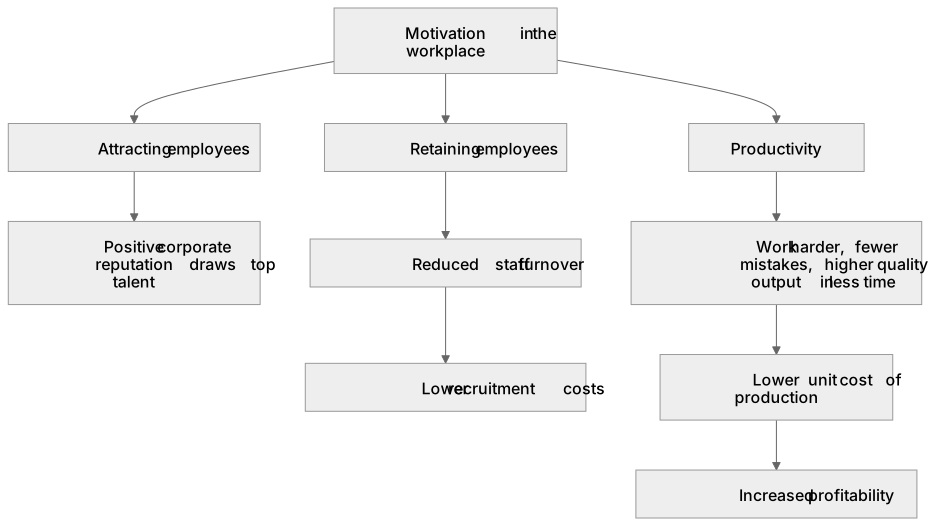
Label the diagram
Some boxes have lost their names. Pick the right name for each number.
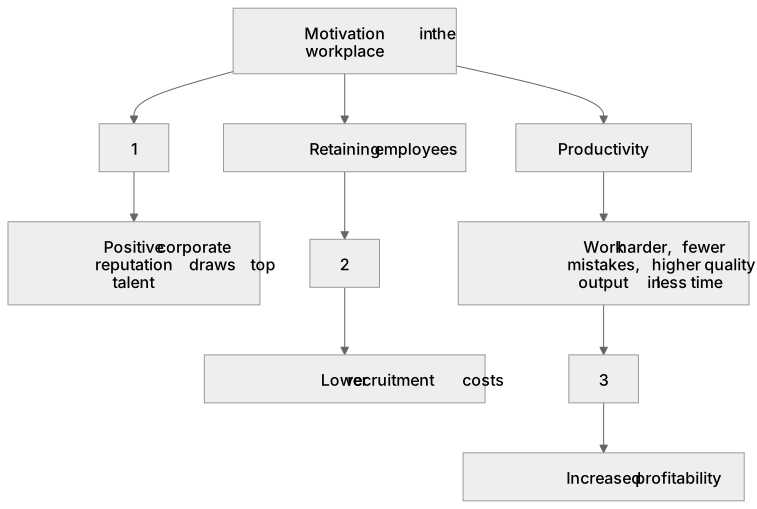
1Box 1
2Box 2
3Box 3
There is more to this lesson
The full lesson goes on to check your understanding and help you earn the marks. Create a free account to carry on, with your progress saved.
A week of Premium from your first lesson · Then the free plan continues · No card, no charge
Test your understanding of Motivation: The importance of motivation in the workplace: ● attracting employees, retaining employees, productivity.
Active recall beats re-reading. Take an instant quiz now to test what you’ve learned and lock it into long-term memory.
A week of Premium from your first lesson · Then the free plan continues · No card, no charge