Pearson Edexcel · GCSE · Business
Course version: 1BS0 · Version from Sept 2017
The impact of risk and reward on business activity: ● risk: business…
Full specification wording
Risk and reward: The impact of risk and reward on business activity: ● risk: business failure, financial loss, lack of security ● reward: business success, profit, independence.
Starting a business involves balancing potential risks against desired rewards.
Checked against the Pearson Edexcel 1BS0 specification (opens in a new tab) on .
- 4 key terms
Study notes
From the checked teaching notes for this specification point.
The idea
Starting a business involves balancing potential risks against desired rewards. For example, an entrepreneur opening a bakery faces significant risks, including business failure if revenues cannot cover costs. This leads to direct financial loss, especially if personal savings were invested. Furthermore, leaving a salaried job creates a lack of security, as income becomes unpredictable. However, these risks are taken in pursuit of compelling rewards. Achieving business success allows the bakery to build a loyal customer base. The primary financial reward is profit, the surplus remaining after deducting all costs. Finally, running a business offers independence, giving the owner complete control over decision-making and working hours.
What earns the marks
- Identify business failure as a primary risk where a business is forced to close due to insolvency or poor cash flow.
- Explain financial loss in terms of losing invested capital or personal assets if the business does not generate sufficient revenue.
- Describe lack of security as the absence of a guaranteed regular income, sick pay, or holiday pay compared to traditional employment.
- Define profit as the financial reward calculated by subtracting total costs from total revenue.
- Explain independence as the non-financial reward of being one's own boss and having autonomy over business decisions.
Common mistakes and how to put them right
Confusing profit with revenue.
Put it right: Revenue is the total money brought in, whereas profit is the reward left over after deducting all costs.
Assuming all rewards are financial.
Put it right: Independence and personal satisfaction from business success are crucial non-financial rewards.
Stating that limited liability eliminates financial loss.
Put it right: Limited liability only protects personal assets, but the entrepreneur can still lose their invested capital.
Exam tips
- When evaluating a business decision, always weigh a specific risk (like financial loss) against a potential reward (like increased profit).
- Use the context of the case study to explain why a lack of security might be particularly daunting for the specific entrepreneur mentioned.
- Clearly distinguish between business success (such as market share or survival) and profit (financial gain) when discussing rewards.
Try the lesson
The start of the Risk and reward: The impact of risk and reward on business activity: ● risk: business failure, financial loss, lack of security ● reward: business success, profit, independence. lesson, made from checked teaching notes for this specification point.
Have a go first
Which of the following is classified as a primary reward of starting a new business activity?
Listen
Starting a business involves balancing potential risks against desired rewards. For example, an entrepreneur opening a bakery faces significant risks, including business failure if revenues cannot cover costs. This leads to direct financial loss, especially if personal savings were invested. Furthermore, leaving a salaried job creates a lack of security, as income becomes unpredictable. However, these risks are taken in pursuit of compelling rewards. Achieving business success allows the bakery to build a loyal customer base. The primary financial reward is profit, the surplus remaining after deducting all costs. Finally, running a business offers independence, giving the owner complete control over decision-making and working hours. A strong answer earns marks for these points. Identify business failure as a primary risk where a business is forced to close due to insolvency or poor cash flow. Explain financial loss in terms of losing invested capital or personal assets if the business does not generate sufficient revenue. Describe lack of security as the absence of a guaranteed regular income, sick pay, or holiday pay compared to traditional employment. Define profit as the financial reward calculated by subtracting total costs from total revenue. A common slip: Confusing profit with revenue. Instead, revenue is the total money brought in, whereas profit is the reward left over after deducting all costs. Exam tip: When evaluating a business decision, always weigh a specific risk (like financial loss) against a potential reward (like increased profit).
See it

Key words
Say what each word means before you turn the card.
Risk
Try answering aloud or in your head before turning the card.
Reward
Try answering aloud or in your head before turning the card.
Profit
Try answering aloud or in your head before turning the card.
Independence
Try answering aloud or in your head before turning the card.
See every definition
- Risk
- Starting a business involves risks such as business failure, financial loss and a lack of security.
- Reward
- The rewards of business activity include business success, profit and independence.
- Profit
- The financial reward calculated by subtracting total costs from total revenue.
- Independence
- The non-financial reward of being one's own boss and having autonomy over business decisions.
Label the diagram
Some boxes have lost their names. Pick the right name for each number.
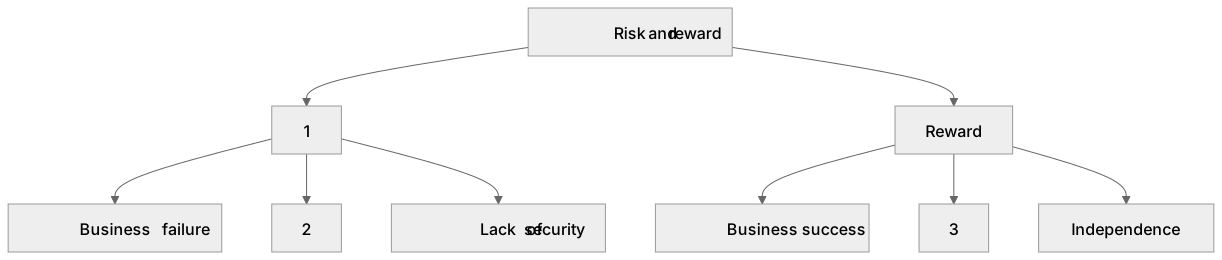
1Box 1
2Box 2
3Box 3
There is more to this lesson
The full lesson goes on to check your understanding and help you earn the marks. Create a free account to carry on, with your progress saved.
A week of Premium from your first lesson · Then the free plan continues · No card, no charge
Test your understanding of Risk and reward: The impact of risk and reward on business activity: ● risk: business failure, financial loss, lack of security ● reward: business success, profit, independence.
Active recall beats re-reading. Take an instant quiz now to test what you’ve learned and lock it into long-term memory.
A week of Premium from your first lesson · Then the free plan continues · No card, no charge