Pearson Edexcel · GCSE · Business
Course version: 1BS0 · Version from Sept 2017
Different types of technology used by business: ● e-commerce ● social…
Full specification wording
Technology and business: Different types of technology used by business: ● e-commerce ● social media ● digital communication ● payment systems.
Businesses use various technologies to operate efficiently and reach customers.
Checked against the Pearson Edexcel 1BS0 specification (opens in a new tab) on .
- Point 1 of 2
- 4 key terms
Study notes
From the checked teaching notes for this specification point.
The idea
Businesses use various technologies to operate efficiently and reach customers. E-commerce allows firms to sell products online 24/7, expanding their market globally but requiring investment in website maintenance and logistics. Social media provides a platform for targeted advertising and direct customer engagement, though negative reviews can spread rapidly. Digital communication, such as email and video conferencing, speeds up internal decision-making and allows flexible remote working. Finally, modern payment systems, including contactless cards and digital wallets, offer convenience and speed for customers, reducing queuing times in physical stores while ensuring secure, traceable transactions for the business.
What earns the marks
- Explain how e-commerce increases potential sales revenue by providing access to a wider, potentially global, customer base.
- Analyse the use of social media for market research and building brand loyalty through direct customer interaction.
- Assess how digital communication improves operational efficiency by reducing travel costs and enabling remote collaboration.
- Evaluate the impact of implementing new payment systems on customer convenience and the initial setup costs for the business.
Common mistakes and how to put them right
Treating e-commerce and social media as the exact same thing.
Put it right: Distinguish e-commerce as the platform for buying and selling, and social media as the tool for marketing and communication.
Focusing only on the benefits of technology.
Put it right: Consider the drawbacks, such as the high initial costs of implementation or the risk of cyber security breaches.
Using outdated examples of payment systems.
Put it right: Refer to current technologies like contactless payments, mobile wallets, or integrated online payment gateways.
Exam tips
- Link the type of technology to the specific needs of the business in the case study, such as a local café using social media to attract nearby footfall.
- When evaluating technology, contrast the long-term efficiency savings against the short-term installation and training costs.
- Consider how digital communication impacts different stakeholders, such as employees benefiting from flexible working arrangements.
Try the lesson
The start of the Technology and business: Different types of technology used by business: ● e-commerce ● social media ● digital communication ● payment systems. lesson, made from checked teaching notes for this specification point.
Have a go first
A small independent bookshop decides to start selling its products through its own website rather than just in its physical store. Which type of technology is the business adopting to achieve this?
Listen
Businesses use various technologies to operate efficiently and reach customers. E-commerce allows firms to sell products online 24/7, expanding their market globally but requiring investment in website maintenance and logistics. Social media provides a platform for targeted advertising and direct customer engagement, though negative reviews can spread rapidly. Digital communication, such as email and video conferencing, speeds up internal decision-making and allows flexible remote working. Finally, modern payment systems, including contactless cards and digital wallets, offer convenience and speed for customers, reducing queuing times in physical stores while ensuring secure, traceable transactions for the business. A strong answer earns marks for these points. Explain how e-commerce increases potential sales revenue by providing access to a wider, potentially global, customer base. Analyse the use of social media for market research and building brand loyalty through direct customer interaction. Assess how digital communication improves operational efficiency by reducing travel costs and enabling remote collaboration. Evaluate the impact of implementing new payment systems on customer convenience and the initial setup costs for the business. A common slip: Treating e-commerce and social media as the exact same thing. Instead, distinguish e-commerce as the platform for buying and selling, and social media as the tool for marketing and communication. Exam tip: Link the type of technology to the specific needs of the business in the case study, such as a local café using social media to attract nearby footfall.
See it

Key words
Say what each word means before you turn the card.
E-commerce
Try answering aloud or in your head before turning the card.
Social media
Try answering aloud or in your head before turning the card.
Digital communication
Try answering aloud or in your head before turning the card.
Payment systems
Try answering aloud or in your head before turning the card.
See every definition
- E-commerce
- A platform for buying and selling that allows firms to sell products online 24/7, expanding their market globally.
- Social media
- A tool for marketing and communication that provides a platform for targeted advertising and direct customer engagement.
- Digital communication
- Technology such as email and video conferencing that speeds up internal decision-making and allows flexible remote working.
- Payment systems
- Modern systems, including contactless cards and digital wallets, that offer convenience and speed for customers and ensure secure, traceable transactions for the business.
Label the diagram
Some boxes have lost their names. Pick the right name for each number.
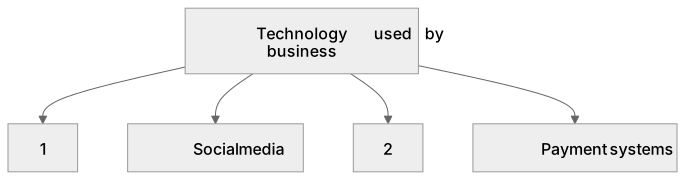
1Box 1
2Box 2
There is more to this lesson
The full lesson goes on to check your understanding and help you earn the marks. Create a free account to carry on, with your progress saved.
A week of Premium from your first lesson · Then the free plan continues · No card, no charge
Test your understanding of Technology and business: Different types of technology used by business: ● e-commerce ● social media ● digital communication ● payment systems.
Active recall beats re-reading. Take an instant quiz now to test what you’ve learned and lock it into long-term memory.
A week of Premium from your first lesson · Then the free plan continues · No card, no charge