Study Notes

Overview
Human Resources (HR) is the function within a business responsible for managing employees. In your GCSE Business exam, this topic tests your understanding of how businesses recruit, train, motivate, and organise their workforce to achieve their aims. Examiners expect candidates to not only describe HR processes but to evaluate their effectiveness in specific business contexts. This means understanding that a small local bakery will have very different HR needs compared to a multinational tech corporation.
Listen to our comprehensive revision podcast to solidify your understanding of these core concepts:
Recruitment and Selection
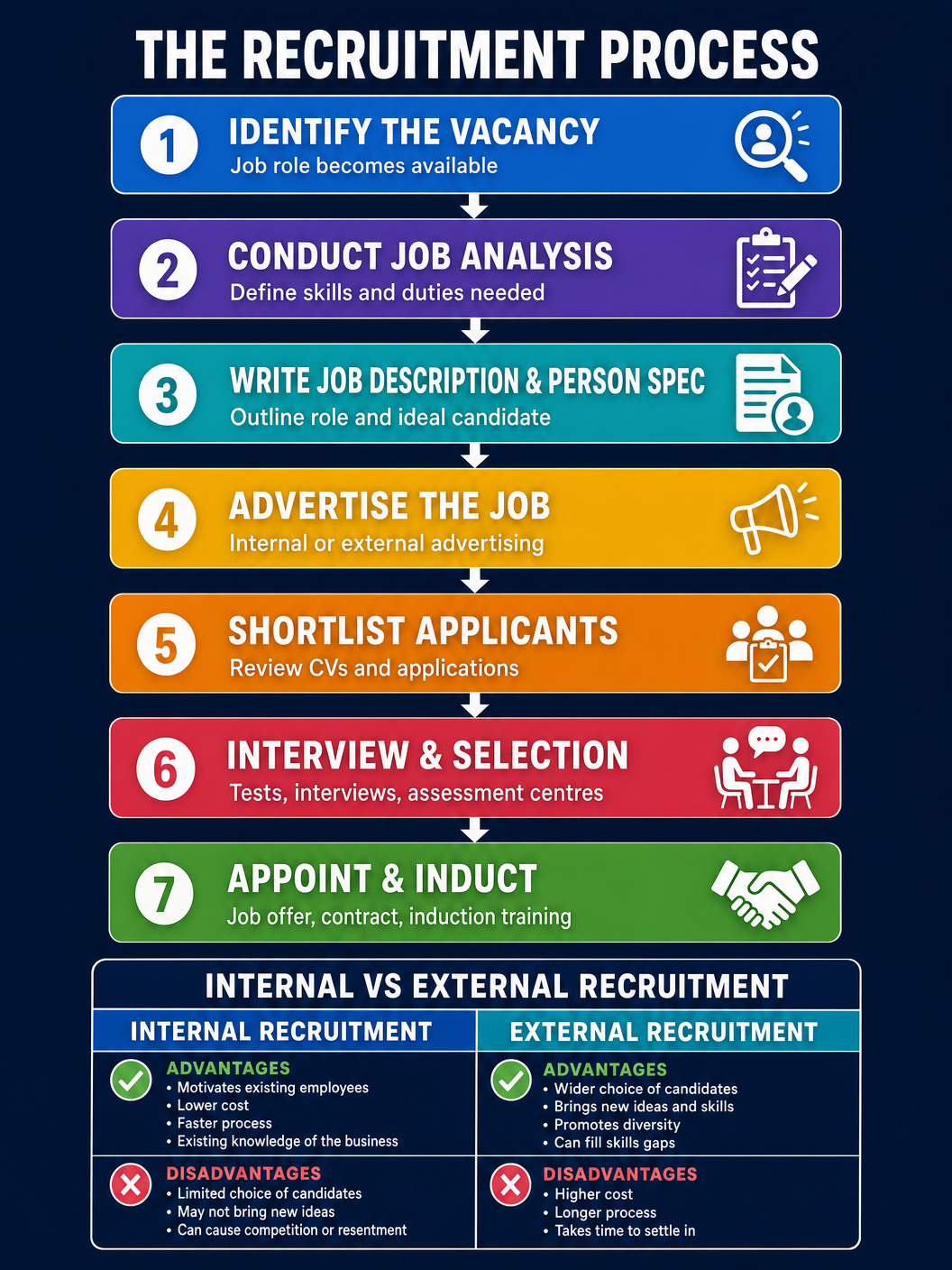
Recruitment is the process of identifying a need for a new employee, attracting candidates, and selecting the most suitable person. The process typically follows these steps:
- Identify the vacancy: A role becomes available due to expansion or an employee leaving.
- Job analysis: Determining the specific duties and requirements of the role.
- Job description: A document outlining the tasks, duties, and responsibilities of the job.
- Person specification: A document detailing the skills, qualifications, and experience required of the ideal candidate.
- Advertising: Promoting the vacancy either internally (within the business) or externally (outside the business).
- Shortlisting: Selecting the best candidates from the initial applications.
- Interviews and selection: Assessing candidates through interviews, tests, or assessment centres.
- Appointment and induction: Offering the job and providing initial training to help the new employee settle in.
Training and Development
Once employees are hired, they need training to perform their roles effectively and develop their skills. Examiners frequently ask candidates to recommend and justify a type of training for a specific business scenario.
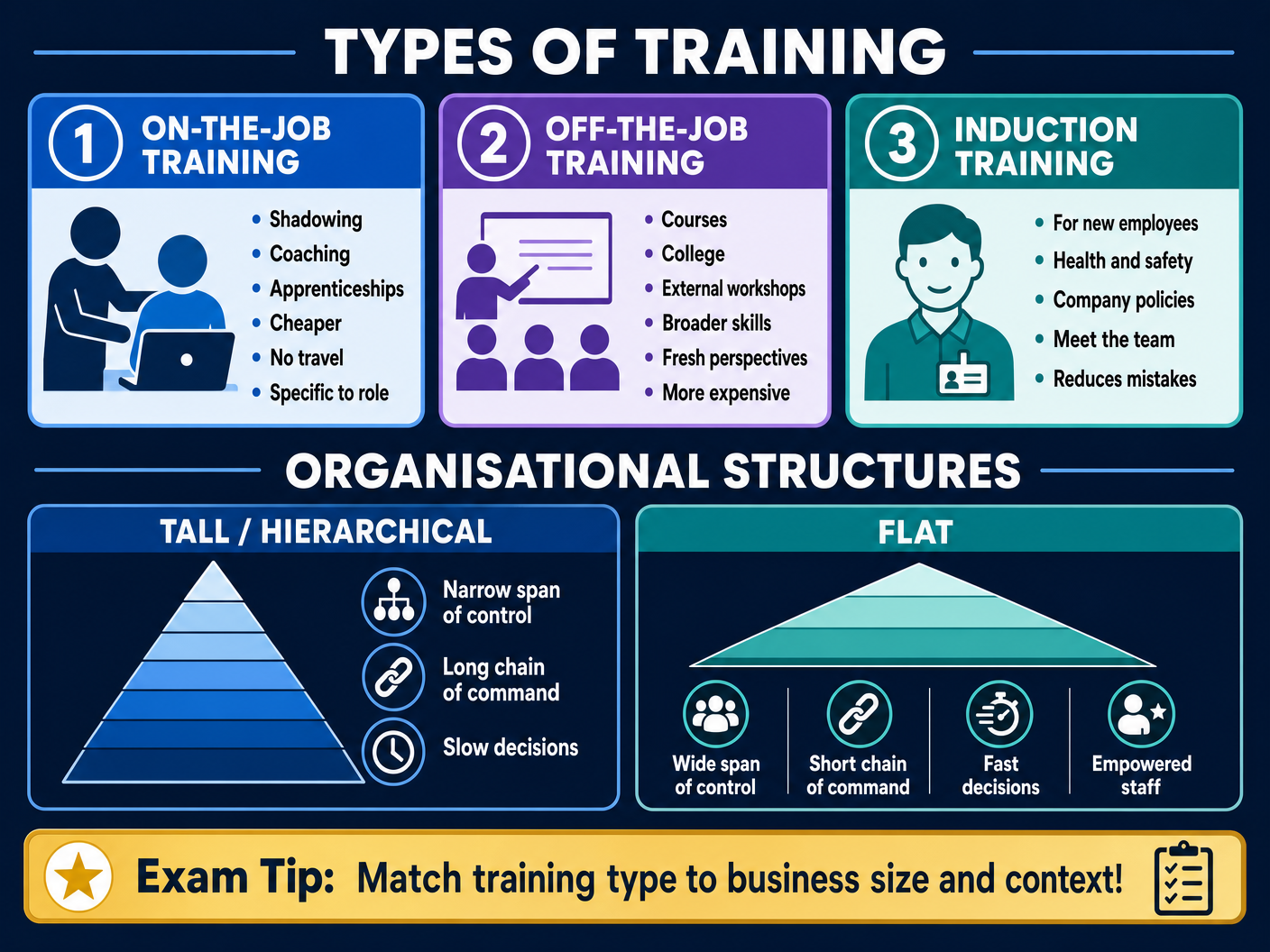
Induction Training
Provided to new employees when they join. It covers health and safety, company policies, and introduces them to the team. Why it matters: It helps employees settle in quickly, reduces mistakes, and ensures legal compliance.
On-the-Job Training
Training that takes place while doing the job in the workplace (e.g., shadowing, mentoring).
- Advantages: Cheaper (no travel or external course costs), specific to the business, employee continues to produce output.
- Disadvantages: Trainer may pass on bad habits, trainer's own productivity drops while teaching.
Off-the-Job Training
Training that takes place away from the workplace (e.g., at a college or specialist training centre).
- Advantages: Delivered by experts, broader range of skills learned, no workplace distractions.
- Disadvantages: More expensive, employee is not producing output while away.
Motivation Theories
Motivation is the desire to work hard and achieve goals. A motivated workforce leads to higher productivity, lower absenteeism, and lower labour turnover. You must understand three key theories:
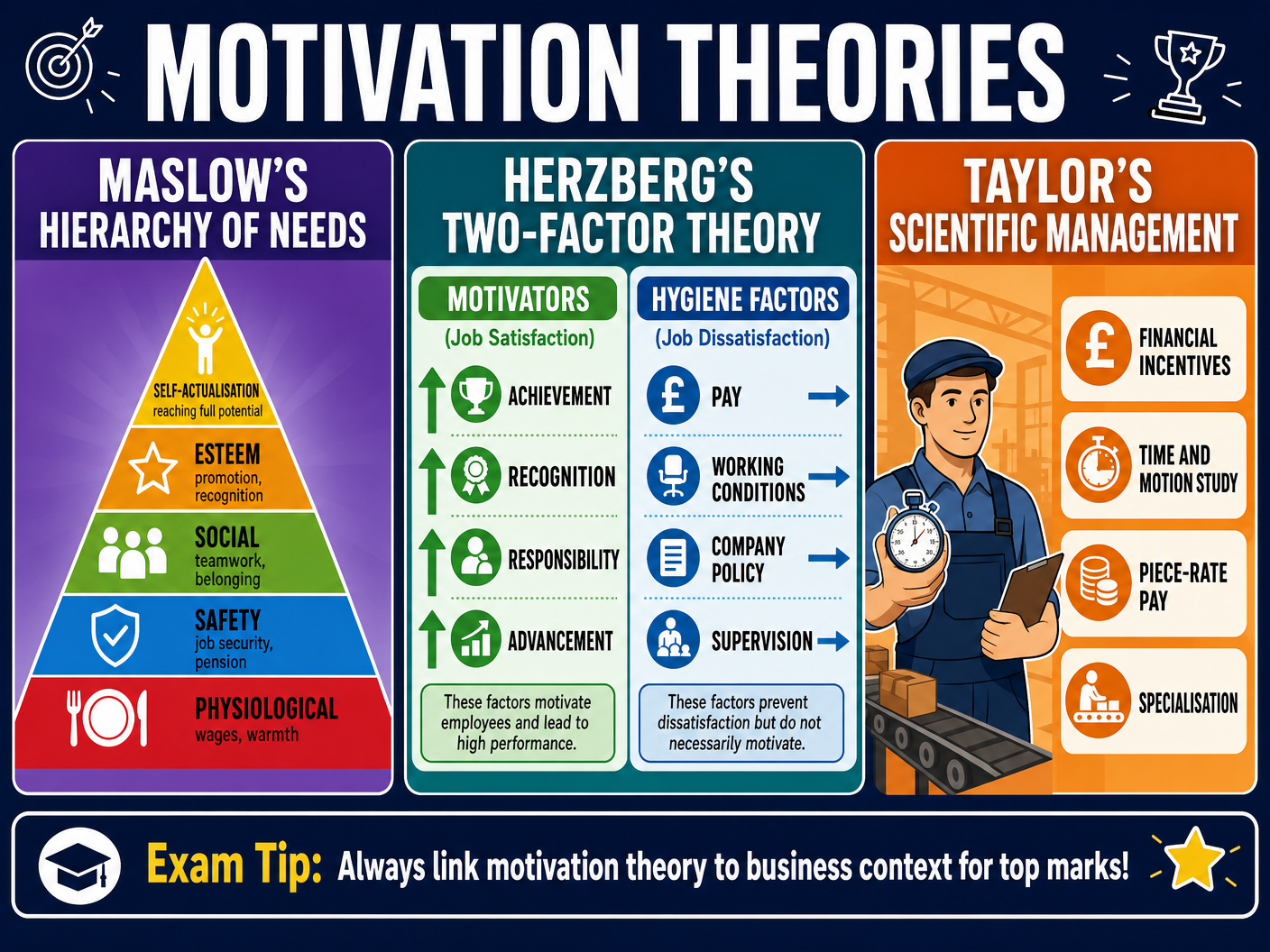
F.W. Taylor (Scientific Management)
Taylor believed workers are primarily motivated by money. He advocated for breaking jobs down into simple, repetitive tasks (specialisation) and paying workers based on how much they produce (piece-rate pay).
Abraham Maslow (Hierarchy of Needs)
Maslow proposed that humans have five levels of need. Once a lower need is met, it no longer motivates, and the person moves up to the next level:
- Physiological: Basic survival (wages to buy food/shelter).
- Safety: Security and stability (job security, safe conditions).
- Social: Belonging and teamwork (friendly colleagues).
- Esteem: Respect and recognition (promotion, job title).
- Self-Actualisation: Reaching full potential (challenging work).
Frederick Herzberg (Two-Factor Theory)
Herzberg identified two sets of factors:
- Hygiene Factors: Things that prevent dissatisfaction but do not motivate (e.g., pay, working conditions, company policy). If these are poor, workers are unhappy. If they are good, workers are just 'not unhappy'.
- Motivators: Things that actively motivate and give job satisfaction (e.g., achievement, recognition, responsibility, advancement).
Organisational Structures
The way a business is organised affects communication and decision-making.
- Tall Structure: Many layers of management, long chain of command, narrow span of control. Communication can be slow, but managers have tight control.
- Flat Structure: Few layers of management, short chain of command, wide span of control. Communication is faster, and employees often have more autonomy, but managers have less direct control.
Employment Law
Businesses must comply with legislation protecting workers:
- Equality Act 2010: Prevents discrimination based on characteristics like age, gender, race, or disability.
- National Minimum Wage: The legal minimum hourly rate employers must pay.
- Health and Safety at Work Act 1974: Employers must provide a safe working environment and adequate training.
Worked Examples
3 detailed examples with solutions and examiner commentary
Practice Questions
Test your understanding — click to reveal model answers
State two items that would usually be found in a person specification. (2 marks)
Hint: Think about what describes the IDEAL CANDIDATE, not the job itself.
Explain one disadvantage to a business of having a tall organisational structure. (3 marks)
Hint: Think about the 'chain of command' and how information travels.
A factory manufactures high-quality wooden furniture. The manager is considering changing the payment system from an hourly wage to piece-rate pay. Discuss the likely impact of this change on the business. (6 marks)
Hint: Use Taylor's theory for the positive side, but think about the impact on 'high-quality' for the negative side.
Analyse the impact of a high labour turnover on a business. (6 marks)
Hint: Build a chain of reasoning: Staff leave -> What happens next? -> How does that affect costs or output?
Evaluate whether off-the-job training is the best way for a national bank to train its new customer service advisors. (9 marks)
Hint: Consider the need for consistent, accurate training (laws/finance) vs the cost and time away from the branch.