Alcohols Revision Notes

    Subject: Chemistry | Level: A-Level | Exam Board: AQA

    Master the production, classification, and reactions of alcohols. This topic is a heavy hitter for marks in organic chemistry, testing your ability to link reaction conditions to specific products.

    Revision Notes & Key Concepts

    ## Overview ![Header image for Alcohols](https://xnnrgnazirrqvdgfhvou.supabase.co/storage/v1/object/public/study-guide-assets/guide_2d84eb35-699e-475e-9ffd-20200a9dfe65/header_image.png) Alcohols are a crucial homologous series in organic chemistry, characterised by the presence of the hydroxyl (–OH) functional group. This topic bridges the gap between basic hydrocarbons and more complex organic molecules like aldehydes, ketones, and carboxylic acids. Examiners frequently test this area because it requires candidates to recall specific reaction conditions and apply their knowledge of mechanisms. Understanding alcohols is not just about memorising equations; it's about recognising how the structure of the alcohol dictates its chemical behaviour. You will need to confidently classify alcohols as primary, secondary, or tertiary, and predict their oxidation products. This topic also introduces the debate around biofuels, testing your ability to evaluate the environmental impact of chemical processes. Expect a mix of short-answer recall questions, mechanism drawing, and longer evaluation questions comparing production methods. ![Alcohols Revision Podcast](https://xnnrgnazirrqvdgfhvou.supabase.co/storage/v1/object/public/study-guide-assets/guide_2d84eb35-699e-475e-9ffd-20200a9dfe65/alcohols_podcast.mp3) ## Key Concepts ### Concept 1: Production of Alcohols Alcohols, specifically ethanol, can be produced via two main routes: the industrial hydration of alkenes and the biological fermentation of glucose. Examiners expect you to know the exact conditions for both and to be able to compare them. **Hydration of Alkenes** involves reacting ethene with steam. This is an addition reaction where water is added across the carbon-carbon double bond. - **Conditions:** High temperature (approx. 300°C), high pressure (60-70 atm), and a solid phosphoric acid catalyst. - **Why it works:** The high pressure forces the gases together, increasing the collision frequency, while the catalyst provides an alternative pathway with a lower activation energy. It produces pure ethanol continuously but relies on non-renewable crude oil. **Fermentation of Glucose** uses yeast to break down sugars anaerobically (without oxygen). - **Conditions:** Yeast, warm temperature (30-40°C), and anaerobic conditions. - **Why it works:** The enzymes in yeast catalyse the breakdown of glucose. If it's too cold, the reaction is too slow; if it's too hot, the enzymes denature. Anaerobic conditions are vital because in the presence of oxygen, yeast respires aerobically, producing carbon dioxide and water instead of ethanol. ### Concept 2: Classification of Alcohols ![Classifying Alcohols](https://xnnrgnazirrqvdgfhvou.supabase.co/storage/v1/object/public/study-guide-assets/guide_2d84eb35-699e-475e-9ffd-20200a9dfe65/classification_diagram.png) Alcohols are classified based on the number of carbon atoms attached to the carbon atom that bears the –OH group. This classification is the key to predicting how an alcohol will behave when oxidised. - **Primary (1°) Alcohols:** The –OH group is on a carbon attached to only ONE other carbon (or none, in the case of methanol). Example: Propan-1-ol. - **Secondary (2°) Alcohols:** The –OH group is on a carbon attached to TWO other carbons. Example: Propan-2-ol. - **Tertiary (3°) Alcohols:** The –OH group is on a carbon attached to THREE other carbons. Example: 2-methylpropan-2-ol. ### Concept 3: Oxidation of Alcohols ![Oxidation of Alcohols](https://xnnrgnazirrqvdgfhvou.supabase.co/storage/v1/object/public/study-guide-assets/guide_2d84eb35-699e-475e-9ffd-20200a9dfe65/oxidation_diagram.png) This is where candidates often lose marks. The standard oxidising agent is **acidified potassium dichromate(VI)** (K₂Cr₂O₇/H₂SO₄). The dichromate(VI) ion (Cr₂O₇²⁻) is orange and is reduced to the green chromium(III) ion (Cr³⁺) during the reaction. **Primary Alcohols** can be oxidised twice: 1. **Partial Oxidation to an Aldehyde:** Use a limited amount of oxidising agent and **distil** the product as it forms to prevent further oxidation. 2. **Complete Oxidation to a Carboxylic Acid:** Use an excess of oxidising agent and heat under **reflux**. **Secondary Alcohols** are oxidised to **ketones**. Heating under reflux is used to ensure completion. They cannot be easily oxidised further. **Tertiary Alcohols** cannot be easily oxidised because there is no hydrogen atom on the carbon bearing the –OH group to be removed. The solution remains orange. ### Concept 4: Distinguishing Aldehydes and Ketones Because primary alcohols form aldehydes and secondary alcohols form ketones, examiners will test your ability to tell them apart chemically. Aldehydes can be further oxidised (they are reducing agents); ketones cannot. - **Tollens' Reagent (Ammoniacal Silver Nitrate):** When warmed with an aldehyde, a silver mirror forms on the inside of the test tube. Ketones show no visible change. - **Fehling's Solution:** When warmed with an aldehyde, the blue solution forms a brick-red precipitate of copper(I) oxide. Ketones show no visible change. ### Concept 5: Dehydration of Alcohols Alcohols can undergo an elimination reaction to form alkenes by losing a molecule of water. This is called dehydration. - **Conditions:** Heat with a concentrated acid catalyst (e.g., concentrated phosphoric acid or concentrated sulfuric acid). - **Why it works:** The acid protonates the –OH group, making it a better leaving group (water). A proton is then removed from an adjacent carbon, forming the C=C double bond. ## Mathematical/Scientific Relationships - **General Formula for Alcohols:** CₙH₂ₙ₊₁OH - **General Formula for Aldehydes:** RCHO - **General Formula for Ketones:** RCOR' - **General Formula for Carboxylic Acids:** RCOOH *(Note: 'R' represents an alkyl group)* ## Practical Applications - **Biofuels:** Ethanol produced by fermentation is used as a fuel, often blended with petrol (e.g., E10 fuel). The debate around its carbon neutrality is a common exam topic. - **Solvents:** Ethanol and methanol are widely used industrial solvents for cosmetics, perfumes, and inks because they can dissolve both polar and non-polar substances. - **Chemical Feedstock:** Alcohols are starting materials for synthesising other organic compounds, such as esters (used in flavourings and fragrances).

    Key Terms & Definitions

    Homologous Series
    A family of organic compounds with the same functional group, same general formula, and similar chemical properties.
    Functional Group
    An atom or group of atoms responsible for the characteristic chemical reactions of a molecule.
    Hydration
    An addition reaction in which water is added to a molecule.
    Fermentation
    The breakdown of sugars by enzymes in yeast in the absence of oxygen to produce ethanol and carbon dioxide.
    Reflux
    Continuous boiling and condensing of a reaction mixture to ensure the reaction goes to completion without losing volatile reactants or products.
    Carbon-Neutral
    A process where the net carbon dioxide emissions to the atmosphere are zero.

    Worked Examples

    Practice Questions

    Alcohols

    AQA
    A-Level
    Chemistry

    Master the production, classification, and reactions of alcohols. This topic is a heavy hitter for marks in organic chemistry, testing your ability to link reaction conditions to specific products.

    6
    Min Read
    3
    Examples
    5
    Questions
    6
    Key Terms
    🎙 Podcast Episode
    Alcohols
    0:00-0:00

    Study Notes

    Overview
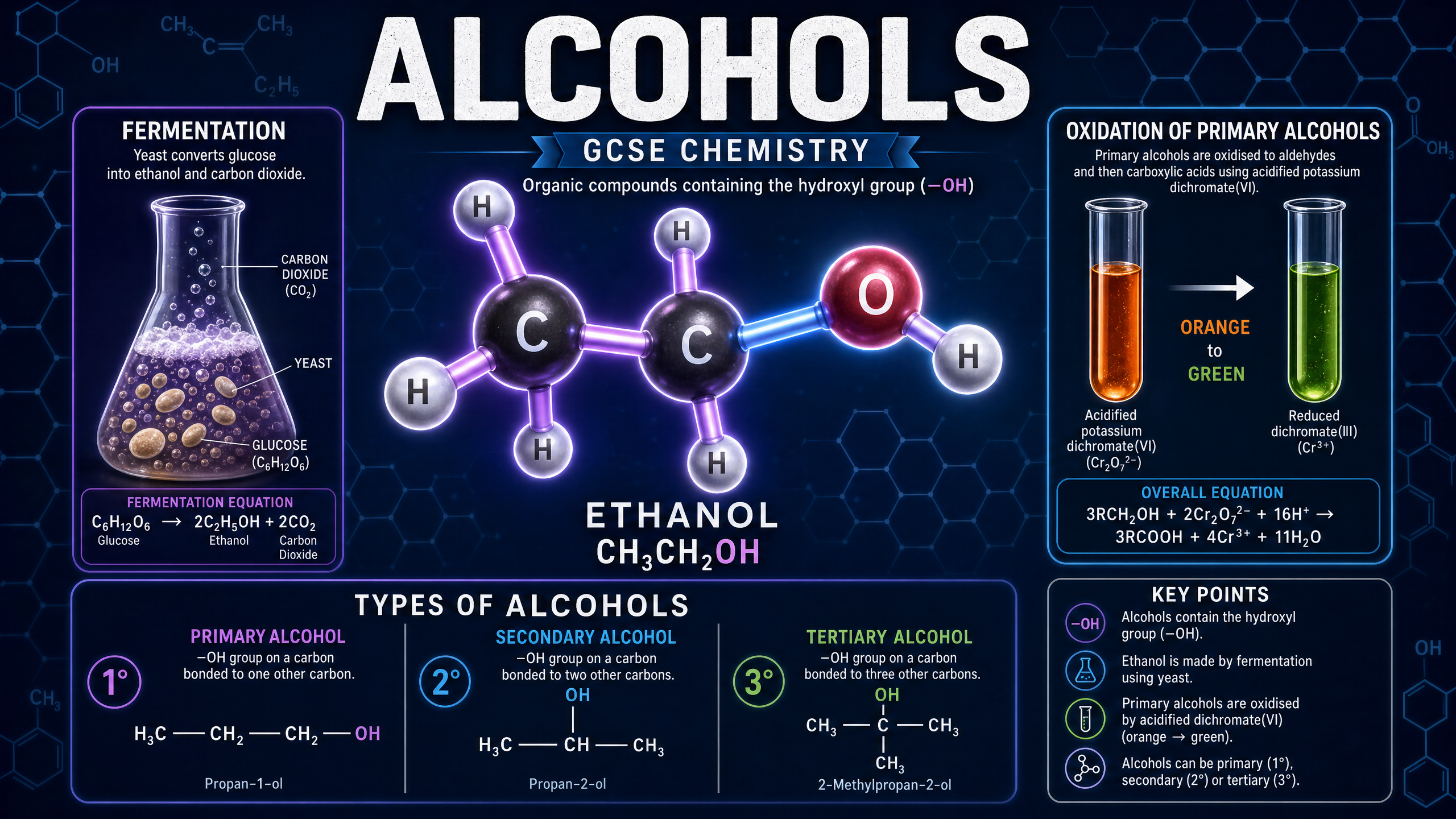
    Header image for Alcohols

    Alcohols are a crucial homologous series in organic chemistry, characterised by the presence of the hydroxyl (–OH) functional group. This topic bridges the gap between basic hydrocarbons and more complex organic molecules like aldehydes, ketones, and carboxylic acids. Examiners frequently test this area because it requires candidates to recall specific reaction conditions and apply their knowledge of mechanisms.

    Understanding alcohols is not just about memorising equations; it's about recognising how the structure of the alcohol dictates its chemical behaviour. You will need to confidently classify alcohols as primary, secondary, or tertiary, and predict their oxidation products. This topic also introduces the debate around biofuels, testing your ability to evaluate the environmental impact of chemical processes. Expect a mix of short-answer recall questions, mechanism drawing, and longer evaluation questions comparing production methods.

    Alcohols Revision Podcast

    Key Concepts

    Concept 1: Production of Alcohols

    Alcohols, specifically ethanol, can be produced via two main routes: the industrial hydration of alkenes and the biological fermentation of glucose. Examiners expect you to know the exact conditions for both and to be able to compare them.

    Hydration of Alkenes involves reacting ethene with steam. This is an addition reaction where water is added across the carbon-carbon double bond.

    • Conditions: High temperature (approx. 300°C), high pressure (60-70 atm), and a solid phosphoric acid catalyst.
    • Why it works: The high pressure forces the gases together, increasing the collision frequency, while the catalyst provides an alternative pathway with a lower activation energy. It produces pure ethanol continuously but relies on non-renewable crude oil.

    Fermentation of Glucose uses yeast to break down sugars anaerobically (without oxygen).

    • Conditions: Yeast, warm temperature (30-40°C), and anaerobic conditions.
    • Why it works: The enzymes in yeast catalyse the breakdown of glucose. If it's too cold, the reaction is too slow; if it's too hot, the enzymes denature. Anaerobic conditions are vital because in the presence of oxygen, yeast respires aerobically, producing carbon dioxide and water instead of ethanol.

    Concept 2: Classification of Alcohols
    Classifying Alcohols

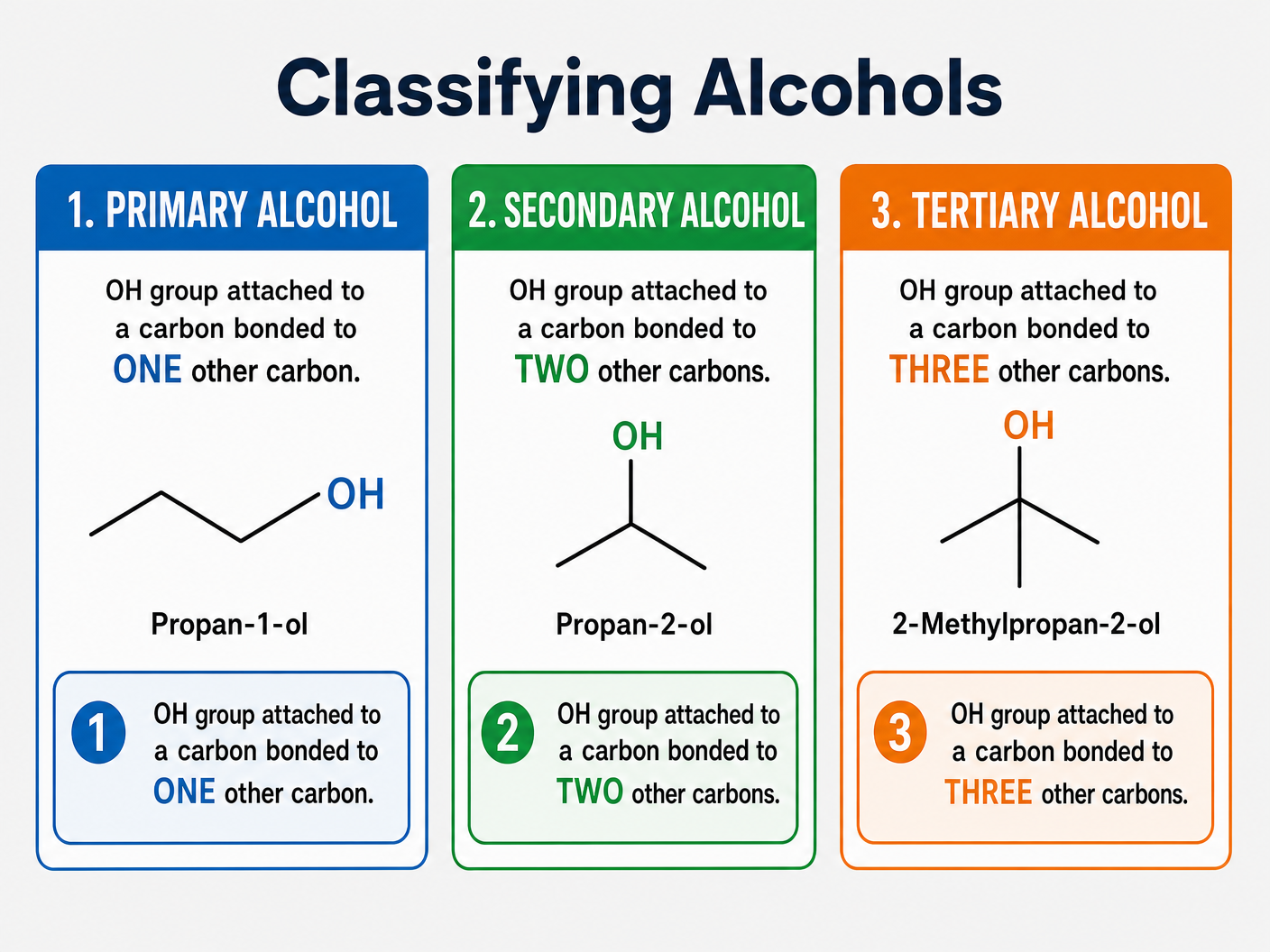
    Alcohols are classified based on the number of carbon atoms attached to the carbon atom that bears the –OH group. This classification is the key to predicting how an alcohol will behave when oxidised.

    • Primary (1°) Alcohols: The –OH group is on a carbon attached to only ONE other carbon (or none, in the case of methanol). Example: Propan-1-ol.
    • Secondary (2°) Alcohols: The –OH group is on a carbon attached to TWO other carbons. Example: Propan-2-ol.
    • Tertiary (3°) Alcohols: The –OH group is on a carbon attached to THREE other carbons. Example: 2-methylpropan-2-ol.

    Concept 3: Oxidation of Alcohols
    Oxidation of Alcohols

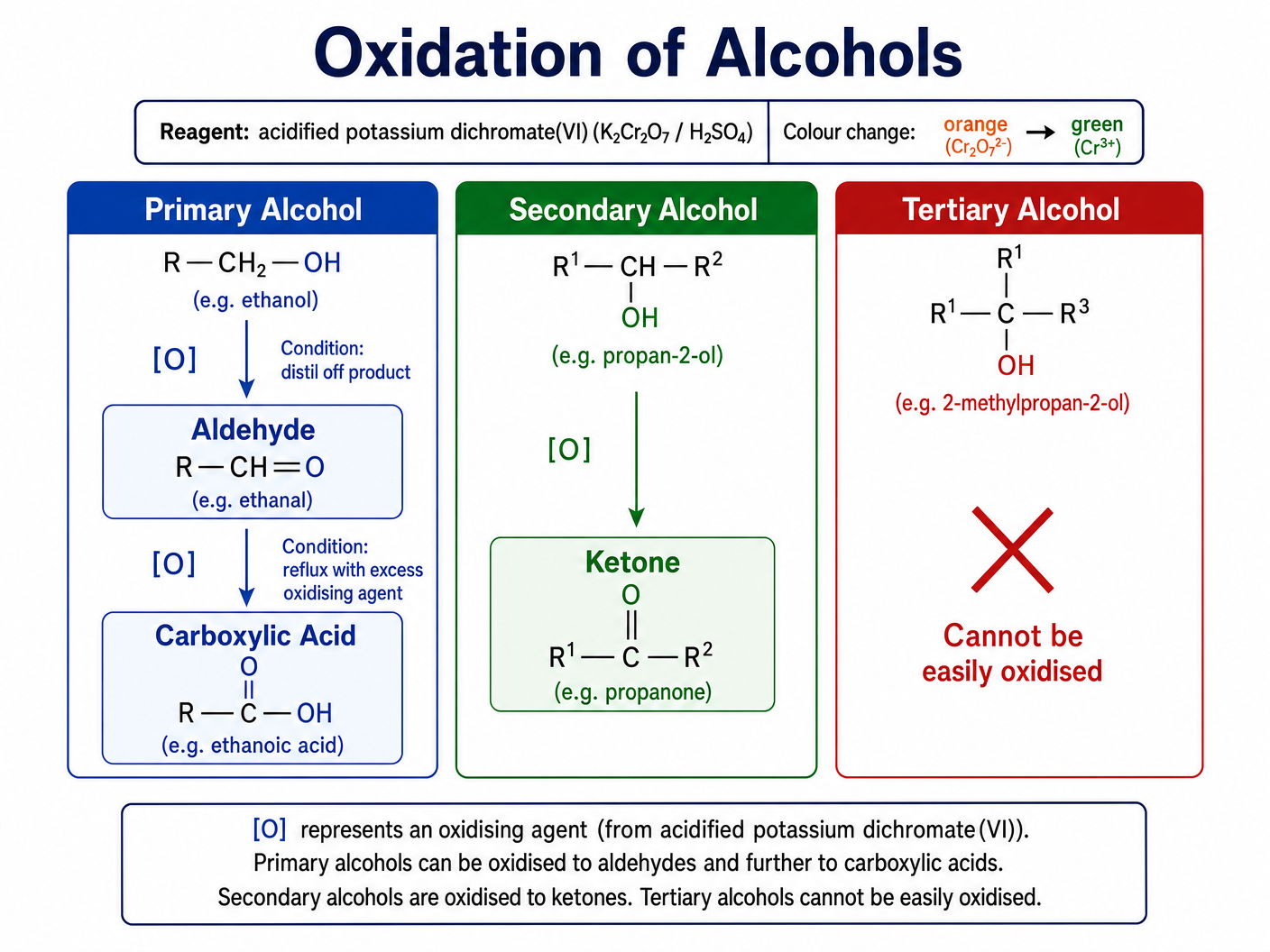
    This is where candidates often lose marks. The standard oxidising agent is acidified potassium dichromate(VI) (K₂Cr₂O₇/H₂SO₄). The dichromate(VI) ion (Cr₂O₇²⁻) is orange and is reduced to the green chromium(III) ion (Cr³⁺) during the reaction.

    Primary Alcohols can be oxidised twice:

    1. Partial Oxidation to an Aldehyde: Use a limited amount of oxidising agent and distil the product as it forms to prevent further oxidation.
    2. Complete Oxidation to a Carboxylic Acid: Use an excess of oxidising agent and heat under reflux.

    Secondary Alcohols are oxidised to ketones. Heating under reflux is used to ensure completion. They cannot be easily oxidised further.

    Tertiary Alcohols cannot be easily oxidised because there is no hydrogen atom on the carbon bearing the –OH group to be removed. The solution remains orange.

    Concept 4: Distinguishing Aldehydes and Ketones

    Because primary alcohols form aldehydes and secondary alcohols form ketones, examiners will test your ability to tell them apart chemically. Aldehydes can be further oxidised (they are reducing agents); ketones cannot.

    • Tollens' Reagent (Ammoniacal Silver Nitrate): When warmed with an aldehyde, a silver mirror forms on the inside of the test tube. Ketones show no visible change.
    • Fehling's Solution: When warmed with an aldehyde, the blue solution forms a brick-red precipitate of copper(I) oxide. Ketones show no visible change.

    Concept 5: Dehydration of Alcohols

    Alcohols can undergo an elimination reaction to form alkenes by losing a molecule of water. This is called dehydration.

    • Conditions: Heat with a concentrated acid catalyst (e.g., concentrated phosphoric acid or concentrated sulfuric acid).
    • Why it works: The acid protonates the –OH group, making it a better leaving group (water). A proton is then removed from an adjacent carbon, forming the C=C double bond.

    Mathematical/Scientific Relationships

    • General Formula for Alcohols: CₙH₂ₙ₊₁OH
    • General Formula for Aldehydes: RCHO
    • General Formula for Ketones: RCOR'
    • General Formula for Carboxylic Acids: RCOOH

    (Note: 'R' represents an alkyl group)

    Practical Applications

    • Biofuels: Ethanol produced by fermentation is used as a fuel, often blended with petrol (e.g., E10 fuel). The debate around its carbon neutrality is a common exam topic.
    • Solvents: Ethanol and methanol are widely used industrial solvents for cosmetics, perfumes, and inks because they can dissolve both polar and non-polar substances.
    • Chemical Feedstock: Alcohols are starting materials for synthesising other organic compounds, such as esters (used in flavourings and fragrances).

    Visual Resources

    2 diagrams and illustrations

    Oxidation of Alcohols
    Oxidation of Alcohols
    Classifying Alcohols
    Classifying Alcohols

    Interactive Diagrams

    2 interactive diagrams to visualise key concepts

    Flowchart summarising the oxidation pathways of primary, secondary, and tertiary alcohols.

    Comparison of the two main routes for ethanol production.

    Worked Examples

    3 detailed examples with solutions and examiner commentary

    Practice Questions

    Test your understanding — click to reveal model answers

    Q1

    Compare the industrial production of ethanol by hydration of ethene with its production by fermentation of glucose. Consider raw materials, rate of reaction, and purity of the product. (6 marks)

    6 marks
    challenging

    Hint: Create a mental table comparing the two methods across the three specific points asked for in the question.

    Q2

    State the reagent and conditions needed to dehydrate ethanol to form ethene. (2 marks)

    2 marks
    foundation

    Hint: What chemical is good at removing water? What condition is needed to make the reaction happen?

    Q3

    An unknown alcohol X is heated with acidified potassium dichromate(VI) under reflux. The solution turns green. The organic product Y does not react with Tollens' reagent. Deduce the classification of alcohol X and the functional group present in product Y. (2 marks)

    2 marks
    standard

    Hint: If it turns green, oxidation happened. If the product doesn't react with Tollens', it's not an aldehyde.

    Q4

    Write an equation for the oxidation of ethanol to ethanoic acid. Use [O] to represent the oxidising agent. (1 mark)

    1 marks
    standard

    Hint: Balance the oxygen atoms. You need to add oxygen and remove hydrogen to form water.

    Q5

    Explain why tertiary alcohols cannot be easily oxidised by acidified potassium dichromate(VI). (2 marks)

    2 marks
    challenging

    Hint: Look at the structure of a tertiary alcohol. What is missing on the central carbon that is present in primary and secondary alcohols?

    Explore this topic further

    View Topic PageAll Chemistry Topics

    Key Terms

    Essential vocabulary to know