Condensation polymerisation (chemistry only)

    AQA
    GCSE
    Chemistry

    This guide covers AQA GCSE Chemistry topic 7.7, Condensation Polymerisation. It is a Higher Tier topic focused on how polyesters are made, a crucial process for creating fabrics like fleece. Mastering this is key for top grades in Paper 2.

    5
    Min Read
    3
    Examples
    5
    Questions
    0
    Key Terms
    🎙 Podcast Episode
    Condensation polymerisation (chemistry only)
    0:00-0:00

    Study Notes

    header_image.png

    Overview

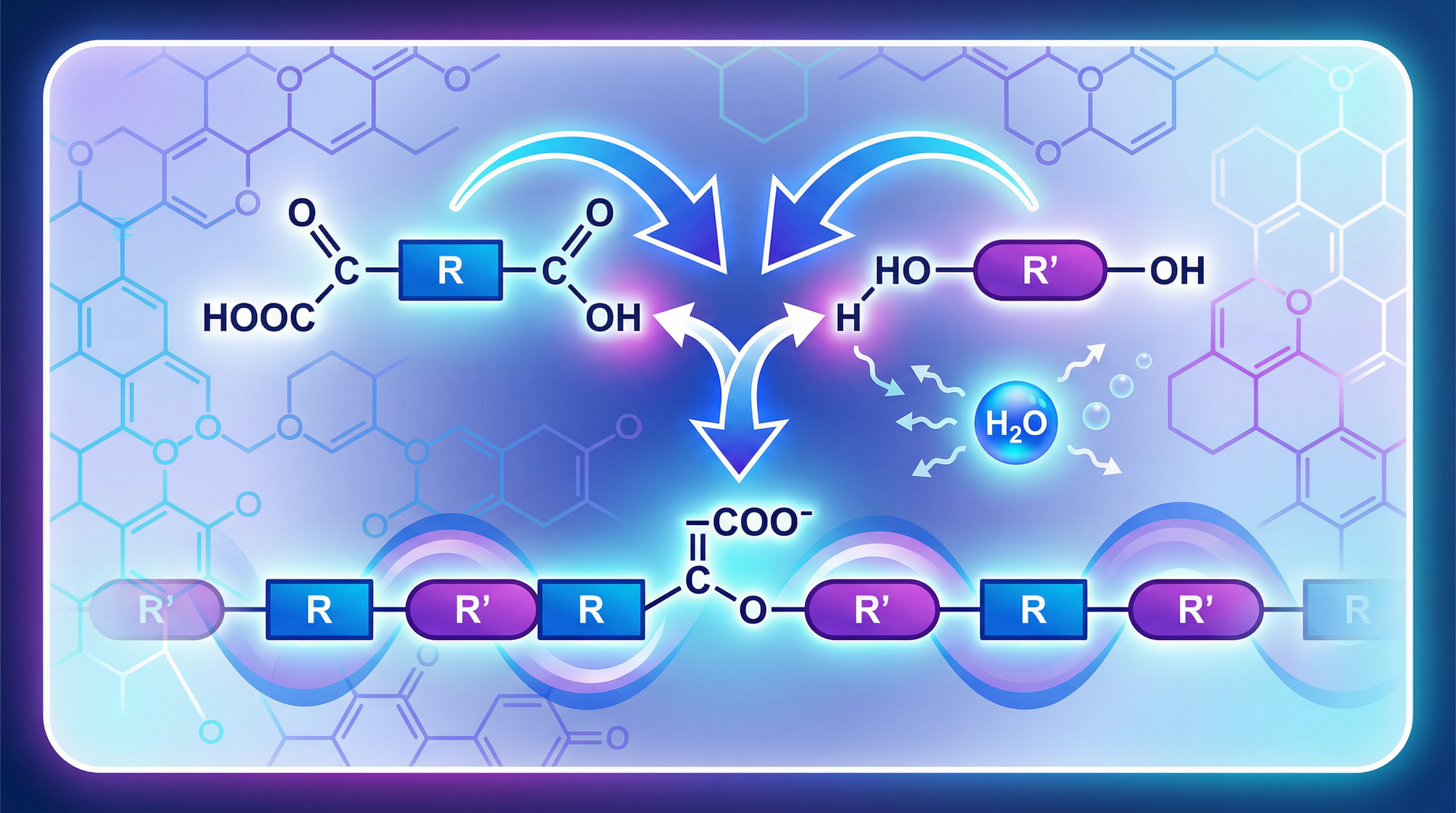
    Condensation polymerisation is a fundamental process in organic chemistry where monomers join together to form a large polymer chain with the simultaneous release of a small molecule, such as water. For AQA GCSE Chemistry, this topic (specification reference 7.7) is exclusive to the Higher Tier and focuses specifically on the formation of polyesters from the reaction between dicarboxylic acids and diols. Unlike addition polymerisation, which involves the opening of a C=C double bond, this mechanism is all about the reaction between two different functional groups. Understanding this distinction is critical for exam success, as comparison questions are extremely common and carry significant marks. This guide will break down the mechanism, show you how to draw the structures examiners expect, and provide strategies to tackle the toughest questions.

    condensation_polymerisation_podcast.mp3

    Key Concepts

    Concept 1: The Monomers - Two is the Magic Number

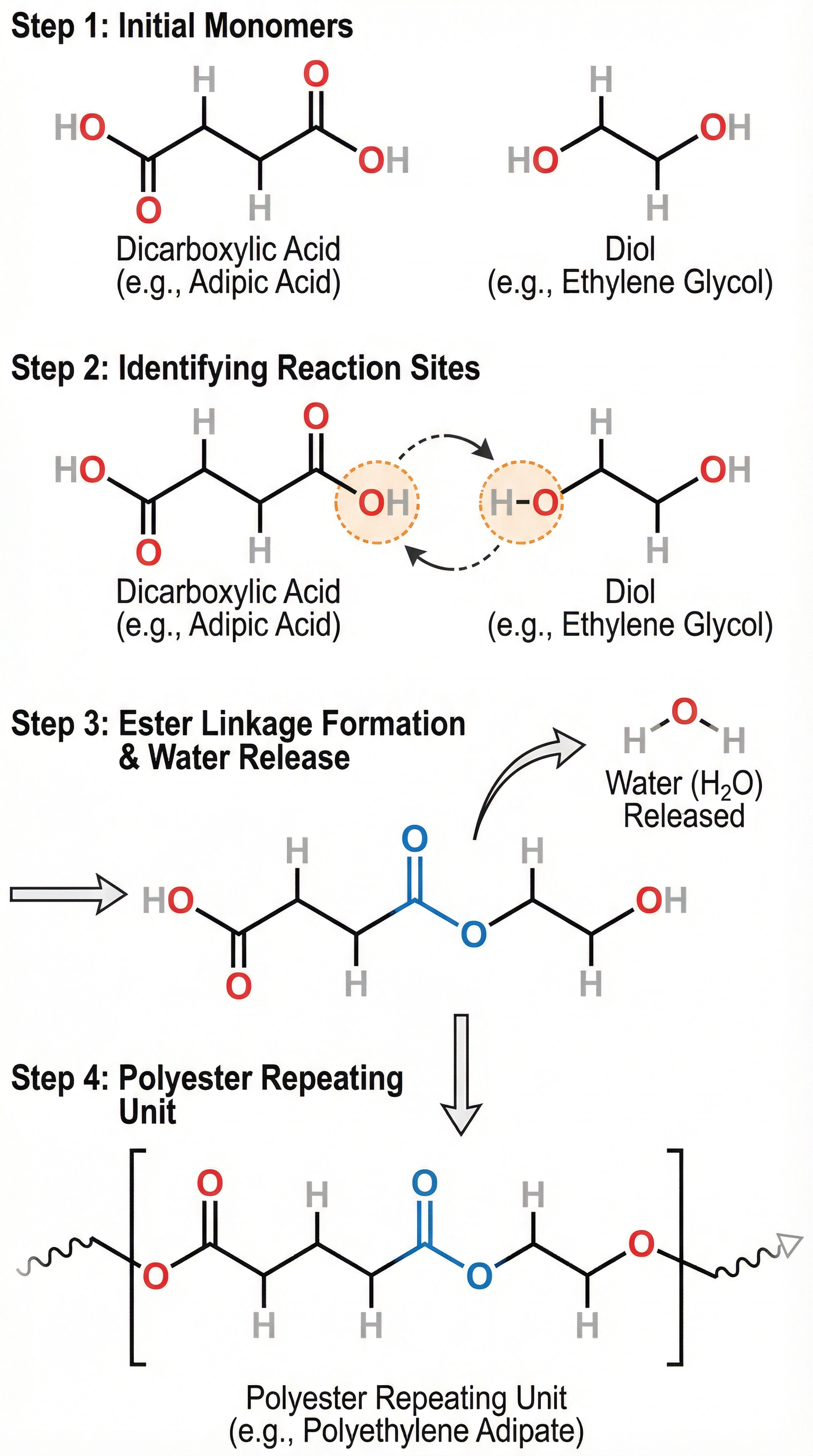
    Credit is always awarded for stating that condensation polymerisation requires monomers with two functional groups. This is the absolute cornerstone of the topic. For polyester formation, the two types of monomers are:

    • Dicarboxylic Acids: These are molecules containing two carboxylic acid functional groups (-COOH), one at each end. For example, ethanedioic acid (HOOC-COOH).
    • Diols: These are molecules containing two alcohol functional groups (-OH), one at each end. For example, ethane-1,2-diol (HO-CHâ‚‚-CHâ‚‚-OH).

    The presence of two reactive sites on each monomer allows the chain to grow in both directions, leading to the formation of a long polymer.

    Concept 2: The Reaction - Forming the Ester Link

    The reaction occurs between the carboxylic acid group of one monomer and the alcohol group of the other. Specifically, the -OH part of the carboxylic acid group reacts with the -H from the alcohol group. These atoms combine and are eliminated as a water molecule (Hâ‚‚O). The remaining parts of the monomers join together, forming an ester linkage (-COO-). This is the repeating link that holds the entire polymer chain together.
    polyester_formation.png

    Concept 3: The Products - Polymer and a Small Molecule

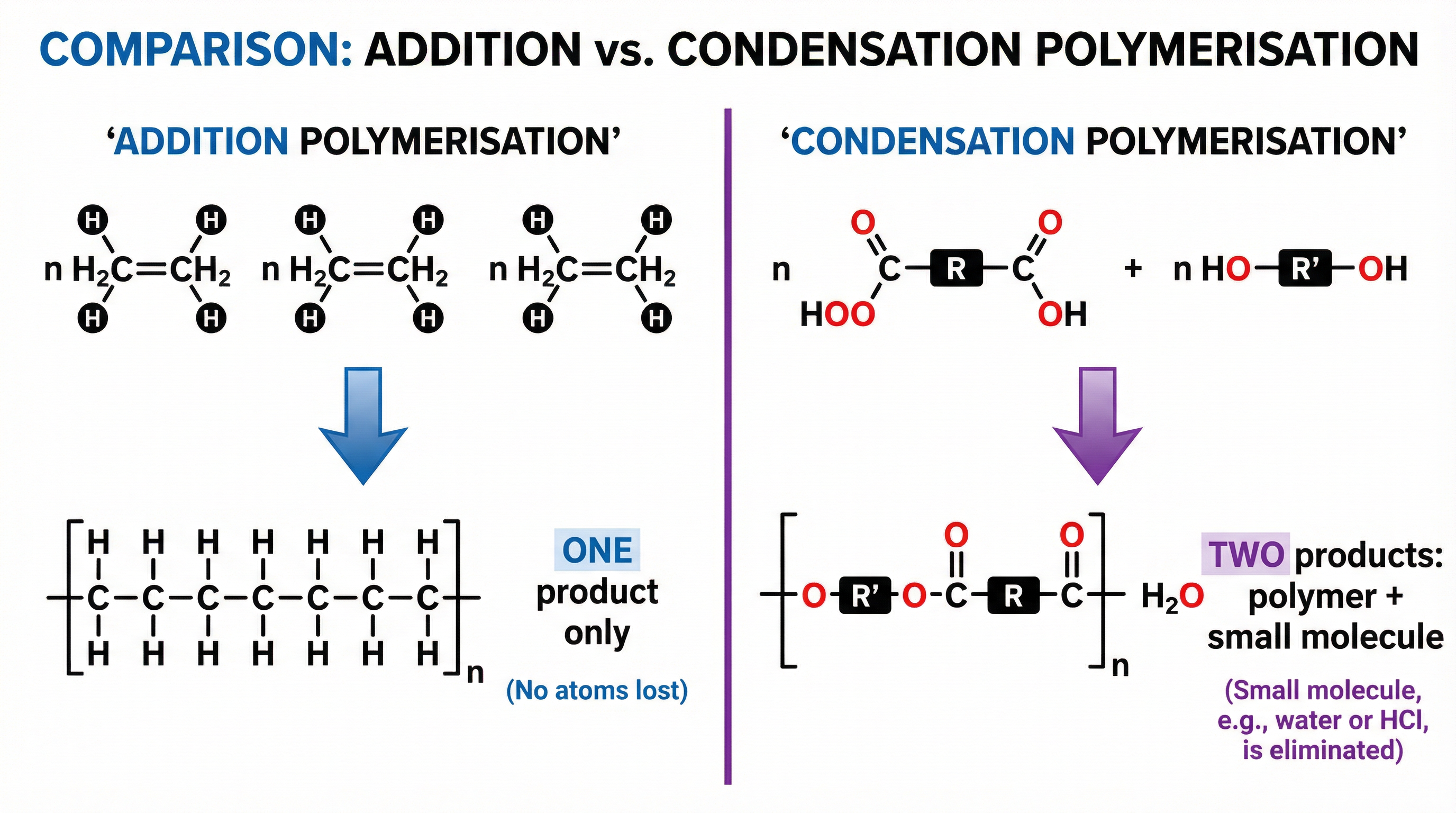
    A key difference that you must be able to recall is that condensation polymerisation produces two products:

    1. The Polymer: A long-chain molecule (in this case, a polyester).
    2. A Small Molecule: For the formation of polyesters, this is always water (Hâ‚‚O).

    This is in direct contrast to addition polymerisation, which only forms one product (the polymer). Being able to clearly articulate this difference is a frequent source of marks.
    addition_vs_condensation.png

    Mathematical/Scientific Relationships

    The general equation for the formation of a polyester is a crucial piece of knowledge that combines all the key concepts. When 'n' molecules of a dicarboxylic acid react with 'n' molecules of a diol, they produce a polymer chain of 'n' repeating units and, importantly, '2n' molecules of water.

    **General Equation:**n HOOC-R-COOH + n HO-R'-OH → [-OC-R-COO-R'-]n + 2n H₂O

    • n: Represents a large number, indicating many monomer units.
    • R and R': Represent the hydrocarbon sections of the monomers.
    • [-OC-R-COO-R'-]n: This is the repeating unit of the polyester. Note the ester links at both ends of the R groups and the extension bonds passing through the brackets.
    • 2n Hâ‚‚O: This is the part candidates often forget. For every repeating unit formed, two ester links are effectively made (one at each end joining to the next monomer), and thus two molecules of water are eliminated. The total water produced is 2n.

    Practical Applications

    Polyesters are incredibly versatile polymers with widespread applications. The most well-known example is poly(ethylene terephthalate), commonly known as PET. It is used to make plastic bottles for drinks due to its strength, transparency, and unreactivity. Polyesters can also be drawn into fibres to produce fabrics for clothing, such as fleece jackets and sportswear. These materials are popular because they are lightweight, durable, and resistant to stretching and shrinking. They also dry quickly, making them ideal for outdoor wear.

    Worked Examples

    3 detailed examples with solutions and examiner commentary

    Practice Questions

    Test your understanding — click to reveal model answers

    Q1

    State two differences between addition and condensation polymerisation.

    2 marks
    foundation

    Hint: Think about the monomers used and the number of products formed.

    Q2

    Draw the structure of the dicarboxylic acid and the diol needed to form the polyester with the following repeating unit: [-CO-(CHâ‚‚)â‚„-CO-O-(CHâ‚‚)â‚‚-O-]

    4 marks
    standard

    Hint: Perform a hydrolysis reaction on the ester link. Break the C-O bond in the ester and add water (H and OH).

    Q3

    A polyester is made from ethanedioic acid and ethane-1,2-diol. A student states that the empirical formula of the polymer is Câ‚‚Hâ‚‚Oâ‚‚. Explain whether the student is correct.

    4 marks
    challenging

    Hint: First, draw the repeating unit of the polymer. Then, determine its chemical formula and simplify it to find the empirical formula.

    Q4

    Write a balanced chemical equation for the formation of the polyester from n units of ethanedioic acid and n units of ethane-1,2-diol.

    3 marks
    standard

    Hint: Remember the general equation and don't forget the small molecule that is also a product.

    Q5

    Explain why condensation polymerisation is not considered to have a 100% atom economy.

    2 marks
    standard

    Hint: Atom economy compares the mass of the desired product to the total mass of reactants.

    More Chemistry Study Guides

    View all

    Factors Affecting Reaction Rate

    Edexcel
    GCSE

    This topic explores how temperature, concentration, surface area, and catalysts affect the speed of chemical reactions through collision theory. Mastering this content is essential for both Foundation and Higher Tier candidates, as it combines theoretical understanding with practical investigation skills and mathematical graph analysis—all heavily weighted in Edexcel assessments.

    The Periodic Table

    OCR
    GCSE

    This guide provides a comprehensive overview of the Periodic Table for OCR GCSE Chemistry. It covers atomic structure, groups, periods, and reactivity trends, with a strong focus on exam technique to help you secure top marks.

    Fractional Distillation

    Edexcel
    GCSE

    Unlock top marks in your Edexcel GCSE Chemistry exam by mastering fractional distillation. This guide breaks down how crude oil is separated into vital products like petrol and diesel, showing you exactly what examiners want to see in your answers.

    Crude Oil Composition

    Edexcel
    GCSE

    Master Edexcel GCSE Chemistry Topic 2.7 by exploring the journey of crude oil from a raw mixture to the essential fuels that power our world. This guide will equip you with the knowledge to tackle exam questions on fractional distillation, hydrocarbon properties, and alkane chemistry with confidence.

    Elements, compounds and mixtures

    OCR
    GCSE

    This guide breaks down the essential principles of elements, compounds, and mixtures for your OCR GCSE Chemistry exam. It covers how to classify substances, determine purity using melting point data, and master the separation techniques that frequently appear in exams. Secure top marks by understanding not just what these concepts are, but why they work and how examiners will test you on them.

    Chromatography

    AQA
    GCSE

    This guide provides a comprehensive overview of Chromatography for AQA GCSE Chemistry students. It covers the core principles of separation, the required practical, and the calculation of Rf values, all tailored to help you secure maximum marks in your exam.