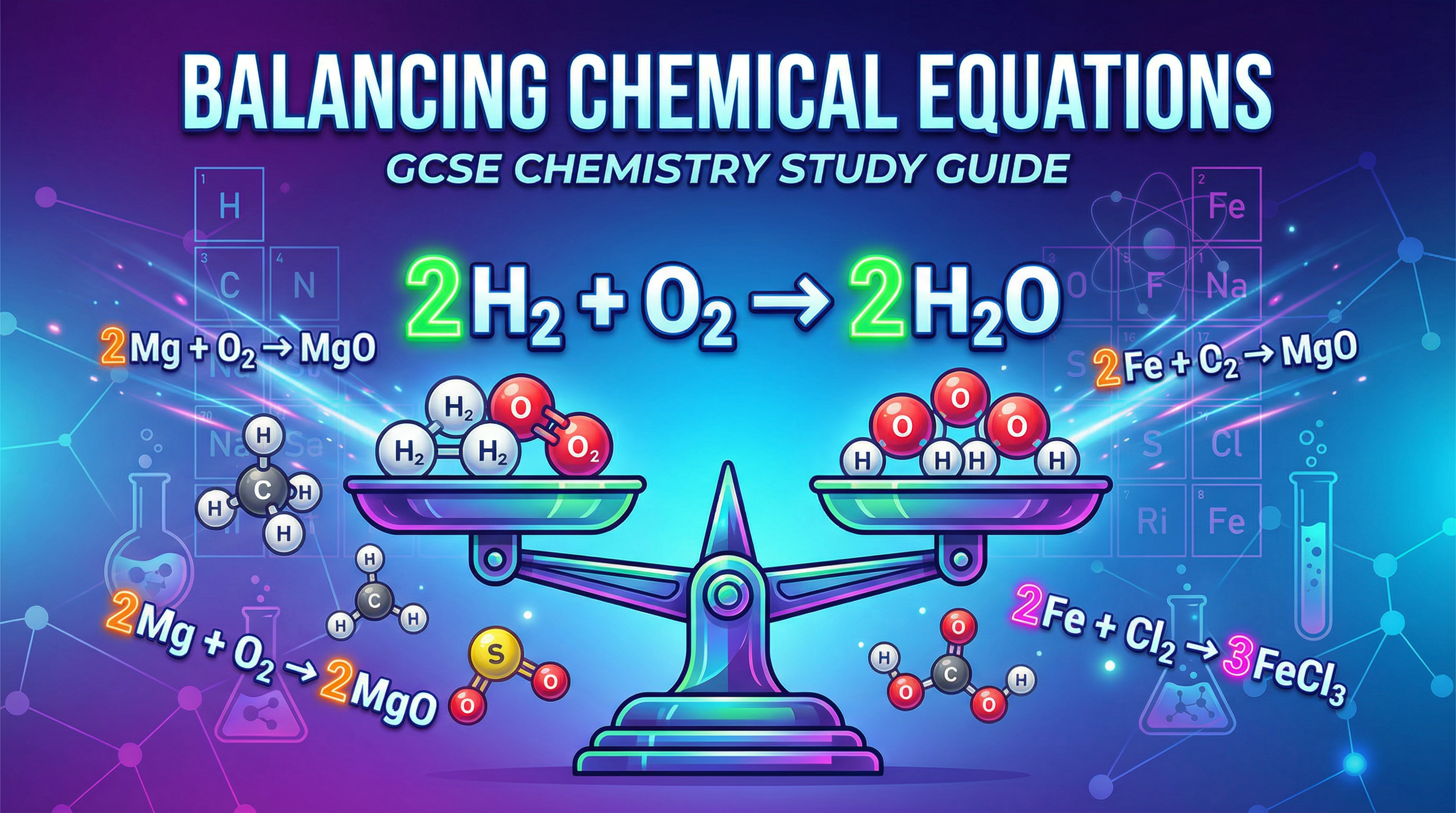
Balancing Chemical Equations — Edexcel GCSE study guide illustration

    Balancing Chemical Equations

    Edexcel
    GCSE
    Chemistry

    Master the essential skill of balancing chemical equations, a cornerstone of GCSE Chemistry. This guide breaks down the Law of Conservation of Mass and provides a step-by-step method to ensure you can confidently tackle any equation, securing crucial marks in your exam.

    5
    Min Read
    3
    Examples
    5
    Questions
    6
    Key Terms
    🎙 Podcast Episode
    Balancing Chemical Equations
    0:00-0:00

    Study Notes

    Header image for Balancing Chemical Equations

    Overview

    Balancing chemical equations is a fundamental skill in chemistry, and for Edexcel GCSE, it falls under specification point 1.10. It's the process of ensuring that a chemical equation adheres to the Law of Conservation of Mass, which states that no atoms are created or destroyed during a chemical reaction. This means you must have the exact same number of atoms of each element on the reactants side (left) as you do on the products side (right). Examiners frequently test this, both in simple balancing tasks and as the first step in more complex calculation questions (stoichiometry). Mastering this not only secures direct marks but is essential for understanding topics like reacting masses, titrations, and atom economy. A typical exam question might ask you to simply balance a given equation, or for higher marks, to write a balanced equation from scratch, including state symbols.

    Listen to our 10-minute podcast guide on balancing equations.

    Key Concepts

    Concept 1: The Law of Conservation of Mass

    This is the bedrock principle. Imagine you're building with LEGO bricks. You start with a pile of red, blue, and yellow bricks. After you've built your model, you still have the same number of red, blue, and yellow bricks, they're just arranged differently. A chemical reaction is the same. The atoms are just rearranged to form new substances. No atoms appear out of nowhere, and none vanish. Credit is given in exams for demonstrating this understanding by ensuring atom counts are equal on both sides of the equation.
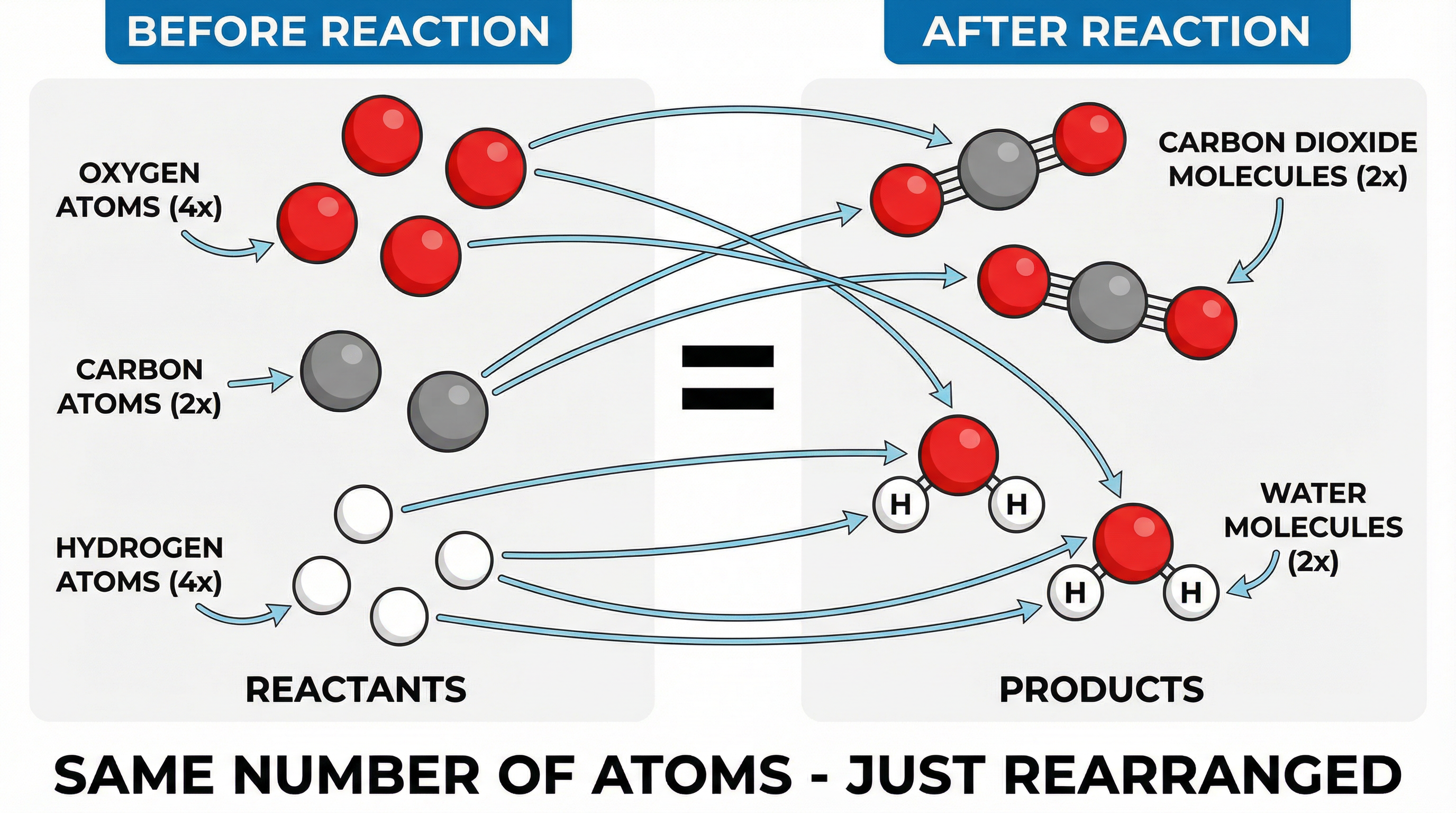
    The Law of Conservation of Mass: Atoms are rearranged, not created or destroyed.

    Example: In the reaction between methane and oxygen (CH₄ + O₂ → CO₂ + H₂O), you start with Carbon, Hydrogen, and Oxygen atoms, and you end with the same atoms, just bonded into different molecules.

    Concept 2: Reactants, Products, and State Symbols

    • Reactants: The substances you start with. They are always written on the left-hand side of the equation.
    • Products: The new substances formed in the reaction. They are written on the right-hand side.
    • State Symbols: These tell you the physical state of each substance. They are often required for full marks. The four state symbols are:
      • (s) - solid
      • (l) - liquid
      • (g) - gas
      • (aq) - aqueous (dissolved in water)

    Concept 3: Coefficients vs. Subscripts

    This is the most common area for mistakes.

    • Subscripts: These are the small numbers written after an atom in a formula (e.g., the '2' in H₂O). You must never change the subscripts. Changing them alters the chemical identity of the substance (e.g., changing H₂O to H₂O₂ changes water to hydrogen peroxide).
    • Coefficients: These are the large numbers placed in front of a chemical formula (e.g., the '2' in 2H₂O). These are the only numbers you can change. A coefficient multiplies every atom in the formula that follows it. So, 2H₂O means you have two water molecules, giving you 4 Hydrogen atoms and 2 Oxygen atoms in total.
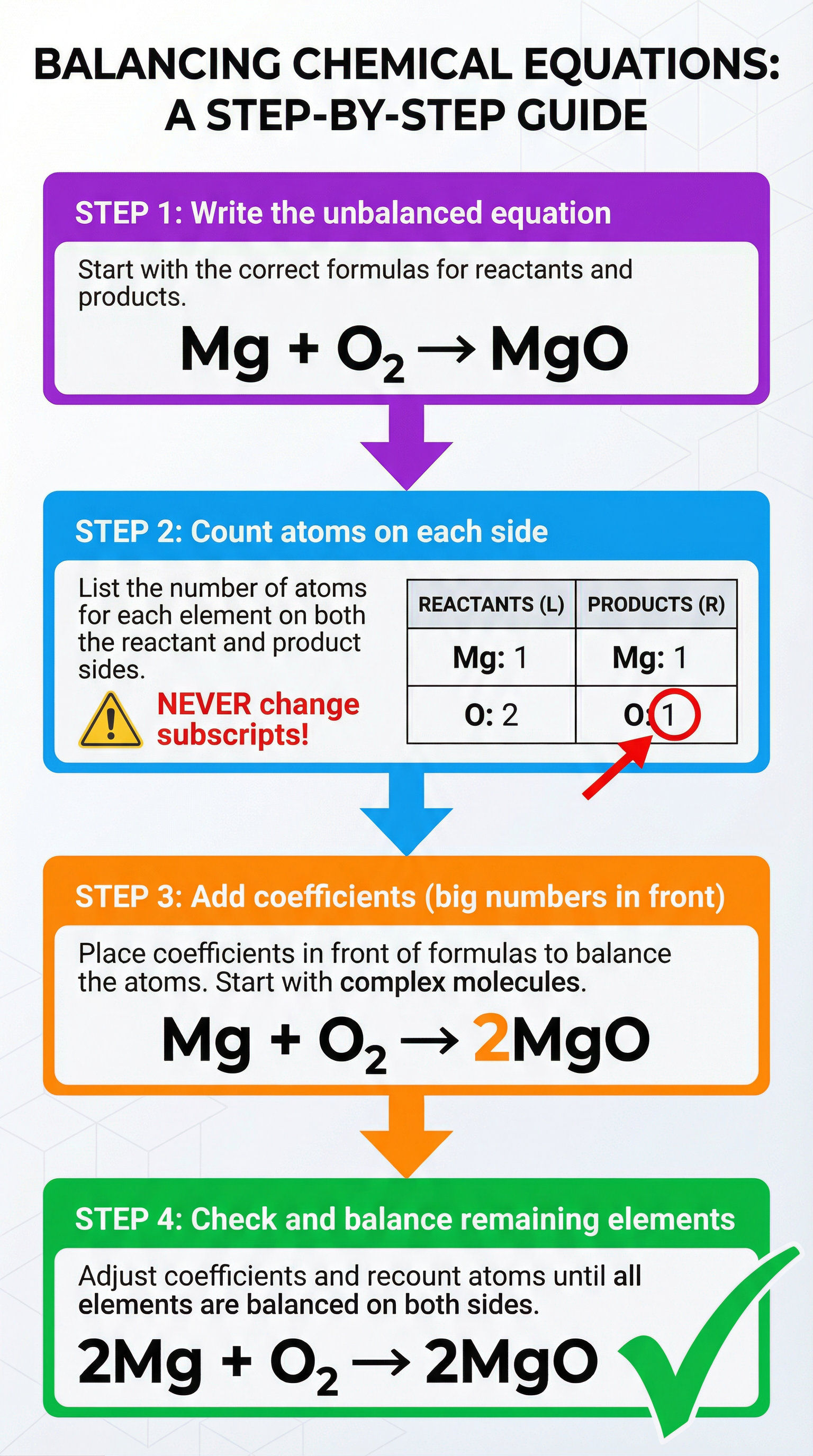
    A 4-step guide to balancing chemical equations.

    Mathematical/Scientific Relationships

    The core relationship is simple:

    Total number of atoms of Element X in Reactants = Total number of atoms of Element X in ProductsTo balance an equation, you follow a systematic process:

    1. Write the unbalanced equation: Ensure all chemical formulae are correct.
    2. Count the atoms: Tally the number of atoms of each element on both the reactant and product sides.
    3. Add coefficients: Place coefficients in front of the chemical formulae to multiply the atoms until they are equal on both sides.
    4. Check your work: Do a final count to ensure all elements are balanced and that the coefficients are in their simplest whole-number ratio.

    Practical Applications

    Balancing equations is vital in the real world. For example, in the Haber process for making ammonia (N₂ + 3H₂ → 2NH₃), chemists need to know the exact ratio of nitrogen to hydrogen to get the maximum yield of ammonia fertilizer. In pharmaceuticals, precise reactions are needed to synthesize drugs safely and efficiently. Even in the kitchen, the reaction that makes cakes rise (sodium bicarbonate reacting with an acid) involves a balanced chemical equation! This topic is also linked to the required practical involving measuring energy changes (calorimetry), where knowing the balanced equation is the first step to calculating the molar enthalpy change.

    Worked Examples

    3 detailed examples with solutions and examiner commentary

    Practice Questions

    Test your understanding — click to reveal model answers

    Q1

    Balance the equation for the reaction between magnesium and hydrochloric acid: Mg + HCl → MgCl₂ + H₂

    2 marks
    foundation

    Hint: Look at the number of chlorine atoms on each side first.

    Q2

    When heated, lead(IV) oxide decomposes to lead(II) oxide and oxygen gas. The unbalanced equation is: PbO₂ → PbO + O₂. Balance this equation.

    2 marks
    standard

    Hint: Start by balancing the lead atoms, then see where that leaves the oxygen atoms.

    Q3

    Ammonia (NH₃) reacts with oxygen (O₂) to produce nitrogen monoxide (NO) and water (H₂O). Write and balance the chemical equation for this reaction.

    4 marks
    challenging

    Hint: This is a tricky one. Try balancing H first, then N. You might need to double all your coefficients at the end to get whole numbers.

    Q4

    Balance the equation for the neutralisation of phosphoric acid by potassium hydroxide: H₃PO₄ + KOH → K₃PO₄ + H₂O

    3 marks
    standard

    Hint: Treat the phosphate ion (PO₄) as a single block. Balance the potassium (K) atoms first.

    Q5

    Write a balanced symbol equation, including state symbols, for the reaction between aqueous calcium chloride (CaCl₂) and aqueous sodium carbonate (Na₂CO₃), which forms solid calcium carbonate (CaCO₃) and aqueous sodium chloride (NaCl).

    4 marks
    standard

    Hint: This is a precipitation reaction. Make sure you get the state symbol for the solid product correct.

    Key Terms

    Essential vocabulary to know

    More Chemistry Study Guides

    View all

    Factors Affecting Reaction Rate

    Edexcel
    GCSE

    This topic explores how temperature, concentration, surface area, and catalysts affect the speed of chemical reactions through collision theory. Mastering this content is essential for both Foundation and Higher Tier candidates, as it combines theoretical understanding with practical investigation skills and mathematical graph analysis—all heavily weighted in Edexcel assessments.

    The Periodic Table

    OCR
    GCSE

    This guide provides a comprehensive overview of the Periodic Table for OCR GCSE Chemistry. It covers atomic structure, groups, periods, and reactivity trends, with a strong focus on exam technique to help you secure top marks.

    Fractional Distillation

    Edexcel
    GCSE

    Unlock top marks in your Edexcel GCSE Chemistry exam by mastering fractional distillation. This guide breaks down how crude oil is separated into vital products like petrol and diesel, showing you exactly what examiners want to see in your answers.

    Crude Oil Composition

    Edexcel
    GCSE

    Master Edexcel GCSE Chemistry Topic 2.7 by exploring the journey of crude oil from a raw mixture to the essential fuels that power our world. This guide will equip you with the knowledge to tackle exam questions on fractional distillation, hydrocarbon properties, and alkane chemistry with confidence.

    Elements, compounds and mixtures

    OCR
    GCSE

    This guide breaks down the essential principles of elements, compounds, and mixtures for your OCR GCSE Chemistry exam. It covers how to classify substances, determine purity using melting point data, and master the separation techniques that frequently appear in exams. Secure top marks by understanding not just what these concepts are, but why they work and how examiners will test you on them.

    Chromatography

    AQA
    GCSE

    This guide provides a comprehensive overview of Chromatography for AQA GCSE Chemistry students. It covers the core principles of separation, the required practical, and the calculation of Rf values, all tailored to help you secure maximum marks in your exam.