Calculation of Relative Formula Mass (Mr) — Edexcel GCSE study guide illustration

    Calculation of Relative Formula Mass (Mr)

    Edexcel
    GCSE
    Chemistry

    Master the essential skill of calculating Relative Formula Mass (Mr) for your Edexcel GCSE Chemistry exam. This guide breaks down the core concepts, provides worked examples, and reveals common mistakes to help you secure every mark on this foundational topic.

    4
    Min Read
    3
    Examples
    5
    Questions
    6
    Key Terms
    🎙 Podcast Episode
    Calculation of Relative Formula Mass (Mr)
    0:00-0:00

    Study Notes

    Header image for Relative Formula Mass (Mr)

    Overview

    Calculating Relative Formula Mass (Mr) is a fundamental skill in chemistry that underpins most quantitative work. It represents the combined mass of all atoms in a chemical formula, scaled relative to the mass of a carbon-12 atom. For your Edexcel GCSE exam, mastering Mr calculations is not just about one type of question; it is the gateway to accessing marks in a huge range of other topics, including moles, concentrations, percentage yield, and atom economy. Examiners frequently use Mr calculations as the first step in more complex, multi-stage problems. A mistake here can unfortunately lead to a cascade of lost marks, so getting it right is crucial. This guide will walk you through the process step-by-step, from simple molecules to complex hydrated salts, ensuring you can tackle any Mr question with confidence.

    Key Concepts

    Concept 1: Relative Atomic Mass (Ar)

    Before you can calculate the Mr of a compound, you must understand Relative Atomic Mass (Ar). The Ar is the larger of the two numbers shown for an element on the Periodic Table provided in your exam. It represents the weighted average mass of the isotopes of an element compared to 1/12th the mass of a carbon-12 atom. For example, the Ar of Carbon (C) is 12, and the Ar of Chlorine (Cl) is 35.5. It is vital that candidates use this number, not the smaller Atomic (Proton) Number. A common error is to use the wrong value, which immediately results in zero marks for the calculation.

    Example: For Magnesium (Mg), the Periodic Table shows two numbers: 12 and 24.3. The Relative Atomic Mass (Ar) is the larger one, 24.3 (often rounded to 24 for GCSE purposes unless specified otherwise).

    Concept 2: The Summation Method

    The core principle of calculating Mr is simple addition. You must identify every atom present in the chemical formula, find its Ar from the Periodic Table, and then sum these masses together. The process involves multiplying the Ar of each element by the number of atoms of that element in the formula (indicated by the subscript number).

    Formula: Mr = Sum of (Number of atoms of an element × Ar of the element)

    Example: For Carbon Dioxide (CO2):

    • One Carbon atom: 1 × 12 = 12
    • Two Oxygen atoms: 2 × 16 = 32
    • Total Mr = 12 + 32 = 44

    Concept 3: Handling Brackets

    This is a key area where marks are often lost, particularly at the Higher tier. When a formula contains brackets, the small number (subscript) outside the bracket multiplies every atom inside the bracket. Candidates must apply this multiplier correctly to get the right atom count before summing the masses.
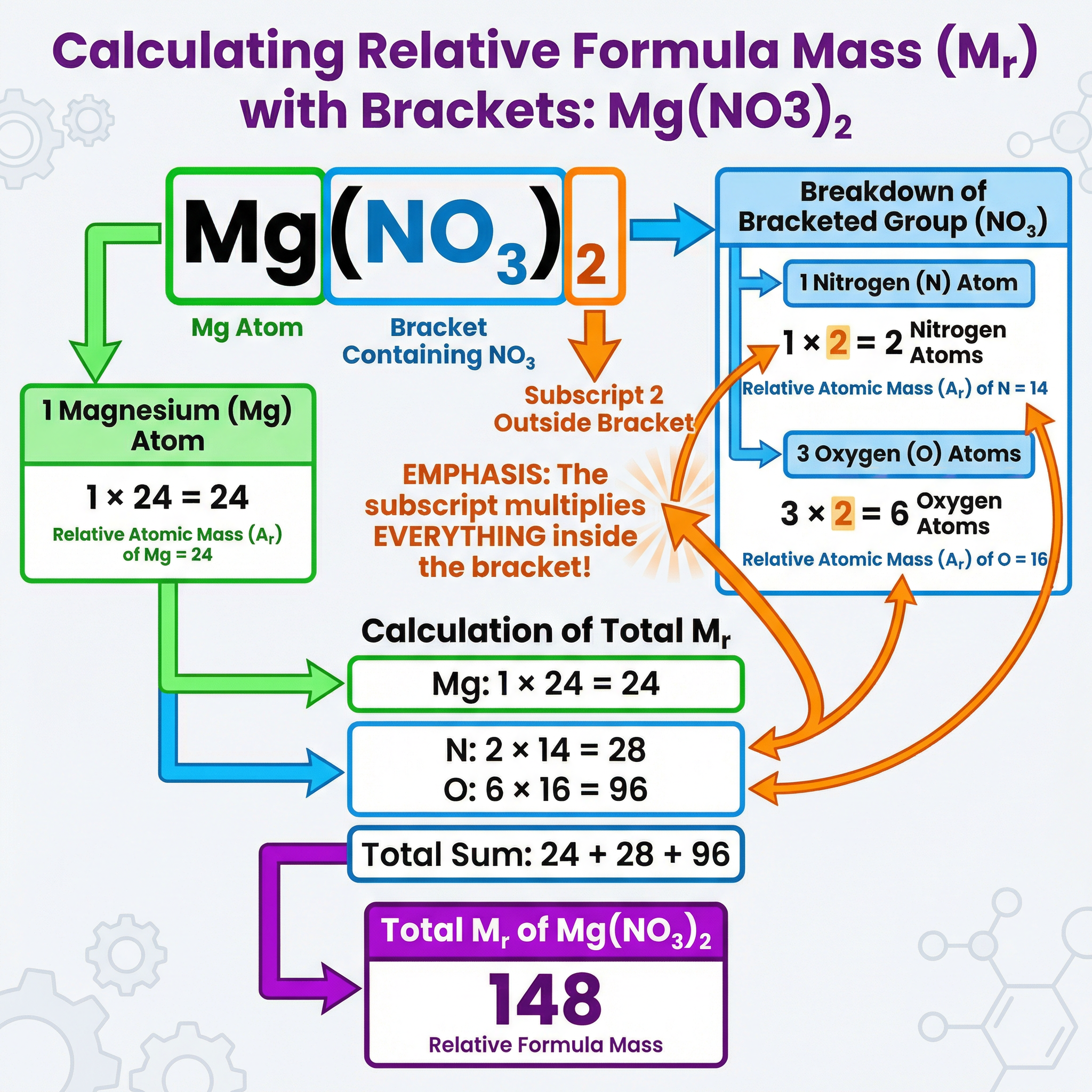
    Visual breakdown of handling brackets in Mr calculations.

    Example: For Calcium Hydroxide, Ca(OH)2:

    • The (OH) group is in brackets with a subscript 2 outside.
    • This means there are 2 Oxygen atoms and 2 Hydrogen atoms.
    • One Calcium atom: 1 × 40 = 40
    • Two Oxygen atoms: 2 × 16 = 32
    • Two Hydrogen atoms: 2 × 1 = 2
    • Total Mr = 40 + 32 + 2 = 74

    Concept 4: Hydrated Salts (Higher Tier)

    Hydrated salts contain water of crystallisation, indicated by a dot in the formula (e.g., ·5H2O). This dot signifies addition, not multiplication. To calculate the Mr of a hydrated salt, you calculate the Mr of the anhydrous salt part and then add the total mass of the water molecules.

    Example: For hydrated Copper(II) Sulfate, CuSO4·5H2O:

    • First, calculate the Mr of the anhydrous salt, CuSO4:
      • Cu: 1 × 64 = 64
      • S: 1 × 32 = 32
      • O: 4 × 16 = 64
      • Mr of CuSO4 = 64 + 32 + 64 = 160
    • Next, calculate the total mass of the water molecules, 5H2O:
      • Mr of H2O = (2 × 1) + 16 = 18
      • Mass of 5 water molecules = 5 × 18 = 90
    • Finally, add the two parts together:
      • Total Mr = 160 + 90 = 250

    Worked Examples

    3 detailed examples with solutions and examiner commentary

    Practice Questions

    Test your understanding — click to reveal model answers

    Q1

    Calculate the relative formula mass (Mr) of sodium carbonate, Na2CO3. (Ar: C=12, O=16, Na=23)

    2 marks
    foundation

    Hint: Remember to multiply the Ar of sodium by its subscript.

    Q2

    Calculate the relative formula mass (Mr) of ammonium sulfate, (NH4)2SO4. (Ar: H=1, N=14, O=16, S=32)

    4 marks
    standard

    Hint: Be very careful with the brackets. The subscript '2' applies to both N and H.

    Q3

    A compound contains 40.0% carbon, 6.7% hydrogen, and 53.3% oxygen by mass. Its relative formula mass is 180. This is not a question about calculating Mr from scratch, but about understanding its meaning. If the empirical formula is CH2O, what is the molecular formula?

    3 marks
    challenging

    Hint: First, calculate the Mr of the empirical formula (CH2O). Then, see how many times this fits into the total Mr of 180.

    Q4

    Calculate the difference in relative formula mass between anhydrous copper sulfate (CuSO4) and hydrated copper sulfate (CuSO4·5H2O). (Ar: H=1, O=16, S=32, Cu=64)

    3 marks
    standard

    Hint: You don't need to calculate the Mr of CuSO4. The difference is simply the mass of the water of crystallisation.

    Q5

    Calculate the relative formula mass (Mr) of the complex ion [Cu(NH3)4(H2O)2]2+. (Ar: H=1, N=14, O=16, Cu=64).

    4 marks
    challenging

    Hint: The charge on the ion (2+) does not affect its relative formula mass, as electrons have negligible mass. Treat the square brackets like normal brackets.

    Key Terms

    Essential vocabulary to know

    More Chemistry Study Guides

    View all

    Factors Affecting Reaction Rate

    Edexcel
    GCSE

    This topic explores how temperature, concentration, surface area, and catalysts affect the speed of chemical reactions through collision theory. Mastering this content is essential for both Foundation and Higher Tier candidates, as it combines theoretical understanding with practical investigation skills and mathematical graph analysis—all heavily weighted in Edexcel assessments.

    The Periodic Table

    OCR
    GCSE

    This guide provides a comprehensive overview of the Periodic Table for OCR GCSE Chemistry. It covers atomic structure, groups, periods, and reactivity trends, with a strong focus on exam technique to help you secure top marks.

    Fractional Distillation

    Edexcel
    GCSE

    Unlock top marks in your Edexcel GCSE Chemistry exam by mastering fractional distillation. This guide breaks down how crude oil is separated into vital products like petrol and diesel, showing you exactly what examiners want to see in your answers.

    Crude Oil Composition

    Edexcel
    GCSE

    Master Edexcel GCSE Chemistry Topic 2.7 by exploring the journey of crude oil from a raw mixture to the essential fuels that power our world. This guide will equip you with the knowledge to tackle exam questions on fractional distillation, hydrocarbon properties, and alkane chemistry with confidence.

    Elements, compounds and mixtures

    OCR
    GCSE

    This guide breaks down the essential principles of elements, compounds, and mixtures for your OCR GCSE Chemistry exam. It covers how to classify substances, determine purity using melting point data, and master the separation techniques that frequently appear in exams. Secure top marks by understanding not just what these concepts are, but why they work and how examiners will test you on them.

    Chromatography

    AQA
    GCSE

    This guide provides a comprehensive overview of Chromatography for AQA GCSE Chemistry students. It covers the core principles of separation, the required practical, and the calculation of Rf values, all tailored to help you secure maximum marks in your exam.