Pearson Edexcel · GCSE · Chinese
Course version: Pearson-GCSE-Chinese · Version from Mar 2026
Celebrating success
This topic covers essential vocabulary for school types, achievements, and celebrations. You will master key grammar structures like the past completion marker '了', future intention '会', and the crucial opinion structure '因为...所以...'. It prepares you for all four skills, particularly narrating past successes and justifying feelings about school.
- 11 min read
- 4 worked examples
- 6 practice questions
- 8 key terms
Check what you remember
Read the wording for your board, then hide it and explain 了 (le) in your own words. Rough notes are fine. This is a self-check, with no mark or grade.
Reference: Pearson Edexcel
A particle placed after a verb or at the end of a sentence to indicate that an action is completed.
Study Notes
Overview
This study guide focuses on Celebrating Success (庆祝成功) within the school environment. It is a highly testable topic across all exam boards for GCSE Chinese. Examiners frequently use this theme to test your ability to narrate events in different timeframes (past achievements, future goals) and to justify your opinions. Mastering this topic will give you versatile vocabulary that you can apply in the Listening and Reading papers, as well as high-scoring structures for your Speaking (Photo Card and General Conversation) and Writing tasks.
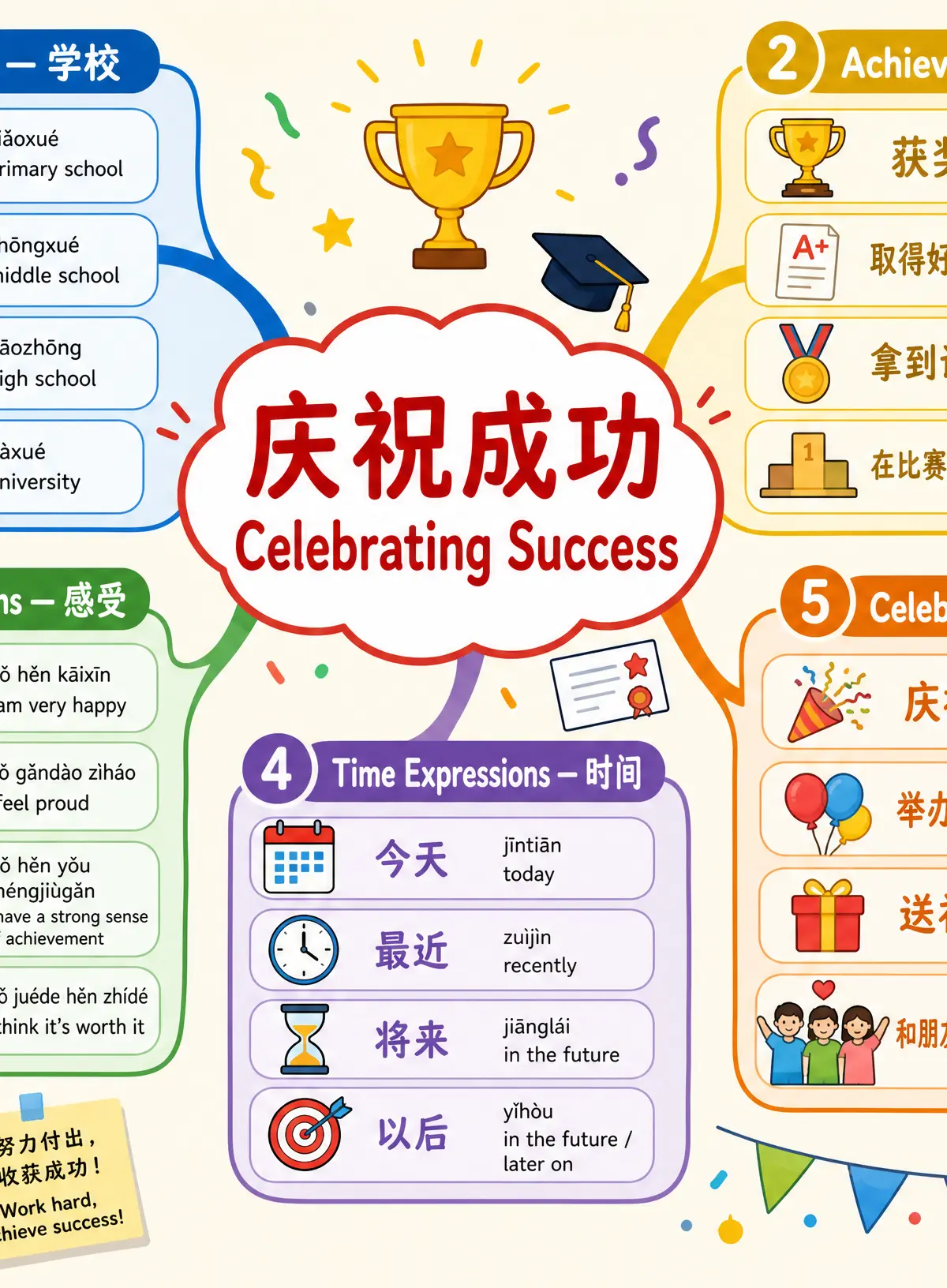
📖 Essential Vocabulary
Tier 1 — Foundation Core
| Chinese | English | Gender | Example Sentence |
|---|---|---|---|
| 学校 (xuéxiào) | school | n/a | 我的学校很大。 (My school is very big.) |
| 小学 (xiǎoxué) | primary school | n/a | 我弟弟在小学上学。 (My younger brother goes to primary school.) |
| 中学 (zhōngxué) | middle/secondary school | n/a | 我是一名中学生。 (I am a secondary school student.) |
| 高中 (gāozhōng) | high school | n/a | 明年我想上高中。 (Next year I want to go to high school.) |
| 大学 (dàxué) | university | n/a | 哥哥在大学学习。 (Older brother studies at university.) |
| 考试 (kǎoshì) | exam / test | n/a | 明天我有中文考试。 (Tomorrow I have a Chinese exam.) |
| 成绩 (chéngjì) | result / grade | n/a | 我的考试成绩很好。 (My exam results are very good.) |
| 庆祝 (qìngzhù) | to celebrate | n/a | 我们要庆祝一下。 (We are going to celebrate.) |
| 努力 (nǔlì) | hard-working / to work hard | n/a | 他学习很努力。 (He studies very hard.) |
| 开心 (kāixīn) | happy | n/a | 取得好成绩我很开心。 (I am very happy to get good results.) |
| 礼物 (lǐwù) | gift / present | n/a | 妈妈给了我一个礼物。 (Mum gave me a gift.) |
| 派对 (pàiduì) | party | n/a | 我们周末举办派对。 (We are holding a party this weekend.) |
| 朋友 (péngyou) | friend | n/a | 我和朋友一起庆祝。 (I celebrate together with friends.) |
| 老师 (lǎoshī) | teacher | n/a | 老师很高兴。 (The teacher is very happy.) |
| 喜欢 (xǐhuan) | to like | n/a | 我喜欢我的学校。 (I like my school.) |
Tier 2 — Higher Tier
| Chinese | English | Gender | Example Sentence |
|---|---|---|---|
| 成功 (chénggōng) | success / to succeed | n/a | 努力是成功的关键。 (Hard work is the key to success.) |
| 成就感 (chéngjiùgǎn) | sense of achievement | n/a | 获奖让我很有成就感。 (Winning an award gives me a strong sense of achievement.) |
| 自豪 (zìháo) | proud | n/a | 父母为我感到自豪。 (My parents feel proud of me.) |
| 获奖 (huòjiǎng) | to win an award | n/a | 去年我在比赛中获奖了。 (Last year I won an award in the competition.) |
| 证书 (zhèngshū) | certificate | n/a | 我拿到了一张证书。 (I received a certificate.) |
| 压力 (yālì) | pressure / stress | n/a | 考试的压力很大。 (The pressure of exams is very high.) |
| 期望 (qīwàng) | expectation / to expect | n/a | 老师对我们期望很高。 (Teachers have high expectations of us.) |
| 进步 (jìnbù) | progress / to make progress | n/a | 我的中文进步了。 (My Chinese has made progress.) |
| 奖励 (jiǎnglì) | reward / to reward | n/a | 努力应该得到奖励。 (Hard work should be rewarded.) |
| 意义重大 (yìyì zhòngdà) | of great significance | n/a | 这次成功对我来说意义重大。 (This success is of great significance to me.) |
High-Frequency Words & Phrases
| Phrase | English | Usage Context |
|---|---|---|
| 取得好成绩 (qǔdé hǎo chéngjì) | to achieve good results | When discussing academic success |
| 在比赛中获胜 (zài bǐsài zhōng huòshèng) | to win in a competition | When talking about sports or academic contests |
| 去餐厅吃饭 (qù cāntīng chīfàn) | to go to a restaurant to eat | A common way to celebrate in Chinese culture |
| 感到非常高兴 (gǎndào fēicháng gāoxìng) | to feel extremely happy | Expressing emotion about an achievement |
| 将来 (jiānglái) | in the future | Shifting timeframe to future goals |
| 去年 (qùnián) | last year | Shifting timeframe to past events |
| 最近 (zuìjìn) | recently | Talking about recent achievements |
| 一方面...另一方面... (yī fāngmiàn... lìng yī fāngmiàn...) | on one hand... on the other hand... | Balancing an argument (e.g., about school pressure) |
| 不但...而且... (bùdàn... érqiě...) | not only... but also... | Linking ideas to show complex structure |
| 对我来说 (duì wǒ lái shuō) | as for me / in my opinion | Introducing a personal perspective |
📝 Grammar Focus
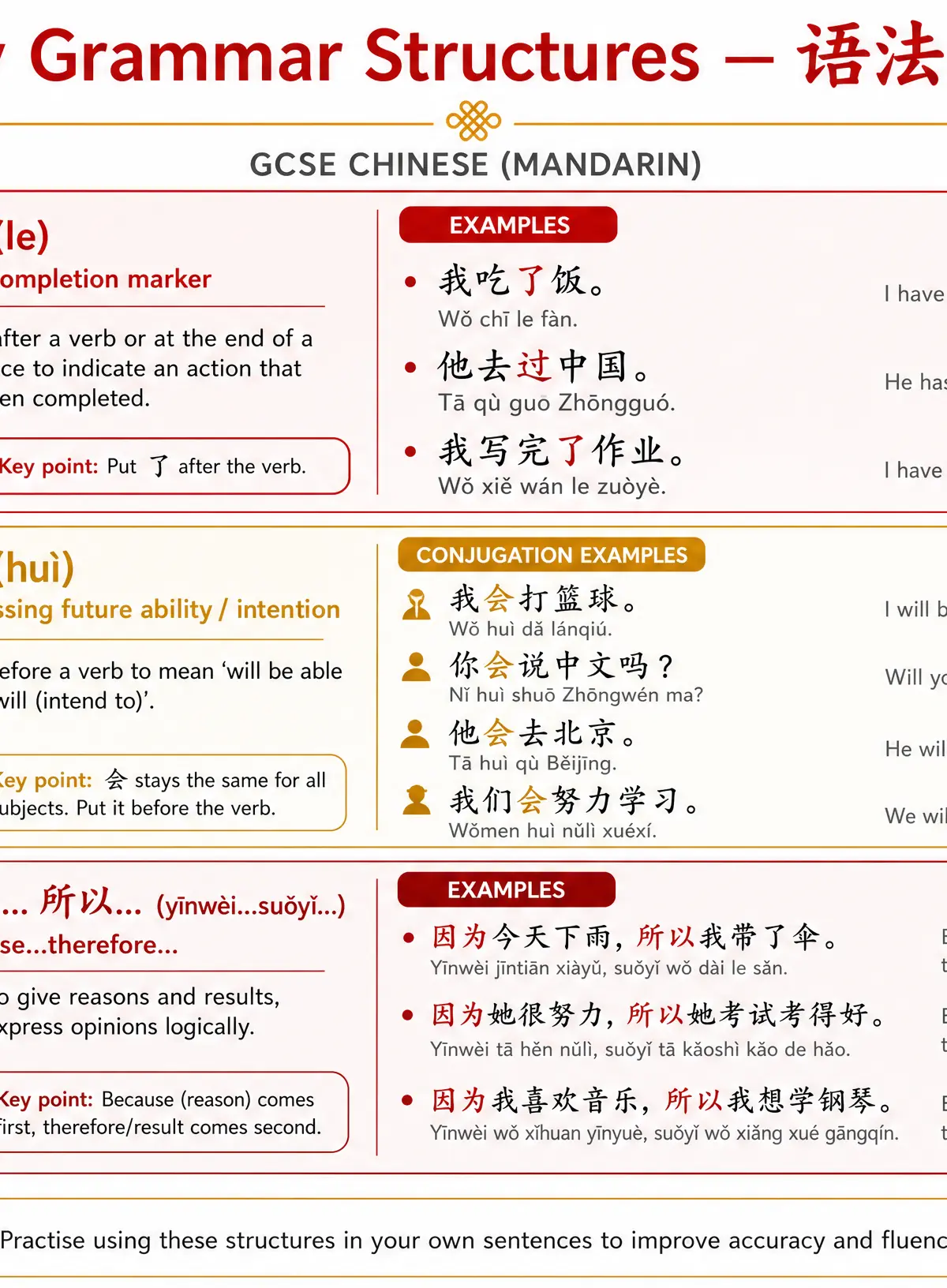
Key Structure 1: 了 (le) — Past Completion Marker
When to use it: Use '了' to indicate that an action has been completed. This is essential for narrating past successes, which examiners look for to award marks for varied timeframes.
Conjugation Table
| Subject | Verb Form | English |
|---|---|---|
| 我 (wǒ) | 参加了 (cānjiā le) | I participated / took part |
| 你 (nǐ) | 获得了 (huòdé le) | You received / obtained |
| 他/她 (tā) | 考了 (kǎo le) | He/She took (an exam) |
| 我们 (wǒmen) | 赢了 (yíng le) | We won |
| 你们 (nǐmen) | 去了 (qù le) | You (pl) went |
| 他们/她们 (tāmen) | 庆祝了 (qìngzhù le) | They celebrated |
Irregulars to learn: Mandarin verbs don't conjugate like European languages. The verb stays the same, you just add '了' after it or at the end of the sentence. Remember: DO NOT use '了' with habitual past actions (things you used to do regularly).
Key Structure 2: 会 (huì) — Future Intention / Ability
When to use it: Use '会' before a verb to express something that will happen or that someone intends to do. It's crucial for talking about future aspirations or how you plan to celebrate.
Conjugation Table
| Subject | Verb Form | English |
|---|---|---|
| 我 (wǒ) | 会努力 (huì nǔlì) | I will work hard |
| 你 (nǐ) | 会参加 (huì cānjiā) | You will participate |
| 他/她 (tā) | 会举办 (huì jǔbàn) | He/She will hold (an event) |
| 我们 (wǒmen) | 会庆祝 (huì qìngzhù) | We will celebrate |
| 你们 (nǐmen) | 会取得 (huì qǔdé) | You (pl) will achieve |
| 他们/她们 (tāmen) | 会去 (huì qù) | They will go |
Irregulars to learn: '会' is invariable. It is also used to express a learned skill (e.g., 我会说中文 - I can speak Chinese).
Key Structure 3: 因为...所以... (yīnwèi...suǒyǐ...) — Because... Therefore...
When to use it: This is the most important structure for justifying opinions. Examiners explicitly reward candidates who give reasons for their views. In Chinese, the reason MUST come first, followed by the result.
Example Sentences
- 因为我取得了很棒的成绩,所以我感到非常自豪。
(Because I achieved great results, therefore I feel very proud.) - 因为父母想庆祝我的成功,所以他们带我去了中国餐厅。
(Because my parents wanted to celebrate my success, therefore they took me to a Chinese restaurant.) - 因为考试压力很大,所以我们需要好好休息。
(Because exam pressure is very high, therefore we need to rest well.)
🎧 Listening Skills
What to Expect
In the listening exam, you will hear students discussing their exam results, parents talking about their children's achievements, or announcements about school prize-giving ceremonies. The recordings will often mix timeframes to test your comprehension of past, present, and future.
Listening Strategies
- Listen for Time Markers: Words like 去年 (last year), 昨天 (yesterday), 今天 (today), 将来 (future) are huge clues to the tense being used.
- Watch for Negatives: Listen carefully for 没 (méi) or 不 (bù). A sentence might sound positive with words like 获奖 (win an award), but if it's preceded by 没有, it means they didn't win.
- Identify the Emotion: Listen to the speaker's tone and keywords like 开心 (happy) or 压力大 (stressed) to understand their attitude towards school.
Common Listening Traps
- Confusing similar sounds: 考试 (kǎoshì - exam) sounds a bit like 老师 (lǎoshī - teacher). Make sure you distinguish the initial consonant.
- Multiple subjects: The recording might mention that the brother won an award but the sister didn't. Make sure you match the achievement to the correct person.
🗣️ Speaking Skills
Role Play Scenarios
Scenario: You are talking to your Chinese exchange partner about your recent exam results.
- Partner: 你最近的考试成绩怎么样? (How were your recent exam results?)
- You: 我的成绩很好,我考了A+。 (My results were very good, I got an A+.)
- Partner: 你打算怎么庆祝? (How do you plan to celebrate?)
- You: 周末我会和家人去餐厅吃饭庆祝。 (At the weekend I will go to a restaurant to eat and celebrate with my family.)
Photo Card Practice
Model Photo Card Response:
- Qu 1 (Description - What is in the photo?): 照片里有三个学生,他们拿着一张证书,看起来非常开心。 (In the photo there are three students, they are holding a certificate, and look very happy.)
- Qu 2 (Opinion - Do you think celebrating success is important?): 我认为庆祝成功很重要,因为这能给我们成就感,鼓励我们继续努力。 (I think celebrating success is very important, because this can give us a sense of achievement and encourage us to continue working hard.)
- Qu 3 (Related topic - What subjects are you good at?): 我最擅长数学和科学,因为我觉得它们很有趣。 (I am best at Maths and Science, because I think they are very interesting.)
- Qu 4 (Past - How did you celebrate your last success?): 去年我在体育比赛中获胜了,妈妈给我买了一个新手机作为奖励。 (Last year I won in a sports competition, mum bought me a new mobile phone as a reward.)
- Qu 5 (Future - What do you want to achieve next year?): 明年我希望能考上一个好高中,所以我会更加努力学习。 (Next year I hope to get into a good high school, so I will study even harder.)
General Conversation Questions
| Question (Chinese) | Model Answer | English Translation |
|---|---|---|
| 你喜欢你的学校吗?为什么? | 我很喜欢我的学校,因为老师很友好,而且我有很多好朋友。 | I really like my school, because the teachers are friendly, and I have many good friends. |
| 英国学生的学习压力大吗? | 我觉得压力很大,特别是考试的时候,我们需要复习很多科目。 | I think the pressure is very high, especially during exams, we need to revise many subjects. |
| 你最近取得了什么好成绩? | 上个月我的中文考试考得很好,我感到非常自豪。 | Last month I did very well in my Chinese exam, I feel very proud. |
| 你通常怎么庆祝成功? | 我通常会和家人一起去中国餐厅吃烤鸭,因为我最喜欢吃中国菜。 | I usually go to a Chinese restaurant with my family to eat roast duck, because I like eating Chinese food the most. |
| 将来你想上大学吗? | 是的,我想去伦敦上大学,因为我想学习医学。 | Yes, I want to go to university in London, because I want to study medicine. |
✍️ Writing Skills
Translation Practice
English → Chinese:
| English | Chinese | Key Grammar |
|---|---|---|
| My school is very big. | 我的学校很大。 | Basic description |
| Last year, I won an award. | 去年,我获奖了。 | Past time word + 了 |
| Because I worked hard, I got good results. | 因为我很努力,所以我取得了好的成绩。 | 因为...所以... structure |
| We will hold a party to celebrate. | 我们会举办一个派对来庆祝。 | 会 for future intention |
| Winning makes me feel very proud. | 获胜让我感到非常自豪。 | 让人 (makes someone) + emotion |
Extended Writing
Model 90-word response (Foundation):
我叫大卫,我是一名中学生。我的学校很大,老师也很好。上个星期,我有一次数学考试。因为我每天都复习,所以我考得很好,取得了好成绩。我感到非常开心和自豪。为了庆祝,周末我的父母带我去了市中心的中国餐厅吃饭。我们吃了烤鸭和饺子,非常好吃。将来,我会更加努力学习,因为我想上大学。
Model 150-word response (Higher):
庆祝成功在学校生活中是非常重要的一部分。上个月,我们学校举办了体育比赛。因为我每天放学后都练习跑步,所以我不仅在比赛中获胜了,而且还拿到了一张金色的证书。站在领奖台上,我感到非常自豪,这对我来说意义重大。我觉得努力付出就应该得到奖励。为了庆祝这次成功,周末我邀请了几个好朋友来我家举办派对。我们一边吃比萨饼,一边看电影,玩得非常开心。虽然现在学习的压力越来越大,但是取得好成绩能给我们带来很大的成就感。将来,我希望能考上一所好大学,所以我一定会继续努力学习,迎接新的挑战。
Writing Checklist
- ✅ Have I used three different tenses (e.g., 去年, 现在, 将来)?
- ✅ Have I given opinions and justified them using 因为...所以...?
- ✅ Have I used connectives like 不但...而且... (not only...but also)?
- ✅ Are my measure words correct (e.g., 一张证书 - a certificate)?
📚 Reading Skills
Key Strategies
When tackling reading comprehensions on this topic, read the questions first (in English or Chinese, depending on the section) so you know what specific information to look for. Often, the text will describe a student's hard work, the pressure they felt, and then the final result and celebration. Map this narrative arc as you read.
False Friends & Tricky Words
| Word | Looks Like | Actually Means |
|---|---|---|
| 证书 (zhèngshū) | A book (书) | A certificate (though it contains the character for book) |
| 成绩 (chéngjì) | Success | Results/grades (can be good or bad, unlike 'success' which is always positive) |
| 奖励 (jiǎnglì) | To encourage | A reward / to reward (related to encouragement, but specifically a prize or reward) |
🌍 Cultural Knowledge
In Chinese culture, academic success is highly valued and often celebrated as a family achievement, not just an individual one. Parents place high expectations (期望) on their children regarding education. When a student achieves a high score in the Gaokao (the Chinese university entrance exam) or wins a significant competition, it is common for the extended family to hold a large celebration banquet (庆祝宴席) at a restaurant. Red envelopes (红包 - hóngbāo) containing money might also be given as a practical reward and a symbol of good luck for future studies. Mentioning a family meal at a restaurant as a way of celebrating is highly culturally authentic in your speaking and writing exams.
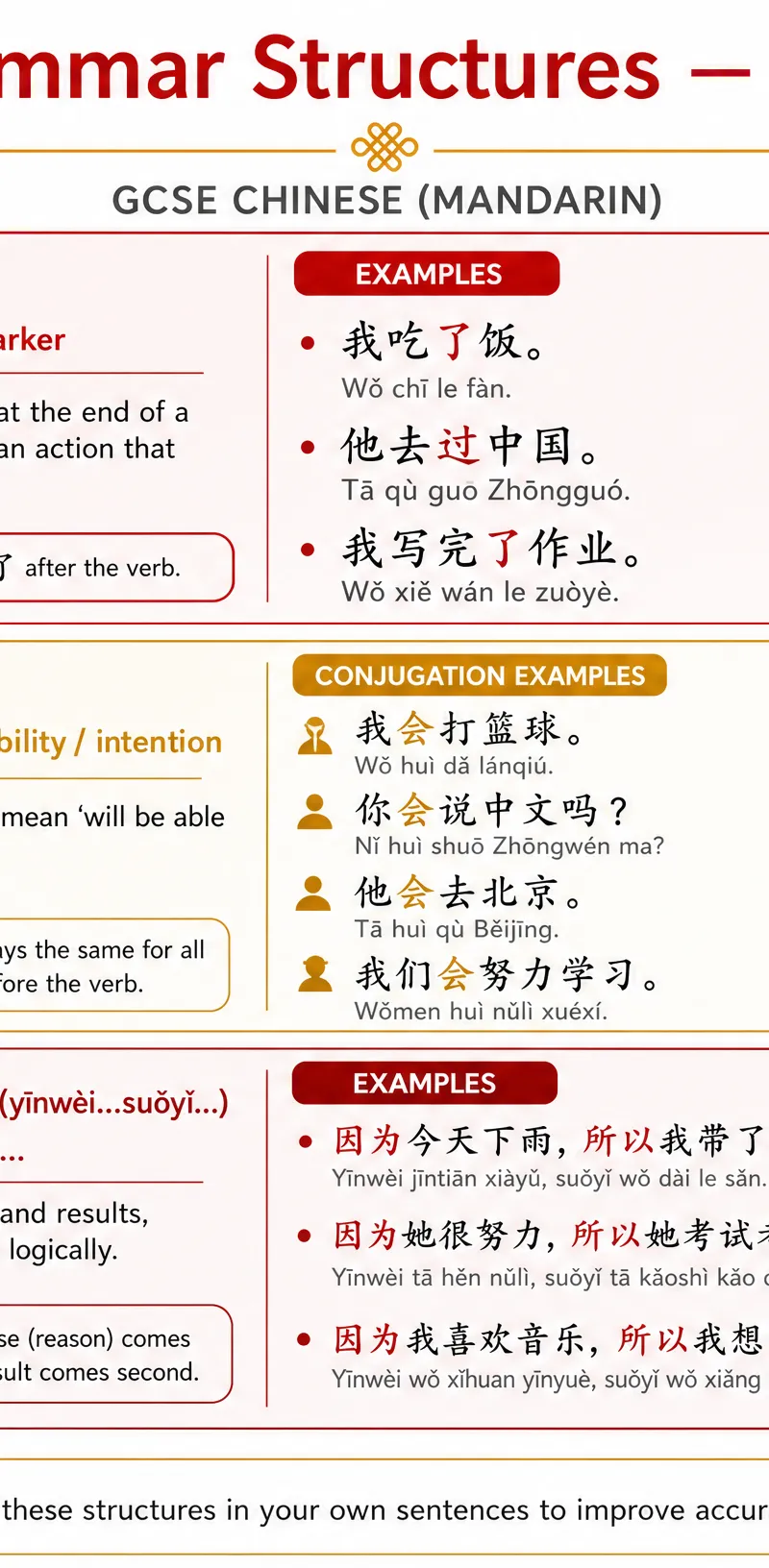
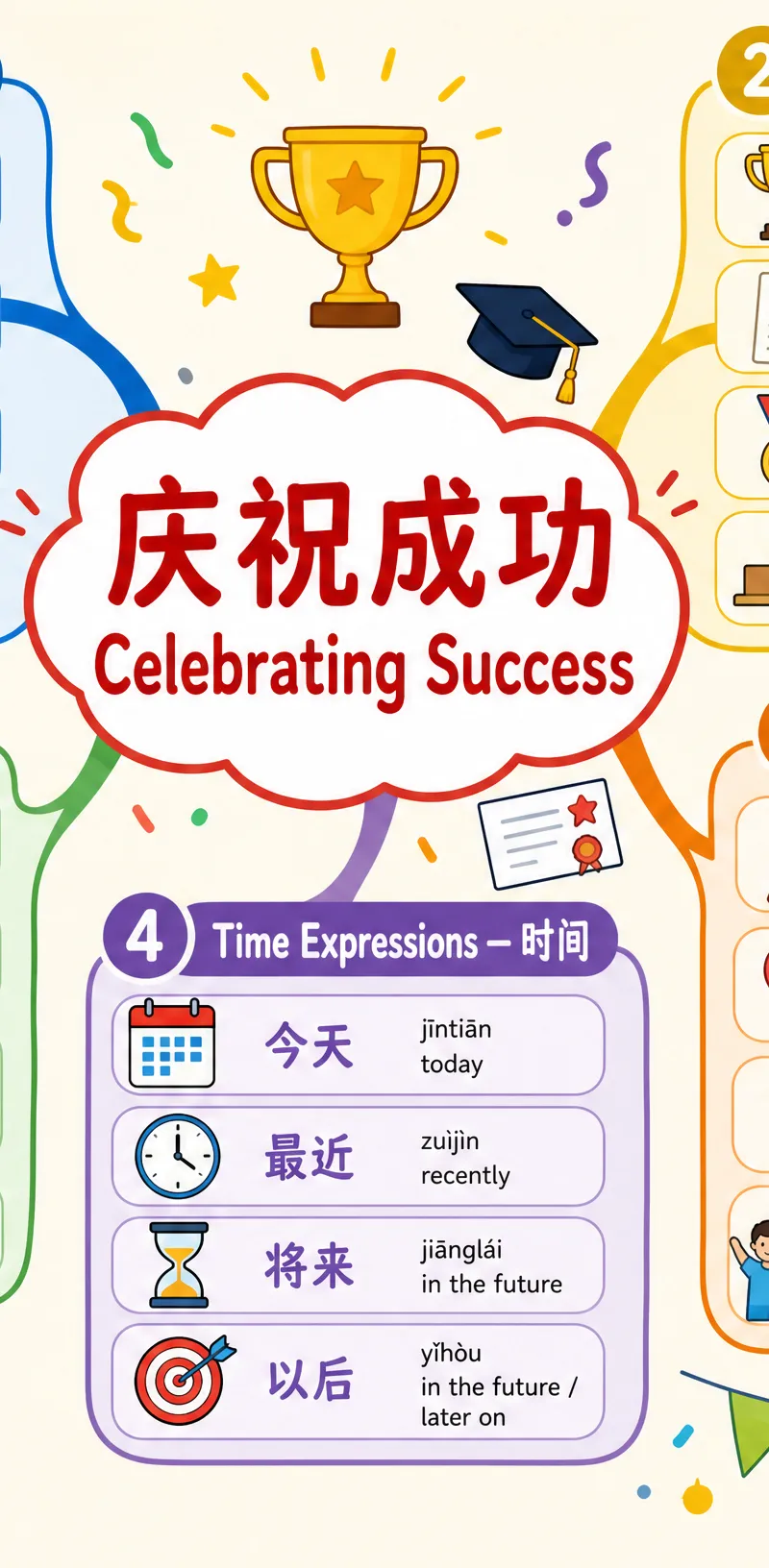
Interactive Diagrams
1 interactive diagram to visualise key concepts
Conceptual Flow Outline
Timeframe strategy for speaking and writing tasks
Worked Examples
4 worked examples — open one to explore the question and available guidance.
Practice Questions
Try the question, then reveal an answer plan or example response
Reading (Foundation): Read the sentence and answer in English: 因为我每天做作业,所以我的成绩进步了。 Why did the student's grades improve?
Hint: Look at the phrase after '因为' (because).
Translation (Standard): Translate into Chinese: 'I feel very proud because I won an award.'
Hint: Remember the Chinese structure: Because [reason], therefore [result].
Writing (Higher): Write a short paragraph (approx 50 words) about a recent school achievement and how your parents reacted.
Hint: Include a past time word, the '了' particle, and an emotion word.
Speaking (Standard): Photo Card Question - 你觉得考试压力大吗? (Do you feel exam pressure is high?)
Hint: Give an opinion, justify it, and suggest a solution.
Listening (Higher): Listen to the sentence and translate the main point into English: 虽然我的成绩不是最好的,但是我已经尽力了,所以我很开心。
Hint: Listen for the contrast structure '虽然...但是...' (Although... but...).
Writing (Foundation): Translate into Chinese: 'Next year, I will go to university.'
Hint: Time word first, then subject, then '会'.
Exam technique
How to turn what you know into marks
How to approach the question
Skill-by-skill strategy: Listening — read questions first, note keywords. Speaking — prepare opinions in advance, have fillers ready. Reading — skim first, then detail. Writing — plan before writing, check accuracy after.
How to structure your answer
Writing: Introduction → Main points with opinions → Justified reasons → Different tenses → Conclusion. Speaking: Give opinion → Justify → Extend → Use different tense.
Timing
Listening: 25 mins (heard twice). Speaking: 7-12 mins total (role play + photo card + conversation). Reading: 45-60 mins. Writing: 60-75 mins (translation + structured + extended).
Common pitfalls
- Forgetting to use '了' for past events, relying entirely on time words.
- Using only the present tense — examiners want at least 3 tenses at Higher.
- Giving one-word Speaking answers instead of developing responses.
- Putting the reason after the result (English word order) instead of using '因为...所以...'.
- Confusing '作业' (homework) with general 'work'.
- Not justifying opinions with '因为' (because).
What the command words want
- Describe the photo
- Say what you can see, give an opinion, relate to your experience.
- Translate into Chinese
- Write full sentences with correct grammar — partial marks for partially correct characters.
- Translate into English
- Meaning over word-for-word — capture the sense, don't guess cognates.
- Write approximately 90 words
- Foundation task — cover all 4 bullet points, use present + one other tense.
- Write approximately 150 words
- Higher task — 3 tenses, opinions, complex structures, ambitious vocabulary.
Watch or listen (optional)
Test your understanding of Celebrating success
Active recall beats re-reading. Take an instant quiz now to test what you’ve learned and lock it into long-term memory.
7 days Premium · Then the free plan continues · No card, no charge