Pearson Edexcel · GCSE · Chinese
Course version: Pearson-GCSE-Chinese · Version from Mar 2026
Environmental issues
This topic covers essential vocabulary for environmental issues, including pollution, climate change, and green actions. Key grammar focuses on expressing past, present, and future tenses, and justifying opinions to score highly in Speaking and Writing.
- 13 min read
- 4 worked examples
- 6 practice questions
- 8 key terms
Check what you remember
Read the wording for your board, then hide it and explain Measure Word (量词) in your own words. Rough notes are fine. This is a self-check, with no mark or grade.
Reference: Pearson Edexcel
A classifier required in Chinese between a number and a noun (e.g., 个, 辆, 棵).
Study Notes
Overview
The 'Environmental Issues' (环境问题) topic is a cornerstone of the GCSE Chinese specification. It appears frequently across all four papers (Listening, Speaking, Reading, Writing) because it naturally invites complex language. Examiners love this topic as it provides excellent opportunities for candidates to express and justify opinions, refer to past, present, and future events, and use a range of vocabulary beyond Foundation level. Mastering this topic is key to accessing the highest mark bands.
🎧 Audio Resource: Revision Podcast
Listen to this 10-minute audio guide covering core vocabulary, grammar strategies, and a quick-fire recall quiz.
📖 Essential Vocabulary
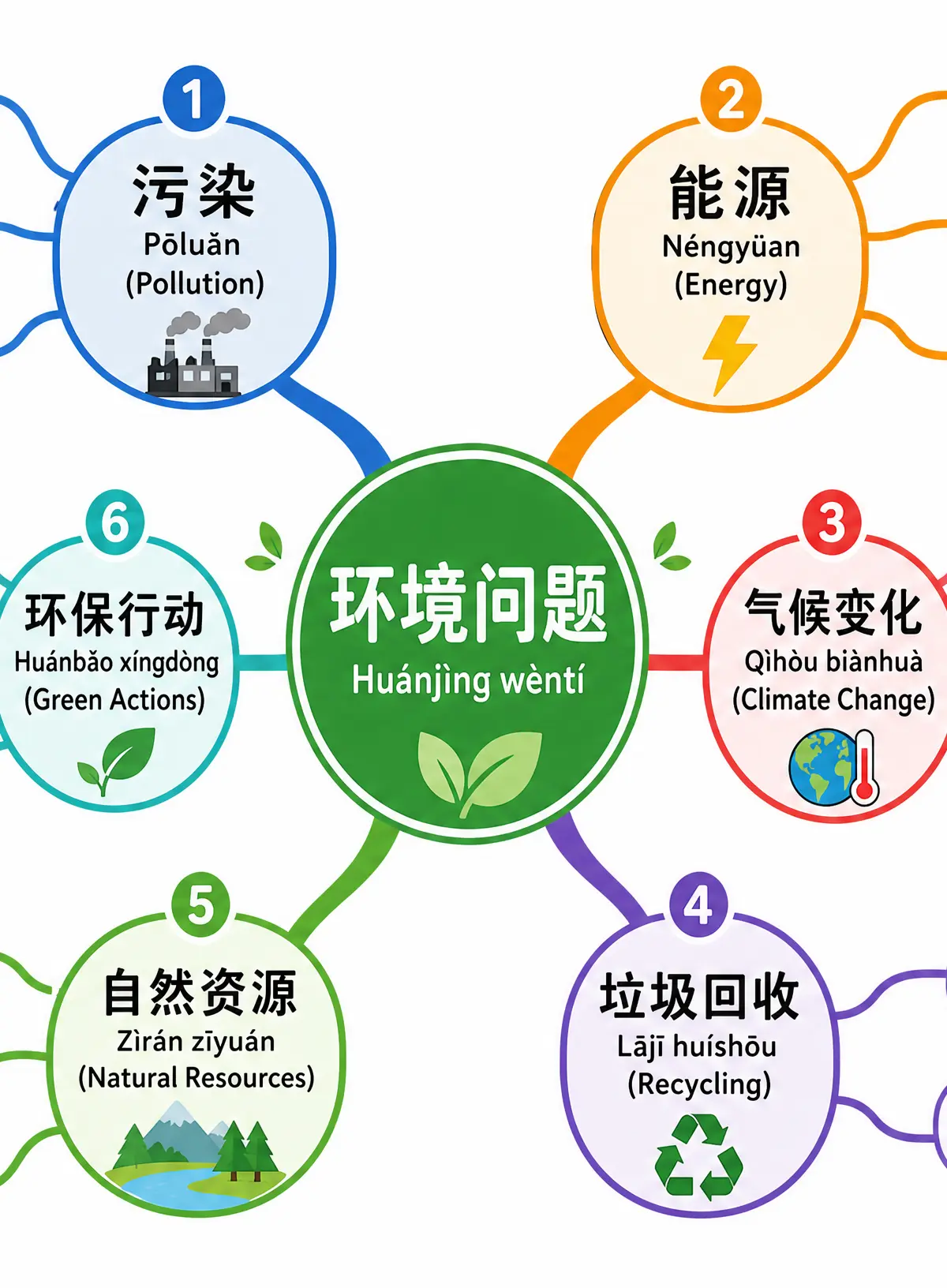
Tier 1 — Foundation Core
| Chinese | Pinyin | English | Example Sentence |
|---|---|---|---|
| 环境 | huánjìng | environment | 保护环境很重要。 (Protecting the environment is important.) |
| 污染 | wūrǎn | pollution | 这里的污染很严重。 (The pollution here is very serious.) |
| 垃圾 | lājī | rubbish / garbage | 请不要乱扔垃圾。 (Please don't throw rubbish around.) |
| 回收 | huíshōu | to recycle | 我们每天回收垃圾。 (We recycle rubbish every day.) |
| 浪费 | làngfèi | to waste | 浪费水是不好的。 (Wasting water is not good.) |
| 节约 | jiéyuē | to save / conserve | 我们应该节约用电。 (We should save electricity.) |
| 保护 | bǎohù | to protect | 保护动物是我们的责任。 (Protecting animals is our responsibility.) |
| 树 | shù | tree | 我昨天种了一棵树。 (I planted a tree yesterday.) |
| 纸 | zhǐ | paper | 请使用再生纸。 (Please use recycled paper.) |
| 水 | shuǐ | water | 水污染是一个大问题。 (Water pollution is a big problem.) |
| 塑料 | sùliào | plastic | 我们少用塑料袋。 (We use fewer plastic bags.) |
| 汽车 | qìchē | car | 汽车有很多废气。 (Cars have a lot of exhaust gas.) |
| 骑自行车 | qí zìxíngchē | to ride a bike | 我每天骑自行车上学。 (I ride a bike to school every day.) |
| 走路 | zǒulù | to walk | 走路对身体好。 (Walking is good for your health.) |
| 公共交通 | gōnggòng jiāotōng | public transport | 坐公共交通很环保。 (Taking public transport is eco-friendly.) |
Tier 2 — Higher Tier
| Chinese | Pinyin | English | Example Sentence |
|---|---|---|---|
| 全球变暖 | quánqiú biànnuǎn | global warming | 全球变暖影响了气候。 (Global warming affects the climate.) |
| 气候变化 | qìhòu biànhuà | climate change | 气候变化是一个严重的挑战。 (Climate change is a serious challenge.) |
| 碳排放 | tàn páifàng | carbon emissions | 工厂必须减少碳排放。 (Factories must reduce carbon emissions.) |
| 可再生能源 | kě zàishēng néngyuán | renewable energy | 我们应该多用可再生能源。 (We should use more renewable energy.) |
| 太阳能 | tàiyángnéng | solar energy | 太阳能是干净的能源。 (Solar energy is clean energy.) |
| 砍伐森林 | kǎnfá sēnlín | deforestation | 砍伐森林破坏了动物的家。 (Deforestation destroys animals' homes.) |
| 濒危动物 | bīnwēi dòngwù | endangered animals | 我们要保护濒危动物。 (We must protect endangered animals.) |
| 环保 | huánbǎo | eco-friendly | 买环保产品是个好主意。 (Buying eco-friendly products is a good idea.) |
| 塑料污染 | sùliào wūrǎn | plastic pollution | 塑料污染对海洋不好。 (Plastic pollution is bad for the ocean.) |
| 噪音污染 | zàoyīn wūrǎn | noise pollution | 城市的噪音污染很严重。 (Noise pollution in the city is serious.) |
High-Frequency Words & Phrases
| Phrase | Pinyin | English | Usage Context |
|---|---|---|---|
| 我认为... | Wǒ rènwéi... | I think that... | Giving an opinion in Speaking/Writing |
| 因为... 所以... | Yīnwèi... suǒyǐ... | Because... therefore... | Justifying an opinion |
| 为了... | Wèile... | In order to... | Explaining purpose (e.g., 'In order to protect the environment...') |
| 越来越... | Yuè lái yuè... | More and more... | Describing a changing situation (e.g., 'more and more serious') |
| 应该 | yīnggāi | should | Giving advice or recommendations |
| 必须 | bìxū | must | Expressing strong obligation |
| 一方面... 另一方面... | Yī fāngmiàn... lìng yī fāngmiàn... | On one hand... on the other hand... | Balancing an argument (Higher tier) |
| 除了... 以外,还... | Chúle... yǐwài, hái... | Besides... also... | Adding extra information to score higher marks |
| 以前 | yǐqián | in the past | Fulfilling the 'past event' requirement |
| 将来 | jiānglái | in the future | Fulfilling the 'future event' requirement |
📝 Grammar Focus
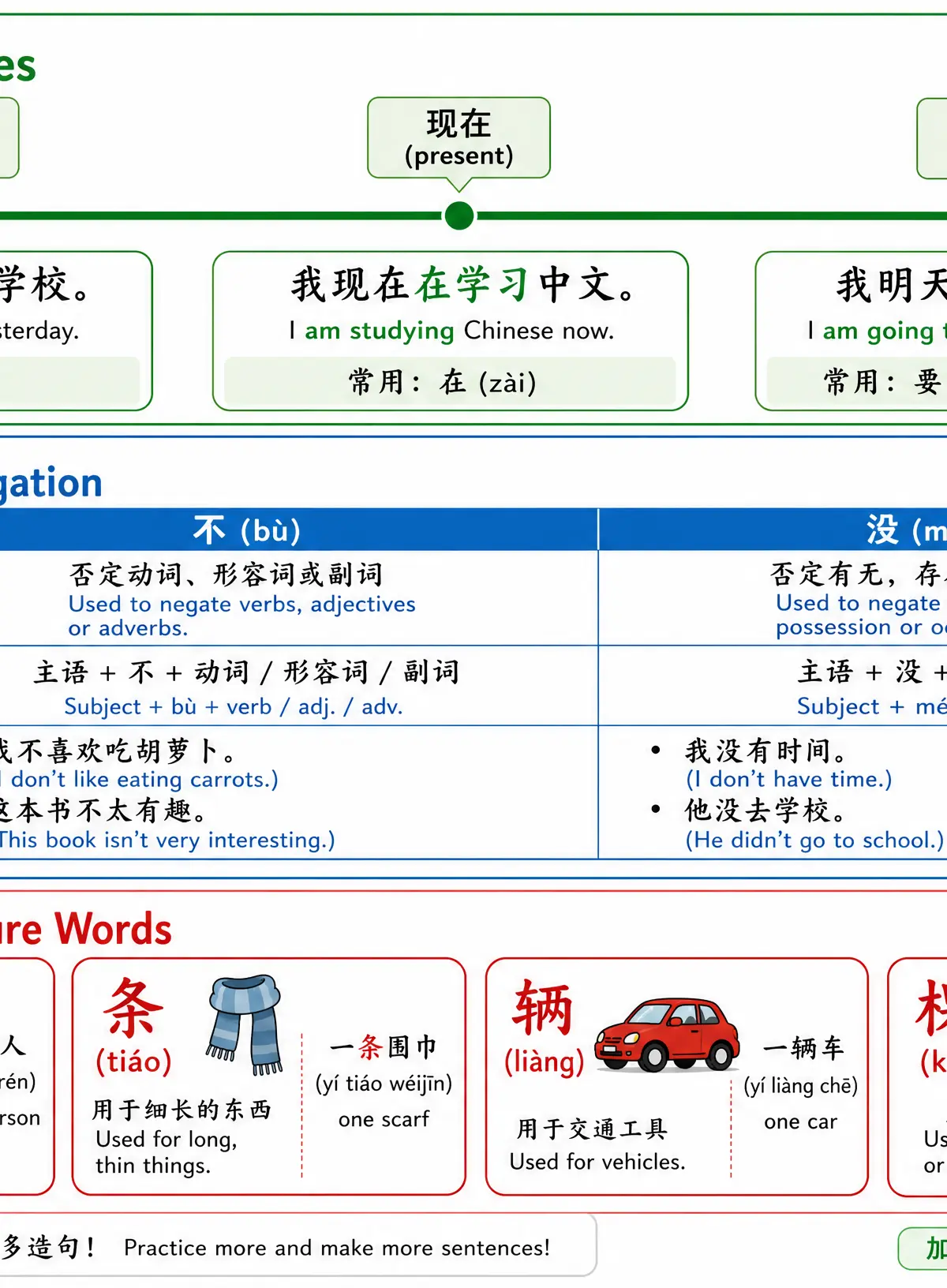
Key Structure 1: Expressing Tenses (Past, Present, Future)
When to use it: In all Writing and Speaking tasks, examiners explicitly look for the ability to refer to past, present, and future events. Chinese verbs do not conjugate; instead, you use time words and aspect markers.
Time Markers Table
| Tense | Chinese Marker | Pinyin | English | Example |
|---|---|---|---|---|
| Past | 以前 | yǐqián | in the past | 以前,这里有很多树。 (In the past, there were many trees here.) |
| Past | 了 | le | (completed action) | 昨天我回收了垃圾。 (Yesterday I recycled rubbish.) |
| Present | 现在 | xiànzài | now | 现在,空气污染很严重。 (Now, air pollution is very serious.) |
| Present | 正在 | zhèngzài | (action in progress) | 我们正在保护环境。 (We are currently protecting the environment.) |
| Future | 将来 | jiānglái | in the future | 将来,我想买环保车。 (In the future, I want to buy an eco-friendly car.) |
| Future | 会 / 要 | huì / yào | will / going to | 明天我们会去种树。 (Tomorrow we will go plant trees.) |
Common Mistake: Placing time words at the end of the sentence (like in English). In Chinese, time words must go at the beginning of the sentence or right after the subject: 我明天去 (I tomorrow go), NOT 我去明天 (I go tomorrow).
Key Structure 2: Justifying Opinions (因为...)
When to use it: To access the higher mark bands in Speaking (Photo Card, General Conversation) and Writing (90-word and 150-word tasks), you must state opinions and justify them.
Opinion Structures
| Opinion Phrase | English | Justification | English |
|---|---|---|---|
| 我觉得... (Wǒ juéde...) | I feel that... | 因为... (yīnwèi...) | because... |
| 我认为... (Wǒ rènwéi...) | I think that... | 因为它... (yīnwèi tā...) | because it... |
| 在我看来... (Zài wǒ kànlái...) | In my opinion... | 因为对...有好处 (yīnwèi duì... yǒu hǎochù) | because it is good for... |
Example: 我认为骑自行车很好,因为对环境有好处。 (I think riding a bike is very good, because it is good for the environment.)
Key Structure 3: Measure Words (量词)
When to use it: In Chinese, a measure word is required between a number/demonstrative (this/that) and a noun. Omitting or misusing them is a frequent error that loses accuracy marks.
Common Measure Words for this Topic
| Measure Word | Pinyin | Used for | Example |
|---|---|---|---|
| 个 | gè | General objects, people | 一个问题 (one problem), 一个垃圾桶 (one rubbish bin) |
| 棵 | kē | Trees, plants | 一棵树 (one tree) |
| 辆 | liàng | Vehicles | 一辆汽车 (one car), 一辆自行车 (one bicycle) |
| 张 | zhāng | Flat objects (paper) | 一张纸 (one piece of paper) |
🎧 Listening Skills
What to Expect
Listening tasks on this topic often feature short announcements (e.g., about recycling rules), radio interviews with environmentalists, or conversations between friends discussing their green habits.
Listening Strategies
- Listen for Time Words: Pay close attention to words like 以前 (past) and 将来 (future). Questions often try to trick you by asking what someone used to do versus what they do now.
- Note Negatives: Listen carefully for 不 (bù) and 没 (méi). A speaker might say they don't drive to work, which completely changes the answer.
- Identify the Core Issue: Listen for key vocabulary like 污染 (pollution) or 垃圾 (rubbish) to quickly grasp the context of the recording.
Common Listening Traps
- False Friends/Similar Sounds: 气候 (qìhòu - climate) sounds similar to 时候 (shíhòu - time). 污染 (wūrǎn - pollution) can be confused with 无聊 (wúliáo - boring) if you aren't listening carefully.
🗣️ Speaking Skills
Role Play Scenarios
You may be asked to play the role of a student talking to a teacher about a school recycling project, or discussing travel plans to reduce carbon footprint.
Photo Card Practice
Model Photo Card Response (A photo showing people picking up litter in a park):
- Qu 1 (Description): 照片里有三个人。他们在公园里捡垃圾。天气很好,是晴天。(There are three people in the photo. They are picking up rubbish in the park. The weather is good, it's sunny.)
- Qu 2 (Opinion): 我觉得他们做得很好,因为保护环境是每个人的责任。(I think they are doing very well, because protecting the environment is everyone's responsibility.)
- Qu 3 (Related topic): 在我家,我们每天都回收纸和塑料。(At my house, we recycle paper and plastic every day.)
- Qu 4 (Past/Future): 上个周末,我和朋友也去了海边捡垃圾。(Last weekend, my friends and I also went to the seaside to pick up rubbish.)
- Qu 5 (Unpredictable): 将来,我想买一辆电动车,因为对空气好。(In the future, I want to buy an electric car because it's good for the air.)
General Conversation Questions
| Question (Chinese) | Model Answer | English Translation |
|---|---|---|
| 你觉得最大的环境问题是什么? | 我认为全球变暖是最大的问题,因为它影响整个地球。 | What do you think is the biggest environmental problem? / I think global warming is the biggest problem because it affects the whole earth. |
| 你在家里怎么保护环境? | 在家里,我总是关灯,我也节约用水。 | How do you protect the environment at home? / At home, I always turn off the lights, and I also save water. |
| 你的学校有回收箱吗? | 有,我们每个教室都有回收箱,我们回收纸和塑料。 | Does your school have recycling bins? / Yes, we have recycling bins in every classroom, we recycle paper and plastic. |
| 你上个周末做了什么环保的事情? | 上个周末,我没有坐车,我骑自行车去了市中心。 | What eco-friendly thing did you do last weekend? / Last weekend, I didn't take a car, I rode my bike to the city centre. |
| 将来,你会买电动车吗? | 会的,将来我会买电动车,因为汽油车污染空气。 | In the future, will you buy an electric car? / Yes, in the future I will buy an electric car, because petrol cars pollute the air. |
✍️ Writing Skills
Translation Practice
English → Chinese:
| English | Chinese | Key Grammar |
|---|---|---|
| I recycle rubbish every day. | 我每天回收垃圾。 | Basic SVO structure, time word position |
| We should not waste water. | 我们不应该浪费水。 | Modal verb (应该) + negative (不) |
| Yesterday, I rode a bike to school. | 昨天我骑自行车去学校。 | Past time word (昨天) position |
| I think global warming is very serious. | 我认为全球变暖很严重。 | Opinion phrase (我认为) + adjective degree (很) |
| In the future, I will plant more trees. | 将来我会种更多的树。 | Future marker (将来/会) + comparative (更) |
Extended Writing
Model 90-word response (Foundation):
保护环境很重要。在家里,我每天回收纸和塑料。我也节约用水。上个周末,我和家人去公园捡了垃圾。我觉得我们做得很好,因为公园变得很干净。现在,很多城市的空气污染很严重。为了保护环境,我每天骑自行车上学,我不坐汽车。将来,我想买一辆环保车,因为对空气有好处。我们大家都应该保护地球。
(Translation: Protecting the environment is important. At home, I recycle paper and plastic every day. I also save water. Last weekend, my family and I went to the park to pick up rubbish. I think we did very well, because the park became very clean. Now, air pollution in many cities is very serious. In order to protect the environment, I ride a bike to school every day, I don't take a car. In the future, I want to buy an eco-friendly car, because it is good for the air. We should all protect the earth.)
Model 150-word response (Higher):
目前,环境问题越来越严重,特别是全球变暖和空气污染。我认为保护环境是我们每个人的责任。在日常生活中,我们可以做很多小事。比如,在家里我总是节约用电,离开房间时一定会关灯。此外,我们家每天都把垃圾分类,回收纸张、玻璃和塑料。
上个月,我们学校组织了一个环保活动。我和同学们去了附近的海滩捡垃圾。虽然很累,但是我觉得非常有意义,因为海洋污染对动物非常不好。
另一方面,交通也是一个大问题。为了减少碳排放,我每天骑自行车上学,从来不坐汽车。将来,我希望更多的人使用公共交通,或者买电动车。如果我们现在不采取行动,地球的未来会很糟糕。总之,只要大家一起努力,环境一定会变得更好。
*(Translation: Currently, environmental issues are becoming more and more serious, especially global warming and air pollution. I think protecting the environment is everyone's responsibility. In daily life, we can do many small things. For example, at home I always save electricity, and I definitely turn off the lights when leaving a room. Besides, our family sorts rubbish every day, recycling paper, glass, and plastic.
Last month, our school organised an eco-friendly activity. My classmates and I went to the nearby beach to pick up rubbish. Although it was tiring, I felt it was very meaningful, because ocean pollution is very bad for animals.
On the other hand, traffic is also a big problem. To reduce carbon emissions, I ride my bike to school every day and never take a car. In the future, I hope more people will use public transport or buy electric cars. If we don't take action now, the earth's future will be terrible. In summary, as long as everyone works together, the environment will definitely become better.)*
Writing Checklist
- ✅ Three Tenses: Have you included past (了/以前), present (现在), and future (将来/会)?
- ✅ Opinions & Justification: Did you use 我认为 and 因为?
- ✅ Time Word Position: Are time words at the start of the sentence or after the subject?
- ✅ Measure Words: Did you use the correct measure words (个, 棵, 辆)?
- ✅ Complex Structures: Did you use connectives like 除了...还 (besides...also) or 为了 (in order to)?
📚 Reading Skills
Key Strategies
- Skim for Gist: Read the text quickly first to identify the main topic (e.g., is it about air pollution or recycling?). Look for familiar characters.
- Read the Questions First: Know what information you are looking for before you dive deep into the text.
- Look for Connectives: Words like 但是 (but), 虽然 (although), and 因为 (because) signal shifts in meaning or reasons.
False Friends & Tricky Words
| Word | Pinyin | Looks Like / Sounds Like | Actually Means |
|---|---|---|---|
| 气候 | qìhòu | 时候 (time) | climate |
| 污染 | wūrǎn | 无聊 (boring) | pollution |
| 垃圾 | lājī | 辣 (spicy) | rubbish |
🌍 Cultural Knowledge
Understanding the cultural context can enrich your writing and speaking responses. In China, rapid economic development over the past few decades led to significant environmental challenges, particularly air pollution (雾霾 - smog) in major cities like Beijing. However, China is now a global leader in renewable energy (可再生能源), heavily investing in solar and wind power, and promoting electric vehicles (电动车). Many Chinese cities also have strict rubbish sorting (垃圾分类) regulations. Mentioning these facts in a Higher tier essay (e.g., discussing the shift from fossil fuels to solar power in China) will highly impress examiners by demonstrating cultural awareness alongside linguistic competence.
Visual Resources
2 diagrams and illustrations
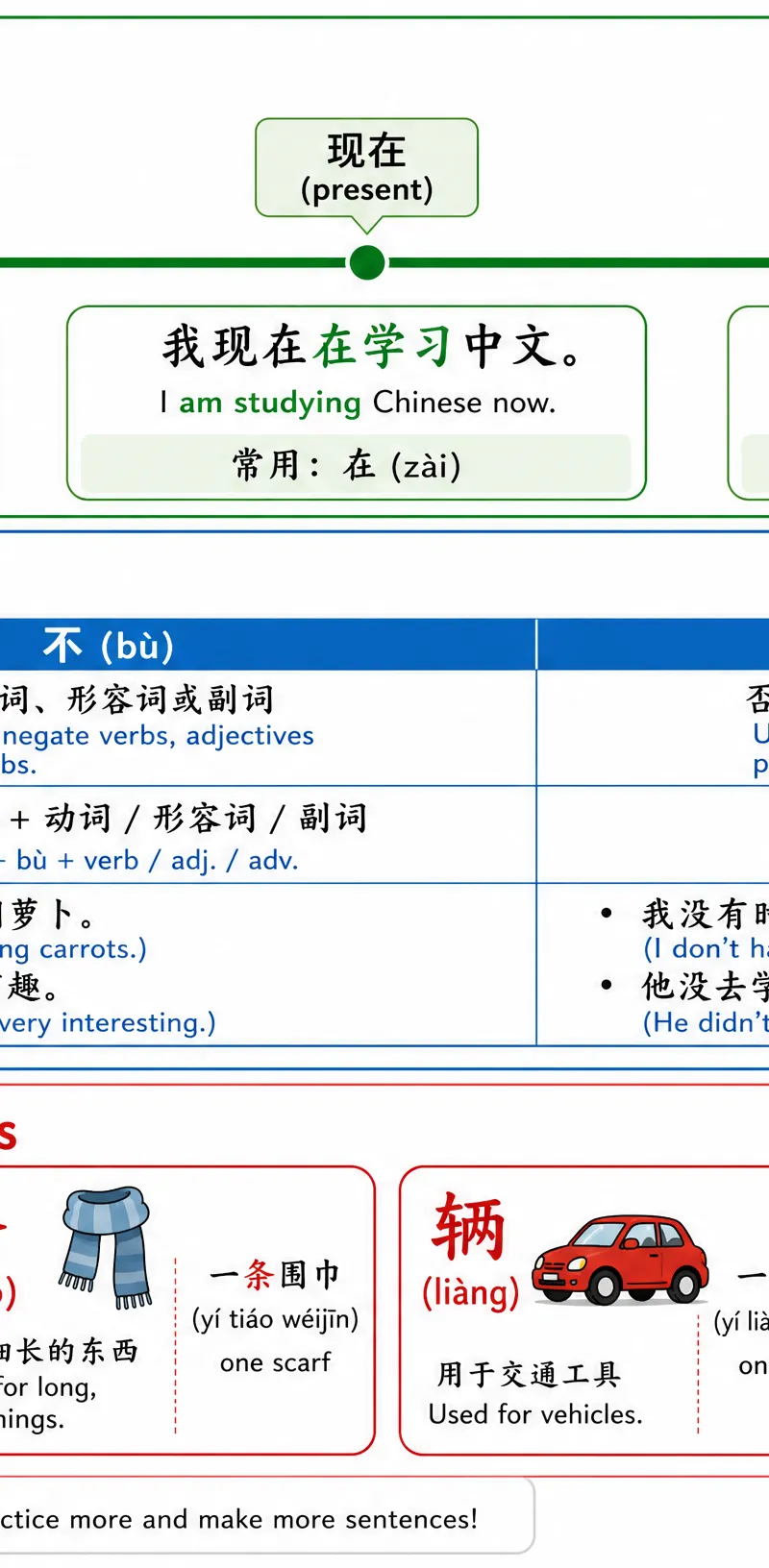
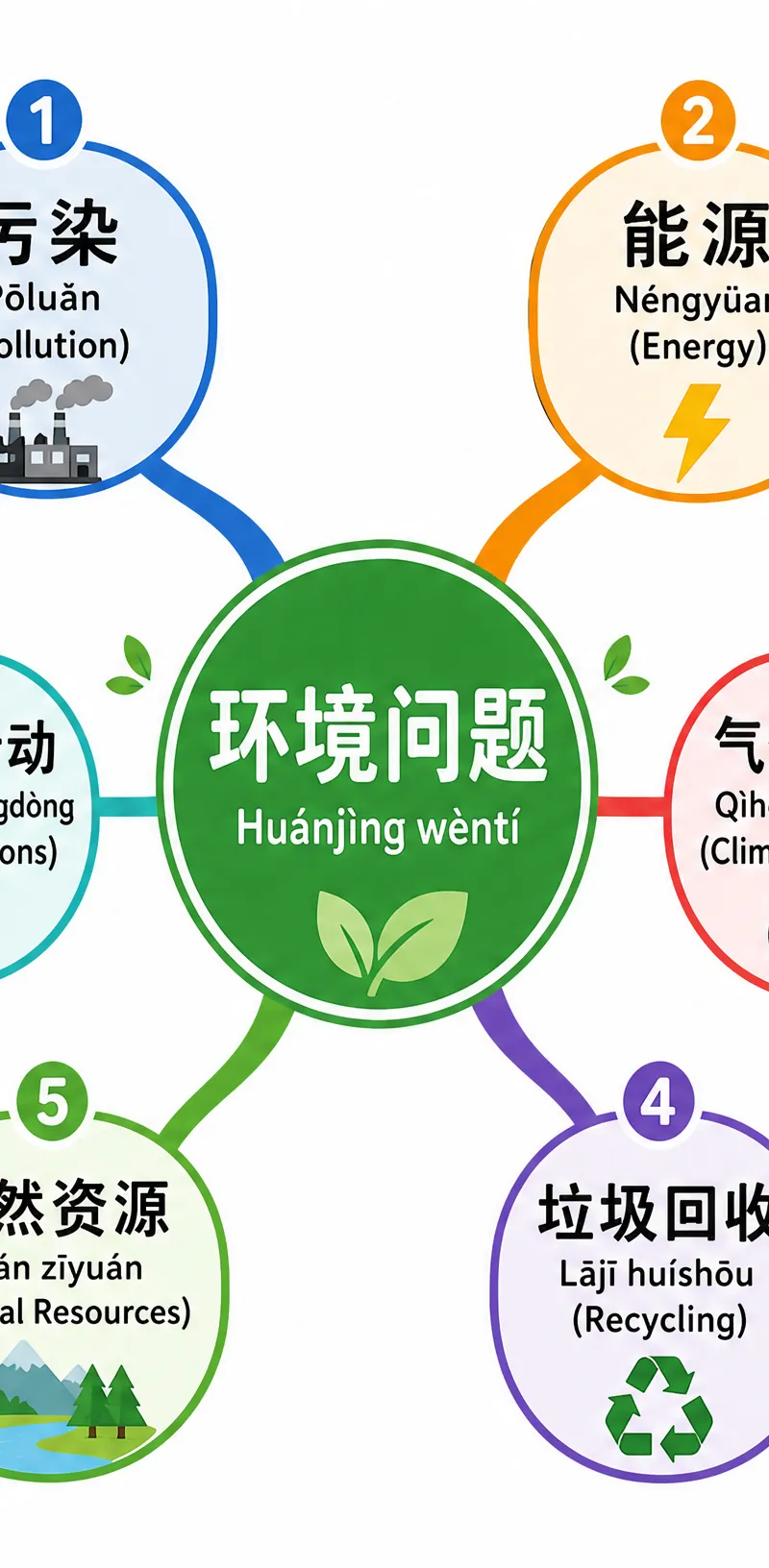
Interactive Diagrams
1 interactive diagram to visualise key concepts
Conceptual Flow Outline
MFL exam approach by skill
Worked Examples
4 worked examples — open one to explore the question and available guidance.
Practice Questions
Try the question, then reveal an answer plan or example response
Writing: Translate the following sentence into Chinese: 'In the future, we should use renewable energy to protect the environment.'
Hint: Remember to put the time word first, and use the 'in order to' (为了) structure if you want to be ambitious, or just sequence the actions logically.
Speaking (Photo Card): Look at a photo of a traffic jam with lots of exhaust fumes. Answer the question: 你觉得照片里的问题严重吗?为什么?(Do you think the problem in the photo is serious? Why?)
Hint: Start with your opinion, use 'because', and mention air pollution.
Reading: Read the text and answer the question in English. '为了减少塑料污染,我们超市不再提供免费的塑料袋。如果你需要袋子,必须买环保袋。' Question: What change has the supermarket made and why?
Hint: Look for the purpose (为了) and the specific action regarding bags.
Listening: Listen to the speaker. '我以前每天开车上班,但是现在我坐公共汽车,因为坐公共汽车更环保。' Question: How does the speaker travel to work now, and why?
Hint: Listen for the contrast between 以前 (past) and 现在 (now).
Writing (90 words): Write a blog post about recycling. Mention: what you recycle at home, why recycling is important, what you recycled last week, and what your school will do in the future.
Hint: Ensure you cover all 4 bullet points and use past, present, and future tenses.
Speaking (General Conversation): 你觉得我们应该怎么保护环境?(How do you think we should protect the environment?)
Hint: Give at least two different actions, and explain the benefit of one of them.
Exam technique
How to turn what you know into marks
How to approach the question
Skill-by-skill strategy: Listening — read questions first, note keywords. Speaking — prepare opinions in advance, have fillers ready. Reading — skim first, then detail. Writing — plan before writing, check accuracy after.
How to structure your answer
Writing: Introduction → Main points with opinions → Justified reasons → Different tenses → Conclusion. Speaking: Give opinion → Justify → Extend → Use different tense.
Timing
Listening: 25 mins (Foundation) / 35 mins (Higher). Speaking: 7-12 mins total (role play + photo card + conversation). Reading: 45 mins (Foundation) / 60 mins (Higher). Writing: 60 mins (Foundation) / 75 mins (Higher).
Common pitfalls
- Placing time words at the end of the sentence instead of the beginning.
- Using only the present tense — examiners want at least 3 tenses at Higher tier.
- Giving one-word Speaking answers instead of developing responses.
- Forgetting to use measure words (like 个, 棵, 辆) with nouns.
- Not justifying opinions with 因为 (because).
- Missing a bullet point in the Writing exam.
What the command words want
- Describe the photo
- Say what you can see, give an opinion, relate to your experience using a past/future tense.
- Translate into Chinese
- Write full sentences with correct grammar — partial marks for partially correct syntax.
- Translate into English
- Meaning over word-for-word — capture the sense, don't guess false friends.
- Write approximately 90 words
- Foundation task — cover all 4 bullet points, use present + one other tense.
- Write approximately 150 words
- Higher task — 3 tenses, opinions, complex structures, ambitious vocabulary.
Watch or listen (optional)
Test your understanding of Environmental issues
Active recall beats re-reading. Take an instant quiz now to test what you’ve learned and lock it into long-term memory.
7 days Premium · Then the free plan continues · No card, no charge