Pearson Edexcel · GCSE · Chinese
Course version: Pearson-GCSE-Chinese · Version from Mar 2026
Forming relationships
This topic covers the essential vocabulary for discussing friendships, family, and social interactions. Key grammar includes using time markers to express past, present, and future relationships, and opinion verbs to justify thoughts. Mastering this topic prepares candidates for all four exam skills, especially the role play and extended writing tasks.
- 13 min read
- 4 worked examples
- 6 practice questions
- 8 key terms
Check what you remember
Read the wording for your board, then hide it and explain Aspect Marker (了) in your own words. Rough notes are fine. This is a self-check, with no mark or grade.
Reference: Pearson Edexcel
A particle placed immediately after a verb to indicate that an action is completed. It is not exactly a past tense, but acts like one in most GCSE contexts.
Study Notes

Overview
This study guide covers the 'Forming Relationships' (建立关系) sub-topic within the broader theme of Identity and Culture. It is a high-yield topic that appears frequently across all four exam papers (Listening, Speaking, Reading, and Writing). Examiners use this topic to test your ability to narrate events in different timeframes, express and justify opinions about people, and use a range of adjectives to describe personality and physical appearance. Mastering this topic is essential for accessing the higher mark bands in both the Speaking and Writing exams.
📖 Essential Vocabulary

Tier 1 — Foundation Core
| Chinese | Pinyin | English | Example Sentence |
|---|---|---|---|
| 朋友 | péngyou | friend | 他是我的好朋友。 (He is my good friend.) |
| 认识 | rènshi | to know/meet | 很高兴认识你。 (Very pleased to meet you.) |
| 关系 | guānxi | relationship | 我们关系很好。 (We have a good relationship.) |
| 喜欢 | xǐhuan | to like | 我喜欢和朋友玩。 (I like playing with friends.) |
| 爱 | ài | to love | 我爱我的家人。 (I love my family.) |
| 一起 | yìqǐ | together | 我们一起去公园。 (We go to the park together.) |
| 帮助 | bāngzhù | to help | 朋友互相帮助。 (Friends help each other.) |
| 聊天 | liáotiān | to chat | 我们经常在网上聊天。 (We often chat online.) |
| 玩 | wán | to play | 周末我和朋友玩。 (I play with friends on weekends.) |
| 男朋友 | nánpéngyou | boyfriend | 她没有男朋友。 (She doesn't have a boyfriend.) |
| 女朋友 | nǚpéngyou | girlfriend | 他的女朋友很漂亮。 (His girlfriend is very pretty.) |
| 同学 | tóngxué | classmate | 他是我的老同学。 (He is my old classmate.) |
| 友好 | yǒuhǎo | friendly | 我的朋友很友好。 (My friend is very friendly.) |
| 开心 | gāoxìng | happy | 和他在一起我很开心。 (I am happy when I'm with him.) |
| 觉得 | juéde | to feel/think | 我觉得他很有趣。 (I think he is very interesting.) |
Tier 2 — Higher Tier
| Chinese | Pinyin | English | Example Sentence |
|---|---|---|---|
| 信任 | xìnrèn | to trust | 朋友之间需要信任。 (Friends need to trust each other.) |
| 尊重 | zūnzhòng | to respect | 我们应该互相尊重。 (We should respect each other.) |
| 理解 | lǐjiě | to understand | 我的朋友很理解我。 (My friend understands me well.) |
| 共同点 | gòngtóngdiǎn | common interests | 我们有很多共同点。 (We have a lot in common.) |
| 分享 | fēnxiǎng | to share | 我喜欢和朋友分享快乐。 (I like sharing happiness with friends.) |
| 交流 | jiāoliú | to communicate | 我们经常交流想法。 (We often communicate our thoughts.) |
| 支持 | zhīchí | to support | 在困难时,朋友会支持我。 (Friends support me in difficult times.) |
| 幽默 | yōumò | humorous | 他是一个很幽默的人。 (He is a very humorous person.) |
| 性格 | xìnggé | personality | 我们的性格不同,但是关系很好。 (Our personalities are different, but our relationship is good.) |
| 诚实 | chéngshí | honest | 诚实是友谊的基础。 (Honesty is the foundation of friendship.) |
High-Frequency Words & Phrases
| Phrase | Pinyin | English | Usage Context |
|---|---|---|---|
| 越来越... | yuè lái yuè... | more and more... | To show development (e.g., 越来越好 - better and better) |
| 对...很好 | duì... hěn hǎo | is good to... | To describe treatment (e.g., 他对我很好 - He is good to me) |
| 虽然...但是... | suīrán... dànshì... | although... but... | To contrast ideas (e.g., Although we argue, we are still friends) |
| 不但...而且... | bùdàn... érqiě... | not only... but also... | To add information (e.g., Not only friendly, but also funny) |
| 认为 | rènwéi | to think/believe | Formal opinion marker for Higher tier writing |
| 同意 | tóngyì | to agree | Useful for Speaking exam discussions |
| 比较 | bǐjiào | relatively/quite | To soften adjectives (e.g., 比较聪明 - quite smart) |
| 总是 | zǒngshì | always | To describe habits in relationships |
| 从来不 | cónglái bù | never | To describe negative habits (e.g., never argues) |
| 吵架 | chǎo jià | to argue | Useful for discussing relationship problems |
📝 Grammar Focus
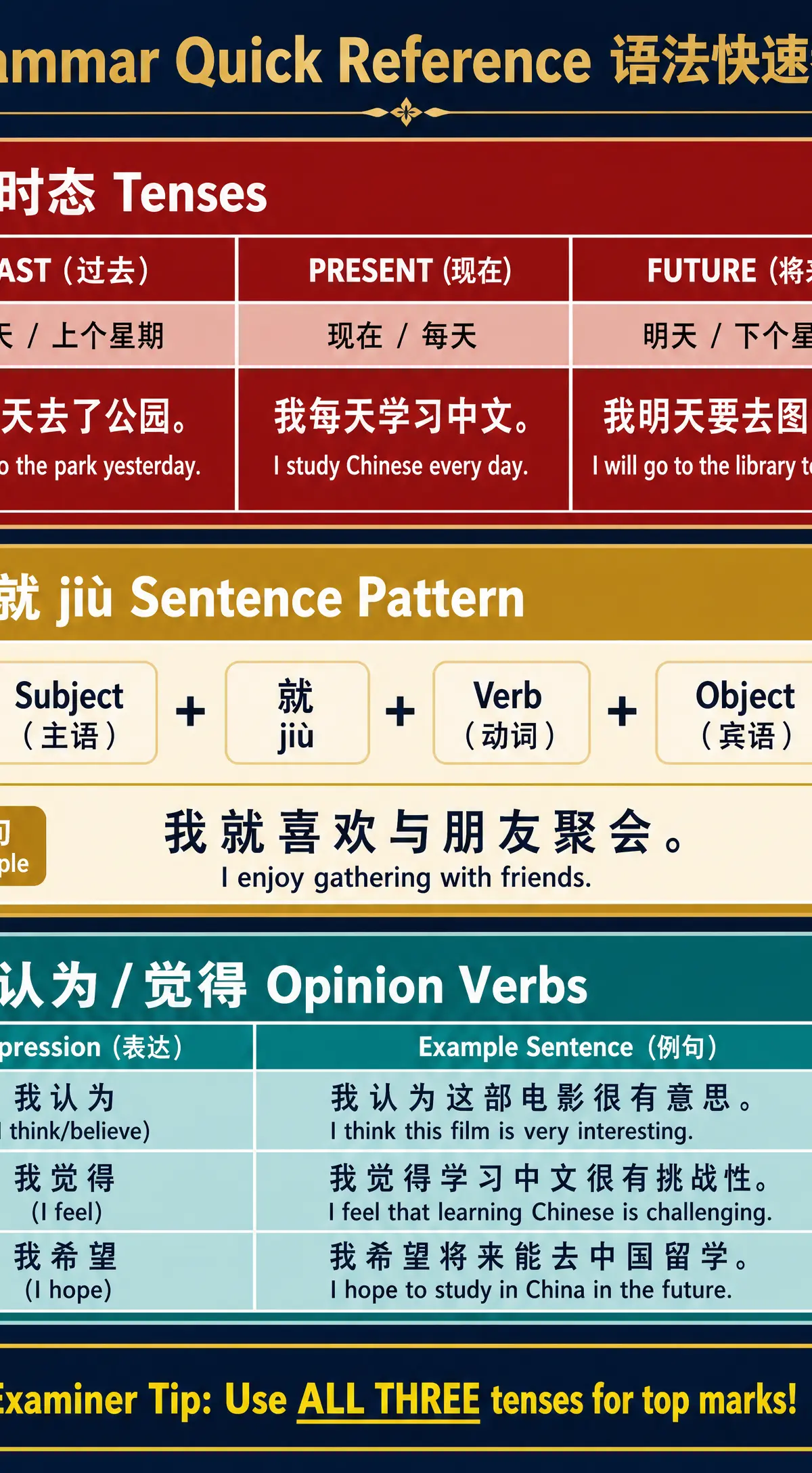
Key Structure 1: Time Words and Aspect Markers (了, 会, 要)
When to use it: Chinese verbs do not conjugate. To show past, present, or future, you MUST use time words (yesterday, tomorrow) and/or aspect markers. Examiners look for these to award marks for 'referring to past, present, and future events'.
Conjugation Table (Aspect/Time Markers)
| Subject | Time/Marker | Verb Phrase | English |
|---|---|---|---|
| 我 (I) | 昨天 (Yesterday) | 认识了一个新朋友。 | Yesterday I met a new friend. (PAST) |
| 他 (He) | 上个周末 (Last weekend) | 去了朋友家。 | Last weekend he went to a friend's house. (PAST) |
| 我们 (We) | 每天 (Every day) | 一起聊天。 | We chat together every day. (PRESENT) |
| 她 (She) | 现在 (Now) | 没有男朋友。 | She doesn't have a boyfriend now. (PRESENT) |
| 我 (I) | 明天 (Tomorrow) | 要去看朋友。 | Tomorrow I am going to see a friend. (FUTURE) |
| 我们 (We) | 将来 (In the future) | 会成为好朋友。 | In the future we will become good friends. (FUTURE) |
Irregulars to learn: There are no irregular verbs in Chinese! Just remember the position: Time words go BEFORE the verb, usually right after the subject. The past marker 了 (le) goes immediately AFTER the verb.
Key Structure 2: Expressing Opinions (觉得 vs 认为)
When to use it: You must express and justify opinions in both Speaking and Writing. 觉得 (juéde) is slightly less formal ('to feel'), while 认为 (rènwéi) is more formal ('to firmly believe').
Opinion Structure Table
| Subject | Opinion Verb | Clause (The Opinion) | Justification (因为... because...) |
|---|---|---|---|
| 我 | 觉得 (feel) | 他很幽默, | 因为他经常让我笑。 (because he often makes me laugh.) |
| 我 | 认为 (believe) | 友谊很重要, | 因为朋友可以互相帮助。 (because friends can help each other.) |
| 妈妈 | 觉得 (feels) | 我应该多交朋友, | 因为这对我好。 (because this is good for me.) |
| 我 | 希望 (hope) | 我们永远是朋友, | 因为我们有很多共同点。 (because we have a lot in common.) |
Key Structure 3: The '是...的' (shì...de) Construction
When to use it: Use this to emphasize the time, place, or manner of an action that happened in the past. It is an excellent complex structure for Higher tier candidates.
'是...的' Structure Table
| Subject | 是 (shì) | Emphasis (Time/Place/Manner) | Verb (+ Object) | 的 (de) | English |
|---|---|---|---|---|---|
| 我们 | 是 | 在学校 | 认识 | 的。 | It was at school that we met. |
| 我 | 是 | 去年 | 认识他 | 的。 | It was last year that I met him. |
| 他们 | 是 | 坐火车 | 去朋友家 | 的。 | It was by train that they went to their friend's house. |
🎧 Listening Skills
What to Expect
In the listening exam, you will hear conversations between young people discussing their friends, family members, or relationships. Topics often include how they met, what they like to do together, or arguments they have had. Foundation tier will focus on basic descriptions (friendly, tall), while Higher tier will involve complex opinions and relationship dynamics (trust, shared interests).
Listening Strategies
- Listen for time markers: Pay close attention to words like 以前 (in the past), 现在 (now), and 将来 (in the future). The question might ask "What did they do?" while the audio mentions what they will do to trick you.
- Note the negatives: Listen carefully for 不 (bù - not) and 没 (méi - didn't/haven't). "He is not friendly" sounds very similar to "He is friendly" if you miss the 'bù'.
- Listen for opinion markers: When you hear 觉得 (juéde) or 认为 (rènwéi), the speaker is about to give the answer to an opinion-based question.
Common Listening Traps
- Distractor opinions: Speaker A might say "I think he is funny", but Speaker B says "I disagree, I think he is annoying." Ensure you answer based on the specific person asked about in the question.
- False Friends/Similar Sounds: 朋友 (péngyou - friend) sounds slightly like 胖 (pàng - fat). Ensure you distinguish tones.
🗣️ Speaking Skills
Role Play Scenarios
Scenario 1: Talking to an exchange student about friends
- Student (You): 你好!你在中国有朋友吗? (Hello! Do you have friends in China?)
- Exchange Student: 有,我有很多朋友。你的好朋友是谁? (Yes, I have many friends. Who is your good friend?)
- Student (You): 我的好朋友叫大卫。他很高,也很幽默。 (My good friend is called David. He is tall and also humorous.)
Scenario 2: Discussing weekend plans with a friend
- Friend: 这个周末你想一起去打球吗? (Do you want to go play ball together this weekend?)
- Student (You): 对不起,我周末要和家人去买东西。下个周末可以吗? (Sorry, I am going shopping with my family this weekend. Is next weekend okay?)
Photo Card Practice
Model Photo Card Response (A photo showing two teenagers laughing together):
- Qu 1 (Description - What is in the photo?): 在这张照片里,我看到两个年轻人。他们看起来很开心,因为他们在笑。我觉得他们是好朋友。 (In this photo, I see two young people. They look very happy because they are laughing. I think they are good friends.)
- Qu 2 (Opinion - Is friendship important?): 我认为友谊非常重要,因为朋友可以分享快乐,也可以互相帮助。 (I believe friendship is very important because friends can share happiness and also help each other.)
- Qu 3 (Related topic - What do you do with friends?): 周末的时候,我经常和朋友一起去电影院看电影,或者去公园踢足球。 (On weekends, I often go to the cinema to watch movies with friends, or go to the park to play football.)
- Qu 4 (Past - What did you do with friends recently?): 上个星期六,我和我的好朋友一起去了市中心买衣服,然后我们吃了中国菜。 (Last Saturday, my good friend and I went to the city centre to buy clothes, and then we ate Chinese food.)
- Qu 5 (Future - Will you stay friends in the future?): 我希望我们将来还是好朋友,因为我们有很多共同点,而且我们互相信任。 (I hope we will still be good friends in the future because we have a lot in common, and we trust each other.)
General Conversation Questions
| Question (Chinese) | Model Answer | English Translation |
|---|---|---|
| 你的好朋友是谁?他/她长什么样? | 我的好朋友叫玛丽。她很高,有长头发和大眼睛。她很漂亮。 | Who is your good friend? What does he/she look like? -> My good friend is called Mary. She is tall, has long hair and big eyes. She is very pretty. |
| 你觉得好朋友应该是什么样的? | 我觉得好朋友应该诚实、友好,而且有幽默感。最重要的是互相信任。 | What do you think a good friend should be like? -> I think a good friend should be honest, friendly, and have a sense of humour. The most important thing is mutual trust. |
| 你和你的朋友有共同点吗? | 有,我们有很多共同点。我们都喜欢踢足球和听音乐。 | Do you and your friend have things in common? -> Yes, we have a lot in common. We both like playing football and listening to music. |
| 上个周末你和朋友做了什么? | 上个周末,我和朋友去了市中心。我们先看了电影,然后去了一家中国饭馆吃饭。很好玩! | What did you do with your friend last weekend? -> Last weekend, my friend and I went to the city centre. We first watched a movie, then went to a Chinese restaurant to eat. It was very fun! |
| 将来你想和朋友一起去旅游吗?为什么? | 将来我想和朋友一起去中国旅游。因为我们都在学习中文,而且我觉得一起旅游很有意思。 | In the future, do you want to travel with friends? Why? -> In the future, I want to travel to China with friends. Because we are both studying Chinese, and I think travelling together is very interesting. |
✍️ Writing Skills
Translation Practice
English → Chinese:
| English | Chinese | Key Grammar |
|---|---|---|
| He is my best friend. | 他是我的好朋友。 | Basic sentence structure (Subject + 是 + Noun) |
| We have a lot in common. | 我们有很多共同点。 | Tier 2 vocabulary (共同点) |
| Yesterday, I went to the park with my friend. | 昨天我和朋友去了公园。 | Past tense (了) and 'with' structure (和...一起) |
| I think friendship is very important. | 我认为友谊非常重要。 | Opinion marker (认为) + degree word (非常) |
| Although we sometimes argue, we are still good friends. | 虽然我们有时候吵架,但是我们还是好朋友。 | Complex connective (虽然...但是...) |
Extended Writing
Model 90-word response (Foundation):
我的好朋友叫大卫。他今年十五岁。他很高,头发很短。他很友好,也很幽默。我们经常一起去公园踢足球。上个周末,我和大卫去了电影院看电影。电影很好看,我们都很开心。我觉得朋友很重要,因为朋友可以帮助我。明天我们要一起做作业。我希望我们永远是好朋友。
(My good friend is called David. He is 15 years old this year. He is tall and his hair is short. He is friendly and also humorous. We often go to the park together to play football. Last weekend, David and I went to the cinema to watch a movie. The movie was very good, we were both very happy. I think friends are very important because friends can help me. Tomorrow we are going to do homework together. I hope we will always be good friends.)
Model 150-word response (Higher):
我认为在年轻人的生活中,友谊是非常重要的一部分。我的好朋友叫安娜,我们是在学校认识的。她不但长得很漂亮,而且性格很好。她非常诚实,也很有幽默感。
我们有很多共同点,比如我们都对音乐和运动感兴趣。虽然我们有时候会因为小事吵架,但是我们很快就会和好,因为我们互相信任,互相尊重。
上个星期六是安娜的生日,我给她买了一本书作为生日礼物。我们和几个同学一起去了一家中餐馆庆祝。我们吃了很多好吃的中国菜,还聊了很长时间的天。大家都觉得那天晚上非常有意思。
下个月放假的时候,我们打算一起去海边玩。我希望将来我们能去同一所大学学习。我相信,无论发生什么,我们永远都会是最好的朋友。
(I believe that in young people's lives, friendship is a very important part. My good friend is called Anna, it was at school that we met. She is not only very pretty, but also has a good personality. She is very honest and also has a great sense of humour. We have a lot in common, for example we are both interested in music and sports. Although we sometimes argue over small things, we quickly make up, because we trust and respect each other. Last Saturday was Anna's birthday, I bought her a book as a birthday present. We went to a Chinese restaurant with several classmates to celebrate. We ate a lot of delicious Chinese food and chatted for a long time. Everyone felt that evening was very interesting. Next month during the holidays, we plan to go to the seaside together. I hope in the future we can go to the same university to study. I believe, no matter what happens, we will always be best friends.)
Writing Checklist
- ✅ Three tenses used accurately (Past with 了, Present, Future with 要/会/打算)
- ✅ Opinions expressed and justified (认为...因为...)
- ✅ Complex connectives included (虽然...但是, 不但...而且)
- ✅ Time words placed correctly (before the verb)
- ✅ Tier 2 vocabulary used (信任, 共同点, 幽默)
📚 Reading Skills
Key Strategies
- Skim for gist: Read the whole text quickly to understand the overall tone. Is it a positive or negative relationship being described?
- Identify characters: Circle the names of people. Often, questions will try to confuse you about who did what.
- Look for time frames: Highlight words like 昨天 (yesterday) or 将来 (future) as these dictate the tense of your English answers.
False Friends & Tricky Words
| Word | Looks Like | Actually Means |
|---|---|---|
| 爱人 (àirén) | A lover | Usually means spouse (husband/wife) in mainland China |
| 关心 (guānzīn) | To close a heart | To care for / be concerned about (Not the same as 关系 - relationship) |
| 便宜 (piányi) | Convenient | Cheap (Often confused with 方便 fāngbiàn - convenient) |
🌍 Cultural Knowledge
In Chinese culture, relationships (关系 - guānxi) hold deep social significance. The concept of 'guānxi' extends beyond simple friendship; it implies a network of mutual obligations, trust, and favors. While teenagers form friendships similarly to those in the UK, there is often a strong emphasis on academic support among classmates (同学 - tóngxué). Respect (尊重 - zūnzhòng) for elders and teachers is paramount, reflecting traditional Confucian values. When writing or speaking about relationships in China, mentioning studying together or showing respect to parents demonstrates excellent cultural awareness to the examiner.
🎧 Revision Podcast
Listen to this 10-minute audio guide covering the core vocabulary, grammar, and exam tips for this topic.
Visual Resources
2 diagrams and illustrations

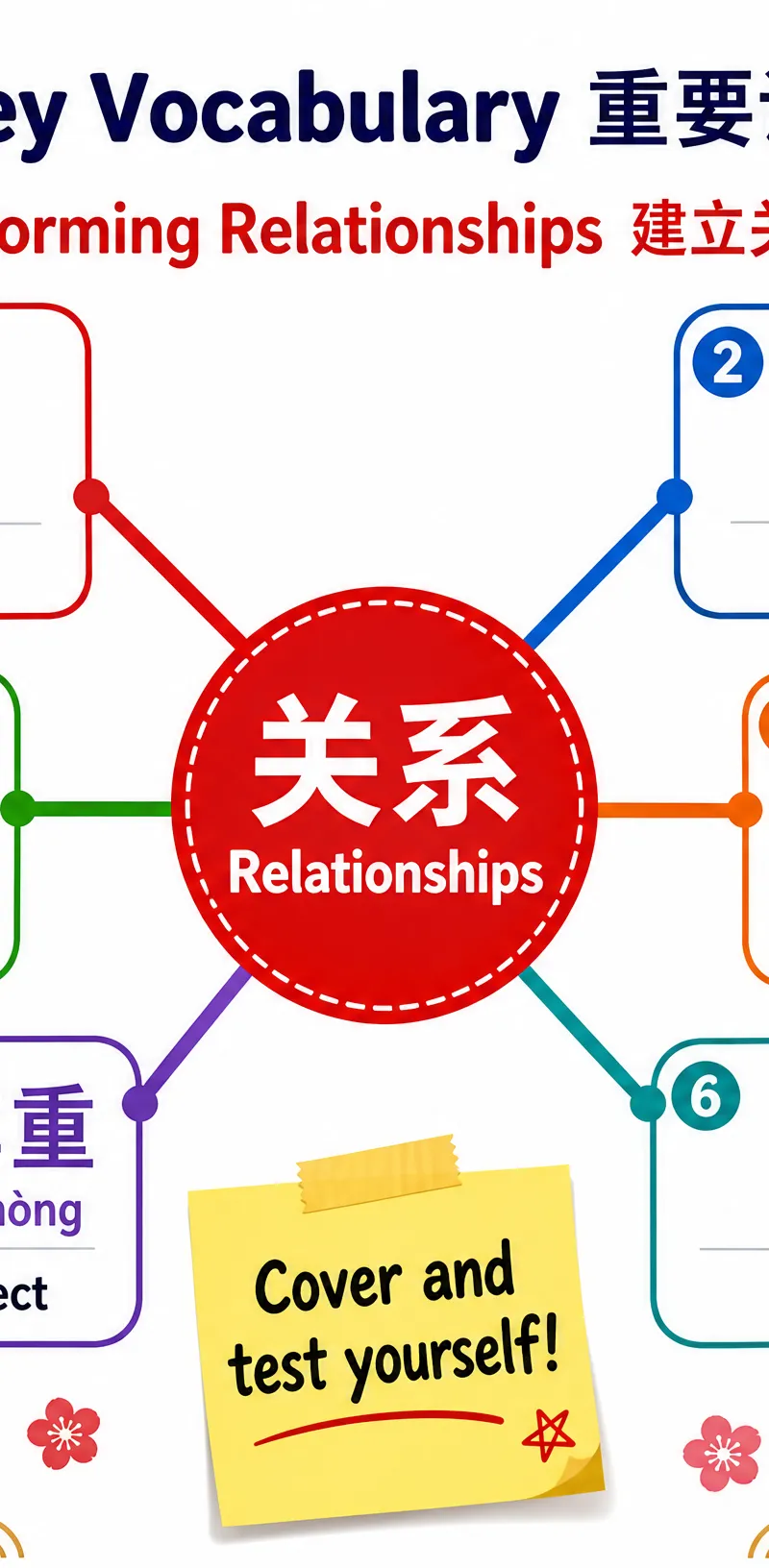
Interactive Diagrams
1 interactive diagram to visualise key concepts
Conceptual Flow Outline
MFL exam approach by skill for Chinese
Worked Examples
4 worked examples — open one to explore the question and available guidance.
Practice Questions
Try the question, then reveal an answer plan or example response
Writing: Translate the following sentence into Chinese: 'Although he is my friend, we sometimes argue.'
Hint: Remember that in Chinese, 'although' must be paired with 'but' in the second clause.
Speaking: Answer the conversation question in Chinese: '你觉得友谊重要吗?为什么?' (Do you think friendship is important? Why?)
Hint: State your opinion clearly using 认为 or 觉得, then use 因为 to give a detailed reason.
Writing (Foundation): Write approximately 90 words about your friend. Include: their name and age, what they look like, what you like doing together, and your plans for next weekend.
Hint: Ensure you cover all 4 bullet points. Use the present tense for descriptions and a future time marker (下个周末要...) for the plans.
Reading (Higher): Read the passage: '我叫李华。我有一个好朋友叫大卫。虽然我们的性格完全不同——他很外向,而我比较安静——但是我们互相信任。去年夏天我们一起去了北京旅游。' Question: How are Li Hua and David different, and what binds them together?
Hint: Look for the contrast structure 虽然...但是 to find the difference and the connection.
Listening (Foundation): Listen to the sentence and translate to English: '她不仅漂亮,而且很聪明。'
Hint: Listen for the 不仅...而且 (not only... but also) structure.
Writing (Higher): Translate into Chinese: 'It was at the library that I met my best friend last year.'
Hint: Use the 是...的 construction to emphasize the place and time of a past event.
Exam technique
How to turn what you know into marks
How to approach the question
Skill-by-skill strategy: Listening — read questions first, note keywords. Speaking — prepare opinions in advance, have fillers ready. Reading — skim first, then detail. Writing — plan before writing, check accuracy after.
How to structure your answer
Writing: Introduction → Main points with opinions → Justified reasons → Different tenses → Conclusion. Speaking: Give opinion → Justify → Extend → Use different tense.
Timing
Listening: 25 mins (heard twice). Speaking: 7-12 mins total (role play + photo card + conversation). Reading: 45-60 mins. Writing: 60-75 mins (translation + structured + extended).
Common pitfalls
- Translating word-for-word from English, putting 'with my friend' at the end of the sentence instead of before the verb.
- Using only the present tense — examiners want at least 3 tenses at Higher.
- Giving one-word Speaking answers instead of developing responses.
- Forgetting the aspect marker 了 for past events.
- Confusing the tones for 朋友 (péngyou) and making it sound incomprehensible.
- Not justifying opinions with 因为 (because).
What the command words want
- Describe the photo
- Say what you can see (在照片里我看到...), give an opinion (我觉得...), relate to your experience.
- Translate into Chinese
- Write full sentences with correct grammar — partial marks for partially correct characters.
- Translate into English
- Meaning over word-for-word — capture the sense, don't guess cognates.
- Write approximately 90 words
- Foundation task — cover all 4 bullet points, use present + one other tense.
- Write approximately 150 words
- Higher task — 3 tenses, opinions, complex structures (虽然...但是), ambitious vocabulary.
Watch or listen (optional)
Test your understanding of Forming relationships
Active recall beats re-reading. Take an instant quiz now to test what you’ve learned and lock it into long-term memory.
7 days Premium · Then the free plan continues · No card, no charge