Pearson Edexcel · GCSE · Chinese
Course version: Pearson-GCSE-Chinese · Version from Mar 2026
Further study
This topic covers essential vocabulary for university, careers, and volunteering, requiring students to express future plans and justify opinions. It tests the ability to navigate past, present, and future tenses confidently across Listening, Speaking, Reading, and Writing skills.
- 10 min read
- 4 worked examples
- 6 practice questions
- 8 key terms
Check what you remember
Read the wording for your board, then hide it and explain Time Phrase in your own words. Rough notes are fine. This is a self-check, with no mark or grade.
Reference: Pearson Edexcel
Words indicating when an action happens (e.g., 昨天 yesterday, 将来 in the future). Must be placed before the verb.
Study Notes
Overview

This study guide covers the crucial topic of Further Study, Future Ambitions, and Work. This theme is a cornerstone of the GCSE Chinese specification and appears frequently across all four exam papers (Listening, Speaking, Reading, and Writing). Examiners use this topic to test your ability to narrate events across different timeframes, justify your opinions, and use more complex grammatical structures. Mastering this topic is essential for accessing the higher mark bands.
🎧 Listen to the Podcast
📖 Essential Vocabulary
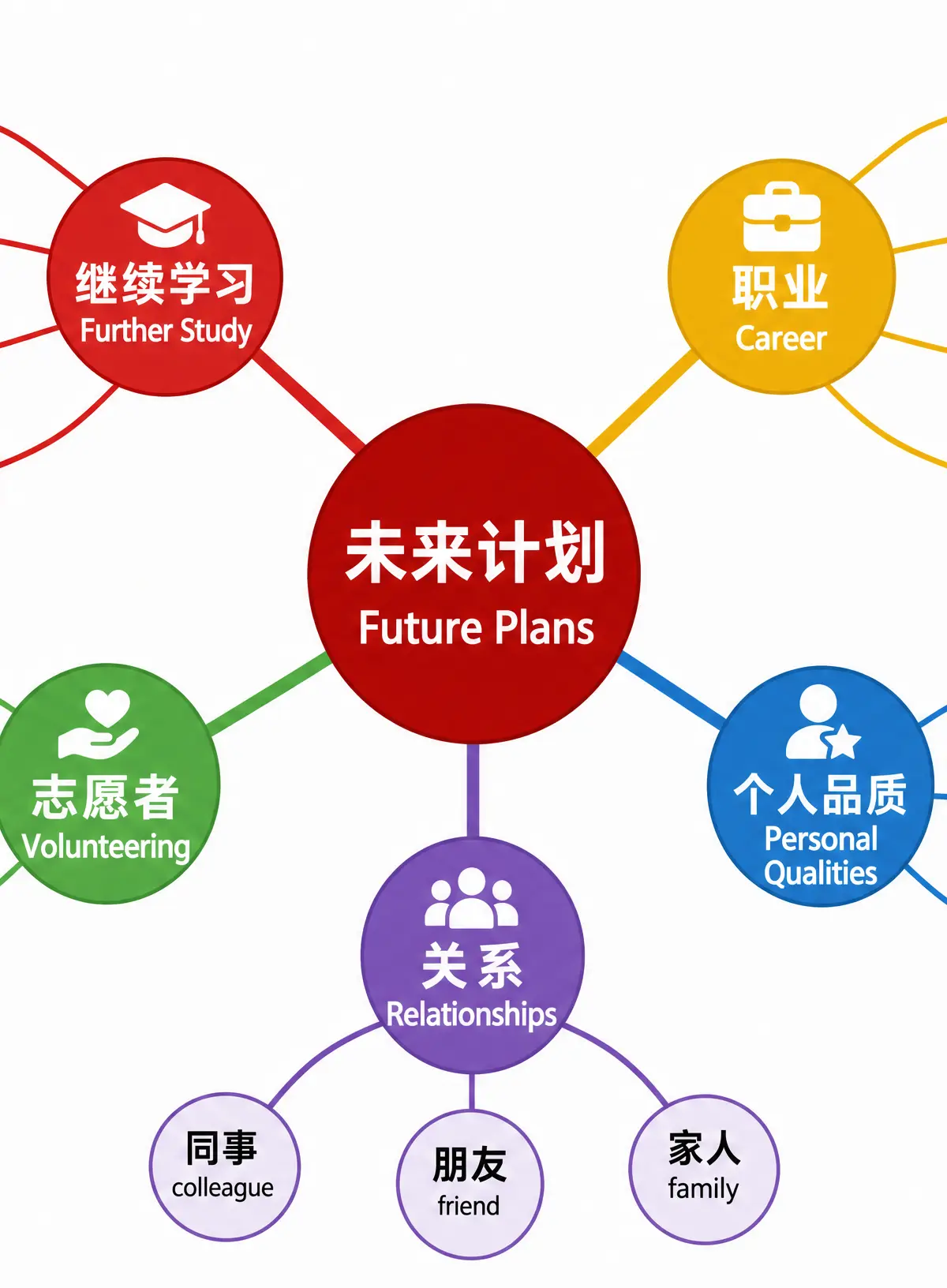
Tier 1 — Foundation Core
| Chinese | Pinyin | English | Example Sentence |
|---|---|---|---|
| 大学 | dàxué | university | 我想上大学。 (I want to go to university.) |
| 工作 | gōngzuò | work/job | 他在医院工作。 (He works at a hospital.) |
| 学习 | xuéxí | to study | 我每天学习中文。 (I study Chinese every day.) |
| 考试 | kǎoshì | exam | 明天我有数学考试。 (I have a maths exam tomorrow.) |
| 老师 | lǎoshī | teacher | 我的老师很好。 (My teacher is very good.) |
| 学生 | xuéshēng | student | 我是一个中学生。 (I am a secondary school student.) |
| 医生 | yīshēng | doctor | 我妈妈是医生。 (My mum is a doctor.) |
| 钱 | qián | money | 这个工作有很多钱。 (This job has a lot of money.) |
| 帮 | bāng | to help | 我喜欢帮人。 (I like to help people.) |
| 以后 | yǐhòu | later/after | 以后我想去中国。 (Later I want to go to China.) |
| 有意思 | yǒu yìsi | interesting | 科学很有意思。 (Science is very interesting.) |
| 难 | nán | difficult | 考试很难。 (The exam is difficult.) |
| 容易 | róngyì | easy | 英文很容易。 (English is easy.) |
| 喜欢 | xǐhuān | to like | 我喜欢我的工作。 (I like my job.) |
| 打算 | dǎsuàn | to plan | 我打算找工作。 (I plan to find a job.) |
Tier 2 — Higher Tier
| Chinese | Pinyin | English | Example Sentence |
|---|---|---|---|
| 职业 | zhíyè | career/profession | 你未来的职业是什么? (What is your future career?) |
| 志愿者 | zhìyuànzhě | volunteer | 我周末做志愿者。 (I am a volunteer on weekends.) |
| 奖学金 | jiǎngxuéjīn | scholarship | 他得到了大学的奖学金。 (He got a university scholarship.) |
| 实习 | shíxí | internship/work experience | 暑假我会在公司实习。 (I will do an internship at a company in the summer holidays.) |
| 申请 | shēnqǐng | to apply | 我正在申请一份新工作。 (I am applying for a new job.) |
| 面试 | miànshì | interview | 明天我有一个重要的面试。 (Tomorrow I have an important interview.) |
| 责任心 | zérènxīn | sense of responsibility | 医生需要有很强的责任心。 (Doctors need to have a strong sense of responsibility.) |
| 挑战 | tiǎozhàn | challenge | 我喜欢有挑战性的工作。 (I like challenging jobs.) |
| 经验 | jīngyàn | experience | 这个工作需要很多经验。 (This job requires a lot of experience.) |
| 独立 | dúlì | independent | 上大学让我更独立。 (Going to university makes me more independent.) |
High-Frequency Words & Phrases
| Phrase | Pinyin | English | Usage Context |
|---|---|---|---|
| 将来我想当... | jiānglái wǒ xiǎng dāng... | In the future I want to be... | Used to state future career goals |
| 我对...感兴趣 | wǒ duì... gǎn xìngqù | I am interested in... | Used to explain why you want to study a subject |
| 在我看来 | zài wǒ kànlái | In my opinion | Used to introduce a formal opinion |
| 另一方面 | lìng yī fāngmiàn | On the other hand | Used to show balanced arguments (AO3) |
| 不但...而且... | bùdàn... érqiě... | Not only... but also... | Used to connect two positive or negative points |
| 虽然...但是... | suīrán... dànshì... | Although... but... | Used to show contrast (complex structure) |
| 为了... | wèile... | In order to... | Used to state purpose or motivation |
| 毕业以后 | bìyè yǐhòu | After graduating | Used as a time marker for future plans |
| 赚很多钱 | zhuàn hěn duō qián | Earn a lot of money | Common justification for job choices |
| 帮助别人 | bāngzhù biérén | Help others | Common justification for caring professions |
📝 Grammar Focus

Key Structure 1: Expressing Future Intentions (想 / 打算 / 会)
When to use it: You must use these modal verbs to express future plans, desires, and certainties. This is essential for accessing the higher mark bands which require you to reference future events.
Usage Table
| Modal Verb | Meaning | Certainty | Example | English |
|---|---|---|---|---|
| 想 (xiǎng) | want to | Desire | 我想上大学。 | I want to go to university. |
| 打算 (dǎsuàn) | plan to | Intention | 我打算学医。 | I plan to study medicine. |
| 会 (huì) | will | Certainty | 我会在伦敦工作。 | I will work in London. |
| 决定 (juédìng) | decide to | Firm plan | 我决定去中国。 | I have decided to go to China. |
Common mistake: Do not use '是' (to be) with these verbs. '我想是医生' is WRONG. Use '当' or '做' to mean 'to become/act as': 我想当医生。
Key Structure 2: Justifying Opinions (因为 / 所以)
When to use it: Giving opinions is not enough; you must justify them. Examiners look for the use of conjunctions to link ideas.
Usage Table
| Structure | Meaning | Example | English |
|---|---|---|---|
| 因为... | Because... | 我想当老师,因为我喜欢小孩。 | I want to be a teacher because I like children. |
| 因为...所以... | Because... therefore... | 因为我想赚钱,所以我努力工作。 | Because I want to earn money, therefore I work hard. |
| ...,而且... | ..., furthermore... | 这个工作很有趣,而且工资很高。 | This job is interesting, and the salary is high. |
Key Structure 3: Expressing Past Experience (了 / 过)
When to use it: To fulfil the requirement of using three timeframes, you must accurately refer to past events, such as work experience or previous studies.
Usage Table
| Particle | Function | Example | English |
|---|---|---|---|
| 了 (le) | Completed action | 去年我去了法国。 | Last year I went to France. |
| 过 (guo) | Past experience | 我做过兼职工作。 | I have done part-time work (in the past). |
| 以前 (yǐqián) | Previously/Before | 以前我不喜欢数学。 | Previously I didn't like maths. |
🎧 Listening Skills
What to Expect
Listening tasks on this topic often feature interviews with young people discussing their university choices, part-time jobs, or work experience. You may hear adults talking about their career paths or giving advice to students.
Listening Strategies
- Listen for Time Markers: Pay close attention to words like 以前 (before), 现在 (now), and 将来 (future). A common trap is asking what someone used to do vs what they want to do.
- Listen for Negatives: Watch out for 不 (not) and 没 (didn't). '我不打算上大学' completely changes the meaning.
- Identify Opinions: Listen for 觉得 and 认为, followed by adjectives like 累 (tiring) or 有意思 (interesting).
Common Listening Traps
- False Friends: 学院 (xuéyuàn) sounds like 'school' but means 'college/institute'. 中学 (zhōngxué) means 'secondary school', not 'middle school' in the American sense.
- Multiple Speakers: In longer extracts, Speaker A might want to be a doctor, while Speaker B wants to be a teacher. Don't mix up who said what.
🗣️ Speaking Skills
Role Play Scenarios
Scenario: You are talking to a Chinese friend about your work experience.
- Friend: 你做过兼职工作吗? (Have you done part-time work?)
- You: 做过。去年夏天我在一家商店做售货员。 (Yes. Last summer I worked as a shop assistant in a shop.)
- Friend: 你觉得这个工作怎么样? (What did you think of this job?)
- You: 我觉得很有意思,因为可以认识很多人,但是也很累。 (I thought it was interesting because I could meet many people, but also very tiring.)
Photo Card Practice
Model Photo Card Response: (A photo showing students studying in a library)
- Qu 1 (Description): 照片里有三个学生,他们在图书馆学习。桌子上有很多书和电脑。 (In the photo there are three students, they are studying in the library. There are many books and computers on the table.)
- Qu 2 (Opinion): 我觉得他们很努力,因为考试快到了。 (I think they are very hardworking because exams are coming soon.)
- Qu 3 (Related topic): 在我看来,去图书馆学习很好,因为那里很安静。 (In my opinion, studying in the library is good because it is very quiet there.)
- Qu 4 (Past/Future): 明年我打算上大学,所以我现在必须努力学习。 (Next year I plan to go to university, so I must study hard now.)
- Qu 5 (Unpredictable): 如果我有空,我也会做志愿者帮助别人。 (If I have free time, I will also volunteer to help others.)
General Conversation Questions
| Question (Chinese) | Model Answer | English Translation |
|---|---|---|
| 你将来想做什么工作?为什么? | 将来我想当一名医生,因为我对科学很感兴趣,而且我想帮助生病的人。 | In the future I want to be a doctor, because I am interested in science, and I want to help sick people. |
| 你打算上大学吗? | 是的,我打算去伦敦上大学学习历史,因为我觉得历史很有意思。 | Yes, I plan to go to university in London to study history, because I think history is interesting. |
| 你做过兼职工作吗? | 做过,去年我在一家饭馆做服务员。虽然很累,但是我赚了一些钱。 | Yes, last year I worked as a waiter in a restaurant. Although it was tiring, I earned some money. |
| 你的父母做什么工作? | 我爸爸是工程师,我妈妈是老师。他们工作都很忙。 | My dad is an engineer, my mum is a teacher. They are both very busy with work. |
| 你觉得做志愿者重要吗? | 我觉得非常重要,因为我们可以帮助社区,也可以学到新技能。 | I think it's very important, because we can help the community and also learn new skills. |
✍️ Writing Skills
Translation Practice
English → Chinese:
| English | Chinese | Key Grammar |
|---|---|---|
| I want to go to university. | 我想上大学。 | Modal verb 想 |
| He works in a hospital. | 他在医院工作。 | Location phrase (在 + place + verb) |
| Last year I did work experience. | 去年我做了实习。 | Past tense marker 了 |
| I think maths is very difficult. | 我觉得数学很难。 | Opinion phrase (觉得) |
| In the future I plan to be a teacher because I like children. | 将来我打算当老师,因为我喜欢小孩。 | Future time word, intention (打算), justification (因为) |
Extended Writing
Model 90-word response (Foundation):
我叫大卫。现在我是一个中学生。我每天学习英文和数学。我觉得数学很难,但是很有用。去年夏天,我在一家商店做兼职工作。我做售货员。虽然工作很累,但是我赚了钱。将来,我打算上大学。我想学习电脑,因为我对电脑很感兴趣。大学毕业以后,我想当工程师。
Model 150-word response (Higher):
我叫大卫,今年十六岁。目前我在中学读书。为了准备明年的考试,我每天都非常努力地学习。我对科学最感兴趣,因为我觉得科学不但有意思,而且对我们的未来很重要。
去年暑假,我在一家当地的医院做了一个月的实习。虽然每天工作很长,有时也觉得很累,但是这段经历让我学到了很多书本上学不到的知识。我也认识了很多友好的医生和护士。
关于未来,我打算先去伦敦上大学,学习医学。毕业以后,我希望成为一名优秀的医生。在我看来,当医生是一份非常有意义的职业,因为我可以帮助生病的人,给社会带来积极的影响。如果可能的话,我还想去其他国家做医疗志愿者。
Writing Checklist
- ✅ Used three tenses (Past: 去年...做了一个月的实习; Present: 目前我在中学读书; Future: 将来我打算...)
- ✅ Opinions with reasons (觉得科学不但有意思,而且...)
- ✅ Complex structures (为了...; 虽然...但是...; 不但...而且...)
- ✅ Accurate character writing and word order (Time phrases placed correctly before verbs)
📚 Reading Skills
Key Strategies
- Skim for Context: Read the title and the first sentence of each paragraph to grasp the overall theme (e.g., is this about university or a part-time job?).
- Highlight Time Words: Underline words like 去年 (last year) and 将来 (future) so you don't confuse past experiences with future plans.
- Look for Connectives: Words like 但是 (but) and 可是 (however) signal a change in opinion or a contrasting point.
False Friends & Tricky Words
| Word | Looks Like | Actually Means |
|---|---|---|
| 学院 (xuéyuàn) | School | College / Institute |
| 爱人 (àirén) | Lover | Spouse (husband/wife) |
| 放心 (fàngxīn) | Put heart | To be at ease / rest assured |
| 经理 (jīnglǐ) | Manage | Manager |
🌍 Cultural Knowledge
In China, the university entrance examination, known as the Gaokao (高考), is a monumental event in a student's life. It is highly competitive and often determines a student's future career prospects. Understanding this pressure adds context when discussing exams and study habits.
Additionally, respect for teachers (尊师重道) is deeply ingrained in Chinese culture, influenced by Confucianism. Professions like teaching and medicine are highly respected. When writing or speaking about careers, mentioning the desire to contribute to society (贡献社会) or help others aligns well with Chinese cultural values and demonstrates a sophisticated understanding of the target culture.
Visual Resources
2 diagrams and illustrations
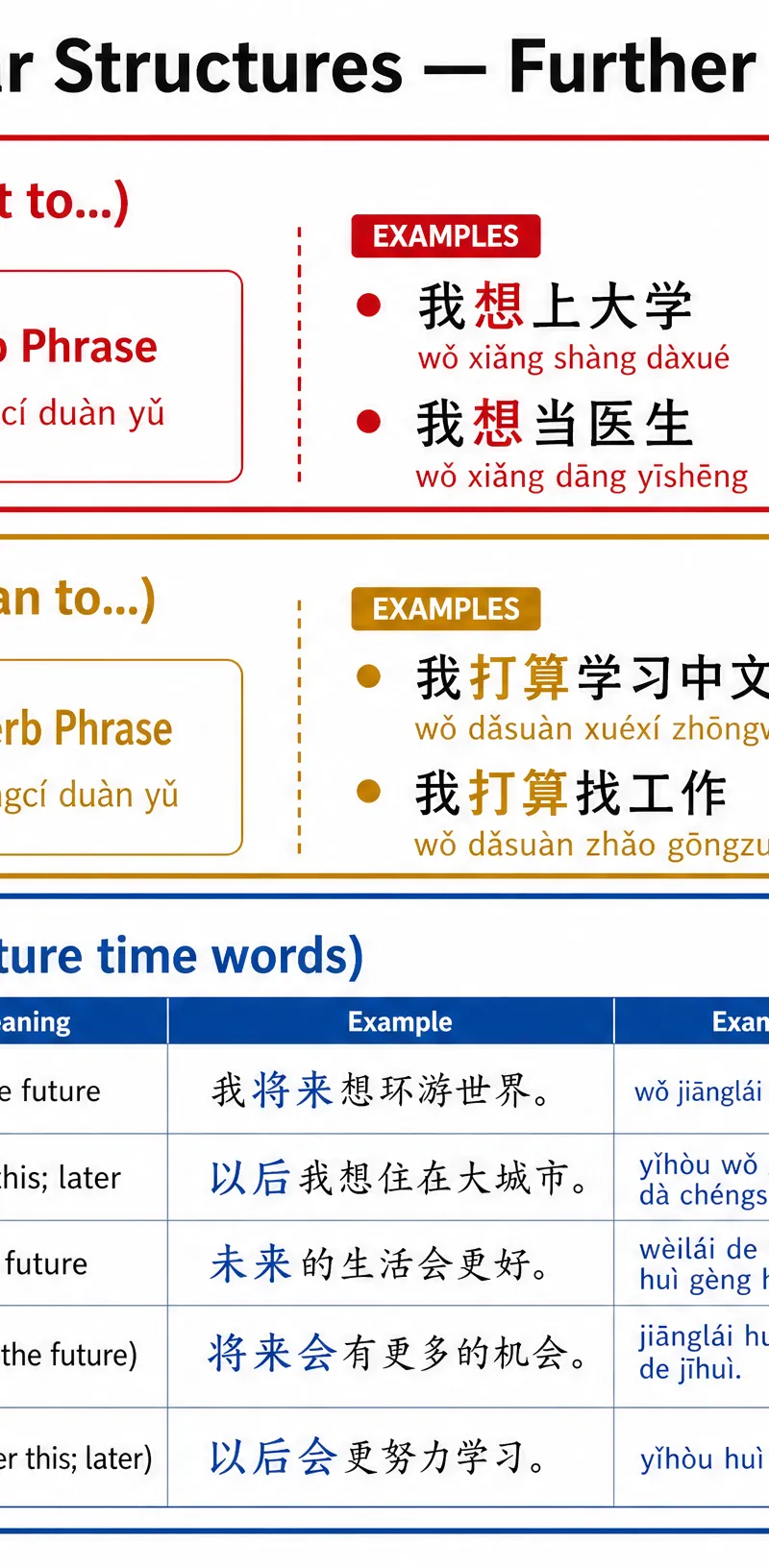
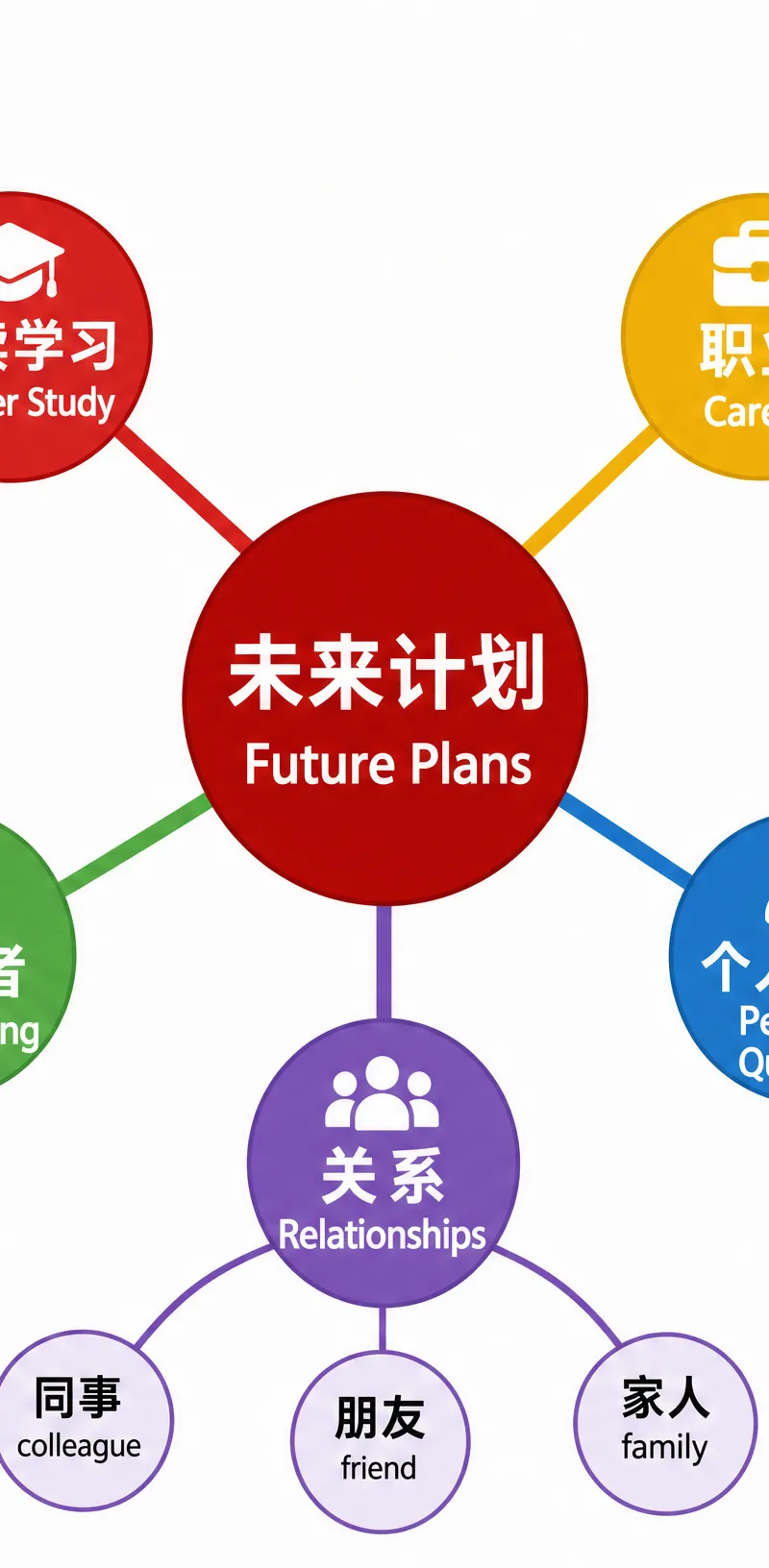
Interactive Diagrams
1 interactive diagram to visualise key concepts
Conceptual Flow Outline
Structured approach for tackling extended writing tasks
Worked Examples
4 worked examples — open one to explore the question and available guidance.
Practice Questions
Try the question, then reveal an answer plan or example response
Writing (Foundation): Write a short email to your Chinese friend about your school and future plans. Mention: what subjects you study, your favourite subject and why, what you want to do in the future.
Hint: Use present tense for subjects, opinion phrases for your favourite, and '想' or '打算' for the future.
Translation (Higher): Translate into Chinese: 'Next year I will go to university in Beijing. I want to study business because I plan to work in a bank in the future.'
Hint: Remember the word order: Time + Subject + 在 + Place + Verb.
Speaking (Conversation): 毕业以后,你打算做什么? (After graduating, what do you plan to do?)
Hint: State your plan, give a reason, and try to use a complex structure.
Reading (Standard): Read the text: '王明今年十八岁。他周末在超市做售货员。他觉得工作很无聊,但是他需要钱买电脑。' Why does Wang Ming work at the supermarket?
Hint: Look for the sentence containing '但是' (but) to find his motivation.
Listening (Higher): You hear: '我以前想当老师,可是现在我对电脑更感兴趣,所以我打算做程序员。' What is the speaker's CURRENT career plan?
Hint: Listen carefully for the time markers '以前' (previously) and '现在/打算' (now/plan to).
Writing (Higher): Write an article for your school magazine about work experience. Include: details of your past work experience, your opinion of it, and your plans for a future career.
Hint: Ensure you use the past tense (了/过) for the experience, and future tense (打算/想) for the career plans.
Exam technique
How to turn what you know into marks
How to approach the question
Writing: Plan your tenses and bullet points before writing a single character. Speaking: Use the 12 minutes prep time to write down key verbs and time phrases, not full sentences. Reading: Read the English questions first to know what to look for.
How to structure your answer
Writing: Introduction (Present) -> Past Experience (Past) -> Future Plans (Future) -> Opinions and Reasons (Throughout).
Timing
Listening: 35-45 mins. Speaking: 10-12 mins total (role play + photo card + conversation). Reading: 45-60 mins. Writing: 60-75 mins.
Common pitfalls
- Using English word order for time and location phrases.
- Forgetting to use past, present, and future tenses in Higher tier writing.
- Writing characters that look similar but mean different things (e.g., 买 buy vs 卖 sell).
- Missing a bullet point in the writing task.
- Giving one-word answers in the speaking exam.
What the command words want
- Translate into Chinese
- Pay close attention to time markers and word order. Ensure characters are written clearly.
- Translate into English
- Focus on the meaning, not a literal word-for-word translation. Ensure it makes sense in English.
- Write approximately 90 words
- Cover all 4 bullet points. Use present tense and at least one other tense (past or future). Give opinions.
- Write approximately 150 words
- Cover all bullet points. Must use past, present, and future tenses. Include complex structures (e.g., 虽然...但是) and justified opinions.
Watch or listen (optional)
Test your understanding of Further study
Active recall beats re-reading. Take an instant quiz now to test what you’ve learned and lock it into long-term memory.
7 days Premium · Then the free plan continues · No card, no charge