Pearson Edexcel · GCSE · Chinese
Course version: Pearson-GCSE-Chinese · Version from Mar 2026
Identity and culture
This topic covers essential vocabulary for describing yourself, your family, hobbies, festivals, and technology. It tests your ability to express and justify opinions across past, present, and future timeframes, which is crucial for achieving high marks in the Speaking and Writing exams.
- 12 min read
- 4 worked examples
- 6 practice questions
- 8 key terms
Check what you remember
Read the wording for your board, then hide it and explain Measure Word (量词) in your own words. Rough notes are fine. This is a self-check, with no mark or grade.
Reference: Pearson Edexcel
A classifier word used between a number/demonstrative and a noun (e.g., 个, 本, 张).
Study Notes

Overview
Welcome to Theme 1: Identity and Culture (身份与文化). This topic is the foundation of your GCSE Chinese course. It explores 'Who am I?' (family, friends, interests), 'Daily Life' (food, shopping, technology), and 'Cultural Life' (festivals, music, sport). It appears across all four exam papers: Listening, Speaking, Reading, and Writing. Mastering this vocabulary gives you the tools to express your own opinions and experiences, which examiners heavily reward.
📖 Essential Vocabulary
Tier 1 — Foundation Core
| Chinese | Pinyin | English | Example Sentence |
|---|---|---|---|
| 爸爸 | bàba | dad | 我爸爸是医生。 (My dad is a doctor.) |
| 妈妈 | māma | mum | 我妈妈喜欢看书。 (My mum likes reading.) |
| 哥哥 | gēge | older brother | 我有一个哥哥。 (I have one older brother.) |
| 妹妹 | mèimei | younger sister | 我没有妹妹。 (I don't have a younger sister.) |
| 朋友 | péngyou | friend | 她是我的好朋友。 (She is my good friend.) |
| 音乐 | yīnyuè | music | 我喜欢听音乐。 (I like listening to music.) |
| 运动 | yùndòng | sport | 他每天做运动。 (He does sport every day.) |
| 电影 | diànyǐng | film | 我们周末看电影。 (We watch films at the weekend.) |
| 电视 | diànshì | television | 弟弟不看电视。 (Younger brother doesn't watch TV.) |
| 饺子 | jiǎozi | dumplings | 中国人喜欢吃饺子。 (Chinese people like eating dumplings.) |
| 米饭 | mǐfàn | rice | 我午饭吃米饭。 (I eat rice for lunch.) |
| 茶 | chá | tea | 英国人喜欢喝茶。 (British people like drinking tea.) |
| 手机 | shǒujī | mobile phone | 这是我的新手机。 (This is my new mobile phone.) |
| 学校 | xuéxiào | school | 我们在学校学习。 (We study at school.) |
| 春节 | Chūnjié | Spring Festival | 春节是中国最大的节日。 (Spring Festival is China's biggest festival.) |
Tier 2 — Higher Tier
| Chinese | Pinyin | English | Example Sentence |
|---|---|---|---|
| 社交媒体 | shèjiāo méitǐ | social media | 现在的年轻人离不开社交媒体。 (Young people today cannot leave social media.) |
| 庆祝 | qìngzhù | to celebrate | 我们一家人一起庆祝中秋节。 (Our whole family celebrates Mid-Autumn Festival together.) |
| 传统 | chuántǒng | tradition / traditional | 饺子是中国的传统食物。 (Dumplings are a traditional Chinese food.) |
| 习俗 | xísú | custom | 每个地方的习俗都不一样。 (Every place's customs are different.) |
| 交流 | jiāoliú | to communicate | 网络让我们更容易交流。 (The internet makes it easier for us to communicate.) |
| 影响 | yǐngxiǎng | to influence / influence | 父母对我的影响很大。 (My parents have a big influence on me.) |
| 减轻压力 | jiǎnqīng yālì | to reduce stress | 听音乐可以帮助我减轻压力。 (Listening to music can help me reduce stress.) |
| 保持健康 | bǎochí jiànkāng | to stay healthy | 多做运动可以保持健康。 (Doing more sport can keep you healthy.) |
| 浪费时间 | làngfèi shíjiān | to waste time | 玩太多电脑游戏是浪费时间。 (Playing too many computer games is a waste of time.) |
| 既...又... | jì...yǒu... | both... and... | 这个问题既有趣又重要。 (This question is both interesting and important.) |
High-Frequency Words & Phrases
| Phrase | English | Usage Context |
|---|---|---|
| 我认为... | I think/believe... | Introducing a formal opinion in Writing or Speaking |
| 觉得... | to feel/think... | Introducing a casual opinion |
| 因为...所以... | because... therefore... | Justifying an opinion (essential for higher marks) |
| 虽然...但是... | although... but... | Showing complex sentence structure |
| 除了...以外,还... | apart from... also... | Listing multiple points |
| 越来越... | more and more... | Describing a changing situation |
| 对我来说... | as for me... | Personalising an answer |
| 有趣 / 没意思 | interesting / boring | Giving reasons for opinions |
| 比较 / 最 | relatively / most | Making comparisons |
| 比如 | for example | Giving examples to expand an answer |

📝 Grammar Focus

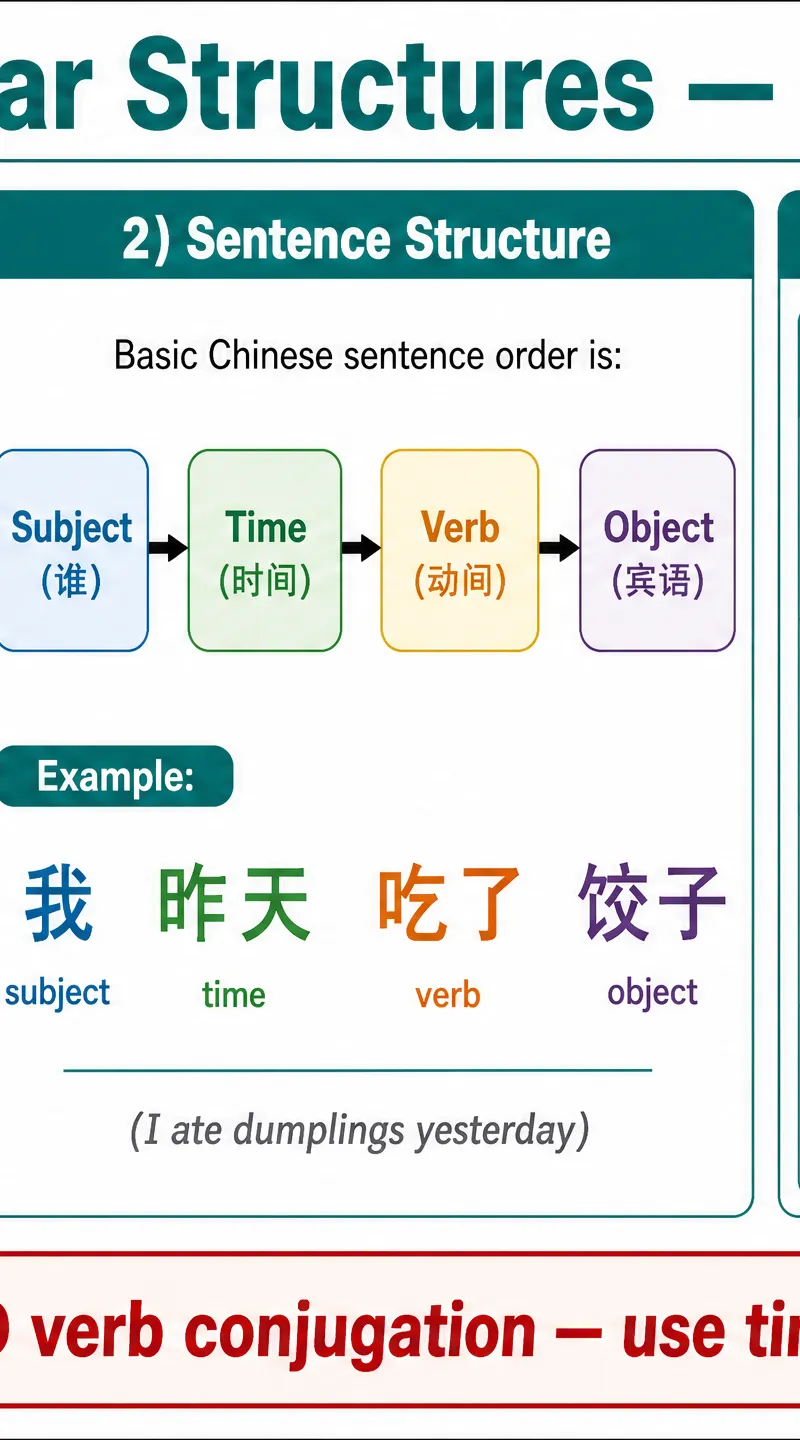
Key Structure 1: Expressing Tense with Time Words
When to use it: Chinese verbs do not conjugate. To show when an action happens, you place a time word before the verb (often after the subject).
Structure Table
| Subject | Time Word | Verb | Object | English |
|---|---|---|---|---|
| 我 | 昨天 (yesterday) | 吃 (eat) | 饺子 | I ate dumplings yesterday. |
| 我 | 今天 (today) | 吃 (eat) | 饺子 | I am eating dumplings today. |
| 我 | 明天 (tomorrow) | 吃 (eat) | 饺子 | I will eat dumplings tomorrow. |
| 他 | 以前 (in the past) | 踢 (play) | 足球 | He used to play football. |
| 他 | 以后 (in the future) | 踢 (play) | 足球 | He will play football in the future. |
Important Note: You can also use the particle 了 (le) after the verb or at the end of the sentence to indicate a completed action: 我看了电影 (I watched a film).
Key Structure 2: Measure Words (量词)
When to use it: Whenever you count a noun or use "this/that" (这/那), you must insert the correct measure word between the number and the noun.
Common Measure Words
| Measure Word | Used for | Example | English |
|---|---|---|---|
| 个 (gè) | People, general items | 一个人 | one person |
| 本 (běn) | Books, magazines | 两本书 | two books |
| 张 (zhāng) | Flat things (paper, photos, tickets) | 三张照片 | three photos |
| 条 (tiáo) | Long, thin things (trousers, fish, rivers) | 一条裤子 | one pair of trousers |
| 件 (jiàn) | Clothes (tops), matters/events | 一件毛衣 | one jumper |
Key Structure 3: Expressing Opinions with Justification
When to use it: To access higher mark bands in Speaking and Writing, you must justify your opinions using structures like 因为...所以... (because... therefore...).
Structure Example
| Opinion | Connector | Reason | English |
|---|---|---|---|
| 我喜欢音乐 | 因为 | 音乐可以让我放松 | I like music because music can make me relax. |
| 我觉得上网很好 | 因为 | 我可以和朋友聊天 | I think going online is good because I can chat with friends. |
| 他不喜欢运动 | 因为 | 他觉得运动太累了 | He doesn't like sport because he thinks sport is too tiring. |
🎧 Listening Skills
What to Expect
You will hear short conversations, announcements, or interviews about family, hobbies, festivals, or technology. Questions will be in English or Chinese, depending on the section. You will hear the recording twice.
Listening Strategies
- Read ahead: Use the reading time to predict vocabulary. If the question is about a festival, expect words like 春节, 吃, 庆祝.
- Listen for negatives: Watch out for 不 (not) and 没 (didn't/haven't). "他不看书" (He doesn't read) is the opposite of "他看书".
- Note time frames: Listen for 昨天 (yesterday), 常常 (often), or 明天 (tomorrow) to understand the tense.
Common Listening Traps
- False friends: 手机 (mobile phone) vs 电视 (television). They both relate to screens but mean different things.
- Distractors: The speaker might mention two sports but only say they like one of them. "我以前踢足球,但是现在喜欢打篮球。" (I used to play football, but now I like playing basketball.)
🗣️ Speaking Skills
Role Play Scenarios
Scenario 1: Buying a mobile phone (Transactional)
- Assistant: 你想买什么手机? (What mobile phone do you want to buy?)
- You: 我想买一个新手机。 (I want to buy a new mobile phone.)
- Assistant: 这个怎么样? (How about this one?)
- You: 很好。多少钱? (Very good. How much is it?)
Photo Card Practice
Model Photo Card Response (A family eating dinner):
- Qu 1 (Description): 照片里有四个人,爸爸,妈妈,哥哥和妹妹。他们在吃晚饭。桌子上有米饭和肉。 (In the photo there are four people, dad, mum, older brother and younger sister. They are eating dinner. On the table there is rice and meat.)
- Qu 2 (Opinion): 我觉得他们很高兴,因为他们在笑。 (I think they are very happy because they are smiling.)
- Qu 3 (Related topic): 在我家,我们通常晚上七点吃晚饭。 (In my house, we usually eat dinner at 7pm.)
- Qu 4 (Past/Future): 昨天晚上,我和家人一起去饭馆吃了中国菜。 (Yesterday evening, my family and I went to a restaurant and ate Chinese food.)
- Qu 5 (Unpredictable): 你喜欢吃什么? (What do you like to eat?) -> 我最喜欢吃饺子。 (I like eating dumplings the most.)
General Conversation Questions
| Question (Chinese) | Model Answer | English Translation |
|---|---|---|
| 请介绍一下你的家庭。 | 我家有四口人,爸爸,妈妈,哥哥和我。我爸爸是老师,妈妈是护士。 | Please introduce your family. -> There are 4 people in my family: dad, mum, older brother and me. My dad is a teacher, mum is a nurse. |
| 你有什么爱好? | 我喜欢听音乐和看书。周末的时候,我常常和朋友一起踢足球。 | What hobbies do you have? -> I like listening to music and reading. At the weekend, I often play football with friends. |
| 你最喜欢的节日是什么? | 我最喜欢春节,因为我可以收到红包,还可以吃好吃的饺子。 | What is your favourite festival? -> I like Spring Festival the most because I can receive red envelopes and eat delicious dumplings. |
| 你昨天做了什么? | 昨天晚上我做了作业,然后看了一个小时的电视。 | What did you do yesterday? -> Yesterday evening I did homework, then watched TV for an hour. |
| 你觉得手机重要吗? | 我觉得手机很重要,因为我可以用手机上网,也可以和朋友聊天。 | Do you think mobile phones are important? -> I think mobile phones are very important because I can use them to go online and chat with friends. |
✍️ Writing Skills
Translation Practice
English → Chinese:
| English | Chinese | Key Grammar |
|---|---|---|
| I like reading. | 我喜欢看书。 | Opinion + Verb object |
| My mum is a teacher. | 我妈妈是老师。 | "是" for professions |
| We ate dumplings yesterday. | 我们昨天吃了饺子。 | Time word (昨天) + 了 |
| I think the internet is very useful. | 我觉得网络很有用。 | Opinion phrase (我觉得) |
| Although I like sport, I don't have time. | 虽然我喜欢运动,但是我没有时间。 | Complex structure (虽然...但是...) |
Extended Writing
**Model 90-word response (Foundation):**Write a blog post about your free time. Mention: what you like doing, what you did last weekend, your opinion on social media, and what you will do next week.
Answer:
你好!我叫大卫。在空闲时间,我喜欢听音乐和做运动。我觉得运动很有意思。上个周末,我和朋友一起去公园踢了足球,我们很高兴。我认为社交媒体很好,因为我可以和朋友聊天。但是,我不喜欢玩电脑游戏。下个周末,我要和家人一起去看电影。谢谢!
(Hello! My name is David. In my free time, I like listening to music and doing sport. I think sport is very interesting. Last weekend, my friends and I went to the park and played football, we were very happy. I think social media is good because I can chat with friends. However, I don't like playing computer games. Next weekend, I am going to watch a film with my family. Thanks!)
**Model 150-word response (Higher):**Write an article for a school magazine about technology and daily life. Include: how you use technology, the pros and cons of social media, what you did online yesterday, and your plans for the future.
Answer:
现在,科技在我们的日常生活中非常重要。我每天都用手机上网和看新闻。对我来说,手机不但很有用,而且很有意思。我认为社交媒体既有优点也有缺点。优点是我们可以很容易地和世界各地的朋友交流。缺点是如果花太多时间在社交媒体上,会影响我们的学习。昨天晚上,我做完作业以后,在网上买了一本书,还和朋友聊了半个小时的天。我觉得网购很方便,因为不但便宜,而且不用出门。将来,我希望科技能帮助更多的人,让我们的生活变得更好。但是,我们也应该花更多的时间和家人在一起,而不是只看手机。
(Nowadays, technology is very important in our daily lives. Every day I use my mobile phone to go online and read the news. As for me, mobile phones are not only very useful, but also very interesting. I think social media has both advantages and disadvantages. The advantage is we can easily communicate with friends all over the world. The disadvantage is if we spend too much time on social media, it will affect our studies. Yesterday evening, after finishing my homework, I bought a book online and chatted with a friend for half an hour. I think online shopping is very convenient because it is not only cheap, but you also don't have to leave the house. In the future, I hope technology can help more people and make our lives better. However, we should also spend more time with family, rather than just looking at our phones.)
Writing Checklist
- ✅ Tenses: Have I used time words for past (昨天), present (每天), and future (明天)?
- ✅ Opinions: Have I included at least two opinions?
- ✅ Justification: Have I used 因为 to explain why?
- ✅ Accuracy: Are my characters correct? Have I used measure words?
- ✅ Complexity: Have I used connectives like 虽然...但是... or 越来越...?
📚 Reading Skills
Key Strategies
- Skim for gist: Read the whole text quickly to understand the main topic before looking at the questions.
- Identify characters: Look for key radicals. The water radical (氵) means it relates to water/liquids (e.g., 渴 thirsty, 汤 soup). The speech radical (讠) relates to language (e.g., 说 speak, 语 language).
False Friends & Tricky Words
| Word | Looks Like | Actually Means |
|---|---|---|
| 爱人 (àirén) | lover | spouse (husband/wife) |
| 东西 (dōngxi) | east-west | things / objects |
| 马上 (mǎshàng) | on a horse | immediately / right away |
🌍 Cultural Knowledge
Understanding Chinese culture adds depth to your answers and shows the examiner real engagement with the language.
- Family structure: Respect for elders (孝顺 xiàoshùn) is a core value. Grandparents often live with the family and help look after children.
- Festivals: The lunar calendar dictates traditional festivals. Spring Festival (春节) is the most important, focusing on family reunion dinners (年夜饭), giving red envelopes (红包) for luck, and eating dumplings (饺子) in the north or rice cakes (年糕) in the south.
- Technology: China is a highly digital society. WeChat (微信) is used for everything from messaging to paying for groceries. Online shopping (网购) is extremely popular.
Visual Resources
2 diagrams and illustrations

Interactive Diagrams
1 interactive diagram to visualise key concepts
Conceptual Flow Outline
Exam strategy by skill area for GCSE Chinese
Worked Examples
4 worked examples — open one to explore the question and available guidance.
Practice Questions
Try the question, then reveal an answer plan or example response
Writing (Foundation): Write a short message to your Chinese friend about your family. Mention: how many people are in your family, your parents' jobs, what you did together last weekend, and ask your friend a question.
Hint: Use '有' for 'there are', '是' for jobs, and a time word like '上个周末' for the past event.
Speaking (Conversation): 你最喜欢什么节日?为什么? (What is your favourite festival? Why?)
Hint: Name the festival, give an opinion using '最喜欢', and justify it using '因为'.
Reading (Higher): Read the paragraph and answer in English. '虽然手机对我们的生活很有帮助,但是我觉得现在的年轻人花太多时间在社交媒体上了。这不仅影响他们的学习,也对他们的眼睛不好。'
Hint: Look out for the '虽然...但是...' (although...but) structure to understand the contrasting ideas.
Writing (Higher): Translate the following sentences into Chinese: 1. I like listening to music. 2. Yesterday I watched a film with my friends. 3. I think the internet is very important because it is convenient.
Hint: Remember the word order: Subject + Time + 'with someone' + Verb + Object.
Listening (Foundation): Listen to the audio and tick the correct box. (Audio: 我哥哥喜欢运动,他每天踢足球。但是弟弟不喜欢运动,他喜欢看电视。) What does the younger brother like doing?
Hint: Listen for '弟弟' (younger brother) and his specific preference.
Speaking (Role Play): You are in a restaurant in China. Tell the waiter what you want to eat and drink.
Hint: Keep it simple. Use '我要...' (I want...) and basic food/drink vocabulary.
Exam technique
How to turn what you know into marks
How to approach the question
Listening: Read questions first, underline key words. Speaking: Prepare opinions and tenses during the 12-min prep time. Reading: Skim for gist, look for radicals to guess unknown words. Writing: Plan your 3 tenses and opinions before writing.
How to structure your answer
Writing: Introduction -> Past event -> Present opinion with reason -> Future plan. Speaking: Give direct answer -> Add an opinion -> Give a reason (因为).
Timing
Listening: 35-45 mins (heard twice). Speaking: 10-12 mins total (role play + photo card + conversation). Reading: 45-60 mins. Writing: 60-75 mins.
Common pitfalls
- Forgetting measure words between numbers and nouns (e.g., writing 一人 instead of 一个人).
- Putting time words at the end of the sentence instead of before the verb.
- Using only the present tense - examiners want past and future references for higher marks.
- Ignoring the tones in the speaking exam, which can change the meaning of words entirely.
- Not writing characters clearly enough for the examiner to read the radicals.
- Forgetting to justify opinions with '因为' (because).
What the command words want
- Describe the photo
- State the obvious first (people, actions), then add your own opinion about what is happening.
- Translate into Chinese
- Ensure correct sentence structure (Subject-Time-Verb-Object) and include necessary measure words.
- Translate into English
- Focus on capturing the correct meaning and tense, rather than a clunky word-for-word translation.
- Write approximately 90 words
- Cover all 4 bullet points clearly. Use present tense and at least one other time frame.
- Write approximately 150 words
- Develop your points. Use 3 time frames, complex opinions, and connectives like 虽然...但是... (although...but...).
Watch or listen (optional)
Test your understanding of Identity and culture
Active recall beats re-reading. Take an instant quiz now to test what you’ve learned and lock it into long-term memory.
7 days Premium · Then the free plan continues · No card, no charge