Pearson Edexcel · GCSE · Chinese
Course version: Pearson-GCSE-Chinese · Version from Mar 2026
Jobs
This comprehensive GCSE Chinese study guide on Jobs covers essential vocabulary for various professions, key grammatical structures for discussing future intentions, and strategies for success across listening, speaking, reading, and writing exams. It provides tiered vocabulary, model answers, and examiner insights to help candidates secure top marks.
- 11 min read
- 4 worked examples
- 6 practice questions
- 8 key terms
Check what you remember
Read the wording for your board, then hide it and explain Timeframe Markers in your own words. Rough notes are fine. This is a self-check, with no mark or grade.
Reference: Pearson Edexcel
Words that indicate when an action happens, since Chinese verbs do not conjugate. Examples: 以前 (before), 现在 (now), 将来 (future).
Study Notes

Overview
The topic of 'Jobs and Careers' (工作 - gōngzuò) is a central pillar of the GCSE Chinese specification. It frequently appears across all four papers (Listening, Speaking, Reading, and Writing) because it naturally invites the use of multiple tenses (past ambitions, present jobs, future plans) and the expression of justified opinions. Mastering this topic is essential for securing high marks, particularly in the extended writing and speaking tasks where examiners look for complex structures and a wide range of vocabulary.
🎧 Audio Revision: The Jobs Podcast
Listen to our exclusive 10-minute revision podcast covering core vocabulary, grammar, and exam tips for this topic.
📖 Essential Vocabulary

Tier 1 — Foundation Core
| Chinese | Pinyin | English | Gender | Example Sentence |
|---|---|---|---|---|
| 医生 | yīshēng | doctor | n/a | 我妈妈是医生。 (My mum is a doctor.) |
| 老师 | lǎoshī | teacher | n/a | 他是一位好老师。 (He is a good teacher.) |
| 护士 | hùshi | nurse | n/a | 护士在医院工作。 (Nurses work in hospitals.) |
| 警察 | jǐngchá | police officer | n/a | 警察的工作很危险。 (A police officer's job is dangerous.) |
| 厨师 | chúshī | chef/cook | n/a | 哥哥想当厨师。 (Older brother wants to be a chef.) |
| 商人 | shāngrén | businessman | n/a | 爸爸是一个商人。 (Dad is a businessman.) |
| 记者 | jìzhě | journalist | n/a | 记者每天写文章。 (Journalists write articles every day.) |
| 演员 | yǎnyuán | actor/actress | n/a | 她是最有名的演员。 (She is the most famous actress.) |
| 工程师 | gōngchéngshī | engineer | n/a | 工程师很聪明。 (Engineers are very smart.) |
| 司机 | sījī | driver | n/a | 出租车司机很忙。 (The taxi driver is very busy.) |
| 售货员 | shòuhuòyuán | shop assistant | n/a | 售货员很友好。 (The shop assistant is very friendly.) |
| 工人 | gōngrén | worker | n/a | 工人在工厂工作。 (Workers work in factories.) |
| 医院 | yīyuàn | hospital | n/a | 医生在医院工作。 (Doctors work in hospitals.) |
| 学校 | xuéxiào | school | n/a | 老师在学校教书。 (Teachers teach at schools.) |
| 公司 | gōngsī | company | n/a | 他在一家大公司工作。 (He works in a big company.) |
Tier 2 — Higher Tier
| Chinese | Pinyin | English | Gender | Example Sentence |
|---|---|---|---|---|
| 会计师 | kuàijìshī | accountant | n/a | 会计师的数学很好。 (Accountants are good at maths.) |
| 建筑师 | jiànzhùshī | architect | n/a | 建筑师设计了这座大楼。 (The architect designed this building.) |
| 心理学家 | xīnlǐxuéjiā | psychologist | n/a | 心理学家帮助人们。 (Psychologists help people.) |
| 企业家 | qǐyèjiā | entrepreneur | n/a | 年轻的企业家很成功。 (The young entrepreneur is successful.) |
| 律师 | lǜshī | lawyer | n/a | 律师的收入很高。 (Lawyers have a high income.) |
| 科学家 | kēxuéjiā | scientist | n/a | 科学家在实验室工作。 (Scientists work in laboratories.) |
| 兽医 | shòuyī | vet | n/a | 兽医喜欢动物。 (Vets like animals.) |
| 兼职 | jiānzhí | part-time job | n/a | 周末我做兼职。 (I do a part-time job at the weekend.) |
| 全职 | quánzhí | full-time job | n/a | 毕业后我要找全职工作。 (After graduation, I will look for a full-time job.) |
| 赚(钱) | zhuàn(qián) | to earn (money) | n/a | 这份工作能赚很多钱。 (This job can earn a lot of money.) |
High-Frequency Words & Phrases
| Phrase | Pinyin | English | Usage Context |
|---|---|---|---|
| 我想当... | Wǒ xiǎng dāng... | I want to be... | Expressing future career ambitions. |
| 将来 | jiānglái | in the future | Starting sentences about future plans. |
| 因为...所以... | yīnwèi...suǒyǐ... | because... therefore... | Justifying opinions on career choices. |
| 很有意思 | hěn yǒu yìsi | very interesting | Giving a positive opinion about a job. |
| 很无聊 | hěn wúliáo | very boring | Giving a negative opinion about a job. |
| 比较累 | bǐjiào lèi | quite tiring | Describing the nature of a job. |
| 工资高 | gōngzī gāo | high salary | Giving a reason for wanting a specific job. |
| 帮助别人 | bāngzhù biérén | help others | Explaining the motivation for jobs like doctor/nurse. |
| 找工作 | zhǎo gōngzuò | look for a job | Discussing post-education plans. |
| 压力大 | yālì dà | highly stressful | Describing demanding professions. |
📝 Grammar Focus
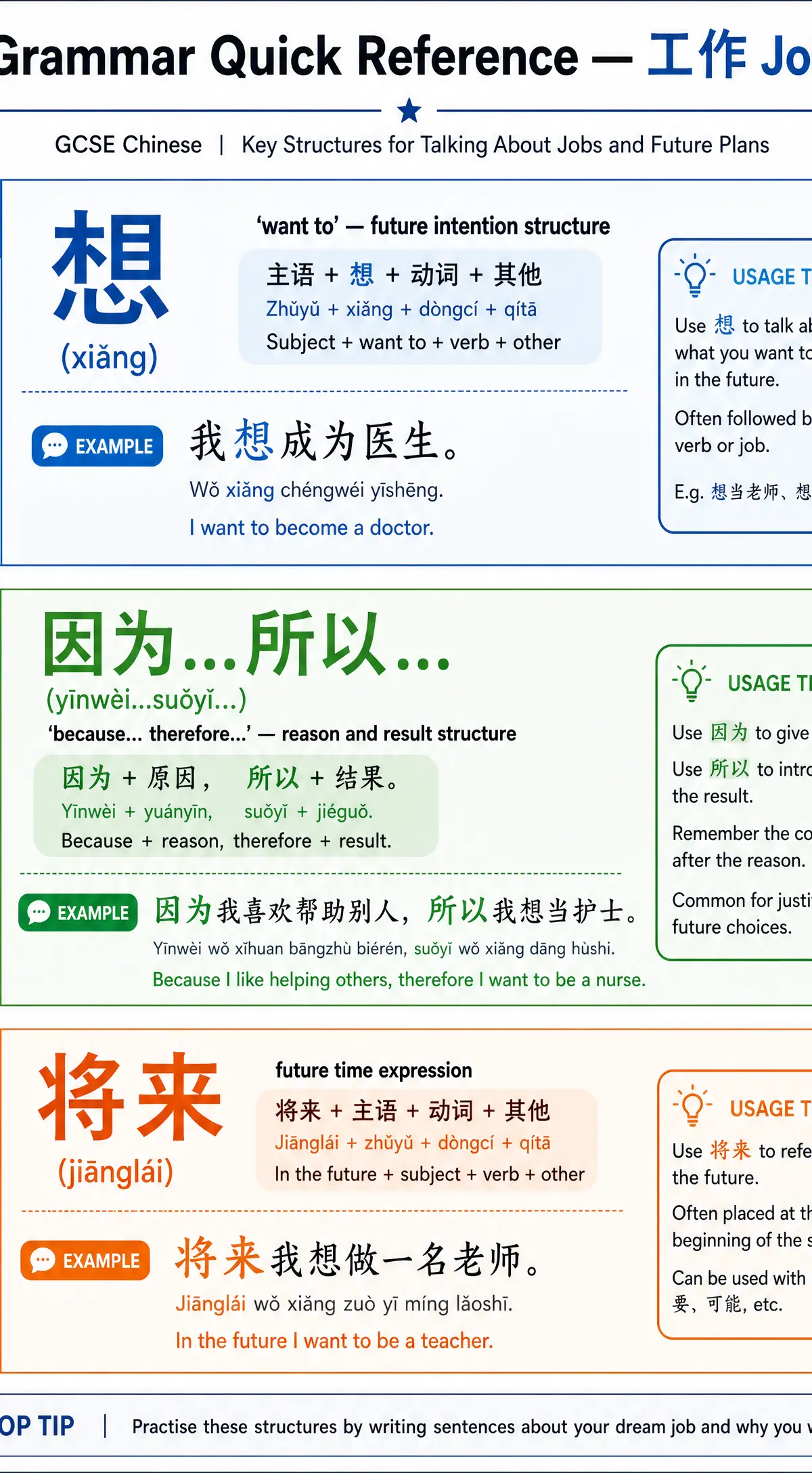
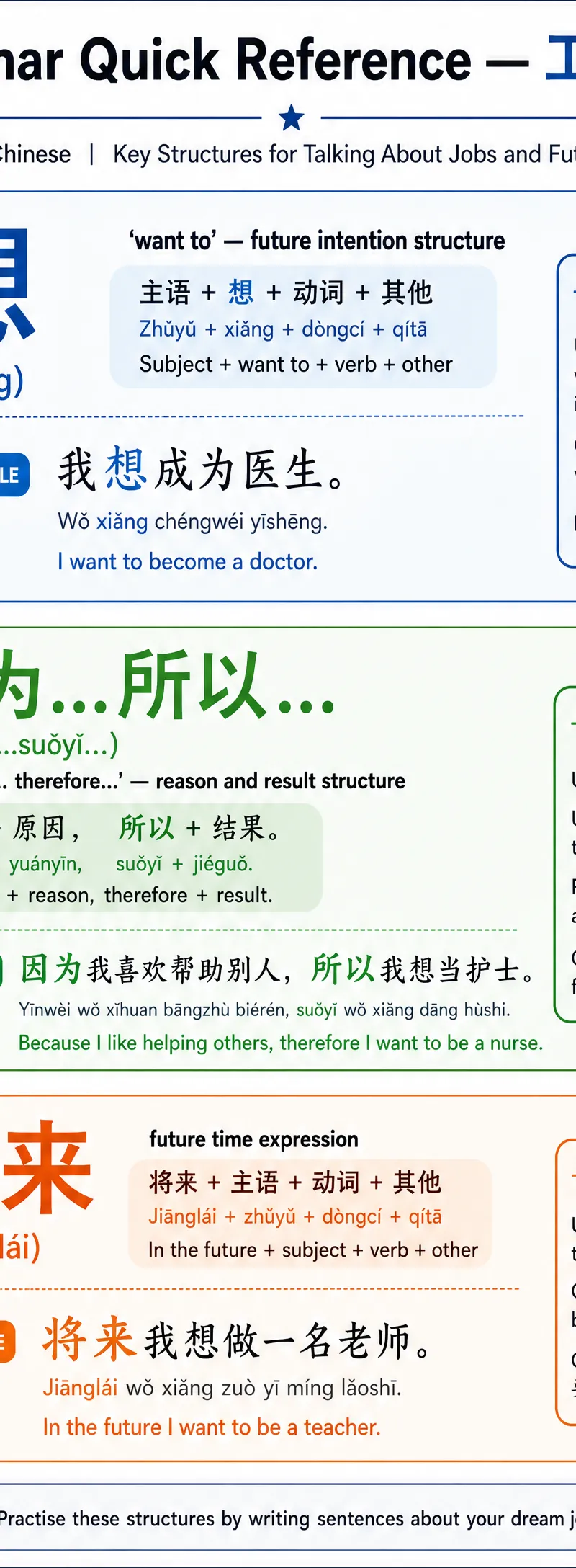
Key Structure 1: 想 (xiǎng) — Expressing Future Intentions
When to use it: Use 想 (xiǎng) to express a desire or intention, particularly when discussing what job you want to do in the future. It is often followed by 当 (dāng) or 成为 (chéngwéi), both meaning 'to become' or 'to work as'.
Conjugation Table
Note: Chinese verbs do not conjugate based on the subject. The structure remains the same regardless of the pronoun.
| Subject | Verb Form | English |
|---|---|---|
| 我 (I) | 想当 (xiǎng dāng) | I want to be... |
| 你 (You) | 想当 (xiǎng dāng) | You want to be... |
| 他/她 (He/She) | 想当 (xiǎng dāng) | He/She wants to be... |
| 我们 (We) | 想当 (xiǎng dāng) | We want to be... |
| 你们 (You pl.) | 想当 (xiǎng dāng) | You (pl.) want to be... |
| 他们/她们 (They) | 想当 (xiǎng dāng) | They want to be... |
Irregulars to learn: There are no irregular verb endings in Chinese, but remember the difference between 想 (want to/would like to) and 要 (want to/must/will). 想 is softer and more common for ambitions.
Key Structure 2: 因为...所以... (yīnwèi...suǒyǐ...) — Giving Reasons
When to use it: This is the essential structure for justifying your opinions, which is a requirement for higher marks across all exam boards. It translates to 'Because... therefore...'.
Pattern: 因为 [reason], 所以 [result].
Example: 因为我喜欢动物,所以我将来想当兽医。 (Because I like animals, [therefore] I want to be a vet in the future.)
Key Structure 3: Expressing Timeframes (Past, Present, Future)
When to use it: To access higher marks in Writing and Speaking, you must demonstrate the ability to use three timeframes. Chinese does not conjugate verbs for tense; instead, it uses time words at the beginning of the sentence or right after the subject.
| Timeframe | Time Word | Example | English |
|---|---|---|---|
| Past | 小时候 (xiǎoshíhou - when young) | 小时候,我想当警察。 | When I was young, I wanted to be a police officer. |
| Present | 现在 (xiànzài - now) | 现在,我在商店做兼职。 | Now, I do a part-time job in a shop. |
| Future | 将来 (jiānglái - in the future) | 将来,我打算去中国工作。 | In the future, I plan to go to China to work. |
🎧 Listening Skills
What to Expect
Listening exams often feature short monologues or dialogues where people discuss their current jobs, their dream jobs, or their parents' professions. You will need to identify the job, the workplace, and the person's opinion of the job (positive, negative, or mixed).
Listening Strategies
- Listen for time markers: Pay close attention to words like 以前 (before), 现在 (now), and 将来 (future). The question might ask 'What did he want to be?' but the audio will mention both his past ambition and his current job to trick you.
- Listen for opinion markers: Words like 觉得 (feel/think), 喜欢 (like), 讨厌 (dislike), 可是 (but), and 但是 (but) signal a shift in opinion or a justification.
- Note the tone: The speaker's tone of voice often gives away whether their opinion of the job is positive or negative, even if you miss a vocabulary word.
Common Listening Traps
- Distractor jobs: The speaker might say 'My dad is a doctor, but I want to be an engineer.' If the question asks what the speaker wants to be, do not write 'doctor'.
- Similar sounding words: Be careful not to confuse 护士 (hùshi - nurse) with 律师 (lǜshī - lawyer) if spoken quickly.
🗣️ Speaking Skills
Role Play Scenarios
Scenario 1: At a careers fair
- Teacher: 你将来想做什么工作? (What job do you want to do in the future?)
- You: 我将来想当工程师。 (I want to be an engineer in the future.)
- Teacher: 为什么? (Why?)
- You: 因为我的数学很好,而且工程师的工资很高。 (Because my maths is very good, and engineers have a high salary.)
Photo Card Practice
Model Photo Card Response: (Imagine a photo of a doctor in a hospital)
- Qu 1 (Description): 照片里有一个医生。他在医院里。他穿着白色的衣服。 (In the photo there is a doctor. He is in a hospital. He is wearing white clothes.)
- Qu 2 (Opinion): 我觉得医生的工作很重要,因为他们帮助生病的人。 (I think a doctor's job is very important because they help sick people.)
- Qu 3 (Related topic): 我的妈妈也是医生,她每天都很忙。 (My mum is also a doctor, she is very busy every day.)
- Qu 4 (Past/Future): 将来我不想当医生,因为太累了。 (In the future I don't want to be a doctor because it is too tiring.)
- Qu 5 (Unpredictable): 我打算上大学学电脑。 (I plan to go to university to study computers.)
General Conversation Questions
| Question (Chinese) | Model Answer | English Translation |
|---|---|---|
| 你将来想做什么工作? | 我将来想当记者,因为我喜欢写作和旅行。 | What job do you want to do in the future? / I want to be a journalist in the future because I like writing and travelling. |
| 你觉得做老师怎么样? | 我觉得做老师很好,但是压力很大,也比较累。 | What do you think about being a teacher? / I think being a teacher is good, but it is highly stressful and quite tiring. |
| 你的父母做什么工作? | 我爸爸是商人,妈妈是护士。他们都很忙。 | What jobs do your parents do? / My dad is a businessman, mum is a nurse. They are both very busy. |
| 你有兼职工作吗? | 有,周末我在一家饭馆做服务员,赚零花钱。 | Do you have a part-time job? / Yes, at the weekend I work as a waiter in a restaurant to earn pocket money. |
| 赚钱重要还是开心重要? | 我觉得开心最重要,但是赚钱也很重要,因为我要买东西。 | Is earning money or being happy more important? / I think being happy is most important, but earning money is also important because I need to buy things. |
✍️ Writing Skills
Translation Practice
English → Chinese:
| English | Chinese | Key Grammar |
|---|---|---|
| I want to be a doctor. | 我想当医生。 | 想当 (xiǎng dāng) structure |
| My dad works in a hospital. | 我爸爸在医院工作。 | 在 + Place + 工作 (zài... gōngzuò) |
| Because I like travelling, I want to be a journalist. | 因为我喜欢旅行,所以我想要当记者。 | 因为...所以... (yīnwèi...suǒyǐ...) |
| When I was young, I wanted to be a teacher. | 小时候,我想做老师。 | Past time marker (小时候) |
| Next year, I plan to look for a part-time job. | 明年,我打算找一份兼职工作。 | Future time marker + 打算 (plan to) |
Extended Writing
Model 90-word response (Foundation):
我叫大卫。我现在是一个中学生。周末,我在一家超市做兼职工作。我觉得做售货员很没意思,但是可以赚零花钱。将来,我不想在超市工作。我想当一名工程师,因为我的科学和数学很好。而且,工程师的工资很高。我的爸爸也是工程师,他在一家大公司工作。他觉得他的工作很有趣。
Model 150-word response (Higher):
对我来说,选择一个好工作非常重要。小时候,我想当一名警察,因为我觉得警察很酷,可以保护别人。但是现在我改变了主意。因为我对电脑很感兴趣,所以我将来打算上大学学习计算机科学。大学毕业以后,我希望成为一名软件工程师。虽然工程师的工作可能压力很大,但是我觉得这个职业很有挑战性,而且工资很高。我的父母都支持我的决定。我妈妈是护士,爸爸是商人,他们工作都很努力。我觉得,不管做什么工作,最重要的是你要喜欢它。赚钱虽然重要,但是每天开心地工作更重要。为了实现我的梦想,我现在必须好好学习。
Writing Checklist
- ✅ Have I used at least three different timeframes (past, present, future)?
- ✅ Have I given opinions and justified them using 因为...所以...?
- ✅ Have I used appropriate measure words (e.g., 一名医生)?
- ✅ Have I checked the word order (Time - Subject - Place - Verb)?
- ✅ Have I used connectives like 而且 (furthermore), 但是 (but), or 虽然...但是... (although... but...)?
📚 Reading Skills
Key Strategies
- Skim for gist: Read the text quickly first to understand the general topic. Is it an advert for a job? A blog post about career dreams? An interview with a professional?
- Scan for keywords: Look for the specific job titles, places of work, and opinion words.
- Watch out for negatives: Words like 不 (not) and 没 (have not) completely change the meaning of a sentence. (e.g., 我不想当老师 - I do not want to be a teacher).
False Friends & Tricky Words
| Word | Looks Like | Actually Means |
|---|---|---|
| 工作 (gōngzuò) | Can be a noun or verb | Work (noun) OR to work (verb) |
| 职业 (zhíyè) | Just another word for job | Profession/Occupation (more formal than 工作) |
| 打算 (dǎsuàn) | To calculate | To plan / to intend |
🌍 Cultural Knowledge
In Chinese culture, education and career success are highly valued. Traditionally, professions like doctors (医生), lawyers (律师), engineers (工程师), and teachers (老师) are highly respected and seen as prestigious, stable career paths. The concept of 'iron rice bowl' (铁饭碗 - tiěfànwǎn) historically referred to a secure government or state-owned enterprise job with guaranteed employment and benefits. While modern China has a booming private sector and young people are increasingly pursuing diverse careers like entrepreneurs (企业家) or in tech, parental expectation and the desire for a stable, well-respected profession remain strong themes. Understanding this cultural emphasis on education leading to professional success can add depth to your extended writing or speaking responses.

Interactive Diagrams
1 interactive diagram to visualise key concepts
Conceptual Flow Outline
Structure for building high-scoring answers about career plans.
Worked Examples
4 worked examples — open one to explore the question and available guidance.
Practice Questions
Try the question, then reveal an answer plan or example response
Writing (Translation): Translate the following sentences into Chinese. 1) My mother is a nurse. 2) I want to be an engineer because I like maths. 3) In the future, I plan to work in China.
Hint: Remember the word order for sentence 3: Time marker goes at the beginning. Use the 因为...所以... structure for sentence 2.
Speaking (General Conversation): 你觉得做医生好不好?为什么? (What do you think about being a doctor? Why?)
Hint: Give a balanced opinion (good points and bad points) to access higher marks.
Reading (Comprehension): Read the text. True, False, or Not Mentioned?
Text: 我叫李华。我的理想是当一名科学家,因为我对科学非常感兴趣。我的父母不支持我,他们希望我当律师,因为律师的收入更稳定。可是我觉得做律师太无聊了。
- Li Hua wants to be a lawyer.
- Li Hua's parents think being a lawyer provides a stable income.
- Li Hua is currently studying science at university.
Hint: Pay attention to who wants what (Li Hua vs. parents).
Listening: Listen to the speaker. What did she want to be when she was younger, and what does she want to be now?
Audio script: 小时候,我特别喜欢画画,所以我想当建筑师。可是现在,我发现我对语言更感兴趣,所以我打算大学毕业后当一名翻译。 (Translation for reference: When I was young, I especially liked drawing, so I wanted to be an architect. But now, I find I am more interested in languages, so I plan to become a translator after graduating university.)
Hint: Listen for the time markers 小时候 (when young) and 现在 (now).
Writing (90 words): Write a blog post about your work experience. Include: 1) What your part-time job is. 2) Your opinion of it. 3) What you plan to do in the future.
Hint: Cover all three bullet points. Use present tense for the first two, and future tense for the last one.
Speaking (Photo Card): Look at the photo of a busy restaurant kitchen with chefs cooking.
Question: 你觉得在饭馆工作好不好? (Do you think working in a restaurant is good?)
Hint: Give an opinion and at least one reason.
Exam technique
How to turn what you know into marks
How to approach the question
Skill-by-skill strategy: Listening — read questions first, note keywords, listen for time markers. Speaking — prepare opinions in advance, use fillers like 那个 (nàge) to buy time. Reading — skim first, then detail, watch for negatives. Writing — plan tenses and complex structures before writing, check measure words after.
How to structure your answer
Writing: Introduction (Current situation) → Past (Childhood ambitions) → Future (Plans & Justified Reasons) → Conclusion. Speaking: Give opinion → Justify (因为) → Extend (而且) → Use different tense.
Timing
Listening: 25-35 mins (heard twice). Speaking: 7-12 mins total. Reading: 45-60 mins. Writing: 60-75 mins.
Common pitfalls
- Translating English word order literally (especially placing 'at the hospital' at the end of the sentence).
- Using only the present tense — examiners want at least 3 tenses at Higher tier.
- Giving one-word Speaking answers instead of developing responses with opinions and reasons.
- Forgetting the comma in the 因为... 所以... structure in written tasks.
- Confusing 工作 (the concept of work) with specific job titles.
- Falling for distractors in Listening/Reading (e.g., parents' jobs vs. the student's dream job).
What the command words want
- Describe the photo
- Say what you can see (人在哪里,穿什么), give an opinion, and relate it to your own experience or future plans.
- Translate into Chinese
- Apply Chinese word order rules strictly (Time-Subject-Place-Verb). Partial marks are awarded for correct vocabulary even if grammar is slightly off.
- Translate into English
- Meaning over word-for-word — capture the sense, ensure the English sentence is grammatically correct.
- Write approximately 90 words
- Foundation task — cover all 4 bullet points equally, use present + one other tense (past or future).
- Write approximately 150 words
- Higher task — use 3 timeframes, justify opinions, use complex structures (因为...所以..., 虽然...但是...), and ambitious vocabulary.
Watch or listen (optional)
Test your understanding of Jobs
Active recall beats re-reading. Take an instant quiz now to test what you’ve learned and lock it into long-term memory.
7 days Premium · Then the free plan continues · No card, no charge