Pearson Edexcel · GCSE · Chinese
Course version: Pearson-GCSE-Chinese · Version from Mar 2026
Music events
This topic covers essential vocabulary for attending and discussing music events (concerts, festivals, performances). It focuses on expressing justified opinions and using three timeframes (past, present, future) to narrate experiences, which is critical for accessing Higher tier marks across all four GCSE skills.
- 13 min read
- 4 worked examples
- 6 practice questions
- 8 key terms
Check what you remember
Read the wording for your board, then hide it and explain Time Word (时间词) in your own words. Rough notes are fine. This is a self-check, with no mark or grade.
Reference: Pearson Edexcel
Words that indicate when an action happens (e.g., 昨天, 现在, 将来). They must be placed before the verb.
Study Notes
Overview
The 'Music Events' (音乐活动) topic sits within the broader theme of 'International and global dimension'. It is a high-yield topic because it naturally lends itself to expressing opinions, describing past experiences, and discussing future plans. Examiners love this topic as it allows candidates to showcase a wide range of adjectives and complex connectives. You can expect to see this topic in the Listening and Reading papers (often involving opinions about a concert or festival), and it is a very common scenario for the Speaking Photo Card and General Conversation. Mastering this topic provides excellent transferable vocabulary that can be used when discussing hobbies, free time, and cultural events.
🎧 Audio Revision: The Music Events Podcast
Listen to our 10-minute revision podcast covering core vocabulary, grammar structures, exam tips, and a quick-fire recall quiz.
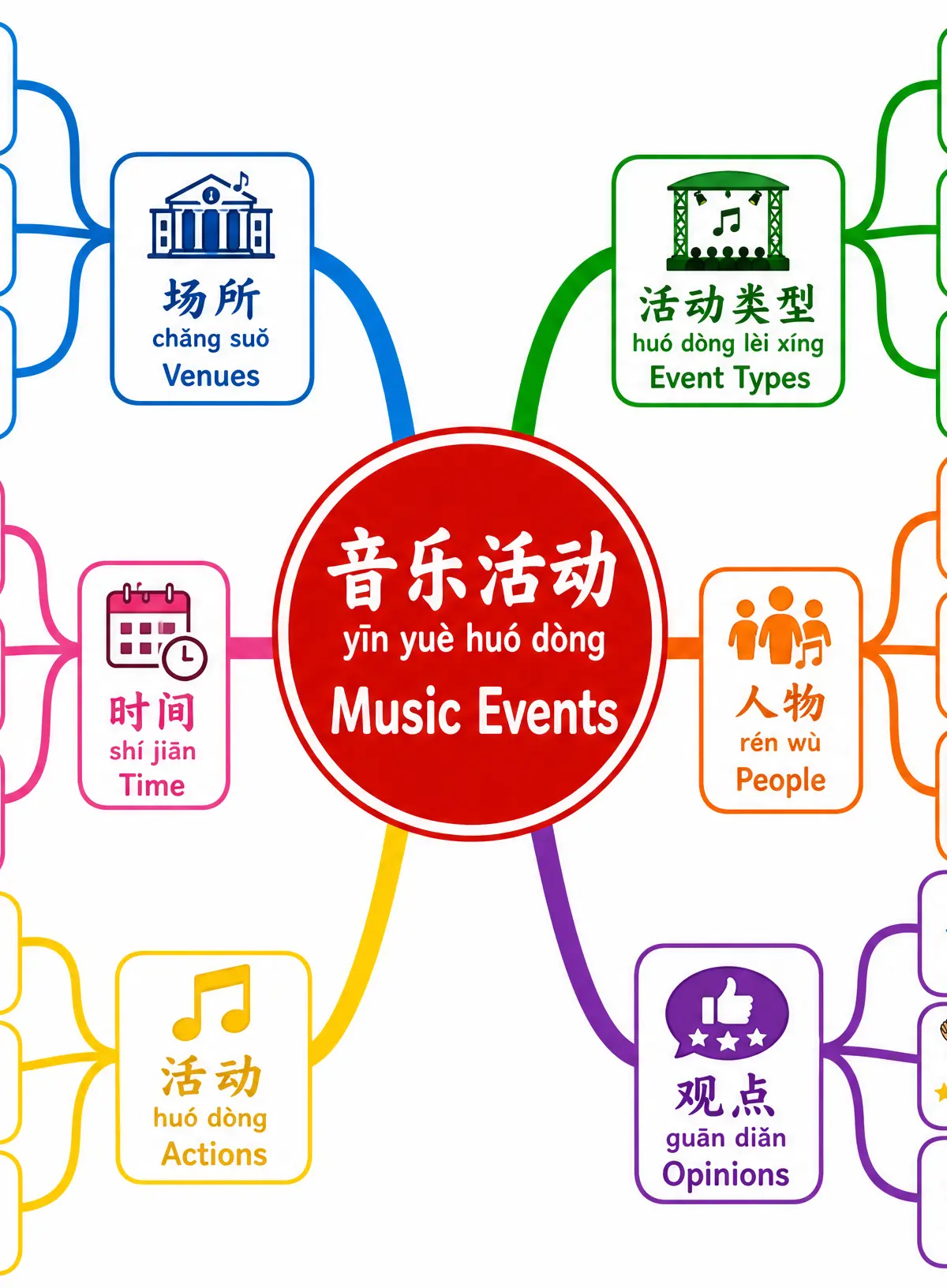
📖 Essential Vocabulary
Tier 1 — Foundation Core
| Chinese | English | Gender | Example Sentence |
|---|---|---|---|
| 音乐 (yīnyuè) | music | n/a | 我喜欢听音乐。(I like listening to music.) |
| 音乐会 (yīnyuèhuì) | concert | n/a | 昨天我去了一场音乐会。(Yesterday I went to a concert.) |
| 唱歌 (gēchàng) | to sing | n/a | 她的爱好是唱歌。(Her hobby is singing.) |
| 歌手 (gēshǒu) | singer | n/a | 他是我最喜欢的歌手。(He is my favourite singer.) |
| 流行音乐 (liúxíng yīnyuè) | pop music | n/a | 很多年轻人喜欢流行音乐。(Many young people like pop music.) |
| 古典音乐 (gǔdiān yīnyuè) | classical music | n/a | 我爸爸喜欢古典音乐。(My dad likes classical music.) |
| 贵 (guì) | expensive | n/a | 音乐会的门票很贵。(The concert tickets are very expensive.) |
| 便宜 (piányi) | cheap | n/a | 这个CD很便宜。(This CD is very cheap.) |
| 好听 (hǎotīng) | pleasant to hear | n/a | 这首歌很好听。(This song is very pleasant to hear.) |
| 票 (piào) | ticket | n/a | 我买了两张票。(I bought two tickets.) |
| 有意思 (yǒu yìsi) | interesting | n/a | 我觉得音乐节很有意思。(I think music festivals are very interesting.) |
| 没意思 (méi yìsi) | boring | n/a | 昨天的表演没意思。(Yesterday's performance was boring.) |
| 朋友 (péngyou) | friend | n/a | 我和朋友一起去。(I go together with friends.) |
| 周末 (zhōumò) | weekend | n/a | 上个周末我去了伦敦。(Last weekend I went to London.) |
| 开心 (kāixīn) | happy | n/a | 我们都很开心。(We were all very happy.) |
Tier 2 — Higher Tier
| Chinese | English | Gender | Example Sentence |
|---|---|---|---|
| 音乐节 (yīnyuèjié) | music festival | n/a | 每年夏天都有很多音乐节。(Every summer there are many music festivals.) |
| 现场演出 (xiànchǎng yǎnchū) | live performance | n/a | 看现场演出比听CD好。(Watching a live performance is better than listening to a CD.) |
| 气氛 (qìfēn) | atmosphere | n/a | 音乐会的气氛非常热闹。(The atmosphere of the concert was very lively.) |
| 观众 (guānzhòng) | audience | n/a | 观众们都很兴奋。(The audience were all very excited.) |
| 乐器 (yuèqì) | musical instrument | n/a | 我会弹两种乐器。(I can play two musical instruments.) |
| 演奏 (yǎnzòu) | to perform (instrument) | n/a | 那个乐手演奏得非常精彩。(That musician performed wonderfully.) |
| 难忘的经历 (nánwàng de jīnglì) | unforgettable experience | n/a | 参加那个音乐节是一次难忘的经历。(Attending that music festival was an unforgettable experience.) |
| 令人兴奋 (lìng rén xīngfèn) | exciting | n/a | 听到他唱歌令人兴奋。(Hearing him sing is exciting.) |
| 欣赏 (xīnshǎng) | to appreciate / enjoy | n/a | 我喜欢欣赏不同风格的音乐。(I like to appreciate different styles of music.) |
| 感动 (gǎndòng) | moved / touched | n/a | 这首歌让我很感动。(This song made me very moved.) |
High-Frequency Words & Phrases
| Phrase | English | Usage Context |
|---|---|---|
| 我认为 (wǒ rènwéi) | I think / in my opinion | Formal way to introduce a justified opinion |
| 比如 (bǐrú) | for example | Giving examples of music genres or singers |
| 对...感兴趣 (duì...gǎn xìngqù) | to be interested in... | Expressing hobbies/interests (e.g., 我对音乐感兴趣) |
| 不但...而且 (bùdàn...érqiě) | not only... but also | Higher-level connective for adding detail |
| 越来越... (yuè lái yuè...) | more and more... | Describing changing trends (e.g., 门票越来越贵) |
| 以前 (yǐqián) | before / in the past | Time marker for past tense |
| 将来 (jiānglái) | in the future | Time marker for future tense |
| 场 (chǎng) | measure word for events | Used with 音乐会 (concert) or 比赛 (match) |
| 首 (shǒu) | measure word for songs | Used with 歌 (song) |
| 张 (zhāng) | measure word for flat objects | Used with 票 (ticket) or CD |
📝 Grammar Focus
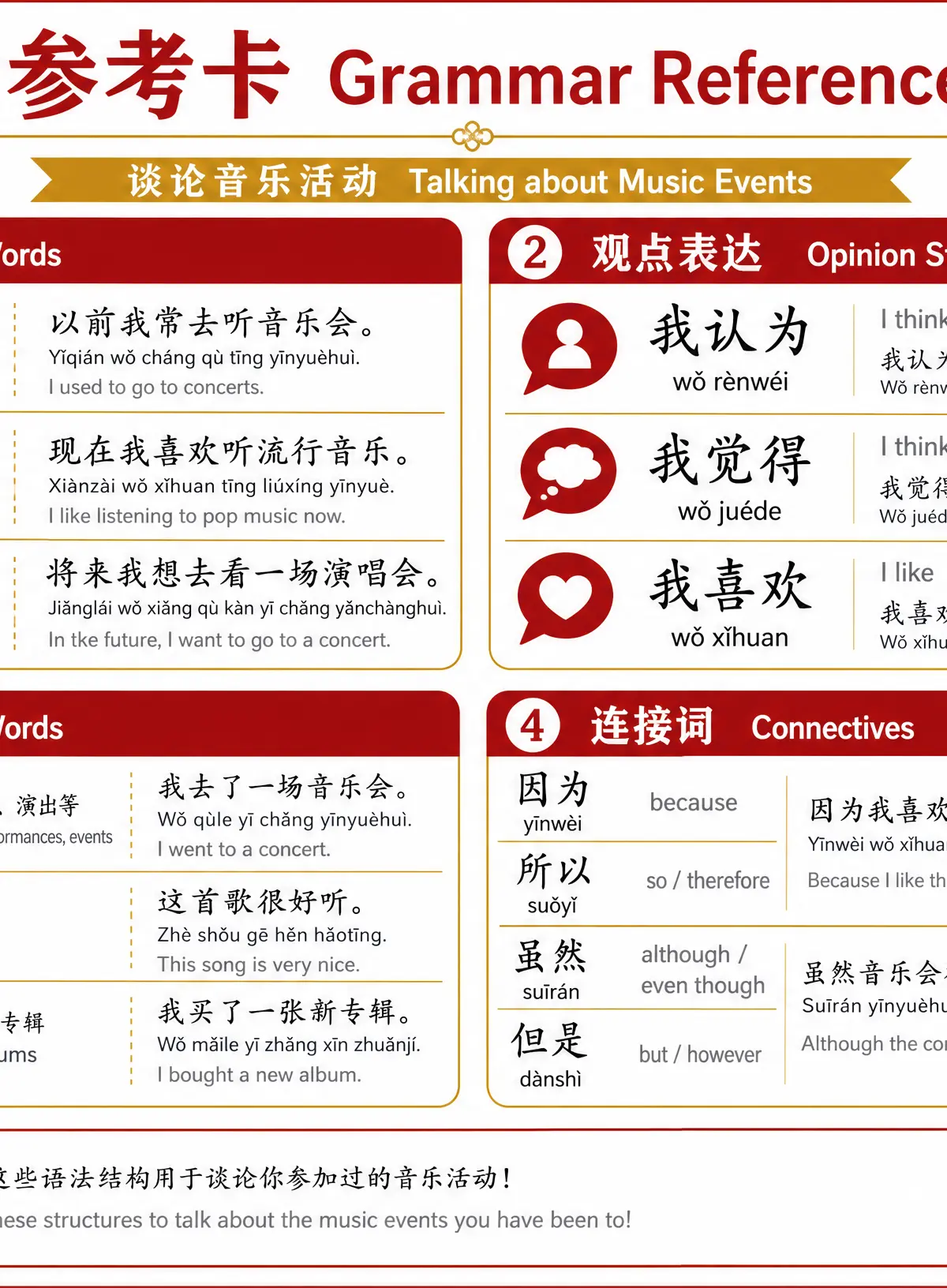
Key Structure 1: Timeframes (Tense Markers)
When to use it: Chinese verbs do not conjugate. To show when an action happens, you MUST use time words (usually placed at the start of the sentence or immediately after the subject) and aspect particles like 了 (le) for completed actions.
Time Word Table
| Timeframe | Time Word | Example | English |
|---|---|---|---|
| Past | 以前 (yǐqián) | 以前我常去听音乐会。 | In the past, I often went to concerts. |
| Past | 去年 (qùnián) | 去年我去了一场演唱会。 | Last year, I went to a concert. (Note the 了) |
| Present | 现在 (xiànzài) | 现在我喜欢听流行音乐。 | Now I like listening to pop music. |
| Present | 常常 (chángcháng) | 周末我常常在家听歌。 | At weekends I often listen to songs at home. |
| Future | 将来 (jiānglái) | 将来我想去中国看音乐节。 | In the future, I want to go to China to see a music festival. |
| Future | 明年 (míngnián) | 明年我打算学弹吉他。 | Next year I plan to learn to play the guitar. |
Examiner Tip: To secure Higher tier marks, ensure you use at least three different timeframes in your extended writing and general conversation.
Key Structure 2: Expressing and Justifying Opinions
When to use it: Examiners specifically look for justified opinions. You must state what you think AND why.
Opinion + Justification Structure
| Opinion Phrase | Subject | Adjective | Connective | Reason |
|---|---|---|---|---|
| 我觉得 (I feel) | 古典音乐 (classical music) | 很好听 (very pleasant) | 因为 (because) | 让人放松 (makes people relax). |
| 我认为 (I think) | 音乐会的票 (concert tickets) | 太贵了 (too expensive) | 所以 (therefore) | 我不常去 (I don't go often). |
| 我最喜欢 (I like most) | 流行音乐 (pop music) | n/a | 因为 (because) | 旋律优美 (the melody is beautiful). |
Key Structure 3: Complex Connectives (虽然...但是...)
When to use it: To link two contrasting ideas in one sentence. This demonstrates complex sentence structure, which is required for the highest grades.
Usage Examples
| Structure | Example | English |
|---|---|---|
| 虽然...但是... (Although... but...) | 虽然门票很贵,但是我还是买了一张。 | Although the ticket was expensive, I still bought one. |
| 不但...而且... (Not only... but also...) | 那个歌手不但唱歌好听,而且长得帅。 | That singer not only sings well, but is also handsome. |
| 除了...以外,还... (Apart from... also...) | 除了流行音乐以外,我还喜欢爵士乐。 | Apart from pop music, I also like jazz. |
🎧 Listening Skills
What to Expect
Listening questions on this topic often feature young people discussing a recent concert they attended, comparing different types of music, or complaining about ticket prices. You will hear opinions, reasons, and descriptions of atmosphere.
Listening Strategies
- Listen for Negatives: Pay close attention to 不 (bù) and 没 (méi). They completely change the meaning. For example, 我没去 (I didn't go) vs 我去了 (I went).
- Identify the Timeframe: Listen for time words like 昨天 (yesterday), 刚才 (just now), or 明天 (tomorrow) to determine if the speaker is talking about a past event or future plan.
- Opinion Qualifiers: Note words that modify opinions, such as 有点儿 (a little bit), 非常 (very), or 最 (most). Examiners test whether you understood how much they liked it.
Common Listening Traps
- Confusing similar sounds: 音乐 (yīnyuè - music) sounds similar to 英语 (yīngyǔ - English language). Use the context to help you.
- Distractors: A speaker might say "My friend wanted to go to a pop concert, BUT we went to a classical concert instead." Listen for connectives like 但是 (but) or 可是 (but) which signal a change in direction.
🗣️ Speaking Skills
Role Play Scenarios
Scenario: You are talking to your Chinese friend about a music event.
- Task 1: Say what kind of music you like. (我喜欢听流行音乐。)
- Task 2: Say what you did last weekend. (上个周末我去了一场音乐会。)
- Task 3: Give your opinion on the concert. (我觉得音乐会很精彩,因为气氛很热闹。)
- Task 4: Ask your friend a question about music. (你最喜欢哪个歌手?)
Photo Card Practice
Model Photo Card Response (A photo showing a large outdoor music festival):
- Qu 1 (Description): 这张照片里有一个很大的舞台,还有很多年轻人。他们在看表演。 (In this photo there is a big stage, and many young people. They are watching a performance.)
- Qu 2 (Opinion): 我觉得他们很开心,因为气氛非常热情。 (I think they are very happy, because the atmosphere is very passionate.)
- Qu 3 (Related topic): 我非常喜欢音乐节,因为可以和朋友一起欣赏不同风格的音乐。 (I like music festivals very much, because I can enjoy different styles of music with friends.)
- Qu 4 (Past/Future): 去年夏天,我和朋友去了一个音乐节。明年我想去中国看音乐节。 (Last summer, my friends and I went to a music festival. Next year I want to go to China to see a music festival.)
- Qu 5 (Unpredictable): 我认为听音乐对年轻人很重要,因为可以让人放松,减轻压力。 (I think listening to music is very important for young people, because it can make people relax and reduce stress.)
General Conversation Questions
| Question (Chinese) | Model Answer | English Translation |
|---|---|---|
| 你喜欢什么类型的音乐?为什么? | 我最喜欢流行音乐,因为旋律很好听,让人放松。 | What type of music do you like? Why? -> I like pop music most, because the melody is pleasant and makes people relax. |
| 你会演奏乐器吗? | 会,我弹钢琴弹了五年了。虽然每天练习很累,但是我喜欢。 | Can you play a musical instrument? -> Yes, I have played the piano for five years. Although practicing every day is tiring, I like it. |
| 说说你最近去过的一场音乐会。 | 上个月我和朋友去听了一场摇滚音乐会。现场气氛非常棒,是一次难忘的经历。 | Tell me about a concert you went to recently. -> Last month my friend and I went to listen to a rock concert. The live atmosphere was fantastic, it was an unforgettable experience. |
| 听现场演出和听CD,你更喜欢哪个? | 我更喜欢听现场演出。因为现场演出的气氛更好,还可以看到我喜欢的歌手。 | Listening to live performances vs CDs, which do you prefer? -> I prefer listening to live performances. Because the live atmosphere is better, and I can also see my favourite singers. |
| 将来你想去参加什么音乐活动? | 将来我想去参加一个大型的户外音乐节,因为可以认识很多新朋友。 | What music event do you want to attend in the future? -> In the future I want to attend a large-scale outdoor music festival, because I can meet many new friends. |
✍️ Writing Skills
Translation Practice
English → Chinese:
| English | Chinese | Key Grammar |
|---|---|---|
| I like listening to music. | 我喜欢听音乐。 | Basic opinion + verb (Foundation) |
| Last year I went to a concert. | 去年我去了一场音乐会。 | Time word (去年) + completed action particle (了) + measure word (场) |
| The tickets were very expensive, but the performance was wonderful. | 虽然门票很贵,但是表演很精彩。 | Complex connective (虽然...但是...) (Higher) |
| In the future, I want to be a musician. | 将来我想当一名乐手。 | Future time word (将来) + profession |
| I think music festivals are interesting because the atmosphere is good. | 我认为音乐节很有意思,因为气氛很好。 | Justified opinion (我认为...因为...) (Higher) |
Extended Writing
Model 90-word response (Foundation):
我非常喜欢听音乐。我最喜欢流行音乐,因为很好听。每天晚上我都在房间里听歌。上个周末,我和好朋友一起去了一场音乐会。虽然门票很贵,但是我们都很开心。音乐会的气氛很热闹。将来,我想学弹吉他,因为我觉得弹吉他很酷。我也想去更多的现场演出。
(Translation: I like listening to music very much. I like pop music most, because it is pleasant to hear. Every evening I listen to songs in my room. Last weekend, my good friend and I went to a concert. Although the tickets were expensive, we were all very happy. The atmosphere of the concert was lively. In the future, I want to learn to play the guitar, because I think playing the guitar is cool. I also want to go to more live performances.)
Model 150-word response (Higher):
音乐在我的生活中非常重要。除了流行音乐以外,我也喜欢古典音乐,因为听古典音乐能让我放松,减轻学习的压力。我弹钢琴弹了六年了,虽然每天练习很花时间,但是我觉得很有意义。
上个月,为了庆祝我的生日,父母给我买了两张音乐会的门票。我和最好的朋友一起去了那场现场演出。那个歌手不但唱歌非常好听,而且现场的气氛令人兴奋。那真是一次难忘的经历!
我认为年轻人参加音乐活动有很多好处。不但可以欣赏不同风格的音乐,还可以认识有相同爱好的新朋友。将来,如果我有机会,我打算去中国参加一个大型的户外音乐节,体验一下那里的音乐文化。
*(Translation: Music is very important in my life. Apart from pop music, I also like classical music, because listening to classical music allows me to relax and reduces study stress. I have played the piano for six years; although practicing every day takes time, I feel it is very meaningful.
Last month, to celebrate my birthday, my parents bought me two concert tickets. My best friend and I went to that live performance together. That singer not only sang beautifully, but the live atmosphere was also exciting. That was truly an unforgettable experience!
I think there are many benefits for young people attending music events. Not only can they appreciate different styles of music, but they can also meet new friends with similar hobbies. In the future, if I have the opportunity, I plan to go to China to attend a large-scale outdoor music festival to experience the music culture there.)*
Writing Checklist
- ✅ Have I used three different timeframes (past, present, future)?
- ✅ Have I expressed opinions AND justified them with reasons (因为)?
- ✅ Have I used complex connectives (虽然...但是, 不但...而且)?
- ✅ Have I checked my measure words (场, 首, 张)?
- ✅ Have I used the particle 了 for completed past actions?
📚 Reading Skills
Key Strategies
When reading longer texts about music events, skim for gist first. Look for the time words (以前, 去年, 明年) to establish the timeline. Then, scan for opinion words (喜欢, 讨厌, 觉得) and the reasons that follow them. Pay attention to who is expressing the opinion — texts often compare the opinions of two different people (e.g., a teenager and their parent).
False Friends & Tricky Words
| Word | Looks Like | Actually Means |
|---|---|---|
| 音乐 (yīnyuè) | English (due to pinyin similarity to yīngyǔ) | Music |
| 流行 (liúxíng) | Travel (due to similarity to lǚxíng) | Popular / Pop (music) |
| 票 (piào) | Beautiful (due to similarity to piàoliang) | Ticket |
🌍 Cultural Knowledge
In Chinese-speaking countries, large-scale music festivals (音乐节) have become increasingly popular among young people, such as the Strawberry Music Festival (草莓音乐节) in China. These events often blend modern rock, pop, and electronic music with traditional Chinese musical elements. Additionally, attending concerts (演唱会) of famous pop idols (C-pop, Mandopop) is a major cultural activity. Knowing these terms and referencing the enthusiasm for live music in modern Chinese youth culture can add excellent depth to your Speaking and Writing responses, demonstrating a genuine cultural awareness to the examiner.
Visual Resources
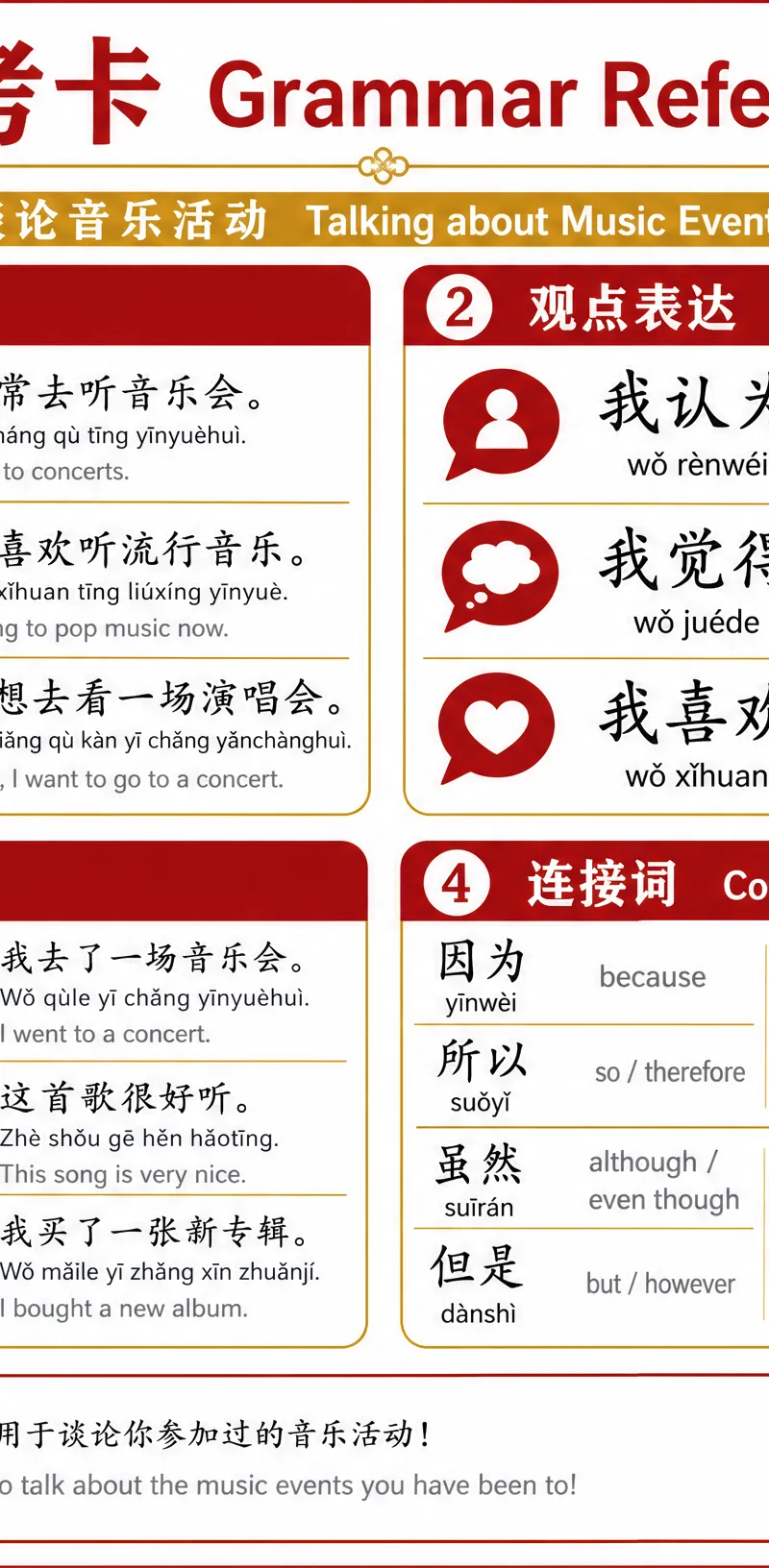
2 diagrams and illustrations
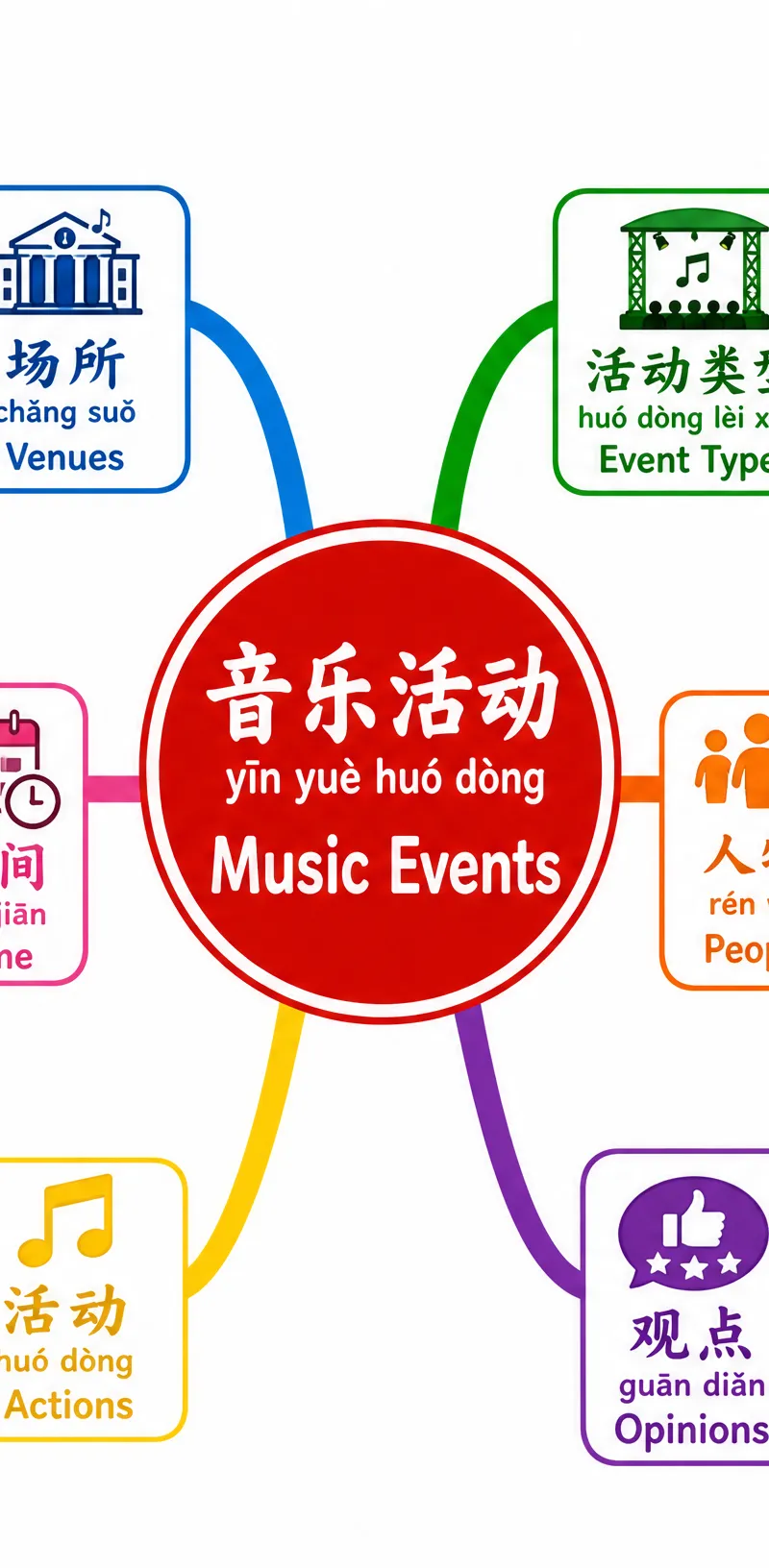
Interactive Diagrams
1 interactive diagram to visualise key concepts
Conceptual Flow Outline
MFL exam approach by skill for Chinese
Worked Examples
4 worked examples — open one to explore the question and available guidance.
Practice Questions
Try the question, then reveal an answer plan or example response
Writing: Translate into Chinese - 'Last year, I went to a music festival with my friends.'
Hint: Remember the S-T-V-O word order and the particle for completed actions.
Speaking: Answer the question - 你觉得古典音乐怎么样?(What do you think of classical music?)
Hint: Give an opinion and justify it.
Writing: Translate into Chinese - 'Although the tickets are expensive, I still want to go.'
Hint: Use the complex connective 'Although...but...'
Reading: Read the sentence and answer in English. 我最喜欢看现场演出,因为气氛比听CD好得多。Why does the speaker prefer live performances?
Hint: Look for the comparative structure '比...好' (better than).
Listening: You hear '明天的演唱会,我不去了,因为我没有票。' Why is the person not going?
Hint: Listen for the negative '没有' (do not have).
Writing (Higher): Write one sentence in Chinese describing a future music plan, using a complex connective.
Hint: Combine a future time word with 不但...而且 or 除了...还.
Exam technique
How to turn what you know into marks
How to approach the question
Skill-by-skill strategy: Listening — read questions first, note keywords. Speaking — prepare opinions in advance, have fillers ready. Reading — skim first, then detail. Writing — plan before writing, check accuracy after.
How to structure your answer
Writing: Introduction → Main points with opinions → Justified reasons → Different tenses → Conclusion. Speaking: Give opinion → Justify → Extend → Use different tense.
Timing
Listening: 25 mins (heard twice). Speaking: 7-12 mins total (role play + photo card + conversation). Reading: 45-60 mins. Writing: 60-75 mins (translation + structured + extended).
Common pitfalls
- Forgetting to use the particle 了 for completed past actions.
- Using English sentence order (putting time at the end of the sentence).
- Giving one-word Speaking answers instead of developing responses with 因为.
- Using the wrong measure words (e.g., using 个 instead of 场 for a concert).
- Confusing 音乐 (music) with 英语 (English language) in Listening exams.
- Not justifying opinions with '因为' (because).
What the command words want
- Describe the photo
- Say what you can see (这照片里有...), give an opinion (我觉得...), relate to your experience (去年我...).
- Translate into Chinese
- Write full sentences with correct grammar — partial marks for partially correct vocabulary, but S-T-V-O order is vital.
- Translate into English
- Meaning over word-for-word — capture the sense, ensure the English flows naturally.
- Write approximately 90 words
- Foundation task — cover all 4 bullet points, use present + one other tense, include simple justified opinions.
- Write approximately 150 words
- Higher task — 3 tenses mandatory, justified opinions, complex structures (虽然...但是), ambitious vocabulary.
Watch or listen (optional)
Test your understanding of Music events
Active recall beats re-reading. Take an instant quiz now to test what you’ve learned and lock it into long-term memory.
7 days Premium · Then the free plan continues · No card, no charge