Pearson Edexcel · GCSE · Chinese
Course version: Pearson-GCSE-Chinese · Version from Mar 2026
Preferences
Master the essential vocabulary and grammar for expressing holiday preferences and narrating travel experiences in Chinese. This topic covers transport, accommodation, and activities across past, present, and future tenses, essential for success in Listening, Speaking, Reading, and Writing papers.
- 13 min read
- 4 worked examples
- 6 practice questions
- 8 key terms
Check what you remember
Read the wording for your board, then hide it and explain Particle 了 (le) in your own words. Rough notes are fine. This is a self-check, with no mark or grade.
Reference: Pearson Edexcel
A grammatical marker placed after a verb to indicate that an action has been completed.
Study Notes

Overview
Welcome to the comprehensive guide for GCSE Chinese Theme 2: Local area, holiday and travel, focusing specifically on Preferences and Holidays (假期偏好). This is a high-yield topic that appears across all four exam papers. Examiners specifically look for your ability to narrate past holiday experiences, discuss future travel plans, and justify your opinions about different destinations and activities. Mastering the three timeframes (past, present, future) and using accurate measure words in this topic will significantly boost your grade.
Listen to our audio guide to reinforce your learning:
📖 Essential Vocabulary
Tier 1 — Foundation Core
| Chinese | English | Pinyin | Example Sentence |
|---|---|---|---|
| 假期 | holiday | jiàqī | 我喜欢暑假。(I like summer holidays.) |
| 飞机 | aeroplane | fēijī | 我们坐飞机去中国。(We go to China by plane.) |
| 火车 | train | huǒchē | 他坐火车去伦敦。(He goes to London by train.) |
| 汽车 | car | qìchē | 爸爸开汽车。(Dad drives a car.) |
| 酒店 | hotel | jiǔdiàn | 这个酒店很好。(This hotel is very good.) |
| 游泳 | swimming | yóuyǒng | 我喜欢在海里游泳。(I like swimming in the sea.) |
| 买东西 | shopping | mǎi dōngxi | 妈妈去买东西。(Mum goes shopping.) |
| 海边 | seaside | hǎibiān | 昨天我们去了海边。(Yesterday we went to the seaside.) |
| 城市 | city | chéngshì | 伦敦是一个大城市。(London is a big city.) |
| 天气 | weather | tiānqì | 今天天气很好。(Today's weather is very good.) |
| 热 | hot | rè | 夏天很热。(Summer is very hot.) |
| 冷 | cold | lěng | 冬天很冷。(Winter is very cold.) |
| 去年 | last year | qùnián | 去年我去了法国。(Last year I went to France.) |
| 现在 | now / present | xiànzài | 现在我在家。(Now I am at home.) |
| 明年 | next year | míngnián | 明年我想去美国。(Next year I want to go to America.) |
Tier 2 — Higher Tier
| Chinese | English | Pinyin | Example Sentence |
|---|---|---|---|
| 青年旅舍 | youth hostel | qīngnián lǚshè | 我们住在便宜的青年旅舍。(We stayed in a cheap youth hostel.) |
| 参观名胜古迹 | visit historical sites | cānguān míngshèng gǔjī | 我喜欢参观名胜古迹。(I like visiting historical sites.) |
| 体验当地文化 | experience local culture | tǐyàn dāngdì wénhuà | 旅行可以体验当地文化。(Travelling can let you experience local culture.) |
| 风景如画 | picturesque scenery | fēngjǐng rú huà | 那里的风景如画。(The scenery there is picturesque.) |
| 难忘的经历 | unforgettable experience | nánwàng de jīnglì | 这是一次难忘的经历。(This is an unforgettable experience.) |
| 设施齐全 | fully equipped facilities | shèshī qíquán | 这个酒店设施齐全。(This hotel has fully equipped facilities.) |
| 交通便利 | convenient transport | jiāotōng biànlì | 城市的交通很便利。(The city's transport is very convenient.) |
| 扩大眼界 | broaden horizons | kuòdà yǎnjiè | 出国旅游能扩大眼界。(Travelling abroad can broaden horizons.) |
| 读万卷书,行万里路 | Read 10,000 books, travel 10,000 miles | dú wàn juǎn shū, xíng wàn lǐ lù | 俗话说:读万卷书,行万里路。(As the saying goes: Read 10,000 books, travel 10,000 miles.) |
| 无论...都... | no matter... always... | wúlùn... dōu... | 无论去哪里,我都很开心。(No matter where I go, I am always happy.) |
High-Frequency Words & Phrases
| Phrase | English | Usage Context |
|---|---|---|
| 我认为 | I think / In my opinion | Used to introduce a formal opinion |
| 我觉得 | I feel / I think | Used to introduce a personal feeling or opinion |
| 因为...所以... | because... therefore... | Essential connective for justifying opinions |
| 虽然...但是... | although... but... | Complex structure for balanced arguments |
| 不但...而且... | not only... but also... | Excellent for adding detail and depth |
| 越来越... | more and more... | Good for describing changing situations |
| 比 | compared to (than) | Essential for comparing two holidays or places |
| 一边...一边... | doing two actions simultaneously | Good for describing activities (e.g., eating while walking) |
| 除了...以外,还... | besides... also... | Great for listing multiple activities or places |
| 先...然后...最后... | first... then... finally... | Perfect for narrating a sequence of events on holiday |

📝 Grammar Focus
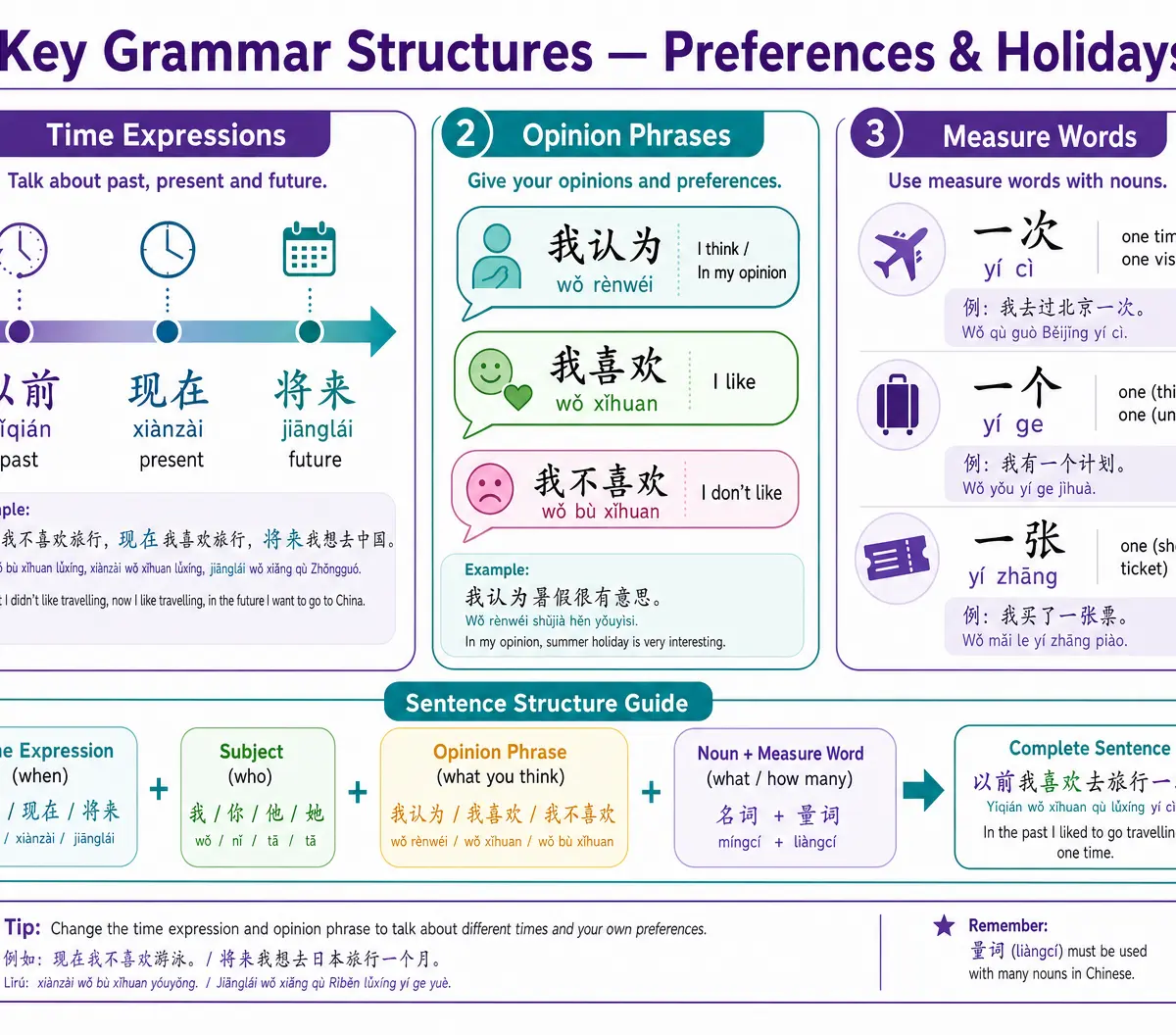
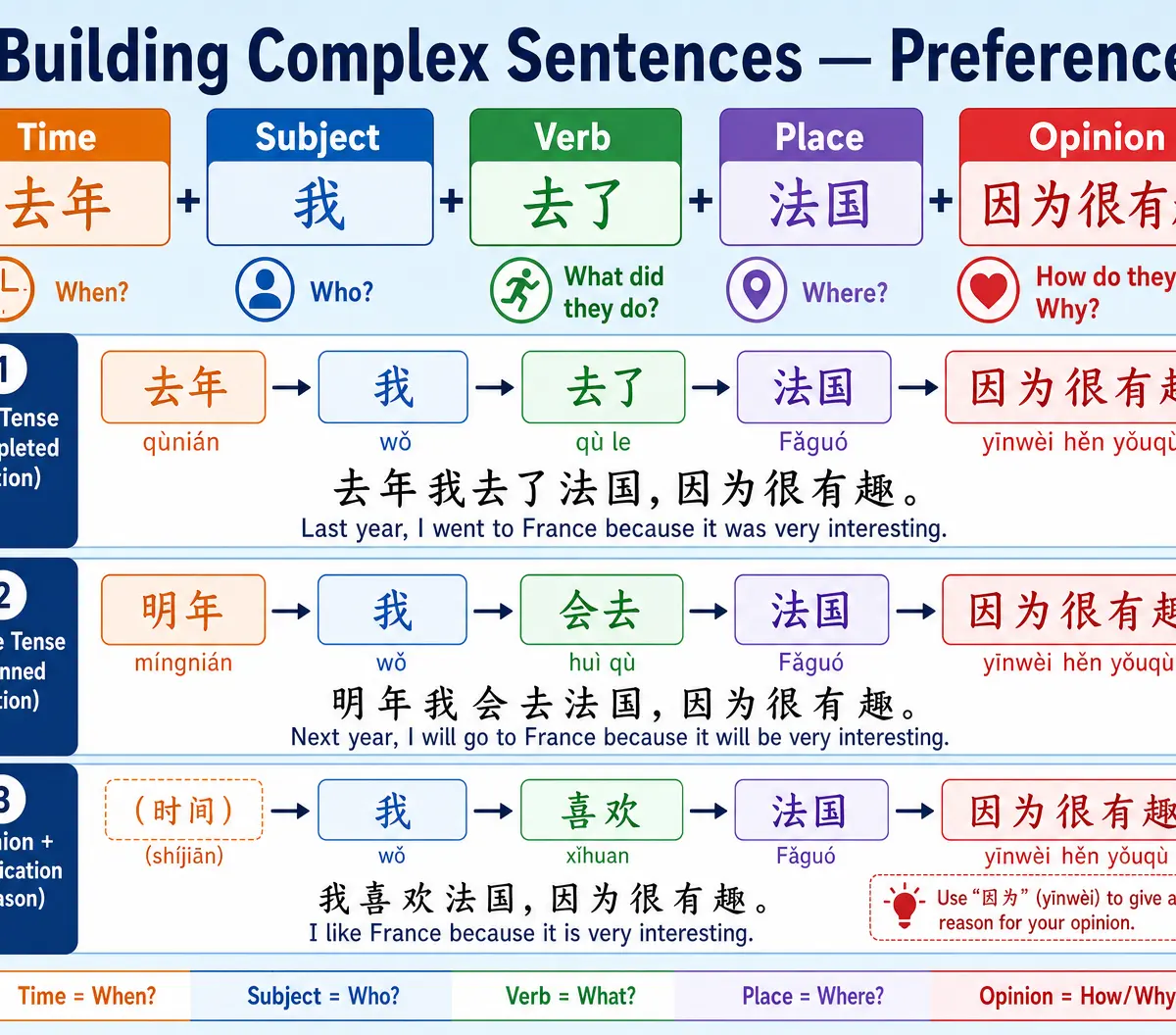
Key Structure 1: The Past Particle 了 (le)
When to use it: To indicate that an action has been completed in the past. This is crucial when narrating past holiday experiences.
Conjugation Table (Pattern)
| Time Word | Subject | Verb + 了 | Object | English |
|---|---|---|---|---|
| 去年 (qùnián) | 我 (wǒ) | 去了 (qù le) | 中国 (Zhōngguó) | Last year I went to China. |
| 昨天 (zuótiān) | 他 (tā) | 吃了 (chī le) | 烤鸭 (kǎoyā) | Yesterday he ate roast duck. |
| 上个月 (shàng gè yuè) | 我们 (wǒmen) | 买了 (mǎi le) | 纪念品 (jìniànpǐn) | Last month we bought souvenirs. |
| 以前 (yǐqián) | 他们 (tāmen) | 看了 (kàn le) | 电影 (diànyǐng) | Before, they watched a movie. |
Important Rule: Place 了 immediately after the verb. Do NOT use 了 with verbs of state or feeling (like 是, 在, 喜欢, 觉得).
Key Structure 2: Measure Words (量词 - liàngcí)
When to use it: Whenever you use a number with a noun, or when using 'this' (这个) or 'that' (那个).
Common Measure Words for Travel
| Measure Word | Used For | Example | English |
|---|---|---|---|
| 个 (gè) | General objects, people, months | 一个计划 (yí gè jìhuà) | one plan |
| 张 (zhāng) | Flat objects (tickets, maps, photos) | 两张机票 (liǎng zhāng jīpiào) | two plane tickets |
| 次 (cì) | Frequency of actions (times) | 去过三次 (qù guò sān cì) | have been three times |
| 家 (jiā) | Businesses (hotels, restaurants) | 一家酒店 (yì jiā jiǔdiàn) | one hotel |
| 件 (jiàn) | Luggage, clothing, matters | 一件行李 (yí jiàn xínglǐ) | one piece of luggage |
Key Structure 3: Expressing Future Intentions
When to use it: To discuss future holiday plans, which is a requirement for higher marks.
Conjugation Table (Pattern)
| Time Word | Subject | Intention Verb | Action | English |
|---|---|---|---|---|
| 明年 (míngnián) | 我 (wǒ) | 打算 (dǎsuàn - plan to) | 去法国 (qù Fǎguó) | Next year I plan to go to France. |
| 将来 (jiānglái) | 我们 (wǒmen) | 希望 (xīwàng - hope to) | 去海边 (qù hǎibiān) | In the future we hope to go to the seaside. |
| 下个暑假 (shàng gè shǔjià) | 她 (tā) | 想 (xiǎng - want to) | 学滑雪 (xué huáxuě) | Next summer holiday she wants to learn skiing. |
| 明天 (míngtiān) | 他们 (tāmen) | 会 (huì - will) | 坐火车 (zuò huǒchē) | Tomorrow they will take the train. |
🎧 Listening Skills
What to Expect
Listening tasks on this topic often feature monologues or dialogues where speakers discuss their recent holidays, complain about problems (like bad weather or delayed transport), or debate where to go next year. You will need to identify destinations, transport methods, activities, and the speaker's overall opinion.
Listening Strategies
- Time markers are crucial: Listen out for 去年 (last year), 现在 (now), or 明年 (next year). A speaker might say they went to Spain last year but are going to China next year. Ensure you answer for the correct timeframe.
- Listen for the 'but': Speakers often give a mixed opinion. They might say "The hotel was nice, 但是 (but) the food was terrible." Wait for the conjunction before deciding if their opinion is positive or negative.
- Note down numbers and transport: Quickly jot down times, durations (e.g., 三天 - three days), and transport methods as you hear them.
Common Listening Traps
- Distractors: The speaker might mention multiple places. "I wanted to go to the beach, but it rained, so we went to the museum instead." If the question asks where they actually went, the answer is the museum.
- False Friends/Similar Sounds: 船 (chuán - ship) and 床 (chuáng - bed) sound similar. 坐船 (take a ship) vs 起床 (get out of bed).
🗣️ Speaking Skills
Role Play Scenarios
Scenario 1: Buying a train ticket
- Attendant: 你好,你想去哪里?(Hello, where do you want to go?)
- You: 你好,我想买一张去北京的火车票。(Hello, I want to buy one train ticket to Beijing.)
- Attendant: 好的。你打算什么时候去?(Okay. When do you plan to go?)
- You: 我打算明天早上八点去。(I plan to go tomorrow morning at 8 o'clock.)
Scenario 2: Discussing holiday plans with a Chinese friend
- Friend: 你去年暑假去了哪里?(Where did you go last summer holiday?)
- You: 去年暑假我去了法国,因为我喜欢法国菜。(Last summer holiday I went to France, because I like French food.)
Photo Card Practice
Model Photo Card Response (A picture of a family at the beach):
- Qu 1 (Description): 照片里有四个人,他们在海边。天气很好,很晴朗。(In the photo there are four people, they are at the seaside. The weather is very good and sunny.)
- Qu 2 (Opinion): 我觉得他们很开心,因为他们在笑。我喜欢去海边,因为很放松。(I think they are very happy because they are smiling. I like going to the seaside because it is relaxing.)
- Qu 3 (Related topic): 在海边,我喜欢游泳和吃冰淇淋。(At the seaside, I like swimming and eating ice cream.)
- Qu 4 (Past/Future): 去年我去了西班牙的海边。明年我打算去山区,因为我想滑雪。(Last year I went to the seaside in Spain. Next year I plan to go to the mountains because I want to ski.)
- Qu 5 (Unpredictable): 旅行很重要,因为可以扩大眼界。(Travelling is very important because it can broaden horizons.)
General Conversation Questions
| Question (Chinese) | Model Answer | English Translation |
|---|---|---|
| 你喜欢什么样的假期? | 我最喜欢去海边度假,因为我喜欢游泳,而且我觉得海边很放松。 | What kind of holiday do you like? / I like going to the seaside for holidays the most, because I like swimming, and moreover I feel the seaside is very relaxing. |
| 你去年去了哪里? | 去年我和家人去了中国。我们参观了长城,吃了北京烤鸭,非常有意思。 | Where did you go last year? / Last year my family and I went to China. We visited the Great Wall and ate Beijing roast duck, it was very interesting. |
| 你觉得旅游有什么好处? | 我认为旅游有很多好处。首先,可以扩大眼界;其次,可以体验不同的文化。 | What do you think are the benefits of travelling? / I think travelling has many benefits. Firstly, it can broaden horizons; secondly, you can experience different cultures. |
| 你明年打算去哪里? | 明年我打算去山区滑雪。虽然天气会很冷,但是我觉得滑雪很刺激。 | Where do you plan to go next year? / Next year I plan to go to the mountains to ski. Although the weather will be very cold, I think skiing is very exciting. |
| 你喜欢和家人还是朋友一起去旅游?为什么? | 我更喜欢和朋友一起旅游,因为我们有一样的爱好,我们可以一起去购物。 | Do you prefer travelling with family or friends? Why? / I prefer travelling with friends, because we have the same hobbies, we can go shopping together. |
✍️ Writing Skills
Translation Practice
English → Chinese:
| English | Chinese | Key Grammar |
|---|---|---|
| I like going to China. | 我喜欢去中国。 | Basic SVO structure |
| Last year I went to France by train. | 去年我坐火车去了法国。 | Time word at start + Transport before Verb + 了 |
| The hotel was very big, but very expensive. | 酒店很大,但是很贵。 | 虽然/但是 structure (although/but) |
| I think travelling is very interesting. | 我认为旅游很有意思。 | Opinion phrase (我认为) |
| Next year I plan to go to the seaside because it is relaxing. | 明年我打算去海边,因为很放松。 | Future intention (打算) + Justification (因为) |
Extended Writing
Model 90-word response (Foundation):
我最喜欢去海边度假,因为我喜欢游泳,而且天气很好。去年暑假,我和家人去了西班牙。我们坐飞机去那里。西班牙很热。我们在海边玩得很高兴。我们吃了西班牙菜,很好吃。明年,我打算去中国,因为我想看长城。我觉得旅游很有意思。
(I like going to the seaside for holidays the most, because I like swimming, and the weather is good. Last summer holiday, my family and I went to Spain. We went there by plane. Spain was very hot. We had a great time playing at the seaside. We ate Spanish food, it was delicious. Next year, I plan to go to China, because I want to see the Great Wall. I think travelling is very interesting.)
Model 150-word response (Higher):
对我来说,假期非常重要,因为我可以放松休息。我最喜欢去城市旅游,因为我喜欢购物和参观名胜古迹。
去年暑假,我和家人坐飞机去了中国北京。我们住在一家很舒服的酒店里。在北京,我们不但参观了长城,而且吃了有名的北京烤鸭。虽然天气很热,但是我们玩得非常开心。这是一次难忘的经历。
将来,我希望能和朋友一起去法国旅游。我们打算坐火车去巴黎。我认为去国外旅游有很多好处。俗话说:读万卷书,行万里路。旅游不仅可以让我们体验不同的文化,还可以扩大眼界。所以,无论去哪里,我都喜欢旅游。
(For me, holidays are very important because I can relax and rest. I like city holidays the most, because I like shopping and visiting historical sites. Last summer holiday, my family and I flew to Beijing, China. We stayed in a very comfortable hotel. In Beijing, we not only visited the Great Wall, but also ate the famous Beijing roast duck. Although the weather was very hot, we had an extremely good time. This was an unforgettable experience. In the future, I hope to travel to France with my friends. We plan to take the train to Paris. I think travelling abroad has many benefits. As the saying goes: Read 10,000 books, travel 10,000 miles. Travelling can not only let us experience different cultures, but also broaden our horizons. Therefore, no matter where I go, I always like travelling.)
Writing Checklist
- ✅ Three Tenses: Have you used past (去年/了), present (现在/喜欢), and future (明年/打算)?
- ✅ Opinions & Reasons: Have you used 认为/觉得 and justified with 因为?
- ✅ Connectives: Have you linked sentences using 但是, 而且, or 不但...而且...?
- ✅ Accuracy: Are your measure words correct? Is the time word at the beginning of the sentence?
- ✅ Complexity (Higher): Have you included an idiom (成语) or complex structure (无论...都...)?
📚 Reading Skills
Key Strategies
- Skim for gist: Read the whole text quickly to understand the general topic before looking at the questions.
- Identify characters: Look for name markers or pronouns to understand who is doing what.
- Scan for keywords: If the question asks "How did they travel?", scan the text for transport vocabulary (飞机, 火车, etc.).
False Friends & Tricky Words
| Word | Looks Like / Sounds Like | Actually Means |
|---|---|---|
| 酒店 (jiǔdiàn) | Alcohol shop | Hotel |
| 饭店 (fàndiàn) | Rice shop | Restaurant / Hotel |
| 爱人 (àiren) | Lover (boyfriend/girlfriend) | Spouse (husband/wife) |
| 马上 (mǎshàng) | On a horse | Immediately / Right away |
🌍 Cultural Knowledge
When writing or speaking about holidays in Chinese-speaking countries, referencing specific cultural knowledge will impress examiners:
- Golden Weeks (黄金周): China has two major week-long holidays where millions travel: Spring Festival (Chinese New Year, usually Jan/Feb) and National Day holiday (first week of October). Mentioning that travel during these times is very busy (人山人海 - mountains and seas of people) shows excellent cultural awareness.
- High-Speed Rail (高铁 - gāotiě): China has the world's largest high-speed rail network. Mentioning 坐高铁 (taking the high-speed train) rather than just 火车 is a sophisticated cultural detail.
- Famous Sites: Knowing specific places beyond just 'China'. Mentioning the Great Wall (长城) in Beijing, the Terracotta Army (兵马俑) in Xi'an, or the Bund (外滩) in Shanghai adds authenticity to your answers.
Visual Resources
3 diagrams and illustrations


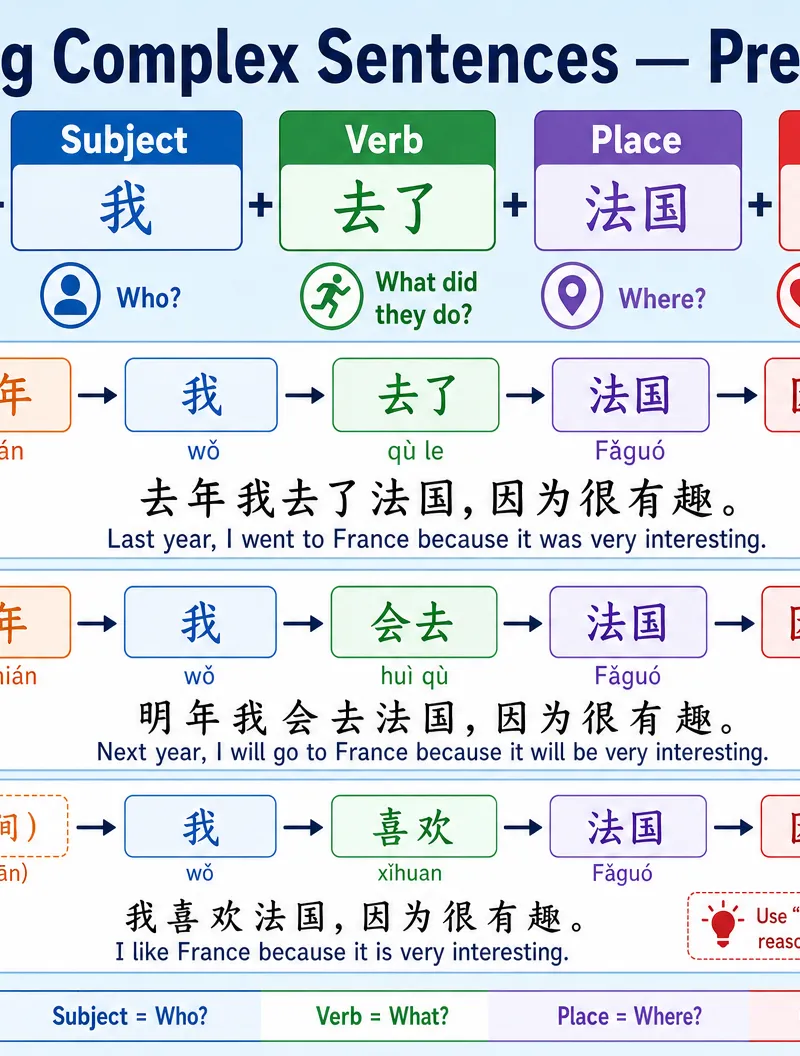
Interactive Diagrams
1 interactive diagram to visualise key concepts
Conceptual Flow Outline
Timeframe strategy for extended writing and speaking
Worked Examples
4 worked examples — open one to explore the question and available guidance.
Practice Questions
Try the question, then reveal an answer plan or example response
Writing (Foundation): Translate this sentence into Chinese: 'Last year I went to France. It was very fun.'
Hint: Remember the time word goes first, and you need the past particle 'le'.
Speaking (General Conversation): 你明年打算去哪里度假?为什么? (Where do you plan to go on holiday next year? Why?)
Hint: Use the future intention verb 'dǎsuàn' (plan to) and justify your answer with 'yīnwèi' (because).
Writing (Higher): Write a paragraph (approx 50 words) comparing a past holiday with a future planned holiday.
Hint: Use 'qùnián' + 'le' for the past, and 'míngnián' + 'dǎsuàn' for the future. Include opinions for both.
Reading (Standard): Read the sentence and answer in English. '虽然酒店的设施很齐全,但是离市中心太远了,交通不便利。' What was the problem with the hotel?
Hint: Look for the negative point after the word '但是' (but).
Listening (Higher): Listen to the sentence. '以前我不喜欢坐飞机,因为我觉得不安全。但是现在我经常坐飞机去国外出差。' How has the speaker's opinion changed?
Hint: Contrast 'yǐqián' (before) with 'xiànzài' (now).
Writing (Translation): Translate into Chinese: 'I think travelling is important because it can broaden horizons.'
Hint: Use 'rènwéi' for 'think' and 'kuòdà yǎnjiè' for 'broaden horizons'.
Exam technique
How to turn what you know into marks
How to approach the question
Skill-by-skill strategy: Listening — read questions first, note keywords. Speaking — prepare opinions in advance, have fillers ready. Reading — skim first, then detail. Writing — plan before writing, check accuracy after.
How to structure your answer
Writing: Introduction → Main points with opinions → Justified reasons → Different tenses → Conclusion. Speaking: Give opinion → Justify → Extend → Use different tense.
Timing
Listening: 35-45 mins (Foundation/Higher). Speaking: 10-12 mins prep + 7-12 mins speaking. Reading: 45-60 mins. Writing: 60-75 mins.
Common pitfalls
- Forgetting the past tense marker 了 (le) when narrating past holidays
- Using English word order (putting the time word at the end of the sentence)
- Giving one-word Speaking answers instead of developing responses with 因为
- Omitting measure words between numbers and nouns (e.g., writing 一票 instead of 一张票)
- Confusing false friends like 酒店 (hotel) and 饭店 (restaurant/hotel)
- Not using at least three different timeframes in extended writing tasks
What the command words want
- Describe the photo
- Start with literal description (who, where, weather), then move to inference (I think they are...), then relate to your own experience.
- Translate into Chinese
- Pay close attention to word order (Time-Subject-Verb) and ensure measure words are included.
- Translate into English
- Focus on capturing the accurate meaning and tense, rather than a literal word-for-word translation that sounds unnatural.
- Write approximately 90 words
- Foundation task — ensure you address every single bullet point in the prompt. Missing a bullet point caps your maximum mark.
- Write approximately 150 words
- Higher task — must include 3 timeframes, justified opinions, complex structures (e.g., 虽然...但是...), and ambitious vocabulary.
Watch or listen (optional)
Test your understanding of Preferences
Active recall beats re-reading. Take an instant quiz now to test what you’ve learned and lock it into long-term memory.
7 days Premium · Then the free plan continues · No card, no charge