Pearson Edexcel · GCSE · Chinese
Course version: Pearson-GCSE-Chinese · Version from Mar 2026
Training
This topic covers essential vocabulary and grammar for discussing training, future aspirations, and volunteering in Chinese. Key skills tested include using time expressions for three tenses, expressing justified opinions, and deploying complex structures like 打算 (plan to) and 希望 (hope to) across listening, speaking, reading, and writing tasks.
- 14 min read
- 4 worked examples
- 6 practice questions
- 8 key terms
Check what you remember
Read the wording for your board, then hide it and explain Time Word Position in your own words. Rough notes are fine. This is a self-check, with no mark or grade.
Reference: Pearson Edexcel
In Chinese, words indicating time (yesterday, next year, in the future) must be placed at the beginning of the sentence or immediately after the subject, NEVER at the end.
Study Notes

Overview
The "Training and Future Aspirations" topic is a core component of the GCSE Chinese specification. It appears across all four papers and tests your ability to discuss education, career plans, and voluntary work. This topic is particularly important because it naturally invites the use of past, present, and future timeframes—a key requirement for accessing higher mark bands. Examiners look for your ability to express and justify opinions about different career paths, describe past work experiences or training, and articulate future ambitions using sophisticated vocabulary and structures.
📖 Essential Vocabulary
Tier 1 — Foundation Core
| Chinese | English | Pinyin | Example Sentence |
|---|---|---|---|
| 学习 | to study / learning | xuéxí | 我在学校学习中文。 (I study Chinese at school.) |
| 工作 | work / job | gōngzuò | 我爸爸的工作很忙。 (My dad's work is very busy.) |
| 大学 | university | dàxué | 我哥哥在大学学习。 (My older brother studies at university.) |
| 考试 | exam | kǎoshì | 明天我有一个数学考试。 (Tomorrow I have a maths exam.) |
| 医生 | doctor | yīshēng | 我妈妈是一个医生。 (My mum is a doctor.) |
| 老师 | teacher | lǎoshī | 我们的中文老师很好。 (Our Chinese teacher is very good.) |
| 钱 | money | qián | 我想赚很多钱。 (I want to earn a lot of money.) |
| 医院 | hospital | yīyuàn | 医生在医院工作。 (Doctors work in a hospital.) |
| 学校 | school | xuéxiào | 我们的学校很大。 (Our school is very big.) |
| 有意思 | interesting | yǒu yìsi | 我觉得科学很有意思。 (I think science is very interesting.) |
| 难 | difficult | nán | 昨天的考试很难。 (Yesterday's exam was difficult.) |
| 将来 | in the future | jiānglái | 将来我想去中国。 (In the future I want to go to China.) |
| 现在 | now | xiànzài | 现在我在做作业。 (Now I am doing homework.) |
| 以前 | before / in the past | yǐqián | 以前我不喜欢运动。 (In the past I didn't like sports.) |
| 帮助 | to help | bāngzhù | 我喜欢帮助别人。 (I like to help other people.) |
Tier 2 — Higher Tier
| Chinese | English | Pinyin | Example Sentence |
|---|---|---|---|
| 培训 | training | péixùn | 下个月我要参加一个电脑培训。 (Next month I will participate in computer training.) |
| 志愿者 | volunteer | zhìyuànzhě | 周末我做社区志愿者。 (At the weekend I work as a community volunteer.) |
| 职业 | career / profession | zhíyè | 教师是一个很好的职业。 (Teaching is a very good profession.) |
| 实习 | internship / work experience | shíxí | 去年夏天我在银行实习。 (Last summer I did an internship at a bank.) |
| 学位 | academic degree | xuéwèi | 我想在大学拿一个科学学位。 (I want to get a science degree at university.) |
| 工资 | salary / wages | gōngzī | 工程师的工资很高。 (An engineer's salary is very high.) |
| 经验 | experience | jīngyàn | 实习给我很多工作经验。 (An internship gives me a lot of work experience.) |
| 成功 | success / successful | chénggōng | 只要努力,你就会成功。 (As long as you work hard, you will be successful.) |
| 挑战 | challenge | tiǎozhàn | 我喜欢有挑战性的工作。 (I like challenging work.) |
| 责任 | responsibility | zérèn | 经理有很大的责任。 (A manager has a lot of responsibility.) |
High-Frequency Words & Phrases
| Phrase | English | Usage Context |
|---|---|---|
| 我打算... | I plan to... | Essential for discussing future career or study plans. |
| 我希望... | I hope to... | Used for expressing aspirations and dreams. |
| 对...有兴趣 | To be interested in... | Great for explaining why you want to pursue a certain career. |
| 为了... | In order to... | Used to explain the purpose of studying or training. |
| 赚更多钱 | Earn more money | A common reason given for career choices. |
| 帮助社会 | Help society | Excellent for discussing volunteering or socially conscious careers. |
| 只要...就... | As long as... then... | A complex structure to show condition (e.g., as long as I work hard, I will succeed). |
| 无论...都... | No matter... all... | Another complex structure (e.g., no matter how hard it is, I will try). |
| 积累经验 | Accumulate experience | Use when discussing the benefits of internships or part-time jobs. |
| 适合我 | Suits me | Perfect for justifying why a job is right for you. |
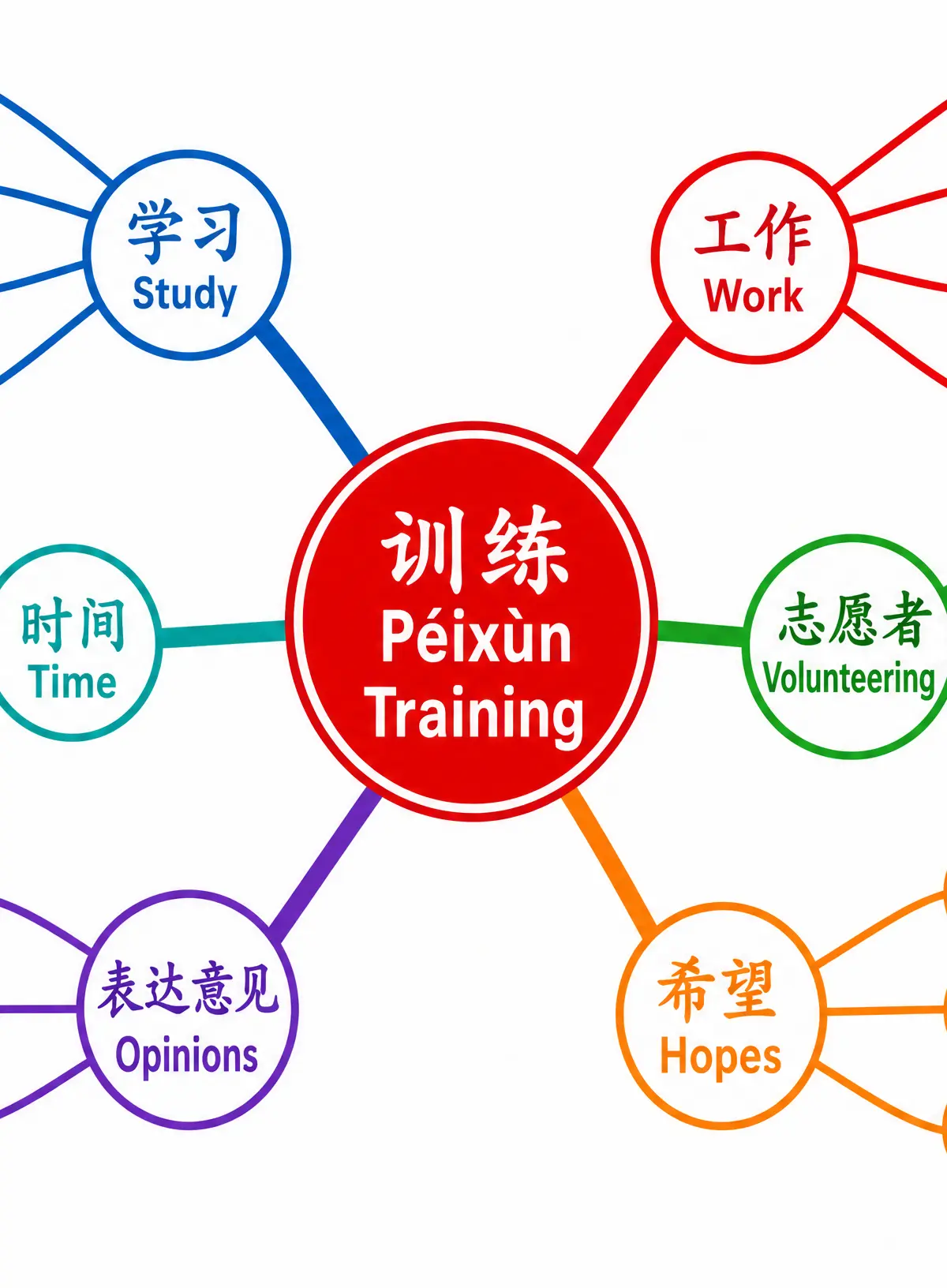
📝 Grammar Focus
Key Structure 1: Expressing Future Plans with 打算 (dǎsuàn) and 希望 (xīwàng)
When to use it: Use these verbs to discuss your career aspirations, university plans, or future training. They are more sophisticated than simply using 想 (want to) or 要 (will/want to) and immediately signal to the examiner that you are using higher-level vocabulary.
Usage Table
| Subject | Auxiliary Verb | Action/Verb Phrase | English Translation |
|---|---|---|---|
| 我 (I) | 打算 (plan to) | 去中国学习 (go to China to study) | I plan to go to China to study. |
| 哥哥 (Older brother) | 打算 (plans to) | 找一份兼职工作 (find a part-time job) | Older brother plans to find a part-time job. |
| 我 (I) | 希望 (hope to) | 成为一名医生 (become a doctor) | I hope to become a doctor. |
| 姐姐 (Older sister) | 希望 (hopes to) | 拿到好成绩 (get good grades) | Older sister hopes to get good grades. |
Examiner Tip: To access the highest marks, combine these with time phrases: 将来我打算... (In the future I plan to...)
Key Structure 2: Expressing Conditions with 只要... 就... (zhǐyào... jiù...)
When to use it: This is a complex grammatical structure that means "As long as... then...". It is perfect for discussing the requirements for success in training or careers.
Usage Table
| 只要 (As long as) | Condition | 就 (then) | Result | English Translation |
|---|---|---|---|---|
| 只要 | 努力学习 | 就 | 能考上好大学 | As long as you study hard, you can get into a good university. |
| 只要 | 有工作经验 | 就 | 容易找工作 | As long as you have work experience, it is easy to find a job. |
| 只要 | 你喜欢 | 就 | 会做得好 | As long as you like it, you will do it well. |
Examiner Tip: Using complex conjunctions like this is a specific requirement for the top mark band in Higher tier writing and speaking.
Key Structure 3: Timeframes without Verb Conjugation
When to use it: Unlike French or Spanish, Chinese verbs do not change form to show tense. Instead, you must use specific time words at the beginning of the sentence to establish whether an event happened in the past, is happening now, or will happen in the future. You MUST show three timeframes in your extended responses.
Usage Table
| Timeframe | Time Word | Subject | Verb Phrase | English Translation |
|---|---|---|---|---|
| Past | 小时候 (When young) | 我 | 想当警察。 | When I was young, I wanted to be a police officer. |
| Past | 去年 (Last year) | 我 | 去了银行实习。 | Last year I went to do an internship at a bank. |
| Present | 现在 (Now) | 我 | 在努力准备考试。 | Now I am studying hard to prepare for exams. |
| Future | 将来 (In the future) | 我 | 打算做志愿者。 | In the future I plan to be a volunteer. |
| Future | 明年 (Next year) | 我 | 希望去大学。 | Next year I hope to go to university. |
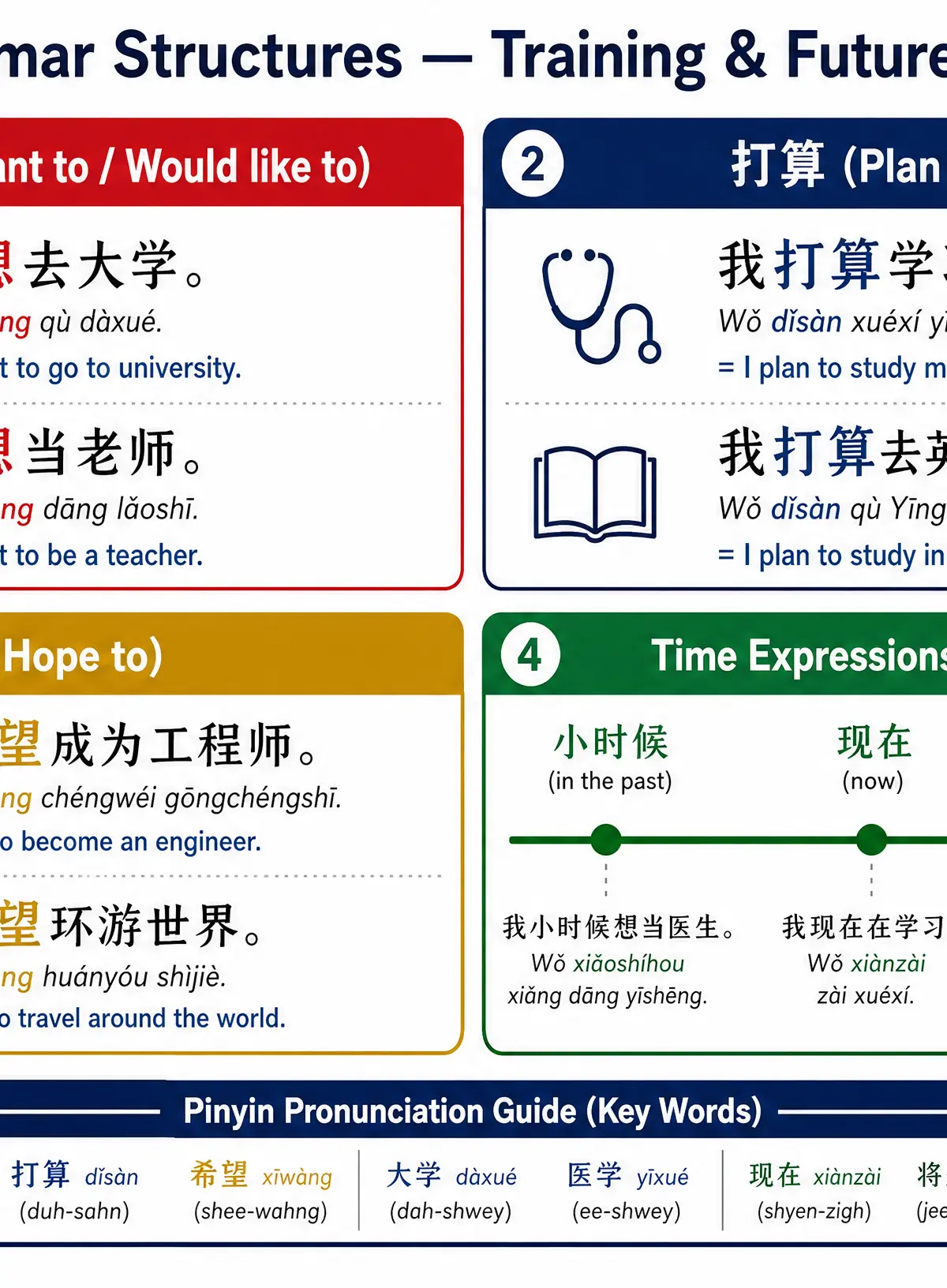
🎧 Listening Skills
What to Expect
In the listening exam, you will hear short conversations, announcements, or interviews about people's jobs, their work experience, or their future study plans. At Foundation tier, you might match jobs to places of work. At Higher tier, you will need to identify specific opinions about a job (e.g., why someone likes or dislikes their training) or distinguish between what someone did in the past versus what they plan to do in the future.
Listening Strategies
- Listen for Time Markers: Pay close attention to words like 以前 (before), 去年 (last year), 现在 (now), and 将来 (future). The question might ask "What did he want to be?" and the audio will mention both his past and present desires.
- Listen for Opinion Qualifiers: Watch out for words like 虽然 (although) and 但是 (but). A speaker might say "虽然工资很高,但是工作太累" (Although the salary is high, the work is too tiring). If the question asks "What is the disadvantage?", the answer follows 但是.
- Note Numbers and Dates: You may hear salaries, working hours, or the duration of a training course. Jot these down immediately in the margin.
Common Listening Traps
- False Friends/Similar Sounds: 医生 (yīshēng - doctor) and 学生 (xuéshēng - student) sound similar. 培训 (péixùn - training) and 练习 (liànxí - practice) are related but distinct concepts.
- Multiple Jobs Mentioned: A speaker might say "My dad is a teacher, but I want to be an engineer." Ensure you are answering about the correct person.
🗣️ Speaking Skills
Role Play Scenarios
Scenario 1: Arranging an internship (Foundation/Higher)
Teacher: 你想在哪儿实习? (Where do you want to do your internship?)
Student: 我想在医院实习,因为我想当医生。 (I want to do an internship in a hospital, because I want to be a doctor.)
Teacher: 你的工作经验是什么? (What is your work experience?)
Student: 去年我在学校做过志愿者。 (Last year I worked as a volunteer at school.)
Photo Card Practice
Model Photo Card Response (A photo showing students in a classroom or training session):
- Qu 1 (Description): 照片里有三个学生,他们在教室里学习。他们看起来很高兴。 (In the photo there are three students, they are studying in a classroom. They look happy.)
- Qu 2 (Opinion): 我觉得学习很重要,因为可以学到新知识。 (I think studying is very important, because you can learn new knowledge.)
- Qu 3 (Related topic): 在我的学校,老师教得很好,我们有很多作业。 (In my school, the teachers teach very well, we have a lot of homework.)
- Qu 4 (Past/Future): 将来,我打算去大学学习科学,因为我想做科学家。 (In the future, I plan to go to university to study science, because I want to be a scientist.)
- Qu 5 (Unpredictable): 如果我有钱,我会去别的国家学习,体验不同的文化。 (If I had money, I would go to another country to study and experience a different culture.)
General Conversation Questions
| Question (Chinese) | Model Answer | English Translation |
|---|---|---|
| 你将来想做什么工作?为什么? | 将来我希望成为一名工程师,因为我对数学和科学很有兴趣,而且工程师的工资很高。 | What job do you want to do in the future? Why? -> In the future I hope to become an engineer, because I am very interested in maths and science, and an engineer's salary is very high. |
| 你做过兼职工作吗? | 去年夏天,我在一家商店做过兼职。虽然很累,但是我学到了很多沟通的技巧。 | Have you done a part-time job? -> Last summer, I did a part-time job in a shop. Although it was tiring, I learned a lot of communication skills. |
| 你觉得上大学重要吗? | 我认为上大学非常重要。只要你有大学学位,就更容易找到好工作。 | Do you think going to university is important? -> I think going to university is extremely important. As long as you have a university degree, it is easier to find a good job. |
| 你打算做志愿者吗? | 是的,明年我打算去社区做志愿者。我想帮助老人,因为我觉得这很有意义。 | Do you plan to be a volunteer? -> Yes, next year I plan to go to the community to be a volunteer. I want to help elderly people, because I think this is very meaningful. |
| 小时候你想做什么? | 小时候我想当警察,但是现在我改变了主意,我想做老师。 | What did you want to be when you were young? -> When I was young I wanted to be a police officer, but now I have changed my mind, I want to be a teacher. |
✍️ Writing Skills
Translation Practice
English → Chinese:
| English | Chinese | Key Grammar |
|---|---|---|
| I want to be a teacher. | 我想当老师。 | Basic desire (想 + verb) |
| Next year I plan to go to university. | 明年我打算去大学。 | Future plan (Time word + 打算) |
| Last week I did an internship at a bank. | 上个星期我在银行实习了。 | Past action (Time word + verb + 了) |
| Although the work is hard, the salary is high. | 虽然工作很辛苦,但是工资很高。 | Complex conjunction (虽然...但是...) |
| I hope to become a doctor in order to help people. | 我希望成为医生,为了帮助别人。 | Aspiration and purpose (希望 + 为了) |
Extended Writing
**Model 90-word response (Foundation):**Write a blog post about your future plans. Mention: what job you want, why you want it, your school subjects, and your work experience.
将来,我想当一名医生。我觉得做医生很好,因为我喜欢帮助别人,而且医生的工资很高。现在,我在学校学习科学和数学,我的成绩很好。去年夏天,我在一家医院做了一个星期的实习。虽然工作很累,但是很有意思。明年我打算去大学学习医学。我希望我的梦想能实现。
(Translation: In the future, I want to be a doctor. I think being a doctor is very good, because I like helping people, and a doctor's salary is very high. Now, I am studying science and maths at school, my grades are very good. Last summer, I did a one-week internship at a hospital. Although the work was tiring, it was very interesting. Next year I plan to go to university to study medicine. I hope my dream can come true.)
**Model 150-word response (Higher):**Write an article for a school magazine about training and careers. Mention: your ideal career and reasons, the importance of university, a past work experience, and volunteering.
谈到将来的职业,我真心希望成为一名工程师。我对电脑和科学非常感兴趣。我认为工程师不仅是一个有挑战性的工作,而且对社会有很大的贡献。为了实现这个目标,我打算去一所好大学拿一个工程学位。我觉得上大学非常重要,因为只要你有高学历,就更容易找到理想的工作。
去年暑假,我在一家科技公司做了一个月的实习。在那儿,我学到了很多书本上学不到的知识,也积累了宝贵的工作经验。虽然每天工作八个小时很辛苦,但是同事们都很友好,我过得很充实。
除了学习和工作,我也打算在周末做社区志愿者。教小孩子用电脑不仅能帮助他们,也能锻炼我的沟通能力。总之,我会努力学习,迎接未来的挑战。
(Translation: Speaking of future careers, I sincerely hope to become an engineer. I am extremely interested in computers and science. I think an engineer is not only a challenging job, but also makes a big contribution to society. In order to achieve this goal, I plan to go to a good university to get an engineering degree. I feel going to university is extremely important, because as long as you have high qualifications, it is easier to find an ideal job. Last summer holidays, I did a one-month internship at a tech company. There, I learned a lot of knowledge you can't learn from books, and also accumulated valuable work experience. Although working 8 hours a day was hard, the colleagues were very friendly, and I had a fulfilling time. Besides studying and working, I also plan to be a community volunteer at weekends. Teaching young children to use computers not only helps them, but also exercises my communication skills. In summary, I will study hard to meet future challenges.)
Writing Checklist
- ✅ Three Timeframes: Have I clearly used past (去年/以前), present (现在), and future (将来/明年) markers?
- ✅ Opinions & Justifications: Have I used 我觉得/我认为 and backed it up with 因为/为了?
- ✅ Complex Structures: Did I include at least one 虽然...但是 (although...but) or 只要...就 (as long as...then)?
- ✅ Ambitious Vocabulary: Did I use words like 实习 (internship), 培训 (training), or 志愿者 (volunteer) instead of just basic vocabulary?
- ✅ Accuracy: Is my word order correct? (Time words MUST go before the verb!).
📚 Reading Skills
Key Strategies
- Skim for Gist: Read the whole text quickly to understand the general context before looking at the questions.
- Identify the Subject: In Chinese, the subject is often dropped if it is understood from context. Make sure you track who is doing the action, especially in texts comparing different people's career plans.
- Scan for Question Keywords: If a question asks about "salary", scan the text specifically for the characters 工资 or 钱.
False Friends & Tricky Words
| Word | Looks Like | Actually Means |
|---|---|---|
| 毕业 (bìyè) | To work (looks like 职业) | To graduate |
| 练习 (liànxí) | Training (培训) | To practice (usually academic exercises) |
| 理想 (lǐxiǎng) | Reason (理由) | Ideal (e.g., 理想的工作 = ideal job) |
| 决定 (juédìng) | Definitely (一定) | To decide / decision |
🌍 Cultural Knowledge
Understanding Chinese culture adds depth to your writing and speaking responses, showing examiners you have a broader appreciation of the language.
- The Gaokao (高考): The National College Entrance Examination in China is incredibly competitive and determines university admissions. Mentioning the pressure of the Gaokao shows excellent cultural awareness.
- Respect for Education: In Chinese culture, education and teachers are highly respected. Professions like doctors, engineers, and teachers are traditionally viewed as very prestigious.
- Volunteering: Volunteering (做志愿者) is becoming increasingly popular among young people in China, especially for large events or community service, and is seen as a valuable way to gain experience before entering the competitive job market.
Visual Resources
2 diagrams and illustrations
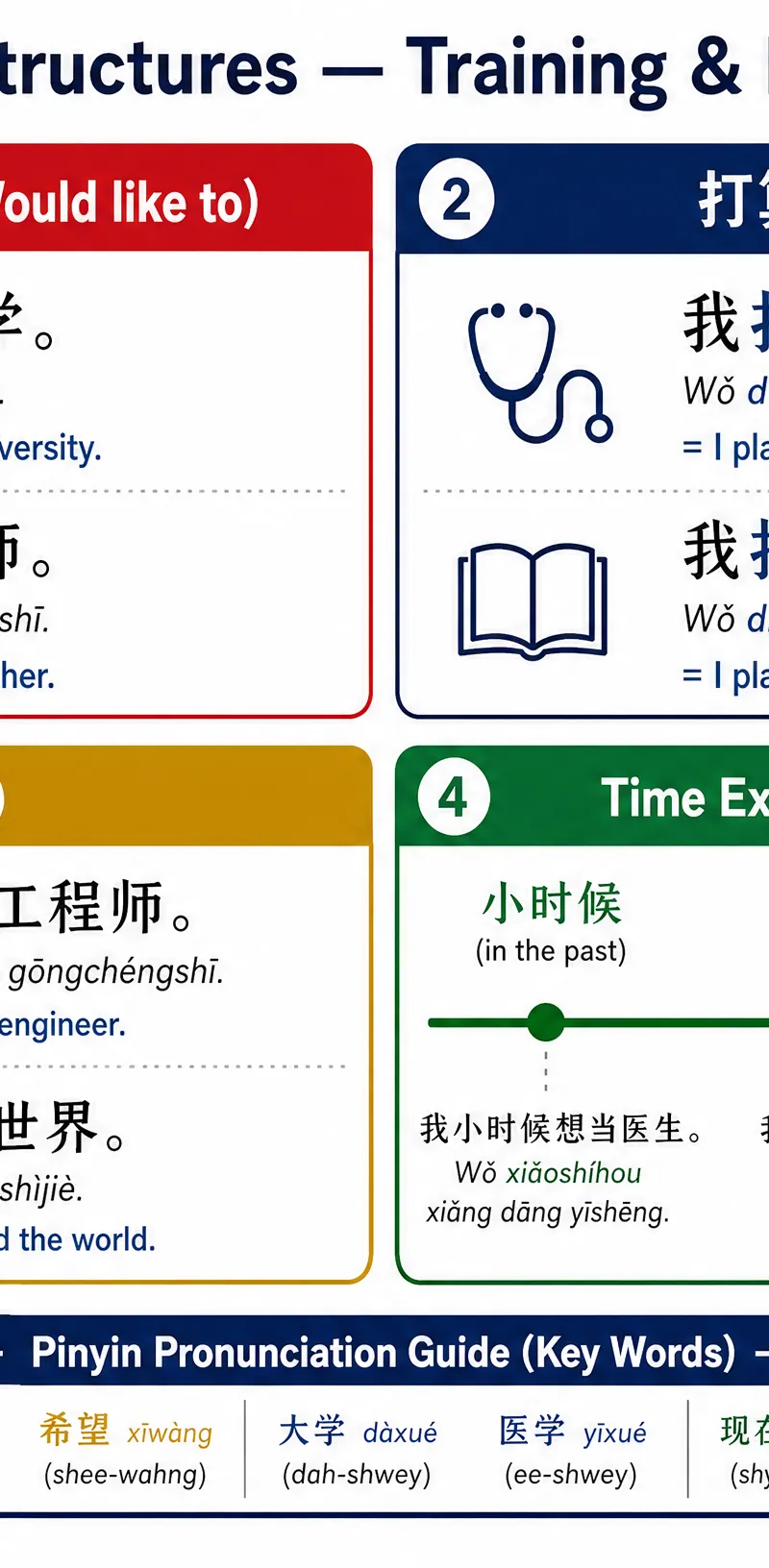
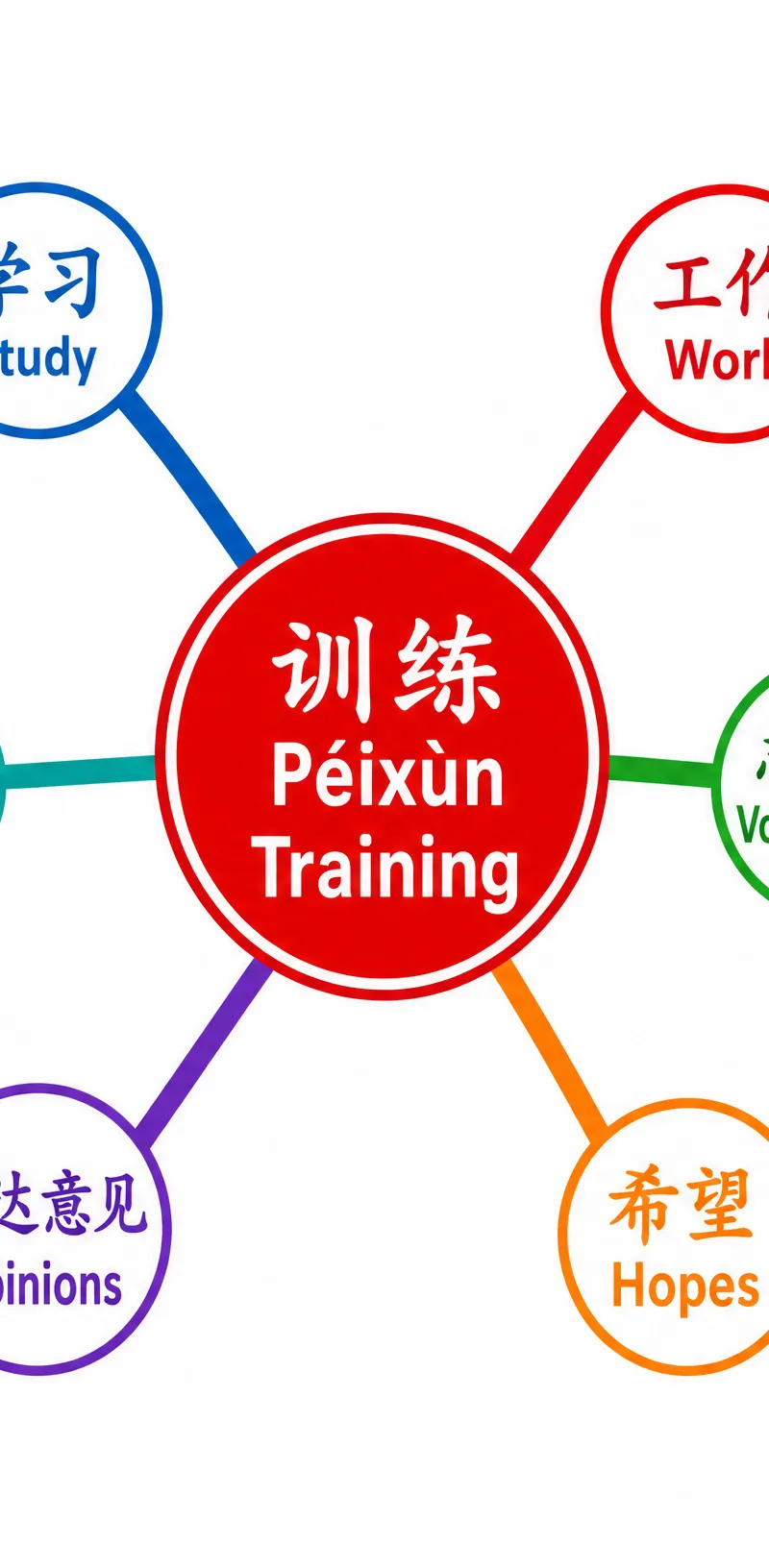
Interactive Diagrams
1 interactive diagram to visualise key concepts
Conceptual Flow Outline
GCSE Chinese Exam Approach by Skill
Worked Examples
4 worked examples — open one to explore the question and available guidance.
Practice Questions
Try the question, then reveal an answer plan or example response
Writing (Foundation): Write approximately 90 words about your work experience. Include: where you worked, what you did, your opinion of the work, and your future plans.
Hint: Ensure you cover all 4 bullet points. Use past tense for the first two bullets, present for the third, and future for the fourth.
Speaking (Photo Card): Look at a photo of someone volunteering. Prepare to answer: 1) What is in the photo? 2) Do you think volunteering is important? 3) Have you volunteered before? 4) What will you do next year?
Hint: Use the 5-point strategy: Describe -> Opinion -> Justify -> Past -> Future.
Translation (Higher): Translate into Chinese: 'Although the training is difficult, I plan to work hard because I hope to become a successful doctor in the future.'
Hint: Break it down: Use 虽然...但是 for 'although', 打算 for 'plan to', and 希望 for 'hope to'. Remember time word position!
Reading (Standard): Read the text. 玛丽说:“我以前想当老师,但是实习以后,我觉得做老师太累了。现在我对电脑很有兴趣,所以将来我打算做电脑工程师。” Question: Why did Mary change her career plan?
Hint: Look for the reason given after her work experience.
Listening (Higher): Listen to the audio. 经理说:“我们公司需要有经验的人。虽然大学学位很重要,但是我们更看重你的沟通能力和团队合作精神。” Question: What does the manager value more than a university degree?
Hint: Listen for the comparative '更' (more) after the concession '虽然...但是'.
Writing (Higher): Translate into English: 为了积累工作经验,去年暑假我去了一家公司实习。同事们不仅很友好,而且教会了我很多东西。
Hint: Identify the purpose phrase (为了), the time phrase, and the complex structure (不仅...而且).
Exam technique
How to turn what you know into marks
How to approach the question
Skill-by-skill strategy: Listening — read questions first, note keywords and time markers. Speaking — prepare opinions in advance, have fillers ready, use repair strategies. Reading — skim for gist first, then scan for details matching the question. Writing — plan tenses and vocabulary before writing, check word order accuracy after.
How to structure your answer
Writing: Introduction (Current situation) → Past experience (实习/工作) → Future plans (打算/希望) → Justified opinions (我觉得...因为) → Conclusion. Speaking: Give opinion → Justify with reason → Extend with an example → Use a different tense.
Timing
Listening: 25-35 mins (heard twice). Speaking: 7-12 mins total (role play + photo card + conversation). Reading: 45-60 mins. Writing: 60-75 mins (translation + structured + extended).
Common pitfalls
- Putting time expressions at the end of the sentence (e.g., 我去大学明年 instead of 明年我去大学).
- Using only the present tense — examiners require at least 3 timeframes at Higher tier.
- Giving one-word Speaking answers instead of developing responses with opinions and reasons.
- Translating English grammar directly into Chinese (Mother-tongue interference).
- Failing to cover all bullet points in the writing tasks.
- Ignoring tones during the speaking exam, making words incomprehensible.
What the command words want
- Describe the photo
- Say what you can see literally, give an opinion on the activity, and relate it to a past or future experience.
- Translate into Chinese
- Write full sentences with correct Chinese grammar. Do not translate English articles (a/the) or tense markers literally.
- Translate into English
- Focus on meaning over word-for-word translation. Ensure the English sentence makes logical sense.
- Write approximately 90 words
- Foundation task — ensure you cover all 4 bullet points clearly. Use present tense and at least one other timeframe (past or future).
- Write approximately 150 words
- Higher task — must include 3 timeframes, justified opinions, complex structures (like 虽然...但是), and ambitious vocabulary.
Watch or listen (optional)
Test your understanding of Training
Active recall beats re-reading. Take an instant quiz now to test what you’ve learned and lock it into long-term memory.
7 days Premium · Then the free plan continues · No card, no charge