Pearson Edexcel · GCSE · Chinese
Course version: Pearson-GCSE-Chinese · Version from Mar 2026
Travel
This comprehensive GCSE Chinese Travel guide equips you with essential vocabulary for transport, accommodation, and directions. You will master three crucial grammar structures (要, 过, and measure words) to access higher marks across Listening, Speaking, Reading, and Writing.
- 11 min read
- 4 worked examples
- 6 practice questions
- 8 key terms
Check what you remember
Read the wording for your board, then hide it and explain Measure Word (量词 liàng cí) in your own words. Rough notes are fine. This is a self-check, with no mark or grade.
Reference: Pearson Edexcel
A classifying word that must be inserted between a number and a noun. (e.g., 个, 张, 条).
Study Notes
Overview
The Travel (旅行) topic is a core pillar of the GCSE Chinese specification. It appears consistently across all four skills: Listening, Speaking, Reading, and Writing. Mastering this topic not only prepares you for travel-specific questions but also provides you with high-frequency vocabulary and grammatical structures that can be applied synoptically to other themes, such as 'Holidays' and 'Free Time'. Examiners specifically look for your ability to use past, present, and future timeframes confidently, express justified opinions, and use appropriate measure words.
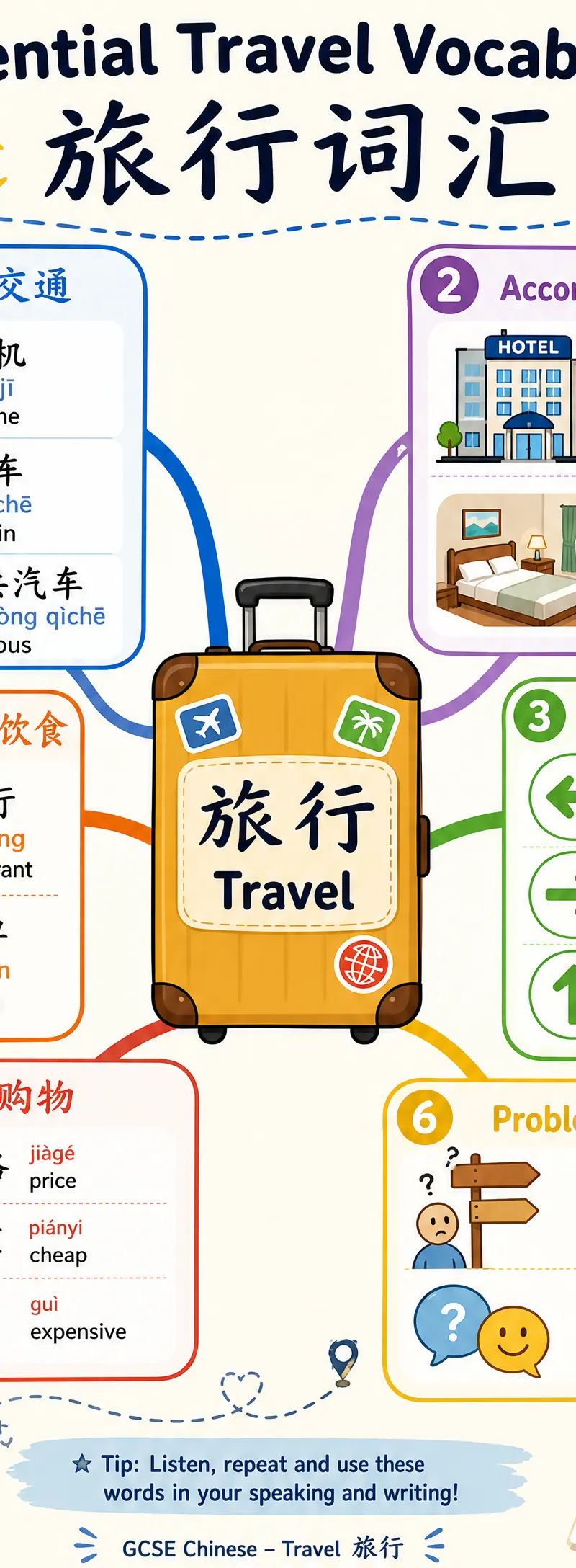
📖 Essential Vocabulary
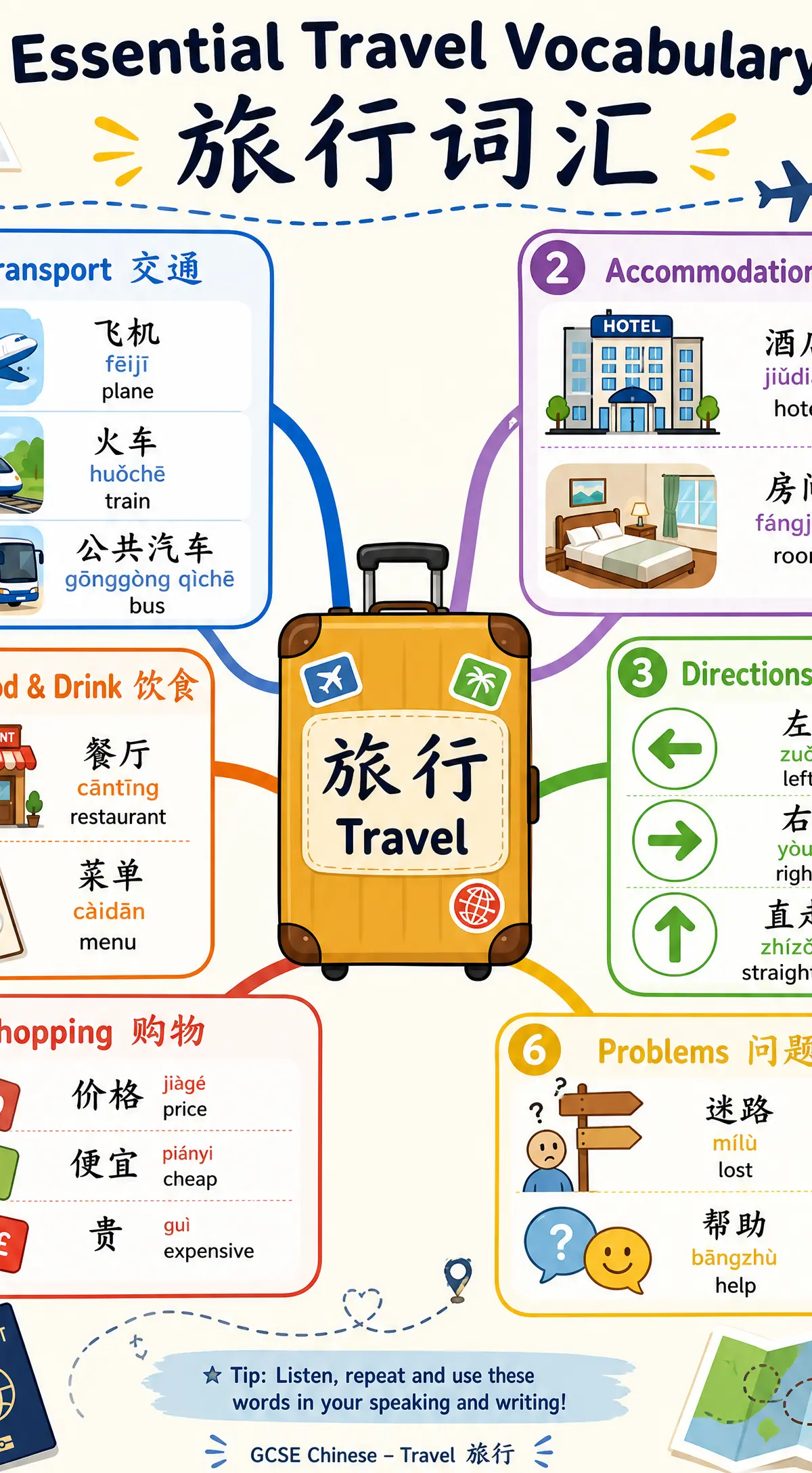
Tier 1 — Foundation Core
| Chinese | Pinyin | English | Example Sentence |
|---|---|---|---|
| 旅行 | lǚ xíng | to travel / travel | 我喜欢去中国旅行。 (I like travelling to China.) |
| 飞机 | fēi jī | aeroplane | 我们坐飞机去北京。 (We are taking a plane to Beijing.) |
| 火车 | huǒ chē | train | 火车很慢。 (The train is very slow.) |
| 汽车 | qì chē | car / bus | 他每天坐汽车上学。 (He takes the bus to school every day.) |
| 酒店 | jiǔ diàn | hotel | 这家酒店很大。 (This hotel is very big.) |
| 房间 | fáng jiān | room | 我的房间很干净。 (My room is very clean.) |
| 票 | piào | ticket | 我买了两张票。 (I bought two tickets.) |
| 护照 | hù zhào | passport | 请给我看你的护照。 (Please show me your passport.) |
| 饭馆 | fàn guǎn | restaurant | 我们去饭馆吃晚饭。 (We are going to the restaurant for dinner.) |
| 贵 | guì | expensive | 这个太贵了! (This is too expensive!) |
| 便宜 | pián yi | cheap | 那个很便宜。 (That one is very cheap.) |
| 远 | yuǎn | far | 机场很远。 (The airport is very far.) |
| 近 | jìn | near | 酒店很近。 (The hotel is very near.) |
| 左 | zuǒ | left | 向左转。 (Turn left.) |
| 右 | yòu | right | 向右转。 (Turn right.) |
Tier 2 — Higher Tier
| Chinese | Pinyin | English | Example Sentence |
|---|---|---|---|
| 高铁 | gāo tiě | high-speed train | 中国的高铁非常快。 (China's high-speed train is extremely fast.) |
| 预订 | yù dìng | to book / reserve | 我想预订一个双人房。 (I want to book a double room.) |
| 航班 | háng bān | flight | 我们的航班晚点了。 (Our flight is delayed.) |
| 迷路 | mí lù | to get lost | 我在市中心迷路了。 (I got lost in the city centre.) |
| 纪念品 | jì niàn pǐn | souvenir | 我买了很多纪念品。 (I bought many souvenirs.) |
| 博物馆 | bó wù guǎn | museum | 参观博物馆很有意思。 (Visiting the museum is very interesting.) |
| 免费 | miǎn fèi | free of charge | 这个景点是免费的。 (This attraction is free of charge.) |
| 护照 | hù zhào | passport | 我的护照丢了。 (I lost my passport.) |
| 结账 | jié zhàng | to pay the bill | 服务员,请结账。 (Waiter, the bill please.) |
| 目的地 | mù dì dì | destination | 我们的目的地是上海。 (Our destination is Shanghai.) |
High-Frequency Words & Phrases
| Phrase | Pinyin | English | Usage Context |
|---|---|---|---|
| 请问 | qǐng wèn | Excuse me, may I ask... | Essential for asking directions or help. |
| 多少钱? | duō shǎo qián? | How much does it cost? | Used in shopping and buying tickets. |
| 在哪里? | zài nǎ lǐ? | Where is...? | Used when looking for a place. |
| 太...了 | tài ... le | Too... | Used to express strong feelings (e.g., 太贵了 - too expensive). |
| 比如 | bǐ rú | For example | Used to give examples and extend answers. |
| 虽然...但是... | suī rán ... dàn shì ... | Although... but... | A complex structure to show contrasting ideas. |
| 因为...所以... | yīn wèi ... suǒ yǐ ... | Because... therefore... | Crucial for justifying opinions. |
| 打算 | dǎ suàn | to plan to | Used for future intentions. |
| 觉得 | jué de | to feel / think | Used to express opinions. |
| 越来越 | yuè lái yuè | more and more | Used to describe a changing situation. |
📝 Grammar Focus
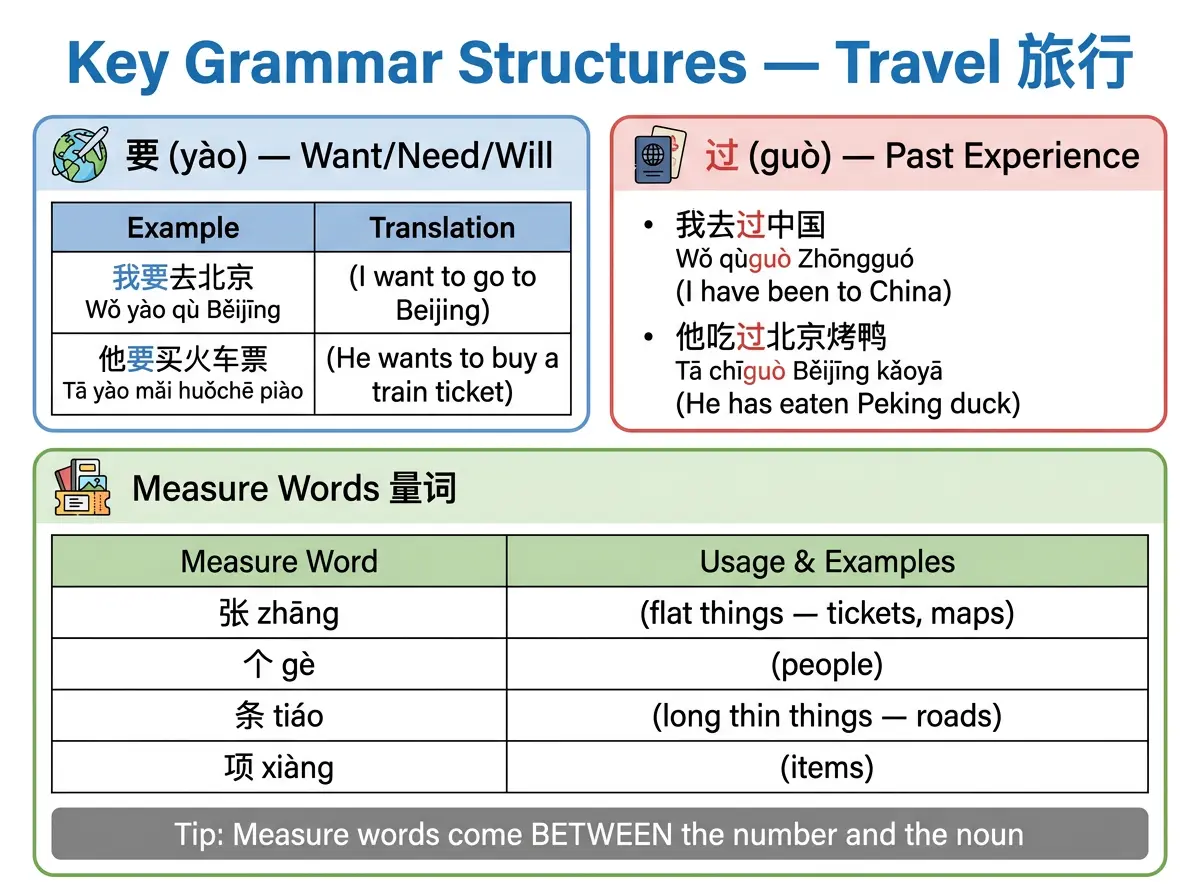
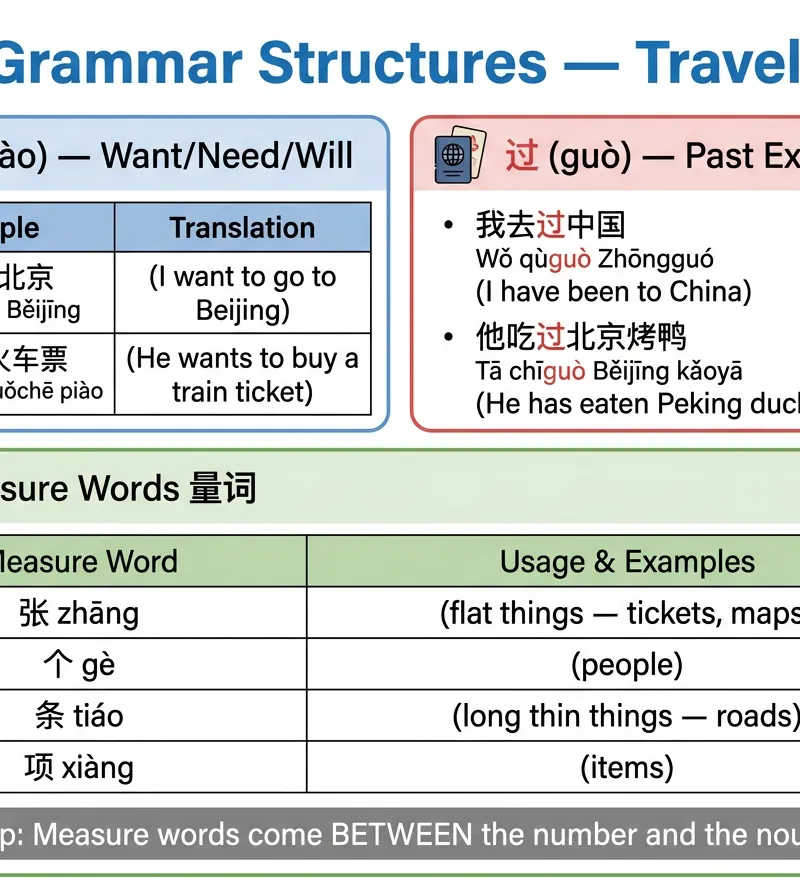
Key Structure 1: 要 (yào) — Want / Need / Will
When to use it: '要' is a versatile modal verb. It can express a desire ("want to"), a necessity ("need to"), or a future action ("will" or "going to"). It is placed directly before the main verb. Chinese verbs do not conjugate, so the form remains the same regardless of the subject.
Conjugation Table (Usage Pattern)
| Subject | Modal Verb | Main Verb | English |
|---|---|---|---|
| 我 (I) | 要 | 去北京 | I want to/will go to Beijing. |
| 你 (You) | 要 | 买票 | You need to/will buy a ticket. |
| 他/她 (He/She) | 要 | 坐飞机 | He/She wants to/will take a plane. |
| 我们 (We) | 要 | 预订酒店 | We need to/will book a hotel. |
| 你们 (You pl.) | 要 | 吃晚饭 | You (pl.) want to/will eat dinner. |
| 他们/她们 (They) | 要 | 结账 | They want to/will pay the bill. |
Common Mistake: Do not confuse '要' (yào) with '想' (xiǎng). '想' means "would like to" (a softer desire), while '要' is stronger ("want to" or "will").
Key Structure 2: 过 (guò) — The Past Experience Marker
When to use it: To talk about an action you have experienced in the past. It is placed immediately after the verb. This is essential for fulfilling the "past timeframe" requirement in writing and speaking tasks.
Conjugation Table (Usage Pattern)
| Subject | Verb | Particle | Object | English |
|---|---|---|---|---|
| 我 (I) | 去 | 过 | 中国 | I have been to China. |
| 你 (You) | 吃 | 过 | 烤鸭 | You have eaten roast duck. |
| 他/她 (He/She) | 坐 | 过 | 高铁 | He/She has taken the high-speed train. |
| 我们 (We) | 看 | 过 | 那个博物馆 | We have seen that museum. |
| 你们 (You pl.) | 买 | 过 | 纪念品 | You (pl.) have bought souvenirs. |
| 他们/她们 (They) | 住 | 过 | 这个酒店 | They have stayed in this hotel. |
Negative Form: To say you have never done something, use '没' (méi) before the verb, and keep '过' after it: 我没去过中国 (I have never been to China).
Key Structure 3: Measure Words (量词 liàng cí)
When to use it: In Chinese, you cannot put a number directly before a noun. You must use a specific measure word in between. The structure is always: Number + Measure Word + Noun.
Common Travel Measure Words
| Number | Measure Word | Noun | English |
|---|---|---|---|
| 一 (1) | 张 (zhāng) - for flat objects | 票 (ticket) | One ticket |
| 两 (2) | 个 (gè) - general/people | 人 (person) | Two people |
| 三 (3) | 家 (jiā) - for businesses | 酒店 (hotel) | Three hotels |
| 四 (4) | 条 (tiáo) - for long/thin things | 路 (road) | Four roads |
| 五 (5) | 件 (jiàn) - for items/luggage | 行李 (luggage) | Five pieces of luggage |
Crucial Rule: When counting "two" of something, you MUST use '两' (liǎng) instead of '二' (èr). Example: 两张票 (two tickets), NOT 二张票.
🎧 Listening Skills
What to Expect
The Listening exam will feature short dialogues, announcements (e.g., at a train station or airport), and longer conversations about travel experiences. You will hear authentic-sounding scenarios involving booking tickets, asking for directions, or complaining about hotel rooms.
Listening Strategies
- Listen for Tones: Pay close attention to tones, as they change the meaning entirely (e.g., mǎi 买 'to buy' vs mài 卖 'to sell').
- Note Numbers and Times: Jot down times, dates, and prices immediately in the margin. Be careful with '十' (shí - 10) and '四' (sì - 4).
- Identify the Timeframe: Listen for time markers like 昨天 (yesterday), 今天 (today), 明天 (tomorrow), 去年 (last year), or particles like 过 (past) and 了 (completed action) to understand when the event happened.
Common Listening Traps
- False Friends/Similar Sounds: Confusing 坐飞机 (zuò fēi jī - take a plane) with 坐火车 (zuò huǒ chē - take a train) because the audio is fast.
- Negatives: Missing the '不' (bù) or '没' (méi). For example, hearing 贵 (expensive) but missing the 不 in front of it (不贵 - not expensive).
🗣️ Speaking Skills
Role Play Scenarios
Scenario: Buying a train ticket
- Examiner (Ticket seller): 你好!你要去哪里? (Hello! Where do you want to go?)
- Candidate: 你好!我要去北京。 (Hello! I want to go to Beijing.)
- Examiner: 你要几张票? (How many tickets do you want?)
- Candidate: 我要两张票。多少钱? (I want two tickets. How much is it?)
Photo Card Practice
Model Photo Card Response (A photo of people at an airport):
- Qu 1 (Description): 照片里有三个人。他们在机场。天气很好。 (There are three people in the photo. They are at the airport. The weather is good.)
- Qu 2 (Opinion): 我觉得他们很高兴,因为他们要去旅行。 (I think they are very happy because they are going to travel.)
- Qu 3 (Related topic): 我喜欢和家人一起旅行。 (I like travelling with my family.)
- Qu 4 (Past/Future): 去年我去了法国。明年我想去中国。 (Last year I went to France. Next year I want to go to China.)
- Qu 5 (Unpredictable): 旅行的时候,我喜欢吃当地的食物。 (When travelling, I like to eat local food.)
General Conversation Questions
| Question (Chinese) | Model Answer | English Translation |
|---|---|---|
| 你喜欢旅行吗?为什么? | 我非常喜欢旅行,因为我可以认识新朋友,也可以吃好吃的食物。 | I like travelling very much, because I can meet new friends, and also eat delicious food. |
| 去年暑假你去了哪里? | 去年暑假我去了西班牙。我和家人一起去的。我们坐飞机去。 | Last summer holiday I went to Spain. I went with my family. We took a plane. |
| 你喜欢住在酒店还是露营? | 我更喜欢住在酒店,因为酒店很舒服,而且有免费的无线网 (Wi-Fi)。 | I prefer staying in a hotel, because hotels are comfortable, and moreover have free Wi-Fi. |
| 在你的城市,交通方便吗? | 在我的城市,交通很方便。有很多公共汽车,也有地铁。 | In my city, transport is very convenient. There are many buses, and also a subway. |
| 明年你打算去哪里旅行? | 明年我打算去中国旅行。我想去北京看长城,我也想吃北京烤鸭。 | Next year I plan to travel to China. I want to go to Beijing to see the Great Wall, I also want to eat Peking duck. |
✍️ Writing Skills
Translation Practice
English → Chinese:
| English | Chinese | Key Grammar |
|---|---|---|
| I want to buy a train ticket. | 我要买一张火车票。 | Modal verb '要' + Measure word '张' |
| Last year, I went to China. | 去年,我去了中国。 | Time phrase at the start + completed action '了' |
| The hotel is very expensive. | 这家酒店很贵。 | Measure word '家' + Adverb '很' (very) before adjective |
| I have eaten Peking duck. | 我吃过北京烤鸭。 | Past experience marker '过' |
| Although the ticket is cheap, the train is slow. | 虽然票很便宜,但是火车很慢。 | Complex structure '虽然...但是...' |
Extended Writing
Model 90-word response (Foundation):
我喜欢旅行。每年夏天,我都和家人一起去旅行。去年我们去了法国。我们坐飞机去,因为飞机很快。我们在法国住了五天。法国的食物很好吃,但是有点儿贵。明年我打算去中国。我想去北京看长城。我也想买很多纪念品。我觉得旅行很有意思,因为我可以认识新朋友。
Model 150-word response (Higher):
对我来说,旅行非常重要。我特别喜欢去不同的国家,因为不但可以了解不同的文化,而且可以品尝当地的美食。去年暑假,我和家人一起去了西班牙。我们是坐飞机去的。虽然机票有点儿贵,但是飞机又快又舒服。我们在海边的一家大酒店住了两个星期。那里的风景美极了!每天我们都在海里游泳。除了游泳以外,我还买了很多便宜的纪念品。
明年,如果我有钱,我打算和朋友一起去中国旅行。因为我学习中文三年了,所以我很想去北京看长城。我也想吃正宗的北京烤鸭。总之,我觉得旅行不但让人放松,而且能开阔眼界。
Writing Checklist
- ✅ Have I used three different timeframes (past, present, future)?
- ✅ Have I included opinions and justified them with '因为' (because)?
- ✅ Are my time phrases at the beginning of the sentence (or right after the subject)?
- ✅ Have I used correct measure words, especially with numbers?
- ✅ Have I used connectives like '不但...而且...' (not only... but also) to link ideas?
📚 Reading Skills
Key Strategies
- Skim for Gist: Read the whole text quickly first to get the general idea before looking at the questions.
- Identify Key Characters: Look for characters you know to guess the meaning of the sentence. If you see '车' (vehicle) and '站' (station), it's likely about a station, even if you don't know the exact word.
- Watch for Negatives: A single '不' (bù) or '没' (méi) changes the entire meaning of the sentence. Highlight them when you see them.
False Friends & Tricky Words
| Word | Looks Like | Actually Means |
|---|---|---|
| 走 (zǒu) | to run | to walk / to go |
| 爱人 (ài ren) | lover | spouse (husband/wife) |
| 便宜 (pián yi) | convenient | cheap (convenient is 方便 fāng biàn) |
🌍 Cultural Knowledge
Understanding Chinese travel culture enriches your speaking and writing responses, demonstrating to examiners a deep engagement with the language.
- High-Speed Rail (高铁 gāo tiě): China has the world's largest high-speed rail network. Mentioning that you want to take the '高铁' instead of just a '火车' shows excellent cultural awareness and vocabulary.
- Golden Week (黄金周 huáng jīn zhōu): There are two main week-long national holidays in China (Spring Festival/Chinese New Year and National Day in October) where millions of people travel simultaneously. Mentioning this when discussing crowded places or expensive tickets is highly impressive.
- Mobile Payments (手机支付 shǒu jī zhī fù): When shopping or eating out in China, almost everyone uses WeChat Pay (微信支付) or Alipay (支付宝) rather than cash or cards. Including this detail in a role-play or writing task shows modern cultural knowledge.
- Bargaining (讨价还价 tǎo jià huán jià): In traditional markets (but not supermarkets or large stores), bargaining is expected. Phrases like '太贵了,便宜一点儿吧' (Too expensive, make it a bit cheaper) are culturally authentic.
Interactive Diagrams
1 interactive diagram to visualise key concepts
Conceptual Flow Outline
The Golden Rule of Chinese Word Order
Worked Examples
4 worked examples — open one to explore the question and available guidance.
Practice Questions
Try the question, then reveal an answer plan or example response
Translation: Translate into Chinese: 'I want to book a hotel room for two people.'
Hint: Remember the measure word for 'people' and the modal verb for 'want'.
Writing (90 words): Write an email to your Chinese friend about a recent trip. Include: where you went, how you travelled, what you did, and where you plan to go next year.
Hint: Ensure you cover all 4 bullet points and use both past and future timeframes.
Reading: Read the text and answer in English. '昨天我的航班晚点了两个小时,所以我很晚才到酒店。酒店的房间很小,但是很干净。' Why was the person late getting to the hotel?
Hint: Look for the word meaning 'flight' and 'delayed'.
Speaking (Conversation): 请说说你最喜欢的一次旅行。(Please tell me about your favourite trip.)
Hint: Use past tense markers (了/过), give detailed opinions with reasons, and use connectives.
Listening: Listen to the announcement. '请注意,去往广州的高铁将在五分钟后出发。' Where is the train going?
Hint: Listen for the city name after '去往'.
Writing (150 words): Write an article for your school magazine about the pros and cons of different types of transport for holidays. Include: your preferred transport, a past experience, advantages/disadvantages of planes vs trains, and your future travel plans.
Hint: You must use 3 timeframes, complex opinions, and comparative language (比, 更, 最).
Exam technique
How to turn what you know into marks
How to approach the question
Skill-by-skill strategy: Listening — read questions first, note keywords in pinyin/English. Speaking — prepare opinions in advance, use the 12 min prep time fully. Reading — skim first, then look for character components. Writing — plan your 3 tenses before writing, check measure words after.
How to structure your answer
Writing: Introduction (present) → Past experience (过/了) → Opinions with reasons (因为) → Future plans (要/打算). Speaking: Give opinion → Justify → Extend.
Timing
Listening: 35-45 mins (heard twice). Speaking: 10-12 mins total (role play + photo card + conversation). Reading: 45-60 mins. Writing: 60-75 mins (translation + structured + extended).
Common pitfalls
- Forgetting measure words between numbers and nouns (e.g., writing 两票 instead of 两张票)
- Using only the present tense — examiners want at least 3 tenses at Higher
- Putting time phrases at the end of the sentence (English style) instead of the beginning (Chinese style)
- Confusing the tones for buy (mǎi) and sell (mài)
- Not justifying opinions with '因为' (because)
- Translating word-for-word in the translation task instead of translating the meaning
What the command words want
- Describe the photo
- Say what you can see, give an opinion, relate to your experience using a past or future tense.
- Translate into Chinese
- Write full sentences with correct grammar — pay special attention to word order (TMPA).
- Translate into English
- Meaning over word-for-word — capture the sense, don't just guess character by character.
- Write approximately 90 words
- Foundation task — cover all 4 bullet points, use present + one other timeframe (past or future).
- Write approximately 150 words
- Higher task — 3 timeframes essential, opinions, complex structures (虽然...但是), ambitious vocabulary.
Watch or listen (optional)
Test your understanding of Travel
Active recall beats re-reading. Take an instant quiz now to test what you’ve learned and lock it into long-term memory.
7 days Premium · Then the free plan continues · No card, no charge