Pearson Edexcel · GCSE · Chinese
Course version: Pearson-GCSE-Chinese · Version from Mar 2026
Volunteering
This topic covers volunteering (志愿服务) and its role in the community. You will learn key vocabulary for people, places, and activities, alongside grammar structures like intentions (想/要/打算) and aspect markers (过/了/着) essential for all four exam skills.
- 13 min read
- 4 worked examples
- 6 practice questions
- 8 key terms
Check what you remember
Read the wording for your board, then hide it and explain Aspect Marker (动态助词) in your own words. Rough notes are fine. This is a self-check, with no mark or grade.
Reference: Pearson Edexcel
Particles like 过, 了, and 着 that indicate the state of an action (e.g., experienced, completed, ongoing).
Study Notes
Overview
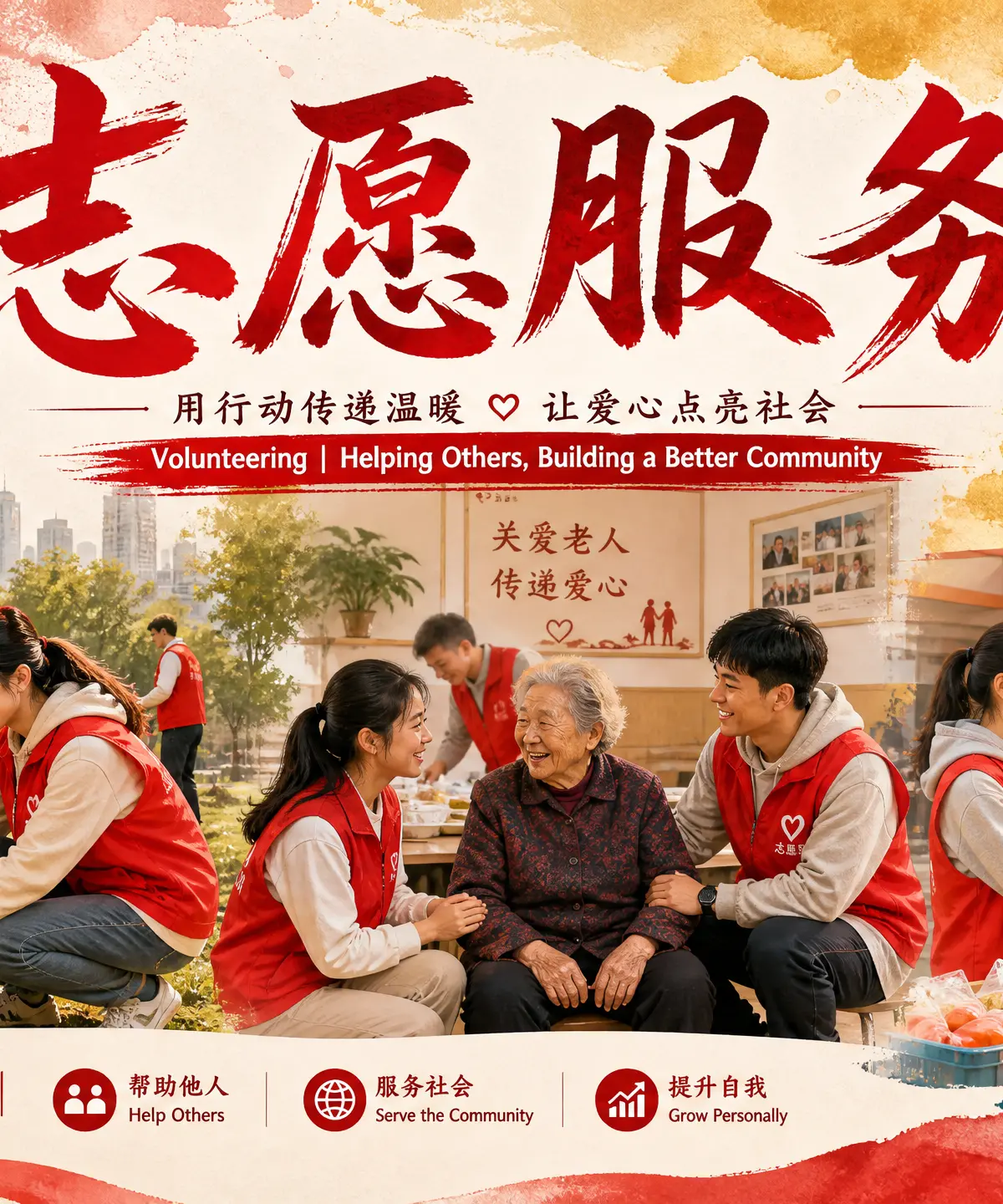
The Volunteering (志愿服务) topic is a core part of the 'Future Aspirations, Study, and Work' theme. It frequently appears in both Foundation and Higher tier papers across all four skills (Listening, Speaking, Reading, Writing). Examiners love this topic because it naturally invites you to use three timeframes (past volunteering experiences, current community work, future plans) and to express justified opinions about the value of helping others.
Listen to our comprehensive audio guide for this topic:
📖 Essential Vocabulary
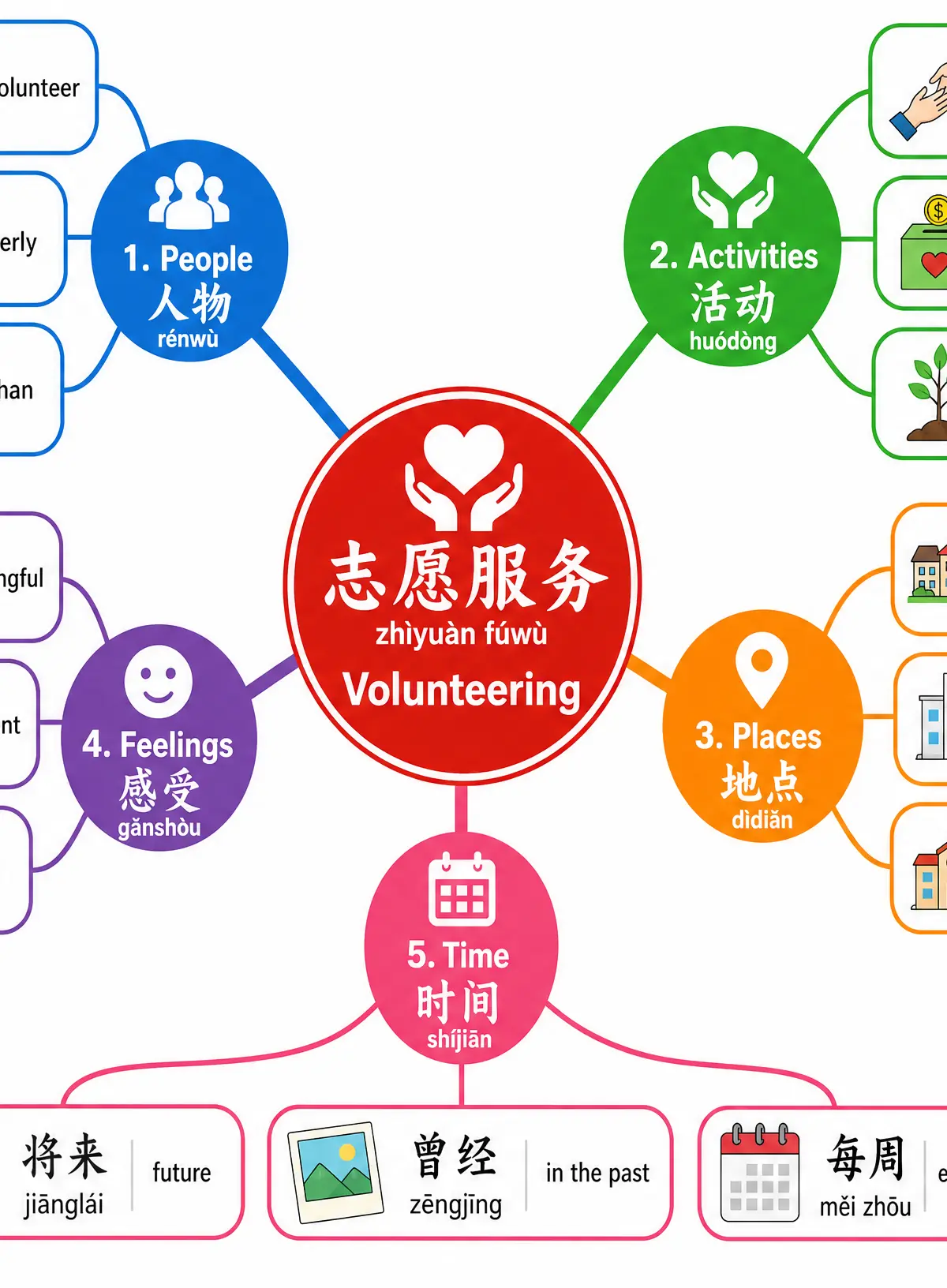
Tier 1 — Foundation Core
| Chinese | English | Example Sentence |
|---|---|---|
| 志愿者 (zhìyuànzhě) | volunteer | 我想做志愿者。 (I want to be a volunteer.) |
| 帮助 (bāngzhù) | to help | 我喜欢帮助别人。 (I like to help others.) |
| 老人 (lǎorén) | elderly person | 我们去敬老院看老人。 (We go to the care home to see the elderly.) |
| 社区 (shèqū) | community | 我在社区中心工作。 (I work at the community centre.) |
| 医院 (yīyuàn) | hospital | 她在医院做志愿工作。 (She does voluntary work at the hospital.) |
| 学校 (xuéxiào) | school | 我在学校帮助老师。 (I help teachers at school.) |
| 孩子 (háizi) | child | 很多孩子需要帮助。 (Many children need help.) |
| 环境 (huánjìng) | environment | 保护环境很重要。 (Protecting the environment is very important.) |
| 垃圾 (lājī) | rubbish | 我们在公园捡垃圾。 (We pick up rubbish in the park.) |
| 钱 (qián) | money | 我捐了一些钱。 (I donated some money.) |
| 工作 (gōngzuò) | work / job | 这是一份好工作。 (This is a good job.) |
| 有用 (yǒu yòng) | useful | 志愿服务很有用。 (Volunteering is very useful.) |
| 开心 (kāixīn) | happy | 帮助别人让我很开心。 (Helping others makes me very happy.) |
| 累 (lèi) | tired | 虽然很累,但是很值得。 (Although it's tiring, it's worth it.) |
| 星期六 (xīngqīliù) | Saturday | 我每个星期六去做志愿者。 (I go volunteering every Saturday.) |
Tier 2 — Higher Tier
| Chinese | English | Example Sentence |
|---|---|---|
| 志愿服务 (zhìyuàn fúwù) | volunteering / voluntary service | 志愿服务对社会有好处。 (Volunteering is beneficial to society.) |
| 敬老院 (jìnglǎoyuàn) | care home for the elderly | 我每个月去一次敬老院。 (I go to the care home once a month.) |
| 孤儿院 (gū'éryuàn) | orphanage | 孤儿院的孩子们很可爱。 (The children at the orphanage are very cute.) |
| 捐款 (juānkuǎn) | to donate money | 我们为贫困地区捐款。 (We donate money to poor areas.) |
| 植树 (zhíshù) | to plant trees | 植树可以改善环境。 (Planting trees can improve the environment.) |
| 慈善机构 (císhàn jīgòu) | charity organisation | 她为一家慈善机构工作。 (She works for a charity organisation.) |
| 满足感 (mǎnzúgǎn) | sense of fulfilment | 这份工作给我带来了很大的满足感。 (This work brings me a great sense of fulfilment.) |
| 有意义 (yǒu yìyì) | meaningful | 我认为做志愿者非常有意义。 (I think being a volunteer is very meaningful.) |
| 弱势群体 (ruòshì qúntǐ) | vulnerable groups | 我们应该多关心弱势群体。 (We should care more about vulnerable groups.) |
| 责任感 (zérèngǎn) | sense of responsibility | 志愿服务培养了我的责任感。 (Volunteering has cultivated my sense of responsibility.) |
High-Frequency Words & Phrases
| Phrase | English | Usage Context |
|---|---|---|
| 参加 (cānjiā) | to participate / take part in | When talking about joining an activity or group. |
| 组织 (zǔzhī) | to organise / organisation | When discussing planning an event or a charity group. |
| 照顾 (zhàogù) | to look after / care for | When talking about helping the elderly or children. |
| 保护 (bǎohù) | to protect | Used frequently with 'environment' (保护环境). |
| 提高 (tígāo) | to improve / raise | When discussing improving skills or living standards. |
| 经验 (jīngyàn) | experience | To talk about gaining work experience (积累经验). |
| 技能 (jìnéng) | skills | To mention learning new skills through volunteering. |
| 无论...都... (wúlùn... dōu...) | no matter... all... | Higher tier structure to show strong commitment. |
| 不仅...而且... (bùjǐn... érqiě...) | not only... but also... | Excellent for linking two positive aspects of volunteering. |
| 既然...就... (jìrán... jiù...) | since... then... | Good for explaining why you decided to volunteer. |
📝 Grammar Focus
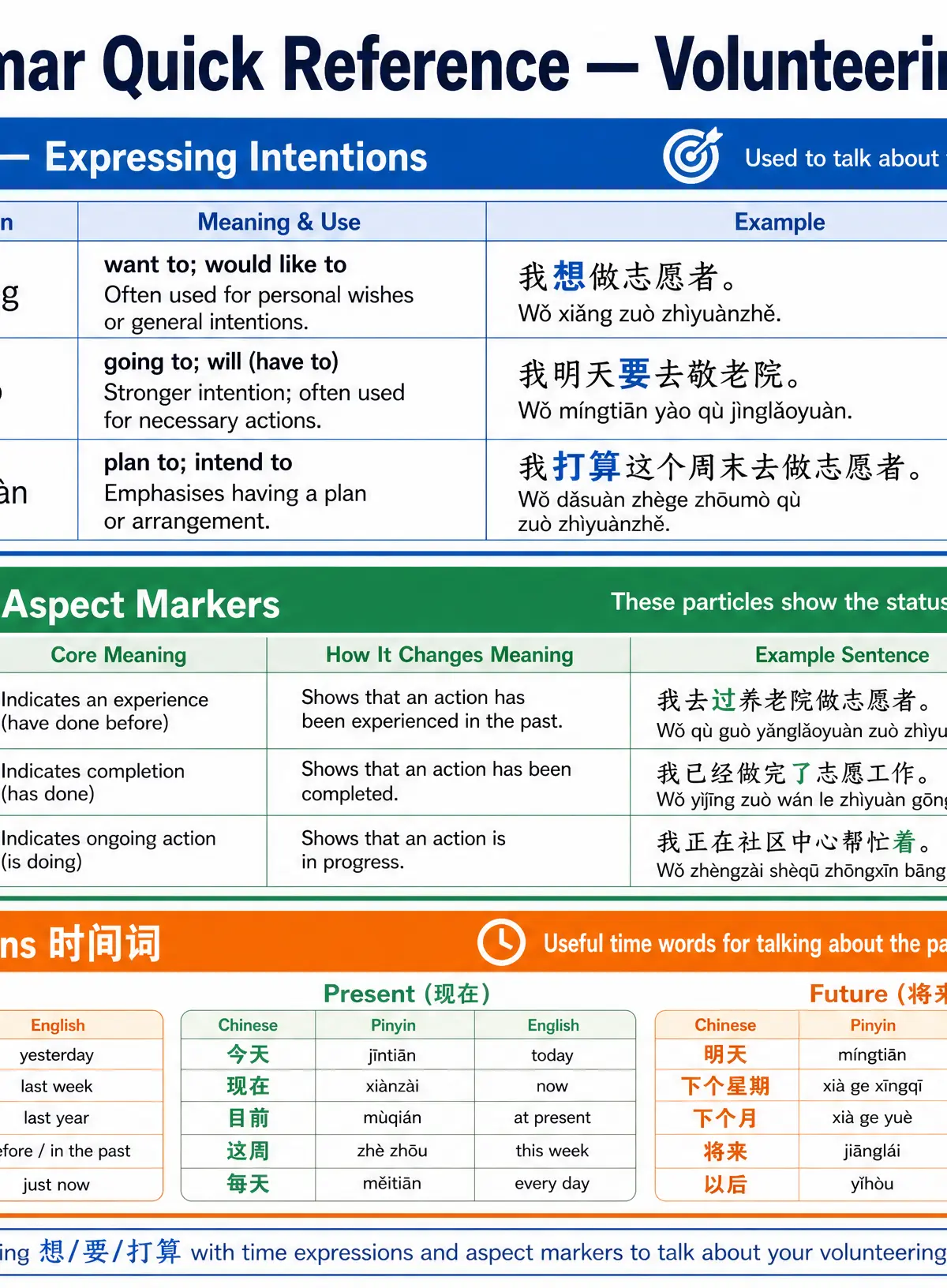
Key Structure 1: Expressing Intentions (想 / 要 / 打算)
When to use it: To talk about your future plans regarding volunteering. This is crucial for hitting the 'future timeframe' requirement in writing and speaking.
Conjugation Table
(Note: Chinese verbs do not conjugate based on the subject, which makes this easier! The structure remains the same regardless of the pronoun.)
| Subject | Intention Word | Verb Phrase | English |
|---|---|---|---|
| 我 (I) | 想 (xiǎng - want to) | 做志愿者 | I want to be a volunteer. |
| 你 (You) | 要 (yào - am going to) | 去敬老院 | You are going to the care home. |
| 他/她 (He/She) | 打算 (dǎsuàn - plan to) | 捐款 | He/She plans to donate money. |
| 我们 (We) | 决定 (juédìng - decide to) | 植树 | We decide to plant trees. |
| 你们 (You pl.) | 希望 (xīwàng - hope to) | 帮助别人 | You (pl.) hope to help others. |
| 他们 (They) | 准备 (zhǔnbèi - prepare to) | 参加活动 | They prepare to participate in the activity. |
Irregulars to learn: None! The beauty of Chinese grammar is its consistency here. Just remember the word order: Subject + Time (optional) + Intention Word + Verb Phrase.
Key Structure 2: Aspect Markers (过 / 了 / 着)
When to use it: To show the status of an action. This is how you demonstrate past experiences and completed actions, hitting the 'past timeframe' requirement.
Usage Table
| Marker | Function | Example Sentence | English |
|---|---|---|---|
| 过 (guò) | Past experience (have done) | 我去过中国做志愿者。 | I have been to China to volunteer. |
| 了 (le) | Completed action | 昨天我帮了一个老人。 | Yesterday I helped an elderly person. |
| 着 (zhe) | Ongoing state | 孩子们笑着对我说谢谢。 | The children smiled (were smiling) and said thank you to me. |
Common mistake: Do not use 过 for something that happened yesterday but is not a life experience. Use 了 for simple completed past actions.
Key Structure 3: Expressing Justified Opinions (因为 / 所以)
When to use it: Examiners award high marks for opinions with reasons. You must master linking your views to justifications.
Structure Table
| Opinion Phrase | Opinion | Connective | Reason |
|---|---|---|---|
| 我认为 (I think) | 志愿服务很重要 | 因为 (because) | 它可以帮助别人。 (it can help others.) |
| 我觉得 (I feel) | 植树很有意义 | 因为 (because) | 保护环境是我们的责任。 (protecting the environment is our responsibility.) |
| 对我来说 (To me) | 去敬老院很好 | 所以 (therefore) | 我每个周末都去。 (I go every weekend.) |
🎧 Listening Skills
What to Expect
Listening tasks on this topic often feature interviews with young volunteers, announcements about charity events, or conversations about future career plans that include a volunteering element.
Listening Strategies
- Listen for time indicators: Words like 以前 (before), 现在 (now), and 将来 (future) are critical. The question might ask 'What did she do last year?' while the audio mentions what she is doing now as a distractor.
- Note opinion markers: Listen carefully for 我认为 (I think), 觉得 (feel), 喜欢 (like), 讨厌 (dislike).
- Watch for negatives: 不 (not) and 没 (did not / have not) can completely reverse the meaning of a sentence.
Common Listening Traps
- Changing opinions: A speaker might say they used to find volunteering tiring, but now they find it rewarding. Ensure you answer based on their current view if asked.
- Distractors with numbers: You might hear several numbers (e.g., 'We needed 50 volunteers, but 100 applied'). Make sure you link the right number to the right fact.
🗣️ Speaking Skills
Role Play Scenarios
Scenario 1: At a charity shop
- Teacher: 你想买什么? (What do you want to buy?)
- Student: 我想买几本书,因为我想为慈善机构捐款。 (I want to buy some books because I want to donate to the charity.)
Scenario 2: Applying to be a volunteer
- Teacher: 你以前做过志愿者吗? (Have you been a volunteer before?)
- Student: 是的,去年我在敬老院做过志愿者。 (Yes, last year I volunteered at a care home.)
Photo Card Practice
Model Photo Card Response:
- Qu 1 (Description): 照片里有三个年轻人。他们在公园里捡垃圾。天气很好。 (There are three young people in the photo. They are picking up rubbish in the park. The weather is good.)
- Qu 2 (Opinion): 我觉得他们做的事情很有意义,因为保护环境非常重要。 (I think what they are doing is very meaningful because protecting the environment is very important.)
- Qu 3 (Related topic): 在我的社区,也有很多人做志愿工作,比如帮助老人。 (In my community, there are also many people doing voluntary work, such as helping the elderly.)
- Qu 4 (Past/Future): 去年夏天,我也参加了植树活动。将来我打算去医院做志愿者。 (Last summer, I also participated in a tree-planting activity. In the future, I plan to volunteer at a hospital.)
- Qu 5 (Unpredictable): 如果我有钱,我会捐给孤儿院,因为孩子们需要更好的教育。 (If I had money, I would donate to an orphanage because the children need better education.)
General Conversation Questions
| Question (Chinese) | Model Answer | English Translation |
|---|---|---|
| 你做过志愿者吗? | 是的,我去年在社区中心做过志愿者。我帮孩子们辅导功课。 | Have you been a volunteer? / Yes, I volunteered at the community centre last year. I helped children with their homework. |
| 你觉得做志愿者有什么好处? | 我觉得做志愿者不仅可以帮助别人,而且可以让我学到新技能,积累工作经验。 | What do you think are the benefits of volunteering? / I think volunteering can not only help others, but also allow me to learn new skills and gain work experience. |
| 将来你想参加什么志愿活动? | 将来我打算去国外教英语,因为我喜欢旅行,也喜欢和孩子们在一起。 | What volunteer activities do you want to participate in in the future? / In the future, I plan to go abroad to teach English, because I like travelling and I like being with children. |
| 为什么有些年轻人不喜欢做志愿者? | 因为他们可能觉得做志愿者很累,或者他们太忙了,没有时间。 | Why do some young people not like volunteering? / Because they might think volunteering is tiring, or they are too busy and have no time. |
| 你的学校有慈善活动吗? | 有的,我们学校每年都会组织长跑比赛,为慈善机构筹款。 | Does your school have charity events? / Yes, our school organises a long-distance running race every year to raise funds for charities. |
✍️ Writing Skills
Translation Practice
English → Chinese:
| English | Chinese | Key Grammar |
|---|---|---|
| I want to be a volunteer. | 我想做志愿者。 | Expressing intention (想) |
| Last year, I helped the elderly in the community. | 去年,我在社区帮助了老人。 | Past timeframe + 了 |
| Volunteering is very meaningful. | 志愿服务非常有意义。 | Opinion vocabulary |
| Although it is tiring, I feel very happy. | 虽然很累,但是我感到很开心。 | Complex structure (虽然...但是) |
| In the future, I plan to donate money to a charity. | 将来,我打算给慈善机构捐款。 | Future timeframe (打算) + preposition (给) |
Extended Writing
Model 90-word response (Foundation):
我喜欢做志愿者。去年夏天,我在社区的敬老院做志愿者。我经常和老人们聊天,也帮他们打扫房间。我觉得这份工作很有意思,因为老人们都很友好。虽然有时候很累,但是我感到很开心。将来,我打算去医院做志愿者,因为我想当一名医生。做志愿者可以帮助我积累经验。我认为每个人都应该帮助别人。
(I like being a volunteer. Last summer, I volunteered at the care home in the community. I often chatted with the elderly and helped them clean their rooms. I think this job is very interesting because the elderly are all very friendly. Although it is sometimes tiring, I feel very happy. In the future, I plan to volunteer at a hospital because I want to be a doctor. Volunteering can help me gain experience. I think everyone should help others.)
Model 150-word response (Higher):
对我来说,志愿服务不仅能帮助弱势群体,还能提升自己的能力。去年暑假,我参加了一个环保组织的活动。我们去海滩捡垃圾,还种了很多树。虽然天气很热,工作很辛苦,但是看到干净的海滩,我感到非常骄傲和满足。
我认为年轻人参加志愿工作是非常必要的。首先,这能培养我们的责任感。其次,我们可以通过这些活动认识新朋友,学习新技能。很多公司也喜欢有志愿服务经验的人。
明年中学毕业后,我打算去中国做一个月的英语教学志愿者。我希望通过这个机会体验不同的文化,同时帮助那里的孩子提高英语水平。总之,无论将来我做什么工作,我都会继续做志愿者,因为用自己的力量让世界变得更好,是一件非常有意义的事情。
*(To me, volunteering not only helps vulnerable groups, but also improves one's own abilities. Last summer holiday, I participated in an environmental organisation's activity. We went to the beach to pick up rubbish and also planted many trees. Although the weather was hot and the work was hard, seeing the clean beach made me feel very proud and fulfilled.
I think it is very necessary for young people to participate in voluntary work. Firstly, this can cultivate our sense of responsibility. Secondly, we can meet new friends and learn new skills through these activities. Many companies also like people with volunteering experience.
Next year after graduating from secondary school, I plan to go to China to be an English teaching volunteer for a month. I hope through this opportunity to experience a different culture, while helping the children there improve their English level. In conclusion, no matter what job I do in the future, I will continue to be a volunteer, because using one's own strength to make the world better is a very meaningful thing.)*
Writing Checklist
- ✅ Have I covered all the bullet points in the prompt?
- ✅ Have I used at least three timeframes (past, present, future)?
- ✅ Have I included opinions and justified them with 因为?
- ✅ Have I used connectives (e.g., 虽然...但是, 不仅...而且)?
- ✅ Have I checked my character strokes and measure words?
📚 Reading Skills
Key Strategies
- Read the questions first: Know what information you are looking for before you read the text.
- Look for contextual clues: If you don't recognise a character, look at the radical (the part of the character that gives a hint about its meaning). For example, characters with the 'hand' radical (扌) usually relate to actions, like 打 (hit), 捐 (donate), 捡 (pick up).
- Identify the timeframe: Spot the time words early on so you know when the events happened.
False Friends & Tricky Words
| Word | Looks Like | Actually Means |
|---|---|---|
| 关心 (guānxīn) | close heart | to care about / show concern for |
| 爱心 (àixīn) | love heart | compassion / caring nature |
| 辛苦 (xīnkǔ) | bitter | hard work / exhausting |
| 经验 (jīngyàn) | test | experience (gained from doing something) |
🌍 Cultural Knowledge
Volunteering in China has grown significantly in recent decades. The concept of 'Lei Feng' (雷锋) is deeply ingrained in Chinese culture. Lei Feng was a soldier in the People's Liberation Army who was characterised as a selfless and modest person devoted to the Communist Party, Chairman Mao Zedong, and the people of China. March 5th is 'Learn from Lei Feng Day' (学雷锋日), where schools and communities organise widespread volunteering activities, such as cleaning public spaces or helping the elderly. Mentioning 'Lei Feng spirit' (雷锋精神) in a Higher tier writing or speaking response will highly impress an examiner, showing deep cultural awareness.
Visual Resources
2 diagrams and illustrations
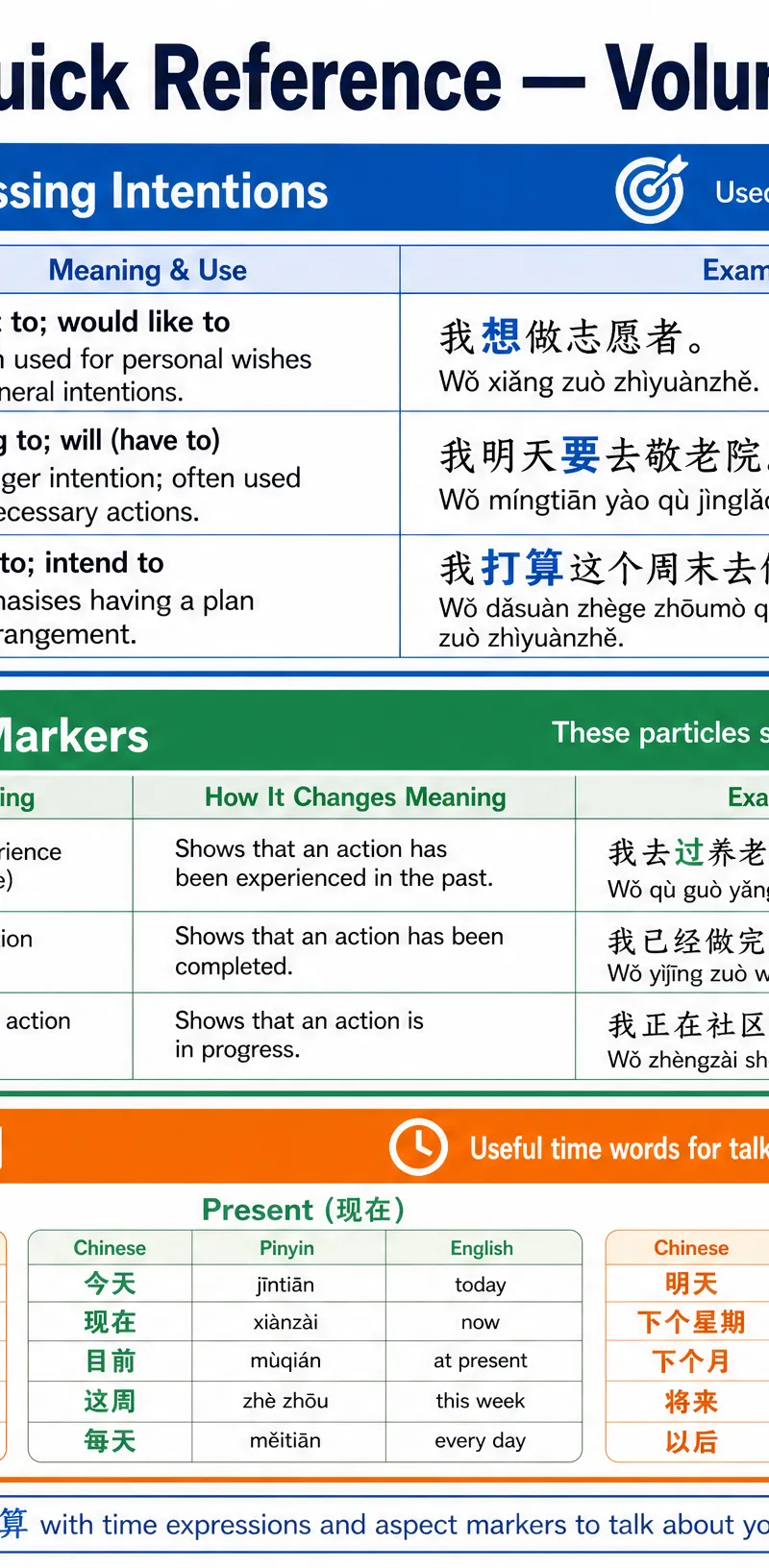
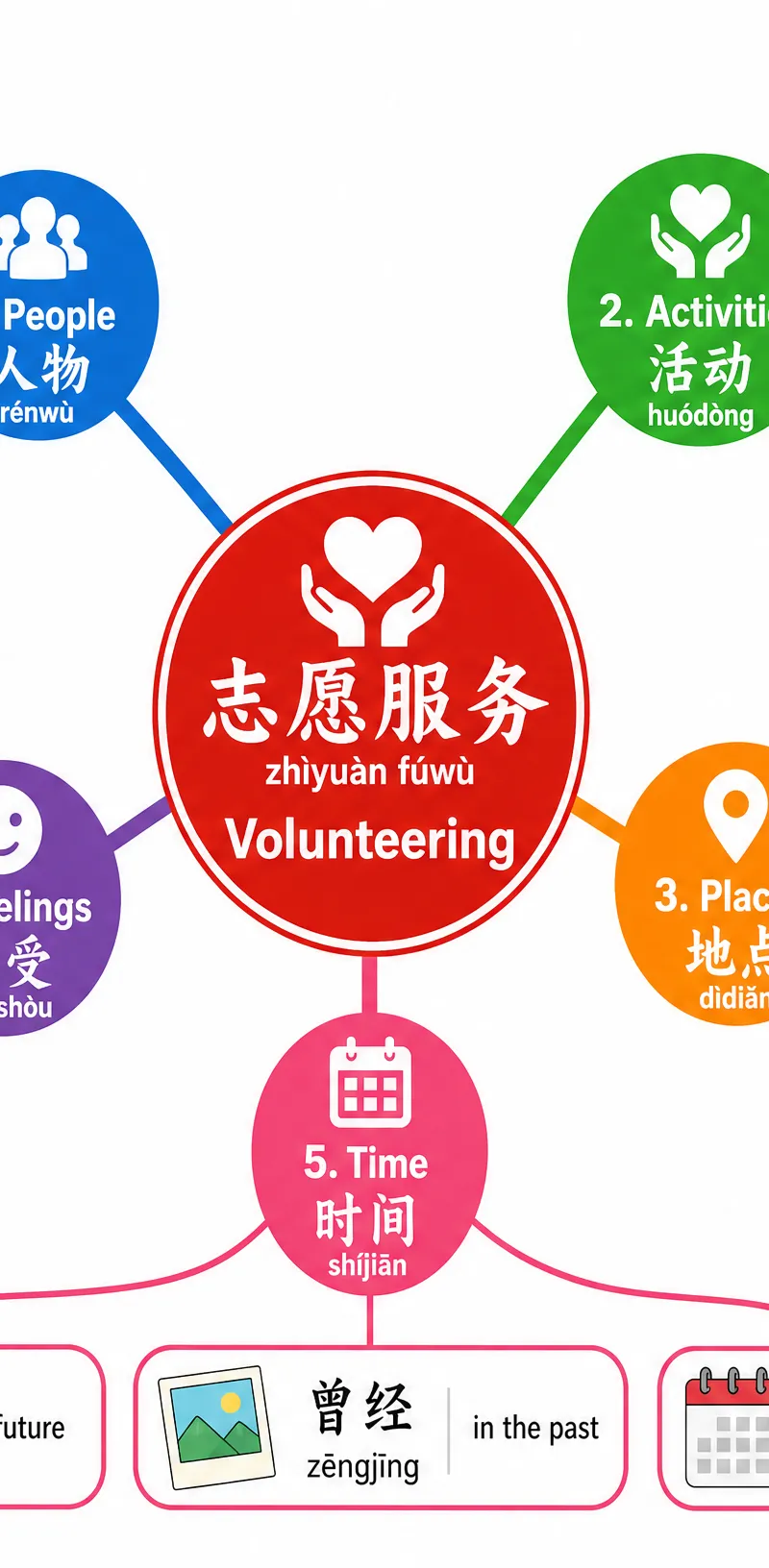
Interactive Diagrams
1 interactive diagram to visualise key concepts
Conceptual Flow Outline
MFL exam approach by skill
Worked Examples
4 worked examples — open one to explore the question and available guidance.
Practice Questions
Try the question, then reveal an answer plan or example response
Writing: Write an email to a Chinese friend about a recent volunteering experience. (90 words)
Hint: Cover all bullet points. Use past tense for the experience, and give an opinion.
Speaking (Conversation): 谈谈你对志愿服务的看法。(Talk about your views on volunteering.)
Hint: Give a clear opinion, use 因为 to justify it, and add an extra detail.
Translation: Translate into Chinese - 'Next year, I plan to go to China to plant trees because protecting the environment is everyone's responsibility.'
Hint: Break it down: Time + Subject + Intention + Place + Action + Because + Reason.
Reading: Read the paragraph and answer - Why did Li Hua decide to volunteer at the hospital?
Hint: Look for the sentence containing '因为' (because) or '为了' (in order to) near the mention of the hospital.
Listening: Listen to the audio and answer - What did the speaker find most difficult about the volunteering work?
Hint: Listen for words indicating difficulty like 难 (difficult), 累 (tiring), or 辛苦 (hard).
Writing (Higher): Write an article for your school magazine about the importance of charity work. (150 words)
Hint: Use a formal register. Include past experience, current views, and future plans. Use complex connectives.
Exam technique
How to turn what you know into marks
How to approach the question
Listening — read questions first, note keywords. Speaking — prepare opinions in advance, have fillers ready. Reading — skim first, then detail. Writing — plan before writing, check accuracy after.
How to structure your answer
Writing: Introduction → Main points with opinions → Justified reasons → Different tenses → Conclusion. Speaking: Give opinion → Justify → Extend → Use different tense.
Timing
Listening: 35-45 mins (heard twice). Speaking: 7-12 mins total (role play + photo card + conversation). Reading: 45-60 mins. Writing: 60-75 mins (translation + structured + extended).
Common pitfalls
- Forgetting to use measure words (e.g., 一个老人 instead of just 一老人)
- Using only the present tense — examiners want at least 3 tenses at Higher
- Giving one-word Speaking answers instead of developing responses
- Writing characters with incorrect strokes which changes the meaning
- Confusing false friends in Listening/Reading
- Not justifying opinions with 因为
What the command words want
- Describe the photo
- Say what you can see, give an opinion, relate to your experience
- Translate into Chinese
- Write full sentences with correct grammar — partial marks for partially correct characters
- Translate into English
- Meaning over word-for-word — capture the sense, don't guess cognates
- Write approximately 90 words
- Foundation task — cover all 4 bullet points, use present + one other tense
- Write approximately 150 words
- Higher task — 3 tenses, opinions, complex structures, ambitious vocabulary
Watch or listen (optional)
Test your understanding of Volunteering
Active recall beats re-reading. Take an instant quiz now to test what you’ve learned and lock it into long-term memory.
7 days Premium · Then the free plan continues · No card, no charge