Pearson Edexcel · GCSE · Chinese
Course version: Pearson-GCSE-Chinese · Version from Mar 2026
Work
This topic covers the essential vocabulary for jobs and professions, the grammatical structures for expressing past, present, and future timeframes, and the phrases needed to justify career aspirations. It is a highly predictable topic that appears across Listening, Speaking, Reading, and Writing exams.
- 11 min read
- 4 worked examples
- 6 practice questions
- 8 key terms
Check what you remember
Read the wording for your board, then hide it and explain Time Markers (时间词) in your own words. Rough notes are fine. This is a self-check, with no mark or grade.
Reference: Pearson Edexcel
Words placed at the start of a sentence or after the subject to indicate tense, since Chinese verbs do not conjugate (e.g., 以前, 现在, 将来).
Study Notes
Overview
This comprehensive study guide covers the essential vocabulary and grammatical structures required to discuss Work and Careers (工作与职业) at the GCSE level. This topic is highly predictable and appears frequently across all four assessment skills: Listening, Speaking, Reading, and Writing. Mastering this topic allows you to discuss future aspirations, describe past work experiences, and express justified opinions about different professions — all of which are key requirements for accessing the higher mark bands.
📖 Essential Vocabulary
Tier 1 — Foundation Core
| Chinese | Pinyin | English | Example Sentence |
|---|---|---|---|
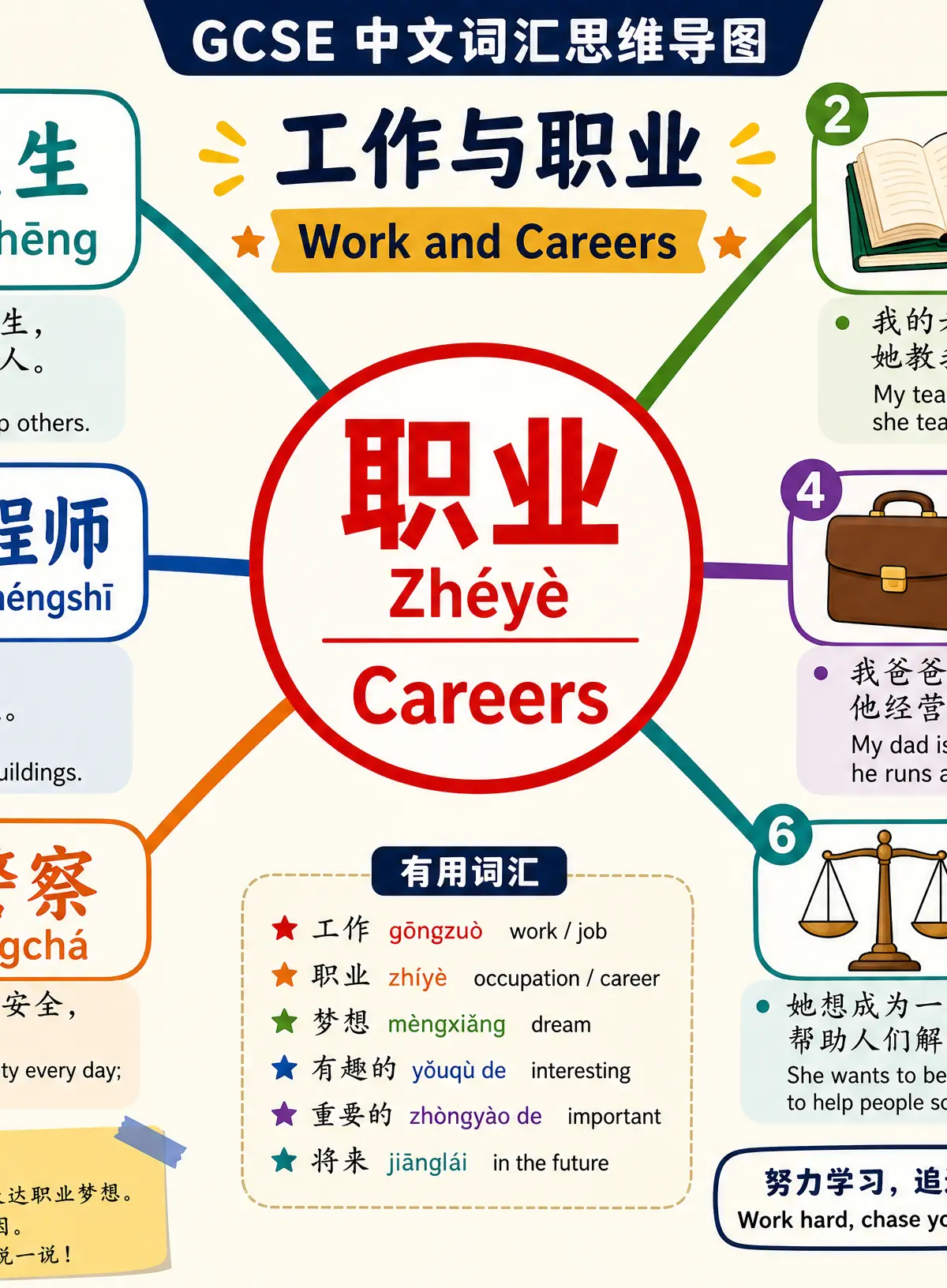
| 工作 | gōngzuò | work / job | 我在医院工作。 (I work in a hospital.) |
| 职业 | zhíyè | occupation / career | 你的职业是什么? (What is your occupation?) |
| 医生 | yīshēng | doctor | 我妈妈是一名医生。 (My mum is a doctor.) |
| 老师 | lǎoshī | teacher | 我的老师很友好。 (My teacher is very friendly.) |
| 工人 | gōngrén | worker | 他是一个工人。 (He is a worker.) |
| 警察 | jǐngchá | police officer | 警察帮助我们。 (Police officers help us.) |
| 护士 | hùshi | nurse | 护士在医院工作。 (Nurses work in the hospital.) |
| 商人 | shāngrén | businessman | 我爸爸是商人。 (My dad is a businessman.) |
| 厨师 | chúshī | chef / cook | 厨师做饭很好吃。 (The chef cooks very well.) |
| 演员 | yǎnyuán | actor | 她是一个有名的演员。 (She is a famous actor.) |
| 公司 | gōngsī | company | 他在一家大公司工作。 (He works in a big company.) |
| 办公室 | bàngōngshì | office | 办公室很大。 (The office is very big.) |
| 同事 | tóngshì | colleague | 我的同事很热情。 (My colleagues are very enthusiastic.) |
| 老板 | lǎobǎn | boss | 我的老板很好。 (My boss is very good.) |
| 钱 | qián | money | 这份工作有很多钱。 (This job has a lot of money.) |
Tier 2 — Higher Tier
| Chinese | Pinyin | English | Example Sentence |
|---|---|---|---|
| 工程师 | gōngchéngshī | engineer | 我哥哥是软件工程师。 (My older brother is a software engineer.) |
| 律师 | lǜshī | lawyer | 律师的工资很高。 (A lawyer's salary is very high.) |
| 科学家 | kēxuéjiā | scientist | 科学家在实验室工作。 (Scientists work in laboratories.) |
| 企业家 | qǐyèjiā | entrepreneur | 他想成为一个成功的企业家。 (He wants to become a successful entrepreneur.) |
| 记者 | jìzhě | journalist | 记者去很多国家。 (Journalists go to many countries.) |
| 兼职 | jiānzhí | part-time work | 周末我在超市做兼职。 (At the weekend I do part-time work in a supermarket.) |
| 全职 | quánzhí | full-time work | 毕业后,我想找全职工作。 (After graduating, I want to find full-time work.) |
| 实习 | shíxí | internship | 去年暑假,我参加了实习。 (Last summer holiday, I participated in an internship.) |
| 面试 | miànshì | job interview | 明天我有一个重要的面试。 (Tomorrow I have an important job interview.) |
| 简历 | jiǎnlì | CV / résumé | 请把你的简历发给我。 (Please send your CV to me.) |
High-Frequency Words & Phrases
| Phrase | Pinyin | English | Usage Context |
|---|---|---|---|
| 我想成为... | wǒ xiǎng chéngwéi... | I want to become... | Expressing future career aspirations. |
| 我打算... | wǒ dǎsuàn... | I plan to... | Discussing future plans. |
| 以前,我... | yǐqián, wǒ... | In the past, I... | Describing past work experience. |
| 将来,我... | jiānglái, wǒ... | In the future, I... | Discussing future ambitions. |
| 我对...感兴趣 | wǒ duì... gǎn xìngqù | I am interested in... | Explaining why you like a certain field. |
| 有意义 | yǒu yìyì | meaningful | Justifying why you like a job. |
| 工资高 | gōngzī gāo | high salary | Giving a reason for choosing a career. |
| 压力大 | yālì dà | highly stressful | Giving a negative opinion about a job. |
| 虽然...但是... | suīrán... dànshì... | Although... but... | Creating complex sentences for higher marks. |
| 因为...所以... | yīnwèi... suǒyǐ... | Because... therefore... | Justifying opinions logically. |
📝 Grammar Focus
Key Structure 1: Expressing Time (Past, Present, Future)
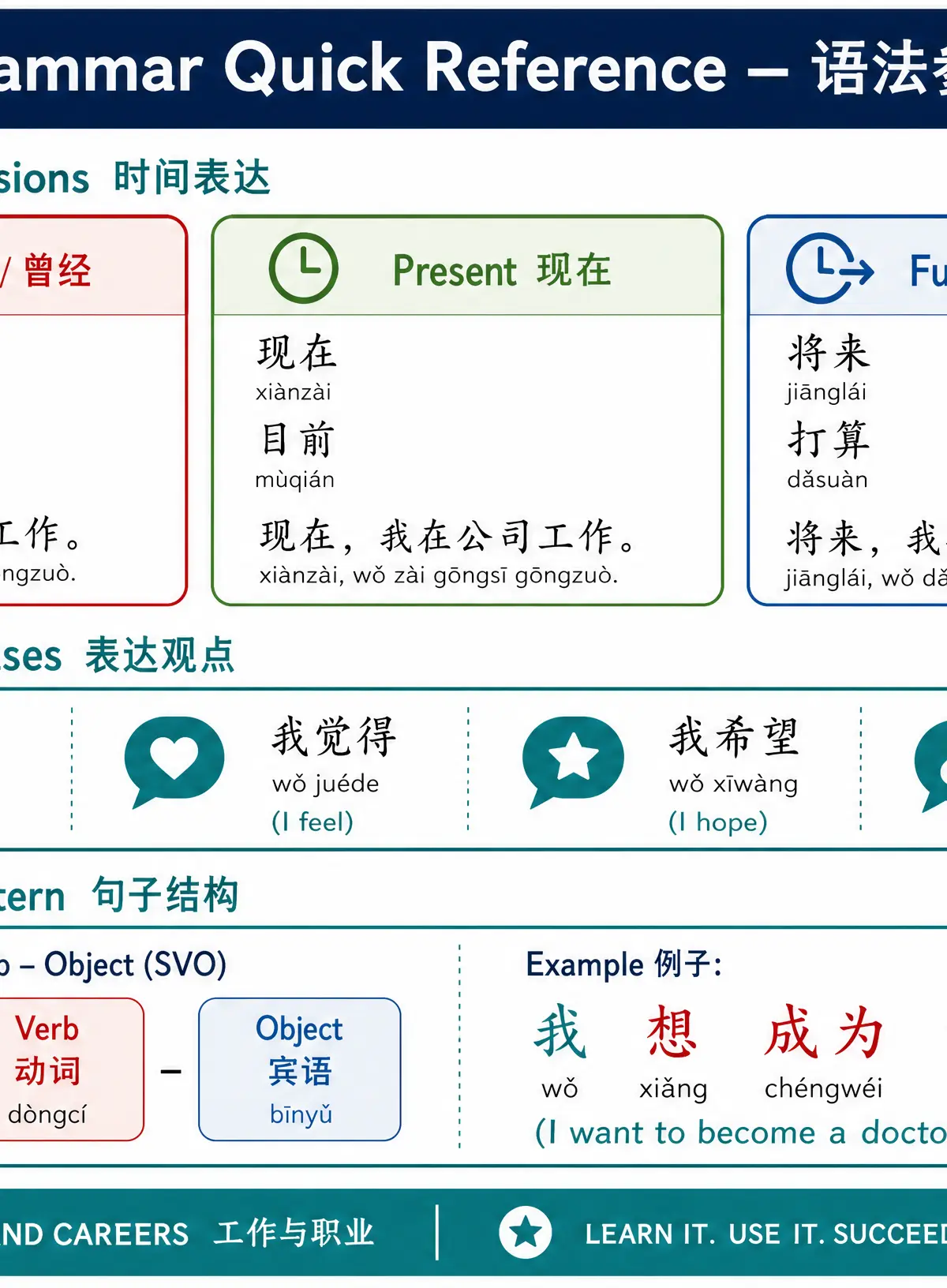
When to use it: Examiners explicitly look for the ability to use three timeframes. Since Chinese verbs do not conjugate, time is indicated using time words placed at the beginning of the sentence or directly after the subject.
Time Frame Table
| Time Frame | Time Word / Marker | Pinyin | Example Sentence | English |
|---|---|---|---|---|
| Past | 以前 | yǐqián | 以前,我在商店工作。 | In the past, I worked in a shop. |
| Past | 曾经 | céngjīng | 我曾经想当医生。 | I once wanted to be a doctor. |
| Past | 了 (verb + le) | le | 昨天我参加了面试。 | Yesterday I attended an interview. |
| Present | 现在 | xiànzài | 现在,我是老师。 | Now, I am a teacher. |
| Present | 目前 | mùqián | 目前,他在找工作。 | Currently, he is looking for a job. |
| Future | 将来 | jiānglái | 将来,我想当律师。 | In the future, I want to be a lawyer. |
| Future | 打算 | dǎsuàn | 我打算去中国工作。 | I plan to go to China to work. |
Key Structure 2: Expressing and Justifying Opinions
When to use it: To access higher mark bands in Speaking and Writing, you must not only state an opinion but also justify it using connectives.
Opinion and Justification Patterns
| Structure | Pinyin | Example Sentence | English |
|---|---|---|---|
| 我认为...因为... | wǒ rènwéi... yīnwèi... | 我认为医生很好,因为可以帮助人。 | I think being a doctor is good because you can help people. |
| 我觉得...因为... | wǒ juéde... yīnwèi... | 我觉得记者很有趣,因为可以去很多地方。 | I feel being a journalist is interesting because you can go to many places. |
| 我希望... | wǒ xīwàng... | 我希望在伦敦工作。 | I hope to work in London. |
Key Structure 3: The 成为 (chéngwéi) Pattern with Measure Words
When to use it: When saying "to become a [profession]". It is crucial to use the correct measure word 名 (míng) for professional roles, rather than the generic 个 (gè).
Structure: Subject + 想/希望 + 成为 + 一名 + Profession
| Subject | Verb | 成为 | Measure Word | Profession | English |
|---|---|---|---|---|---|
| 我 (wǒ) | 想 (xiǎng) | 成为 (chéngwéi) | 一名 (yī míng) | 医生 (yīshēng) | I want to become a doctor. |
| 他 (tā) | 希望 (xīwàng) | 成为 (chéngwéi) | 一名 (yī míng) | 工程师 (gōngchéngshī) | He hopes to become an engineer. |
🎧 Listening Skills
What to Expect
Listening exams often feature short interviews with people discussing their current jobs, their past work experience, or their future career plans. You may hear positive and negative opinions about their work environment, colleagues, or salary.
Listening Strategies
- Listen for Time Markers: Immediately identify if the speaker is saying 以前 (past), 现在 (present), or 将来 (future). This is a common distractor in multiple-choice questions.
- Listen for Opinion Qualifiers: Pay attention to words like 但是 (but) or 虽然 (although). A speaker might start by saying a job is interesting, but then say it is too stressful. The question often asks for the negative aspect.
- Listen for Negatives: Watch out for 不 (bù) and 没 (méi). "I don't want to be a doctor" sounds very similar to "I want to be a doctor" if you miss the 不.
Common Listening Traps
- False Friends: Hearing 科学 (science) and assuming the person is a 科学家 (scientist) when they might actually be a science teacher (科学老师).
- Time Traps: The question asks "What does he want to be in the future?", but the audio first mentions what he used to want to be (以前想当...). Wait for the future time marker (现在打算...).
🗣️ Speaking Skills
Role Play Scenarios
Scenario 1: Job Interview (Formal Register)
- Examiner: 你好!你为什么想在这里工作? (Hello! Why do you want to work here?)
- Student: 你好!我想在这里工作,因为我对电脑很感兴趣,而且我有经验。 (Hello! I want to work here because I am very interested in computers, and I have experience.)
Scenario 2: Discussing Future Plans with a Friend (Informal Register)
- Examiner: 你将来想做什么工作? (What job do you want to do in the future?)
- Student: 将来我想成为一名律师,因为工资很高。你呢? (In the future I want to become a lawyer because the salary is very high. And you?)
Photo Card Practice
Model Photo Card Response (A photo showing a person working in a busy office):
- Qu 1 (Description): 照片里有一个男人。他在办公室工作。他看起来很忙。 (In the photo there is a man. He is working in an office. He looks very busy.)
- Qu 2 (Opinion): 我觉得他的工作压力很大,因为桌子上有很多文件。 (I feel his job is very stressful because there are many documents on the desk.)
- Qu 3 (Related topic): 我不喜欢在办公室工作,因为太无聊了。 (I don't like working in an office because it is too boring.)
- Qu 4 (Past/Future): 将来,我想在医院工作,成为一名医生。 (In the future, I want to work in a hospital and become a doctor.)
- Qu 5 (Unpredictable): 为了找到好工作,我认为学习外语很重要。 (In order to find a good job, I think learning foreign languages is very important.)
General Conversation Questions
| Question (Chinese) | Model Answer | English Translation |
|---|---|---|
| 你将来想做什么工作?为什么? | 将来我想成为一名工程师,因为我对科学很感兴趣,而且工资很高。 | What job do you want to do in the future? Why? / In the future I want to become an engineer because I am very interested in science, and the salary is high. |
| 你觉得做兼职工作好不好? | 我觉得做兼职很好,因为可以赚钱,也可以学到新技能。 | Do you think doing part-time work is good or not? / I think doing part-time work is very good because you can earn money and also learn new skills. |
| 你以前做过什么工作? | 去年暑假,我在一家商店做过兼职。虽然很累,但是很有意思。 | What work have you done in the past? / Last summer holiday, I did part-time work in a shop. Although it was tiring, it was very interesting. |
| 你爸爸/妈妈做什么工作? | 我妈妈是一名老师。她在一所中学教英语。她很喜欢她的工作。 | What job does your dad/mum do? / My mum is a teacher. She teaches English in a secondary school. She really likes her job. |
| 你想在国外工作吗? | 我非常想在国外工作,特别是中国,因为我想练习说中文。 | Do you want to work abroad? / I really want to work abroad, especially in China, because I want to practise speaking Chinese. |
✍️ Writing Skills
Translation Practice
English → Chinese:
| English | Chinese | Key Grammar |
|---|---|---|
| I want to be a teacher. | 我想成为一名老师。 | 成为 pattern + measure word 名 |
| He works in a big company. | 他在一家大公司工作。 | 在 (location) + verb |
| In the past, I worked in a restaurant. | 以前,我在餐馆工作。 | Past time marker 以前 |
| I think being a doctor is very meaningful. | 我认为当医生很有意义。 | Opinion phrase 我认为 + justification |
| Although the salary is low, I like this job. | 虽然工资很低,但是我喜欢这份工作。 | Complex structure 虽然...但是... |
Extended Writing
**Model 90-word response (Foundation):**Write a blog post about your work experience and future plans. Mention: what part-time job you do, what you think of it, what job your parents do, and what you want to be in the future.
我现在在一家超市做兼职工作。每个周末我都去工作。我觉得这份工作很好,因为我可以赚零花钱,我的同事也很友好。但是我不想一辈子在超市工作。我爸爸是一名工程师,他工作很忙,但是工资很高。将来,我想上大学。大学毕业以后,我打算成为一名律师。我认为律师的工作非常有意义,也可以帮助很多人。为了成为律师,我现在必须努力学习。
**Model 150-word response (Higher):**Write an article for a school magazine about careers. Mention: your past work experience, your ideal future job and why, the importance of learning languages for work, and your plans for next year.
去年暑假,我在一家大公司做了一个月的实习。虽然每天都很忙,压力也很大,但是我学到了很多有用的技能。我的同事们都非常友好,他们帮了我很多。
将来,我希望成为一名国际记者。我认为这份工作不仅非常有趣,而且可以去世界各地旅行。为了实现这个梦想,我现在正在努力学习中文和法语。在我看来,学习外语对未来的工作非常重要,因为现在很多公司都是国际化的。如果你会说外语,你就可以找到更好的工作,也可以认识不同国家的人。
明年中学毕业以后,我打算先去中国旅游半年,练习我的中文,然后去大学学习新闻学。我希望未来能有一个成功的职业生涯。
Writing Checklist
- ✅ Three time frames used clearly (以前, 现在, 将来).
- ✅ Opinions given with clear justifications (因为, 所以).
- ✅ Complex structures included (虽然...但是, 不仅...而且).
- ✅ Correct measure words used for professions (一名医生).
- ✅ Formal/informal register appropriate to the task.
📚 Reading Skills
Key Strategies
- Skim for Gist: Read the text quickly first to identify the overall topic (e.g., is this person happy or unhappy with their job?).
- Highlight Time Words: Underline words like 去年 (last year), 现在 (now), and 明年 (next year) as they often hold the key to answering questions correctly.
False Friends & Tricky Words
| Word | Looks Like | Actually Means |
|---|---|---|
| 护士 (hùshi) | Master/Scholar (士) | Nurse |
| 律师 (lǜshī) | Teacher (师) | Lawyer |
| 工程师 (gōngchéngshī) | Worker/Teacher | Engineer |
| 兼职 (jiānzhí) | Simple job | Part-time job |
🌍 Cultural Knowledge
Understanding the cultural context of work in Chinese-speaking countries can enrich your extended writing and speaking responses. In China, the concept of "铁饭碗" (tiě fàn wǎn), meaning "iron rice bowl", refers to a secure job with guaranteed job security, steady income, and benefits — traditionally state-owned enterprise jobs or civil service roles. While modern young people in China are increasingly drawn to tech companies and entrepreneurship, the "iron rice bowl" remains highly respected by older generations. Additionally, the "996" working culture (working from 9 am to 9 pm, 6 days a week) is a widely discussed topic regarding the intense pressure in some Chinese tech companies. Mentioning these concepts in a Higher tier speaking or writing exam demonstrates exceptional cultural awareness and will highly impress the examiner.
Visual Resources
2 diagrams and illustrations
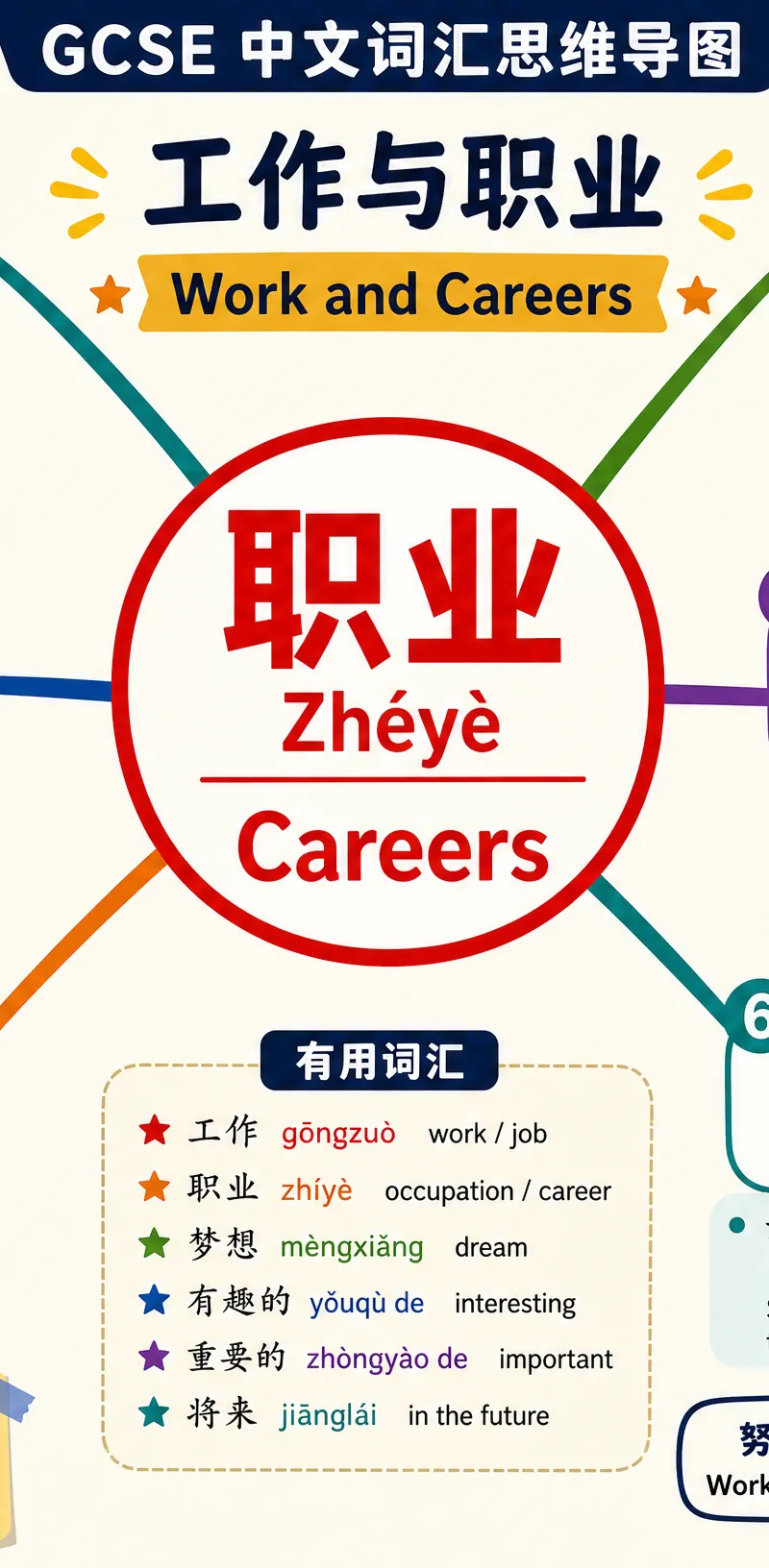
Interactive Diagrams
1 interactive diagram to visualise key concepts
Conceptual Flow Outline
Structuring a response about careers across three timeframes
Worked Examples
4 worked examples — open one to explore the question and available guidance.
Practice Questions
Try the question, then reveal an answer plan or example response
Writing: Translate the following sentence into Chinese: 'In the future, I want to become a doctor because I want to help people.'
Hint: Remember to use the correct measure word for professions and the 'to become' verb.
Speaking: Prepare a 1-minute response to the question: 你将来想做什么工作?为什么? (What job do you want to do in the future? Why?)
Hint: State the job, give a reason, and add a detail about salary or working environment.
Reading: Read the text. '我叫李华。以前我是一个老师,但是我不太喜欢,因为工资很低。现在我是一家公司的老板,我很满意。' Why didn't Li Hua like his previous job?
Hint: Look for the justification following the negative opinion.
Listening: Listen to the audio. '为了找到好工作,我认为上大学很重要。我打算明年去北京上大学。' What does the speaker plan to do next year?
Hint: Listen for the future time marker '明年' (next year).
Writing (Higher): Write approximately 90 words responding to the bullet points: Your past part-time job; Your ideal future career; Why you chose this career.
Hint: Ensure you cover all three bullet points clearly and use past and future time markers.
Speaking (Photo Card): Look at the photo of a chef in a kitchen. Answer the unpredictable question: 你觉得在餐馆工作辛苦吗? (Do you think working in a restaurant is hard work?)
Hint: Give your opinion, justify it, and use an intensifier like 非常.
Exam technique
How to turn what you know into marks
How to approach the question
Listening: Read the English questions carefully before the audio starts to anticipate vocabulary. Speaking: Use the 12-minute prep time to note down key verbs and tenses, not full sentences. Reading: Skim the text first, then scan for time markers. Writing: Tick off every bullet point as you write it.
How to structure your answer
Writing/Speaking: State the fact/opinion -> Justify with 因为 -> Extend with a detail -> Add a different timeframe (e.g., past experience or future plan).
Timing
Listening: 25-35 mins (Foundation/Higher). Speaking: 7-12 mins total (Role play + Photo card + General conversation). Reading: 45-60 mins. Writing: 60-75 mins.
Common pitfalls
- Using the generic measure word 个 instead of 名 for professions.
- Translating 'I am interested in' word-for-word instead of using 对...感兴趣.
- Forgetting to include past and future timeframes in writing tasks.
- Using casual language (like 超级) in formal writing tasks (like a job application).
- Failing to justify opinions with 因为.
What the command words want
- Describe the photo
- State what you see, give an opinion on the activity, and relate it to a past or future experience.
- Translate into Chinese
- Ensure character accuracy and correct sentence structure (Time-Subject-Verb).
- Translate into English
- Focus on capturing the exact meaning and tense; do not guess based on one cognate.
- Write approximately 90 words
- Cover all 4 bullet points equally. Use the present tense and at least one other timeframe.
- Write approximately 150 words
- Use three timeframes, complex structures (虽然...但是), and justified opinions to access top marks.
Watch or listen (optional)
Test your understanding of Work
Active recall beats re-reading. Take an instant quiz now to test what you’ve learned and lock it into long-term memory.
7 days Premium · Then the free plan continues · No card, no charge