AQA · GCSE · Combined Science
Course version: 8464 · Version from Sept 2018
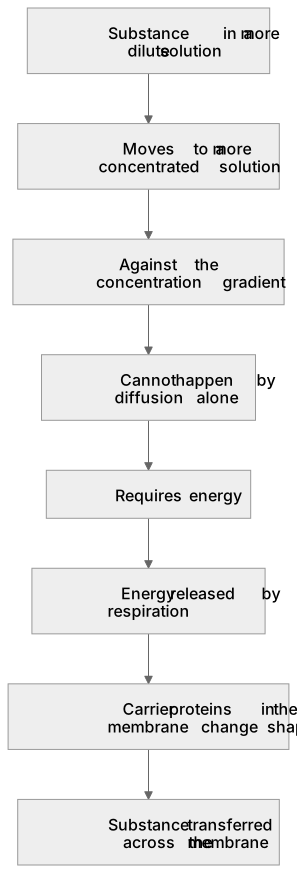
Active transport: Active transport moves substances from a more dilute solution to a more concentrated solution (against a concentration gradient). This requires energy from respiration.
Active transport is the carrier-mediated movement of a substance across a membrane from a region where it is more dilute to a region where it is more concentrated, so it runs against the…
- 4 key terms
Study notes
From the checked teaching notes for this specification point.
The idea
Active transport is the carrier-mediated movement of a substance across a membrane from a region where it is more dilute to a region where it is more concentrated, so it runs against the concentration gradient. Because the substance is being moved away from equilibrium, the process cannot happen by diffusion and the cell must supply energy. That energy comes from respiration, which releases energy from glucose; the energy is used by carrier proteins in the membrane to change shape and transfer the substance. A concrete example is a root hair cell absorbing nitrate ions from soil solution that is more dilute than the cell contents. The rate of active transport depends on the number of carrier proteins and on the rate of respiration, so it stops if respiration is inhibited or oxygen is unavailable.
What earns the marks
- Active transport moves a substance from a more dilute solution to a more concentrated solution, which is against the concentration gradient.
- Movement against a concentration gradient cannot occur by diffusion alone and requires an input of energy.
- The energy for active transport is released by respiration, so the process depends on a supply of glucose and, in aerobic cells, oxygen.
- Carrier proteins in the cell membrane bind the substance and use energy to change shape, transferring the substance across the membrane.
- The rate of active transport is limited by the number of carrier proteins and by the rate of respiration, so it falls when respiration is inhibited.
- Active transport differs from diffusion because diffusion is passive and down a concentration gradient, whereas active transport is energy-requiring and up a concentration gradient.
Common mistakes and how to put them right
Saying that active transport moves substances from a concentrated solution to a dilute solution.
Put it right: The correct direction is from a more dilute solution to a more concentrated solution, against the concentration gradient.
Stating that active transport needs energy but not naming respiration as the source.
Put it right: The energy is released by respiration, so always link the process to respiration.
Confusing active transport with osmosis.
Put it right: Osmosis is the passive movement of water across a partially permeable membrane down a water potential gradient, whereas active transport uses energy and carrier proteins to move solutes against a concentration gradient.
Exam tips
- Define the direction of movement precisely using the words more dilute and more concentrated, then state that this is against the concentration gradient.
- When asked why a cell needs energy, link the answer to respiration releasing energy from glucose rather than simply writing that energy is needed.
- Use a named example, such as a root hair cell absorbing mineral ions, to show that you can apply the definition rather than only recall it.
Try the lesson
The start of the Active transport: Active transport moves substances from a more dilute solution to a more concentrated solution (against a concentration gradient). This requires energy from respiration. lesson, made from checked teaching notes for this specification point.
Have a go first
Which process moves substances from a more dilute solution to a more concentrated solution?
See it
Put it in order
Put these steps in the order they happen.
- 1. Moves to a more concentrated solution
- 2. Against the concentration gradient
- 3. Cannot happen by diffusion alone
- 4. Requires energy
- 5. Energy released by respiration
- 6. Carrier proteins in the membrane change shape
- 7. Substance transferred across the membrane
- 8. Substance in a more dilute solution
Key words
Say what each word means before you turn the card.
Active transport
Try answering aloud or in your head before turning the card.
Concentration gradient
Try answering aloud or in your head before turning the card.
Respiration
Try answering aloud or in your head before turning the card.
Carrier proteins
Try answering aloud or in your head before turning the card.
See every definition
- Active transport
- Moves substances from a more dilute solution to a more concentrated solution, against a concentration gradient, and requires energy from respiration.
- Concentration gradient
- The difference between a more dilute solution and a more concentrated solution, which active transport moves substances against.
- Respiration
- Releases energy from glucose, and this energy is required for active transport.
- Carrier proteins
- Proteins in the membrane that use energy to change shape and transfer the substance across the membrane.
Label the diagram
Some boxes have lost their names. Pick the right name for each number.
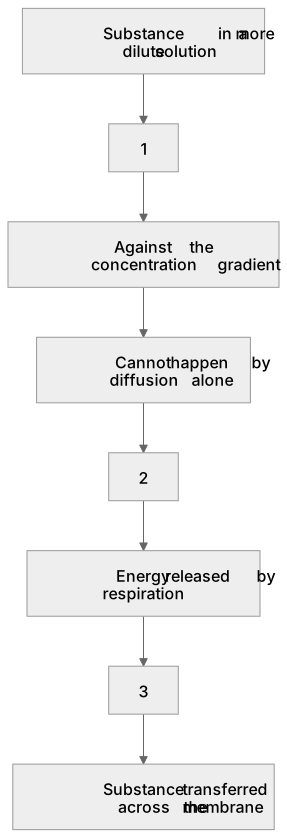
1Box 1
2Box 2
3Box 3
There is more to this lesson
The full lesson goes on to check your understanding and help you earn the marks. Create a free account to carry on, with your progress saved.
A week of Premium from your first lesson · Then the free plan continues · No card, no charge
Test your understanding of Active transport: Active transport moves substances from a more dilute solution to a more concentrated solution (against a concentration gradient). This requires energy from respiration.
Active recall beats re-reading. Take an instant quiz now to test what you’ve learned and lock it into long-term memory.
A week of Premium from your first lesson · Then the free plan continues · No card, no charge