AQA · GCSE · Combined Science
Course version: 8464 · Version from Sept 2018
Adaptations: Organisms have features (adaptations) that enable them to survive in the conditions in which they normally live. These adaptations may be structural, behavioural or functional.
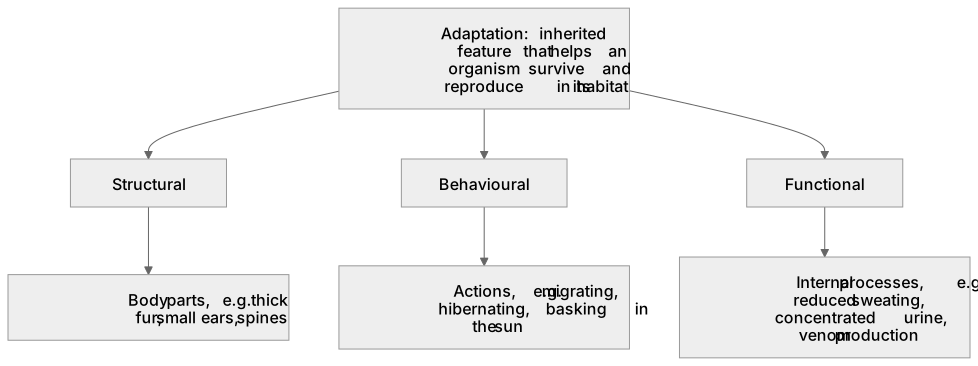
An adaptation is any inherited feature that raises an organism's chance of surviving and reproducing in its habitat.
- 4 key terms
Study notes
From the checked teaching notes for this specification point.
The idea
An adaptation is any inherited feature that raises an organism's chance of surviving and reproducing in its habitat. Structural adaptations are body parts, such as a polar bear's thick fur and small ears reducing heat loss, or a cactus's spines reducing water loss and deterring herbivores. Behavioural adaptations are actions, such as migrating, hibernating or basking in the sun. Functional adaptations are internal processes, such as reduced sweating, concentrated urine or venom production. Because habitats differ in temperature, water, light and predators, the features that help in one place may be useless elsewhere. When explaining an adaptation, name the feature, state the challenge it addresses and link it to survival or reproduction, for example: streamlined shape reduces drag, so the organism escapes predators more easily.
What earns the marks
- Define adaptation as an inherited feature that increases an organism's chance of survival and reproduction in its normal habitat.
- Classify a named example correctly as structural, behavioural or functional, for example thick fur as structural, migration as behavioural and reduced sweating as functional.
- Link each adaptation to a specific selection pressure in the habitat, such as low temperature, scarce water, strong sunlight or predation.
- Explain the consequence of the adaptation for survival or reproduction rather than merely naming the feature.
- Compare organisms in different habitats to show that the same feature can be advantageous in one environment and disadvantageous in another.
Common mistakes and how to put them right
Calling any feature an adaptation without linking it to survival or reproduction.
Put it right by stating the benefit the feature gives in that habitat.
Treating learned behaviour as a behavioural adaptation.
Put it right by checking that the behaviour is inherited and typical of the species.
Confusing functional with structural adaptations.
Put it right by deciding whether the feature is a body part or an internal process such as water retention.
Exam tips
- Use the three labels structural, behavioural and functional explicitly when the question asks you to classify adaptations.
- Structure longer answers as feature, challenge and benefit so every clause of the statement is addressed.
- Choose examples from the habitat named in the question rather than repeating a standard polar bear or cactus answer.
Try the lesson
The start of the Adaptations: Organisms have features (adaptations) that enable them to survive in the conditions in which they normally live. These adaptations may be structural, behavioural or functional. lesson, made from checked teaching notes for this specification point.
Have a go first
A camel has a hump that stores fat and long eyelashes that keep sand out of its eyes. Which type of adaptation are these features?
See it
Key words
Say what each word means before you turn the card.
Adaptation
Try answering aloud or in your head before turning the card.
Structural adaptation
Try answering aloud or in your head before turning the card.
Behavioural adaptation
Try answering aloud or in your head before turning the card.
Functional adaptation
Try answering aloud or in your head before turning the card.
See every definition
- Adaptation
- An inherited feature that increases an organism's chance of survival and reproduction in its normal habitat.
- Structural adaptation
- A body part, such as thick fur or spines, that helps an organism survive in the conditions where it normally lives.
- Behavioural adaptation
- An inherited action, such as migrating, hibernating or basking in the sun, that is typical of the species and helps it survive.
- Functional adaptation
- An internal process, such as reduced sweating or concentrated urine, that helps an organism survive in its habitat.
Label the diagram
Some boxes have lost their names. Pick the right name for each number.
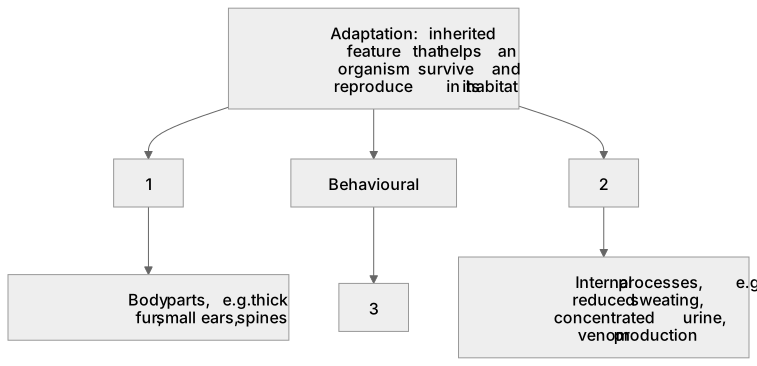
1Box 1
2Box 2
3Box 3
There is more to this lesson
The full lesson goes on to check your understanding and help you earn the marks. Create a free account to carry on, with your progress saved.
A week of Premium from your first lesson · Then the free plan continues · No card, no charge
Test your understanding of Adaptations: Organisms have features (adaptations) that enable them to survive in the conditions in which they normally live. These adaptations may be structural, behavioural or functional.
Active recall beats re-reading. Take an instant quiz now to test what you’ve learned and lock it into long-term memory.
A week of Premium from your first lesson · Then the free plan continues · No card, no charge