AQA · GCSE · Combined Science
Course version: 8464 · Version from Sept 2018
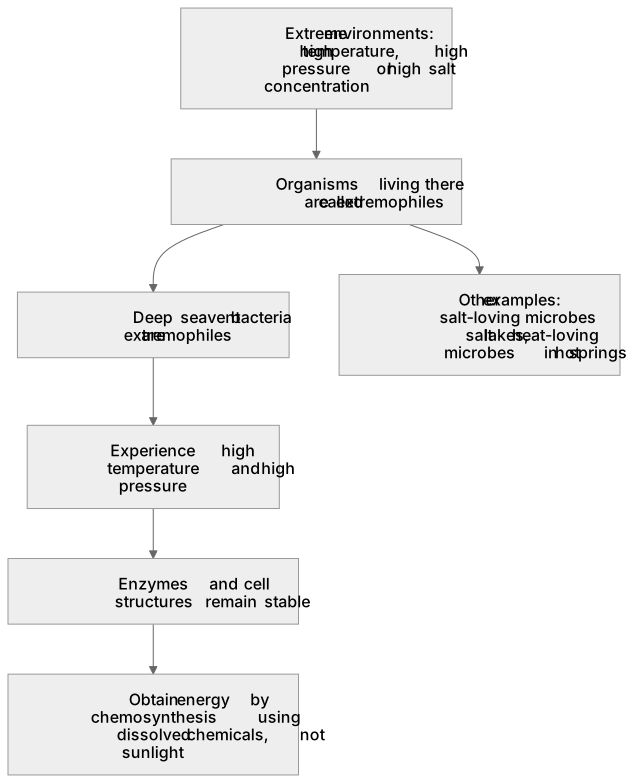
Adaptations: Some organisms live in environments that are very extreme, such as at high temperature, pressure, or salt concentration. These organisms are called extremophiles. Bacteria living in deep sea vents are extremophiles.
Extremophiles are organisms adapted to survive where conditions would kill most life, including very high temperature, very high pressure or very high salt concentration.
- 3 key terms
Study notes
From the checked teaching notes for this specification point.
The idea
Extremophiles are organisms adapted to survive where conditions would kill most life, including very high temperature, very high pressure or very high salt concentration. Deep sea vent bacteria live where superheated water rich in dissolved minerals escapes from the ocean floor, so they experience high temperature and high pressure with no sunlight. Their enzymes and cell structures remain stable under these conditions, and many obtain energy by chemosynthesis, using chemicals such as hydrogen sulfide instead of light. Other examples include salt-loving microbes in salt lakes and heat-loving microbes in hot springs. When answering, name the extreme condition, identify the organism as an extremophile and explain the adaptation that allows it to tolerate that condition, such as heat-stable enzymes or a cell membrane that resists high salt.
What earns the marks
- Define extremophiles as organisms adapted to survive in extreme environments such as high temperature, high pressure or high salt concentration.
- Identify deep sea vent bacteria as extremophiles and state that they experience high temperature and high pressure.
- Explain that extremophile enzymes and cell structures remain functional under extreme conditions that would denature or damage those of most organisms.
- Describe how deep sea vent bacteria obtain energy without sunlight, for example by chemosynthesis using dissolved chemicals.
- Give at least one further example of an extreme environment, such as a salt lake or hot spring, and name an organism adapted to it.
Common mistakes and how to put them right
Stating that extremophiles are a type of bacteria only.
Put it right by noting that extremophiles include members of several groups of organisms.
Saying deep sea vent bacteria photosynthesise.
Put it right by explaining that they use chemosynthesis because sunlight does not reach the vents.
Describing extreme conditions without linking them to an adaptation.
Put it right by pairing each condition with the feature that allows survival.
Exam tips
- Name the specific extreme condition before describing the adaptation, so the link is explicit.
- Use the term extremophile accurately and apply it only to organisms living in extreme environments.
- When asked about deep sea vents, mention both high temperature and high pressure, and refer to chemosynthesis rather than photosynthesis.
Try the lesson
The start of the Adaptations: Some organisms live in environments that are very extreme, such as at high temperature, pressure, or salt concentration. These organisms are called extremophiles. Bacteria living in deep sea vents are extremophiles. lesson, made from checked teaching notes for this specification point.
Have a go first
What name is given to organisms that live in very extreme environments such as deep sea vents?
See it
Key words
Say what each word means before you turn the card.
Extremophiles
Try answering aloud or in your head before turning the card.
Deep sea vent bacteria
Try answering aloud or in your head before turning the card.
Chemosynthesis
Try answering aloud or in your head before turning the card.
See every definition
- Extremophiles
- Organisms adapted to survive in extreme environments such as high temperature, high pressure or high salt concentration.
- Deep sea vent bacteria
- Extremophiles that experience high temperature and high pressure where superheated water rich in dissolved minerals escapes from the ocean floor.
- Chemosynthesis
- An energy pathway without sunlight, using dissolved chemicals such as hydrogen sulfide instead of light.
Label the diagram
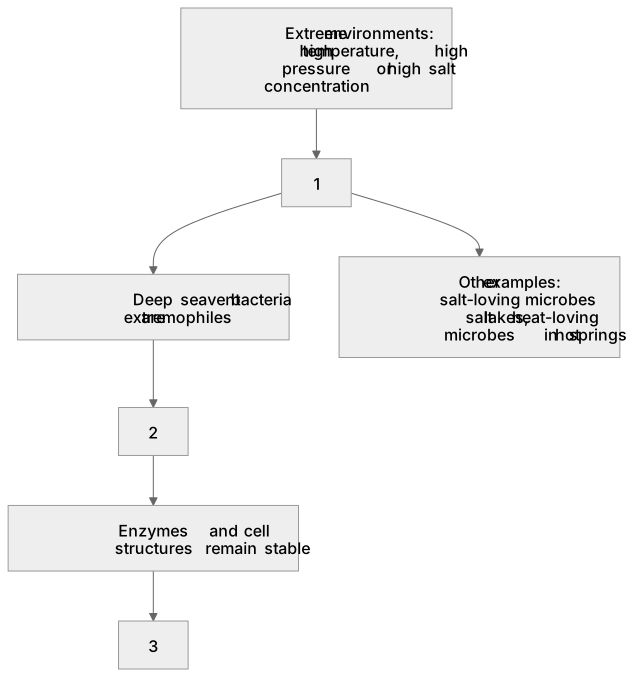
Some boxes have lost their names. Pick the right name for each number.
1Box 1
2Box 2
3Box 3
There is more to this lesson
The full lesson goes on to check your understanding and help you earn the marks. Create a free account to carry on, with your progress saved.
A week of Premium from your first lesson · Then the free plan continues · No card, no charge
Test your understanding of Adaptations: Some organisms live in environments that are very extreme, such as at high temperature, pressure, or salt concentration. These organisms are called extremophiles. Bacteria living in deep sea vents are extremophiles.
Active recall beats re-reading. Take an instant quiz now to test what you’ve learned and lock it into long-term memory.
A week of Premium from your first lesson · Then the free plan continues · No card, no charge