AQA · GCSE · Combined Science
Course version: 8464 · Version from Sept 2018
Aerobic and anaerobic respiration: Anaerobic respiration in muscles is represented by the equation:
Anaerobic respiration in muscles happens when oxygen supply cannot keep up with demand, so glucose is broken down without oxygen.
- 3 key terms
Study notes
From the checked teaching notes for this specification point.
The idea
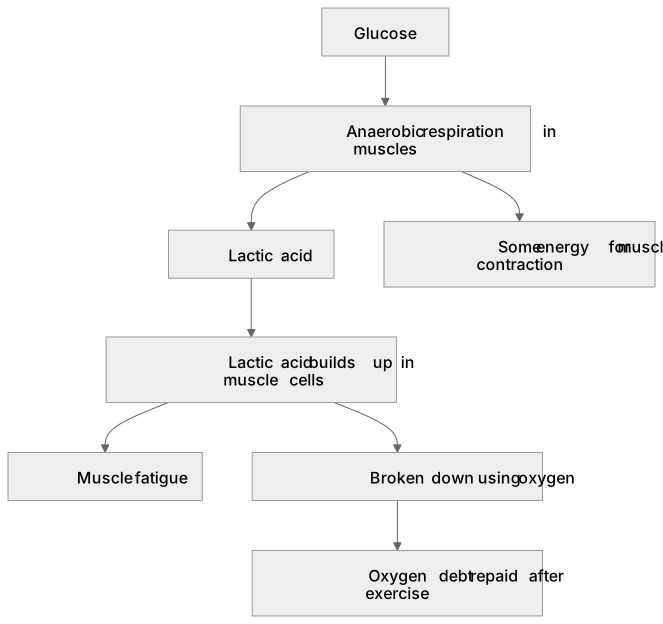
Anaerobic respiration in muscles happens when oxygen supply cannot keep up with demand, so glucose is broken down without oxygen. The word equation is glucose → lactic acid. This releases some energy for muscle contraction, but less than aerobic respiration because glucose is not fully oxidised. Lactic acid builds up in muscle cells and causes fatigue, and it must later be broken down using oxygen. This is why breathing and heart rate stay high after exercise: the extra oxygen repays the oxygen debt. For example, during a sprint, leg muscles run short of oxygen and respire anaerobically, producing lactic acid. The equation summarises the reactant glucose and the single product lactic acid, and it shows that no carbon dioxide or water is formed in this pathway.
What earns the marks
- States the word equation as glucose → lactic acid, with glucose as the reactant and lactic acid as the product.
- Explains that anaerobic respiration occurs when oxygen supply to muscle cells is insufficient, for example during vigorous exercise.
- States that anaerobic respiration releases less energy than aerobic respiration because glucose is not fully broken down.
- Links lactic acid accumulation to muscle fatigue and to the oxygen debt repaid after exercise.
- Recognises that carbon dioxide and water are not products of anaerobic respiration in muscles.
Common mistakes and how to put them right
Writing carbon dioxide and water as products of anaerobic respiration in muscles.
Put it right: The products are lactic acid only, while carbon dioxide and water belong to aerobic respiration.
Confusing anaerobic respiration in muscles with anaerobic respiration in yeast, which produces ethanol and carbon dioxide.
Put it right: Keep the muscle equation as glucose → lactic acid.
Claiming that anaerobic respiration releases more energy than aerobic respiration.
Put it right: It releases less energy because glucose is only partially broken down.
Exam tips
- Write the equation with a clear arrow and correct spellings of glucose and lactic acid.
- If asked to compare, state one similarity and one difference between aerobic and anaerobic respiration rather than describing only one process.
- When explaining fatigue, link lactic acid build-up to reduced muscle contraction and to the oxygen debt rather than saying lactic acid is a waste gas.
Try the lesson
The start of the Aerobic and anaerobic respiration: Anaerobic respiration in muscles is represented by the equation: lesson, made from checked teaching notes for this specification point.
Have a go first
Which word equation represents anaerobic respiration in muscles?
See it
Key words
Say what each word means before you turn the card.
Anaerobic respiration
Try answering aloud or in your head before turning the card.
Lactic acid
Try answering aloud or in your head before turning the card.
Muscle fatigue
Try answering aloud or in your head before turning the card.
See every definition
- Anaerobic respiration
- Glucose is broken down without oxygen when oxygen supply cannot keep up with demand, releasing some energy for muscle contraction.
- Lactic acid
- Builds up in muscle cells and causes fatigue, and must later be broken down using oxygen.
- Muscle fatigue
- Caused by the build-up of lactic acid in muscle cells.
Label the diagram
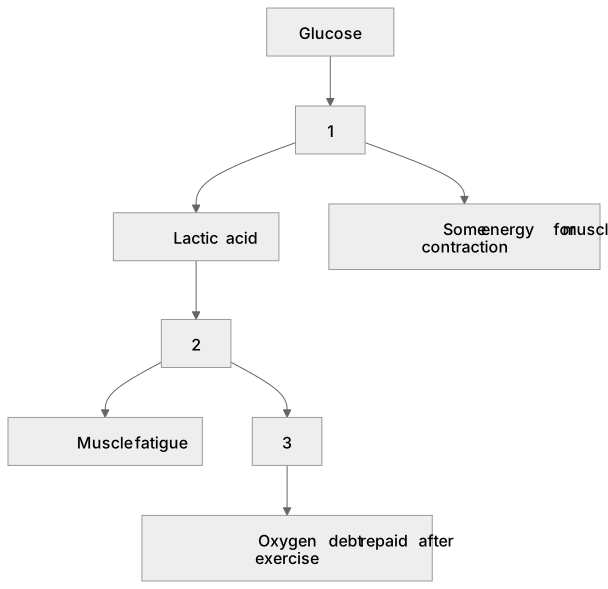
Some boxes have lost their names. Pick the right name for each number.
1Box 1
2Box 2
3Box 3
There is more to this lesson
The full lesson goes on to check your understanding and help you earn the marks. Create a free account to carry on, with your progress saved.
A week of Premium from your first lesson · Then the free plan continues · No card, no charge
Test your understanding of Aerobic and anaerobic respiration: Anaerobic respiration in muscles is represented by the equation:
Active recall beats re-reading. Take an instant quiz now to test what you’ve learned and lock it into long-term memory.
A week of Premium from your first lesson · Then the free plan continues · No card, no charge