AQA · GCSE · Combined Science
Course version: 8464 · Version from Sept 2018
Aerobic and anaerobic respiration: keeping warm.
Keeping warm is a direct consequence of aerobic respiration because the reactions are exothermic and transfer energy to the environment.
- 2 key terms
Study notes
From the checked teaching notes for this specification point.
The idea
Keeping warm is a direct consequence of aerobic respiration because the reactions are exothermic and transfer energy to the environment. In mammals and birds, this transferred energy helps maintain a constant core body temperature despite a cooler environment. The rate of aerobic respiration in muscle tissues can be adjusted to increase heat production when the body cools. This is why shivering, which involves rapid muscle contraction, raises the rate of respiration and generates more warmth.
What earns the marks
- Aerobic respiration is an exothermic reaction that transfers energy to the environment, some of which is used to keep the body warm.
- Mammals and birds maintain a stable core body temperature by using the energy transferred from respiration.
- Shivering involves rapid muscle contraction, which requires more energy and therefore raises the rate of aerobic respiration.
- An increased rate of aerobic respiration during shivering results in more energy being transferred to the body as heat.
- Keeping warm is an example of how the energy transferred by respiration supports homeostasis, not just movement or growth.
Common mistakes and how to put them right
Thinking that respiration only produces energy for movement.
Put it right: Respiration is an exothermic reaction that also transfers energy used for keeping warm.
Confusing breathing with respiration.
Put it right: Breathing is ventilation of the lungs, whereas respiration is the cellular process that transfers energy from glucose.
Assuming that all energy from glucose becomes heat.
Put it right: Some energy is used for useful processes such as muscle contraction, and the rest is transferred to the surroundings as heat.
Exam tips
- Link keeping warm explicitly to the aerobic respiration equation and to the idea of energy transfer, not just to shivering.
- Use the phrase 'rate of respiration' when explaining how heat production changes, and state the direction of the change.
- When asked to explain shivering, give a cause-and-effect chain: cooling detected, shivering triggered, respiration rate increases, more energy transferred as heat.
Try the lesson
The start of the Aerobic and anaerobic respiration: keeping warm. lesson, made from checked teaching notes for this specification point.
Have a go first
Which process in the body releases energy from glucose to help keep the body warm?
See it
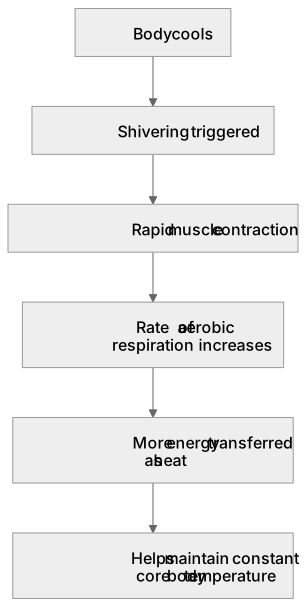
Put it in order
Put these steps in the order they happen.
- 1. Shivering triggered
- 2. Rapid muscle contraction
- 3. Rate of aerobic respiration increases
- 4. More energy transferred as heat
- 5. Helps maintain constant core body temperature
- 6. Body cools
Key words
Say what each word means before you turn the card.
Aerobic respiration
Try answering aloud or in your head before turning the card.
Shivering
Try answering aloud or in your head before turning the card.
See every definition
- Aerobic respiration
- An exothermic reaction that transfers energy to the environment, some of which is used to keep the body warm.
- Shivering
- Involves rapid muscle contraction, which requires more energy and therefore raises the rate of aerobic respiration.
Label the diagram
Some boxes have lost their names. Pick the right name for each number.
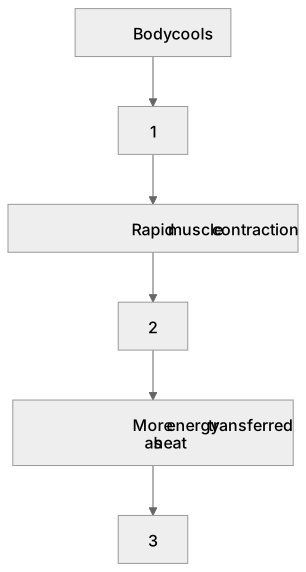
1Box 1
2Box 2
3Box 3
There is more to this lesson
The full lesson goes on to check your understanding and help you earn the marks. Create a free account to carry on, with your progress saved.
A week of Premium from your first lesson · Then the free plan continues · No card, no charge
Test your understanding of Aerobic and anaerobic respiration: keeping warm.
Active recall beats re-reading. Take an instant quiz now to test what you’ve learned and lock it into long-term memory.
A week of Premium from your first lesson · Then the free plan continues · No card, no charge