AQA · GCSE · Combined Science
Course version: 8464 · Version from Sept 2018
Aerobic and anaerobic respiration: Students should recognise the chemical symbols: C₆H₁₂O₆, O₂, CO₂ and H₂O.
Chemical symbols are a shorthand way of representing substances.
- 2 key terms
Study notes
From the checked teaching notes for this specification point.
The idea
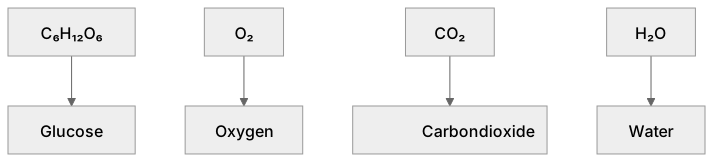
Chemical symbols are a shorthand way of representing substances. In respiration, C₆H₁₂O₆ represents glucose, O₂ represents oxygen, CO₂ represents carbon dioxide and H₂O represents water. The subscript numbers show how many atoms of each element are in one unit of the substance: glucose contains 6 carbon atoms, 12 hydrogen atoms and 6 oxygen atoms; oxygen gas and carbon dioxide each contain 2 oxygen atoms per molecule; water contains 2 hydrogen atoms and 1 oxygen atom. Recognising these symbols lets you read and write the balanced symbol equation for aerobic respiration: C₆H₁₂O₆ + 6O₂ → 6CO₂ + 6H₂O.
What earns the marks
- Matches each symbol to its correct name: C₆H₁₂O₆ is glucose, O₂ is oxygen, CO₂ is carbon dioxide and H₂O is water.
- Interprets subscripts as the number of atoms of each element in a formula unit.
- Uses the symbols to write or recognise the balanced symbol equation for aerobic respiration.
- Distinguishes between elements and compounds, for example O₂ as an element and CO₂ and H₂O as compounds.
- Applies the symbols in unfamiliar contexts, such as identifying reactants and products in a respiration equation.
Common mistakes and how to put them right
Reading C₆H₁₂O₆ as six carbon, twelve hydrogen and six oxygen molecules rather than atoms.
Put it right: The subscripts count atoms within one formula unit.
Writing CO₂ as Co₂ or confusing cobalt with carbon.
Put it right: Chemical symbols use correct capitalisation, so carbon is C and cobalt is Co.
Omitting coefficients when balancing the symbol equation.
Put it right: Six oxygen molecules, six carbon dioxide molecules and six water molecules are needed to balance C₆H₁₂O₆ + 6O₂ → 6CO₂ + 6H₂O.
Exam tips
- Learn the four symbols as a set and practise matching them to names quickly.
- When balancing, count atoms of each element on both sides and adjust coefficients, not subscripts.
- Use correct capitalisation and subscript notation in written answers to avoid losing credit.
Try the lesson
The start of the Aerobic and anaerobic respiration: Students should recognise the chemical symbols: C₆H₁₂O₆, O₂, CO₂ and H₂O. lesson, made from checked teaching notes for this specification point.
Have a go first
Which chemical symbol represents carbon dioxide?
See it
Key words
Say what each word means before you turn the card.
Chemical symbols
Try answering aloud or in your head before turning the card.
Subscripts
Try answering aloud or in your head before turning the card.
See every definition
- Chemical symbols
- A shorthand way of representing substances, such as C₆H₁₂O₆ for glucose, O₂ for oxygen, CO₂ for carbon dioxide and H₂O for water.
- Subscripts
- Numbers that show how many atoms of each element are in one unit of the substance.
Label the diagram
Some boxes have lost their names. Pick the right name for each number.
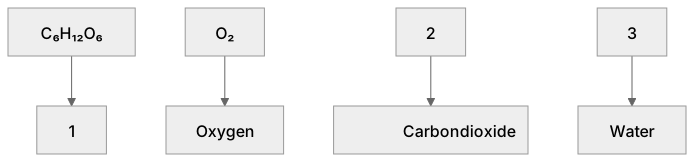
1Box 1
2Box 2
3Box 3
There is more to this lesson
The full lesson goes on to check your understanding and help you earn the marks. Create a free account to carry on, with your progress saved.
A week of Premium from your first lesson · Then the free plan continues · No card, no charge
Test your understanding of Aerobic and anaerobic respiration: Students should recognise the chemical symbols: C₆H₁₂O₆, O₂, CO₂ and H₂O.
Active recall beats re-reading. Take an instant quiz now to test what you’ve learned and lock it into long-term memory.
A week of Premium from your first lesson · Then the free plan continues · No card, no charge