AQA · GCSE · Combined Science
Course version: 8464 · Version from Sept 2018
Alternative methods of extracting metals (HT only): Bioleaching uses bacteria to produce leachate solutions that contain metal compounds.
Bioleaching is a biological method of extracting metals from low-grade ores.
- 3 key terms
Study notes
From the checked teaching notes for this specification point.
The idea
Bioleaching is a biological method of extracting metals from low-grade ores. Bacteria are used to break down the ore, producing a solution containing metal ions. This resulting metal-rich solution is called a leachate. For example, bacteria acting on copper ores produce a leachate containing copper compounds like copper sulfate. Bioleaching avoids the high temperatures of smelting and can work on ores too low in concentration for traditional extraction. The leachate must then be processed to recover the metal, for example by displacement or electrolysis. The bacteria are not the metal source; they facilitate the release of metal compounds into solution.
What earns the marks
- Bacteria are used to break down low-grade ores, releasing metal ions into solution.
- The metal-containing solution produced by the bacteria is called a leachate.
- The leachate contains dissolved metal compounds, such as copper sulfate.
- Bioleaching can extract metals from ores too low in grade for traditional smelting.
- The process relies on biological activity rather than high-temperature reduction.
Common mistakes and how to put them right
Thinking bacteria are the metal source.
Put it right by stating bacteria release metal compounds already present in the ore.
Confusing leachate with slag or tailings.
Put it right by defining leachate as the metal-containing solution.
Assuming bioleaching produces pure metal directly.
Put it right by stating the leachate contains metal compounds that need further processing.
Exam tips
- State that bacteria are used to produce leachate; you do not need to name specific strains of bacteria.
- Use the term leachate precisely when describing the metal-containing solution produced by bacteria.
Try the lesson
The start of the Alternative methods of extracting metals (HT only): Bioleaching uses bacteria to produce leachate solutions that contain metal compounds. lesson, made from checked teaching notes for this specification point.
Have a go first
Bioleaching is a biological method used to extract metals from low-grade ores. Which organisms are used in this process to produce leachate solutions containing metal compounds?
Listen
Bioleaching is a biological method of extracting metals from low-grade ores. Bacteria are used to break down the ore, producing a solution containing metal ions. This resulting metal-rich solution is called a leachate. For example, bacteria acting on copper ores produce a leachate containing copper compounds like copper sulfate. Bioleaching avoids the high temperatures of smelting and can work on ores too low in concentration for traditional extraction. The leachate must then be processed to recover the metal, for example by displacement or electrolysis. The bacteria are not the metal source; they facilitate the release of metal compounds into solution. A strong answer earns marks for these points. Bacteria are used to break down low-grade ores, releasing metal ions into solution. The metal-containing solution produced by the bacteria is called a leachate. The leachate contains dissolved metal compounds, such as copper sulfate. Bioleaching can extract metals from ores too low in grade for traditional smelting. A common slip: Thinking bacteria are the metal source. Instead, stating bacteria release metal compounds already present in the ore. Exam tip: State that bacteria are used to produce leachate; you do not need to name specific strains of bacteria.
See it
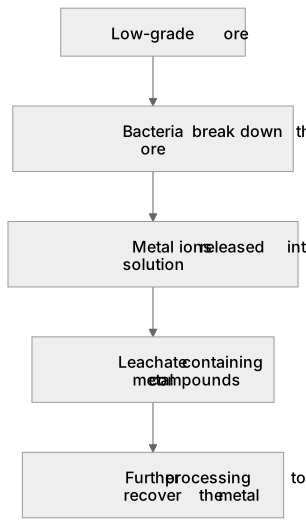
Put it in order
Put these steps in the order they happen.
- 1. Bacteria break down the ore
- 2. Metal ions released into solution
- 3. Leachate containing metal compounds
- 4. Further processing to recover the metal
- 5. Low-grade ore
Key words
Say what each word means before you turn the card.
Bioleaching
Try answering aloud or in your head before turning the card.
Leachate
Try answering aloud or in your head before turning the card.
Low-grade ores
Try answering aloud or in your head before turning the card.
See every definition
- Bioleaching
- Uses bacteria to produce leachate solutions that contain metal compounds.
- Leachate
- The metal-rich solution produced by bacteria acting on ores, containing dissolved metal compounds.
- Low-grade ores
- Ores too low in concentration for traditional extraction, which bioleaching can work on.
Label the diagram
Some boxes have lost their names. Pick the right name for each number.
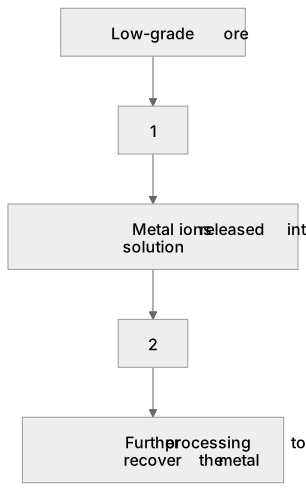
1Box 1
2Box 2
There is more to this lesson
The full lesson goes on to check your understanding and help you earn the marks. Create a free account to carry on, with your progress saved.
A week of Premium from your first lesson · Then the free plan continues · No card, no charge
Test your understanding of Alternative methods of extracting metals (HT only): Bioleaching uses bacteria to produce leachate solutions that contain metal compounds.
Active recall beats re-reading. Take an instant quiz now to test what you’ve learned and lock it into long-term memory.
A week of Premium from your first lesson · Then the free plan continues · No card, no charge